- 128 pages
- English
- ePUB (mobile friendly)
- Available on iOS & Android
eBook - ePub
Sharon
About this book
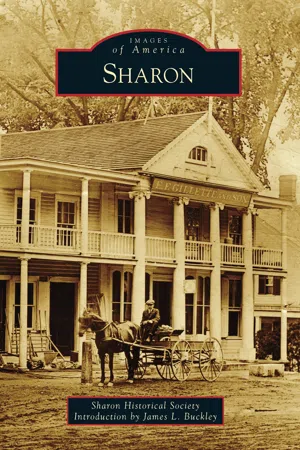
At the turn of the 20th century, Sharon?s very existence was threatened by the collapse of the local iron industry as the town?s economy and population began to decline. However, the popularity of automobile transportation and Sharon?s accessible distance from New York attracted a class of wealthy visitors who fell in love with the rolling hills and quiet valleys. This new weekend population purchased land and built stately country homes, reigniting interest in the area. Steady growth in construction provided much-needed work, and commerce began to thrive again. Early businesses expanded, and new operations opened. Local residents could shop at stores run by the Gillette brothers and A.R. Woodward, fill their tanks at Herman Middlebrook?s gas station, and have their health care needs attended to by doctors at the state-of-the-art Sharon Hospital, built in 1916. Eastern Europeans became the town?s newest residents, taking advantage of the affordable, cleared land to fuel a large number of highly successful farms. Sharon?s residents thrived as they reshaped their town, welcoming newcomers and nurturing a community of inclusion that lasts to the present day.
Trusted by 375,005 students
Access to over 1 million titles for a fair monthly price.
Study more efficiently using our study tools.
Information
One
THE GREEN
AND ITS SURROUNDS
AND ITS SURROUNDS

This is the earliest known photograph of the Sharon Green, believed to have been taken around 1889. Note the figure standing near the center of the frame, which offers a good perspective on the size of the elms planted in 1879. Although there are few fences enclosing homes on the Green today, note the proliferation of fences on both sides of the Green.

The town hall has occupied a prominent place on the Sharon Green since it was built in 1875, with Isaac Newton Bartram serving as contractor. Prior to that time, the “official” town hall was in an upstairs room at the Tavern House, an early name for the Sharon Inn. The recognizable tower was added in 1884, and a new facade of pediment, portico, and four columns was dedicated in 1924. This photograph was taken around 1900, possibly on the day of a town election or other notable occasion.

Shown here is a view of the Sharon Green looking north towards the King House. Horses and buggies are prominent features in many of Sharon’s early photographs. These are hitched to the line of hitching posts made from Stockbridge marble across from town hall.

This shows the Sharon Green looking north from the porch of the Sharon Inn, on the southwest corner of Main Street and what is now Route 343. Note the “U” shape of the end of the Green and the narrow roadway that graces the trunks of the famous elms of Sharon. The sidewalks that residents are so fond of today are absent in this early photograph, which probably dates to 1900 or earlier. When sidewalks were first created, they were simply hard-packed dirt. A diary kept by Lawrence Van Alstyne for the Poconnuck Historical Society (now the Sharon Historical Society) had an entry from April 6, 1912, that noted, “Cement sidewalks laid on west side of Main Street from Van Rensellaer’s place to Mrs. Prindle’s.”
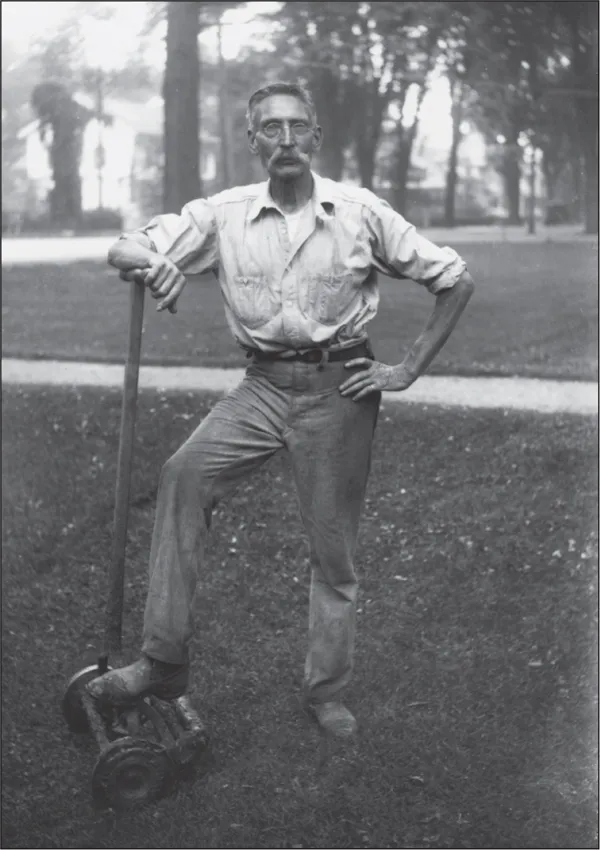
Before motorized lawn mowers, the grass on Sharon Green was tended by hand, first with clippers and then with hand mowers. James Way, pictured here, was an early groundskeeper of Sharon Green, responsible for cutting the entire Green (which continues on South Main Street) with a hand mower. (Photograph by George M. Marckres.)

William Pitcher is shown here riding a horse-drawn mower with a sickle bar on the Sharon Green, a practice that may have occurred well into the 1940s. Jack Ward took charge of mowing the Green in the 1940s with a push-style hand mower that had rotating blades. Horse-drawn equipment remained popular in Sharon for mowing large tracts and farming until well after World War II.

Young Joe Carberry and his brother Paul are pruning elms on the Green. The Carberry family was long known as the caretakers of Sharon’s elm trees. This photograph was taken by George M. Marckres, a well-known Sharon photographer. Over 1,000 of his original glass-plate negatives are held in the Sharon Historical Society collection. (Photograph by George M. Marckres.)

Located at 18 Main Street, the Gay-Hoyt House is home to the Sharon Historical Society. The original brick building was built in 1775 by Lt. Col. Ebenezer Gay of the 14th Regiment of Militia, formerly the North Trainband. Lieutenant Colonel Gay was active throughout the Revolution, mustering the Sharon militia at the time of the Battle of Danbury and marching south to Danbury in pursuit of the retreating British. The following year, he commanded the Sharon militia, which hurried north to fight Burgoyne’s army and was in the engagement until the surrender. This photograph shows how the building was modernized in the Victorian style in the 19th century, like so many of the early houses on the Green.
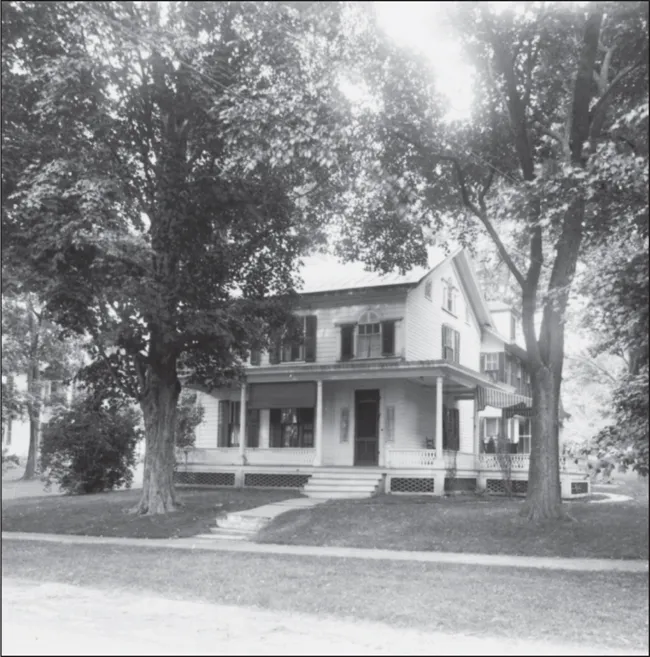
Known locally as the Vosburgh family home, the building at 22 Upper Main Street was long the home of the Sharon Clinic. It was purchased by four physicians who were also known as the four “founding fathers”: Dr. Frederick Gevalt, Dr. Robert Fisher, Dr. George A. Fowler, and Dr. Robert P. Noble, all members of the 1940 graduating class of Columbia University’s College of Physicians and Surgeons. They purchased the building in 1947 upon their return from service in World War II. Local resident (and violin maker) Al Stahovec renovated the building to become the Sharon Clinic, the first multi-specialist practice in Litchfield County.

This home at 34 Upper Main Street was built in 1866, probably on a lot where the law office of Cyrus Swan once stood. Well-known author and playwrite Percival Wilde owned the house from 1935 to 1955. The expansive porch is now gone.

The stately Sedgwick House, at 42 Upper Main Street, was built in 1780 by Dr. Phineas Smith on home lot 28 and boasts a stone in the fireplace featuring that date. Smith was the nephew of Cotton Mather Smith and Dr. Simeon Smith, who built the Georgian-style mansion Weatherstone at 58 South Main Street. Judge Cyrus Swan and his son-in-law Gen. Charles Sedgwick made important additions to the house during their ownership, between 1801 and 1840. The south portion of the house burned in a fire in 1967.

This gambrel-roofed brick building may enclose one of Sharon’s earliest houses. The present dining room of the home is believed to have been a small brick home built in 1769 by John Pennoyer Jr. In 1783, Col. George King purchased it, and he made extensive additions in 1794. In 1924, Adm. Thomas C. and Caroline Brownson Hart purchased the home, which had once belonged to Mrs. Hart’s great-great-grandfather, Col. George King. Admiral Hart was the commander of the ABDA (American-British-Dutch-Australian) naval forces in the Pacific in 1941–1942. Note the positioning of the Sharon Soldier’s Monument, which was originally placed in a direct path from the front door of the King House and was later moved when the road was straightened mid-century.

The Skinner House, at 99 Main Street, was so named because Nathaniel Skinner drew this 26th home lot, building one of the first homes in Sharon in 1739, the same year the town was founded. It is believed that the first town meeting was held on this site. Skinner was the first on the list of the proprietors of the common and undivided land, the first magistrate, the first town clerk, and the first deacon in the church. This became the home of Dr. Jerome Chaffee, founder of Sharon ...
Table of contents
- Cover Page
- Title Page
- Copyright Page
- Dedication
- Table of Contents
- Acknowledgments
- Introduction
- 1. The Green and its Surrounds
- 2. Doing Business
- 3. Education, Arts, and Worship
- 4. On the Farm
- 5. Building a Strong Community
- 6. Play Ball!
- 7. They Came From New York
- 8. Coming Together in Peace and in War
- 9. Moments in Time, Friends, and Family
- Bibliography
Frequently asked questions
Yes, you can cancel anytime from the Subscription tab in your account settings on the Perlego website. Your subscription will stay active until the end of your current billing period. Learn how to cancel your subscription
No, books cannot be downloaded as external files, such as PDFs, for use outside of Perlego. However, you can download books within the Perlego app for offline reading on mobile or tablet. Learn how to download books offline
Perlego offers two plans: Essential and Complete
- Essential is ideal for learners and professionals who enjoy exploring a wide range of subjects. Access the Essential Library with 800,000+ trusted titles and best-sellers across business, personal growth, and the humanities. Includes unlimited reading time and Standard Read Aloud voice.
- Complete: Perfect for advanced learners and researchers needing full, unrestricted access. Unlock 1.4M+ books across hundreds of subjects, including academic and specialized titles. The Complete Plan also includes advanced features like Premium Read Aloud and Research Assistant.
We are an online textbook subscription service, where you can get access to an entire online library for less than the price of a single book per month. With over 1 million books across 990+ topics, we’ve got you covered! Learn about our mission
Look out for the read-aloud symbol on your next book to see if you can listen to it. The read-aloud tool reads text aloud for you, highlighting the text as it is being read. You can pause it, speed it up and slow it down. Learn more about Read Aloud
Yes! You can use the Perlego app on both iOS and Android devices to read anytime, anywhere — even offline. Perfect for commutes or when you’re on the go.
Please note we cannot support devices running on iOS 13 and Android 7 or earlier. Learn more about using the app
Please note we cannot support devices running on iOS 13 and Android 7 or earlier. Learn more about using the app
Yes, you can access Sharon by Sharon Historical Society in PDF and/or ePUB format, as well as other popular books in History & North American History. We have over one million books available in our catalogue for you to explore.