- 128 pages
- English
- ePUB (mobile friendly)
- Available on iOS & Android
eBook - ePub
Lisbon
About this book
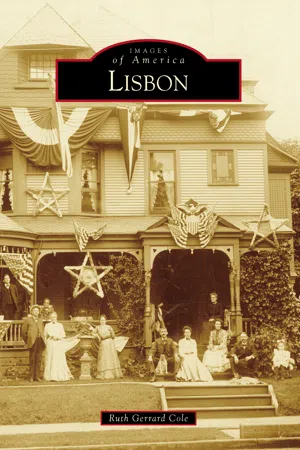
Centered in the midst of the Columbiana County hills, Lisbon was founded in 1803. High hopes for growth and prosperity were first realized through industries producing iron, coal, and pottery; however, even with modern inventions, fascinating people, and hopes for a successful canal, the dream of becoming a city never materialized. During the Civil War, Confederate general John Hunt Morgan and his raiders threatened the community with invasion, but he ultimately surrendered to Union forces. Many political careers had links to Lisbon, including those of Congressman and Copperhead Clement Vallandigham, Sen. Marcus Hanna, Pres. William McKinley, and Associate Justice of the Supreme Court John Clarke. Intriguing families such as the "Fighting McCooks" added to the community's history. Victorian homes abound, and today effort is put into the restoration of other Lisbon homes as well as businesses, creating genuine charm and interest while commercial and industrial progress stretches northward.
Trusted by 375,005 students
Access to over 1.5 million titles for a fair monthly price.
Study more efficiently using our study tools.
Information
One
ESTABLISHING A VILLAGE
In the founding of a community in any age and time, there are certain essential needs. With that given, it is appropriate to look at the beginnings of Lisbon. The founding fathers of this Ohio village recognized the basic requirements. And they began.
Officially begun in 1803, actual incorporation occurred in 1825. Prior to that later date, so much was in place. Lewis Kinney, considered the official founder, built his stone house in 1805. Still standing, it is the landmark of the community—originally an inn, later serving many other purposes. Other places for transients as well as homes for the residents followed shortly. A log cabin served as the original school while churches of various denominations were built in early times. As there was the need for a jail, that, too, was established.
Commerce is critical to survival. Businesses and industries that matched the needs of the day quickly formed. In those early years, there were tanneries, potteries, and brick factories. In the village, a central market for supplying needs quickly evolved with grocers, pharmacists, and clothing stores. Mills for wool and feed appeared. With the farms surrounding the little hamlet, the needs of agriculture were met. Hope for great expansion arrived in the form of canal plans.
And the people came. Doctors, lawyers, ministers, workers—most in families with children—populated the growing community. Names of that day remain in their descendants. Homes built in that time still stand. Government was critical, and the village soon became the county seat with a series of courthouses. To this day, that is a vital part of community life and leads to connections with other county seats and state government. Cultural needs expanded. Late in the first century, a beautiful library was built, and two opera houses graced the village. The town center’s village square sported a gazebo—today, a near replica graces the little park.
Within the confines of the 19th century, Lisbon achieved her identity with all the self-sufficiency, pride, and opportunities of an American small town.

LISBON’S OLD STONE HOUSE. This 1805 building is definitely Lisbon’s oldest house, probably constructed by founder Lewis Kinney although some credit Christian Smith. Its years have been spent as tavern, private residence, and church. In 1952, the house became the property of the Lisbon Historical Society. Restored to its 19th-century origins, the stone structure is a major attraction with its period furniture, portraits, and artifacts. Today, it is considered the oldest stone house in Ohio.
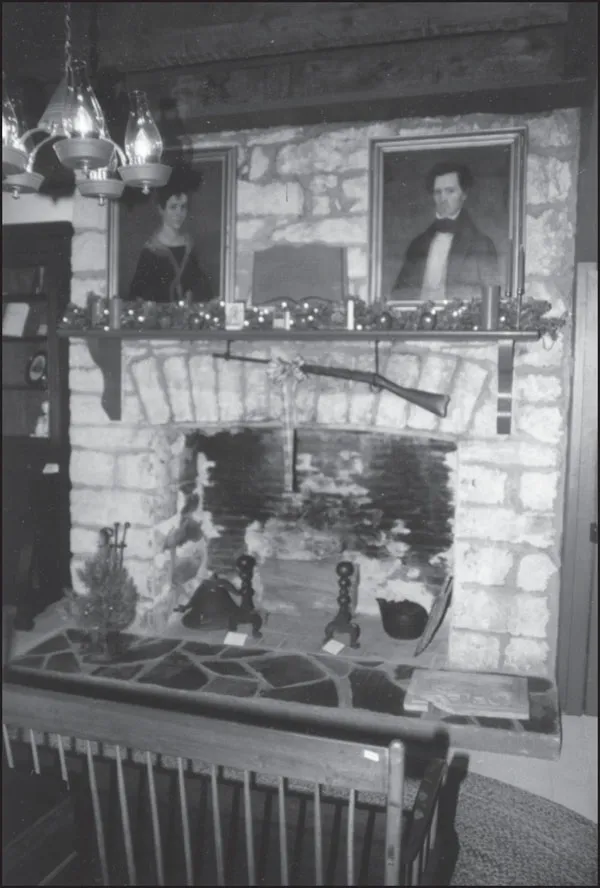
STONE HOUSE INTERIOR. Adults and children step into a bygone world as they experience a basic but beautiful lifestyle on a tour of the house built more than two centuries ago. Decorated for Christmas in this photograph, the mantle also showcases the portraits of Benjamin and Rachel Hanna, parents of Dr. Leonard Hanna and grandparents of Sen. Marcus A. Hanna.

ANDERSON FARMERS HOTEL. From early days, not only was this hotel interesting for its place for travelers through the community, but also for its links to one of the most important figures in Lisbon’s history. This was the home as well as the family business of David Anderson, a most important educator in the Lisbon schools for over 50 years.

CROSS KEYS HOTEL. This old hotel began as the Cross Keys, changed to the Watson House, and ended as the Wick Hotel. Important to the community and the county, it stood until the late 20th century. Both its dining room and guest rooms were heavily patronized by permanent residents and travelers. Pres. Benjamin Harrison recommended it.

AN ORIGINAL SCHOOLHOUSE. As Lisbon began to provide education for its youth, this brick building on Maple Street served as a very early schoolhouse. James McKinley, grandfather of the president, taught here. As new buildings were erected, this structure became a family home even into the 21st century, when it was demolished in order for the residents to construct a new dwelling on the site.
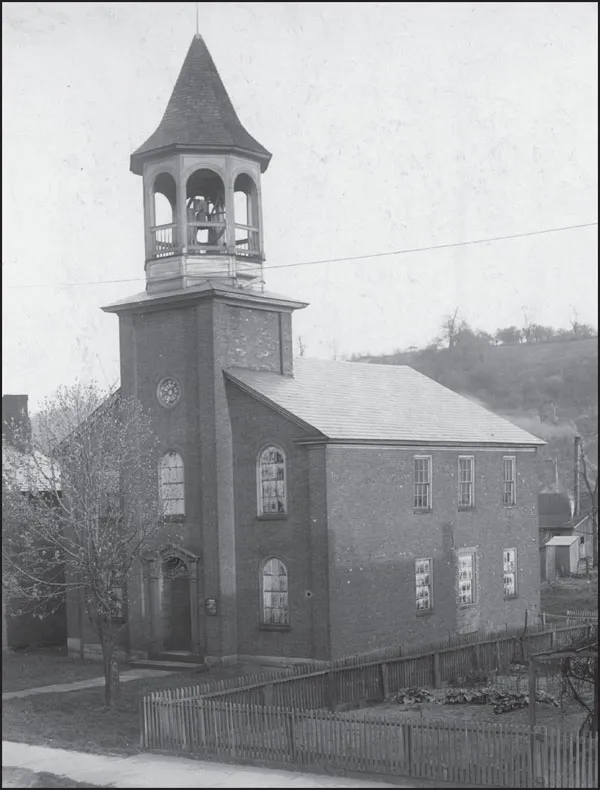
GERMAN LUTHERAN CHURCH. This early church in Lisbon was home originally to combined German Reformed and Lutheran congregations. Built in 1833, services were discontinued in 1860. This was the first church built in the southern portion of town. Later, it housed the Holiness Mission and an automobile garage; the building no longer stands.

OLD REFORMED CHURCH. This clear photograph depicts the original Reformed church on West Walnut Street, now named West Lincoln Way. Later, it became the American Legion Hall, known to many veterans and their families; today it houses a day care for children. The original structure of the building is still quite evident.

THE OLD JAIL. A necessity for every community, this solid stone building, constructed in 1808, remains at the corner of Chestnut and Beaver Streets. After its service as the village jail ended, it became a family home, distinctive with its powerful block structure. It is said that prisoners were separated by a mere curtain.
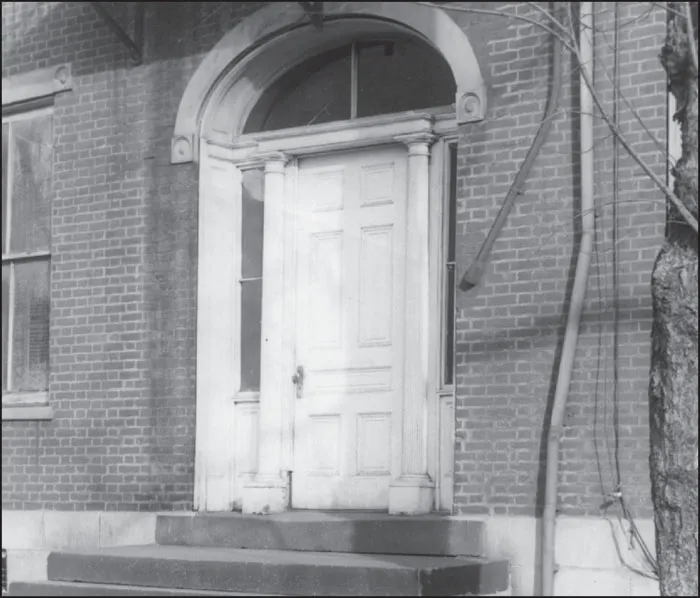
CANAL OFFICE DOORWAY. One of the greatest hopes of the growing village was the potential success of the canal. Chartered in 1828 and completed in 1848, the Sandy and Beaver Canal proved unsuccessful. The old doorway pictured here led to its offices. While that building has bur...
Table of contents
- Cover Page
- Title Page
- Copyright Page
- Dedication
- Table of Contents
- Acknowledgments
- Introduction
- 1. Establishing a Village
- 2. Economic Support
- 3. Notable People and Historic Homes
- 4. Gathering in Community
- 5. Major Moments
- 6. Framed in Time
- Bibliography
- About the Lisbon Historical Society
Frequently asked questions
Yes, you can cancel anytime from the Subscription tab in your account settings on the Perlego website. Your subscription will stay active until the end of your current billing period. Learn how to cancel your subscription
No, books cannot be downloaded as external files, such as PDFs, for use outside of Perlego. However, you can download books within the Perlego app for offline reading on mobile or tablet. Learn how to download books offline
Perlego offers two plans: Essential and Complete
- Essential is ideal for learners and professionals who enjoy exploring a wide range of subjects. Access the Essential Library with 800,000+ trusted titles and best-sellers across business, personal growth, and the humanities. Includes unlimited reading time and Standard Read Aloud voice.
- Complete: Perfect for advanced learners and researchers needing full, unrestricted access. Unlock 1.5M+ books across hundreds of subjects, including academic and specialized titles. The Complete Plan also includes advanced features like Premium Read Aloud and Research Assistant.
We are an online textbook subscription service, where you can get access to an entire online library for less than the price of a single book per month. With over 1.5 million books across 990+ topics, we’ve got you covered! Learn about our mission
Look out for the read-aloud symbol on your next book to see if you can listen to it. The read-aloud tool reads text aloud for you, highlighting the text as it is being read. You can pause it, speed it up and slow it down. Learn more about Read Aloud
Yes! You can use the Perlego app on both iOS and Android devices to read anytime, anywhere — even offline. Perfect for commutes or when you’re on the go.
Please note we cannot support devices running on iOS 13 and Android 7 or earlier. Learn more about using the app
Please note we cannot support devices running on iOS 13 and Android 7 or earlier. Learn more about using the app
Yes, you can access Lisbon by Ruth Gerrard Cole in PDF and/or ePUB format, as well as other popular books in History & North American History. We have over 1.5 million books available in our catalogue for you to explore.