
- 128 pages
- English
- ePUB (mobile friendly)
- Available on iOS & Android
eBook - ePub
Piedmont
About this book
Astride a mighty river separating Greenville and Anderson Counties in the foothills of the Blue Ridge Mountains, Piedmont is a place divided?divided by a river, a county line, and school district lines. But, more importantly, it is tied, connected, and bridged together by its enduring story. Swift and deep, the Saluda River attracted Native Americans, Revolutionary War soldiers, and early settlers to the ford at the shoals. Called Big Shoals of the Saluda by the Cherokee and Garrison Shoals by the settlers, the ford supported a British garrison, an early gristmill, and a venture into textile manufacturing. In fact, Piedmont Manufacturing Company was one of the earliest and largest mills in the South. Today, still spanning the Saluda and linking the mill sites to allow swift crossing, the footbridge connects today?s residents to the souls these waters have affected for hundreds of years.
Trusted by 375,005 students
Access to over 1 million titles for a fair monthly price.
Study more efficiently using our study tools.
Information
One
EARLY TIMES

Although Piedmont’s train station no longer serves the community, many remember riding up or down the line to shop in Greenville or visit family in Pelzer or Williamston. On The Line Road follows the tracks just east of where the station stood on Bessie Road. In Piedmont’s heyday, this station was vital to the mill and the citizens. It is sorely missed. (Courtesy of the Bonnes Amies Club.)

Native Americans crossed at “The Big Shoals of the Saluda,” shown above from below the dam. According to Maj. Samuel Hammond’s account of 1780, Tory soldiers supported a small fort here at Hoil’s (Hoyle’s) old place during the Revolution. Patriot forces approached the garrison, pursuing the Loyalists south to Rutledge’s Ford in Abbeville County, where a skirmish took place. In November 1797, Sheriff Robert Maxwell of Washington County (Greenville, Anderson, Pickens and Oconee) came to the shoals for passage to court in Old Pickensville. Here, he was ambushed and killed, probably by his adversary Dr. Joshua Kennedy. Later, settlers called it “Garrison Shoals,” possibly for David Garrison, who built a gristmill here about 1843. During this pre–Civil War period, the area was principally agrarian. As pictured below, a log cabin and small plantation house overlooked Garrison Shoals from atop a knoll east of the river now known as Hotel Hill. (Above, courtesy of the Bonnes Amies Club; below, courtesy of Margaret Payne.)


Still standing, this house was built by Ignatius Kattlet “Ike” Jenkins around 1880. He and his wife, Mary Elizabeth Few Jenkins, and 10 of their 13 children lived here (one child and a set of twins had died). He built the house with wooden pegs, evidence of which is present today. The house was in the area referred to as Grove Township during the time it was built. This area included territory between the Southern Railroad and Reedy River. (Courtesy of Virginia Agee Dean.)

In 1848, Dr. Junius Smith from New England was an entrepreneur and lawyer who rented a large estate near Piedmont from the Garrison family. Planning Golden Grove Tea Plantation for years, Dr. Smith imported both tea plants and seeds and stated in 1851 that “his plants were doing finely and had withstood a snow 8 to 9 inches deep on January 3 of that year.” Thus, he felt he had succeeded in establishing tea production in the United States. The venture collapsed in 1853 after his death from an attack by rivals upset by his political views. Pictured is the possible location of Dr. Smith’s plantation near Grove Station. (Courtesy of Anne Peden.)
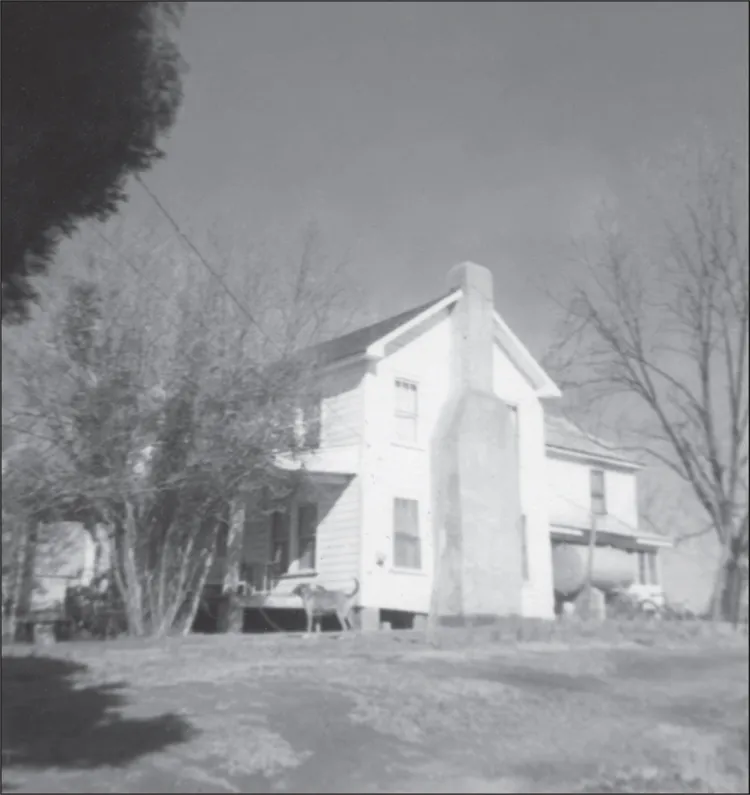
The Garrisons built the home now known as the Tarrant House in 1838. Of several Tarrant houses along Old Pelzer Road in 1882, this one was owned by Nancy Jane Tarrant, who later married John G. Payne and raised several children with him. Nancy was the daughter of Columbus B. Tarrant, who grew the famous cotton bale “Mr. Tarrant,” which is displayed in the Community Building downtown. (Courtesy of Margaret Payne.)

Capt. James Elliott Payne’s original home along Payne Drive, just east of Piedmont off Highway 86, is pictured in the early 1900s. First built in 1771 by John Westfield, it overlooked plowed fields for over 100 years. As this idyllic scene rested to the east, change gripped the area along the river and moved the hills into a new society. (Courtesy of Margaret Payne.)

Henry Pinckney Hammett dreamed of a cotton mill at Garrison Shoals. When the Civil War ended, the board members decided to name their investment Piedmont Manufacturing Company and dubbed the town the same. As the mill began to rise along the Saluda, housing was needed, and artisans flowed into the area. One example was Silas Trowbridge, a carpenter who came to Grove Station from Abbeville County with his young wife, Nancy Nesbitt of Fairview. Later, Trowbridge sold the first bale of cotton to the mill and then bought and sold the first bale of 36-inch sheeting from his store, Trowbridge and Nesbitt. Merchants, architects, engineers, masons, contractors, and service people were all attracted to the rapid growth. Pictured in the pre-1900 photograph above are the dirt movers and trestle, track, and bridge builders that brought rapid transportation to this previously rural area. Engineers diverted the Saluda River to put in the iron bridge. Pictured below during construction are the pylons that can still be seen in the millpond. (Both, courtesy of Betty Davenport.)


Businesses sprang up near the train depot east of town. One building just north of the depot was a cotton warehouse in 1902 and later became a guano warehouse. Another housed the Wigington Iron Works (later W.T. Beard Iron Works), which probably struck all the train tracks, cast iron columns, pilasters, thresholds, galvanized sheet metal cornices, and lintels for the new storefronts after the fire of 1903. Seen here is a view of the depot in the 1950s. (Courtesy of South Caroliniana Library, University of South Carolina.)

This view from just west of the depot is from about 1911. The home on the right has belonged to the James Huff Payne family since 1926. This photograph and the following one on page 15 give an understanding of Piedmont as a young community, with white clapboard homes and white fences lining a wide dirt avenue. (Courtesy of Margaret Payne.)

As the view moves just down the hill from the Payne house, the first Methodist church can be seen in the distance. Prior to the current bridge, Main Street wove through downtown and behind the shopping area to curve across the old iron Wagon Bridge. In 1902 there were two bridges, an iron one and a wooden covered bridge, which was below the warehouse that now houses the Saluda River Grill. (Courtesy of Piedmont Historical Collection.)
...
Table of contents
- Cover Page
- Title Page
- Copyright Page
- Dedication
- Table of Contents
- Acknowledgments
- Introduction
- 1. Early Times
- 2. Clubs and Organizations
- 3. The Mill
- 4. Businesses
- 5. Schools
- 6. Village Life
- 7. Churches
Frequently asked questions
Yes, you can cancel anytime from the Subscription tab in your account settings on the Perlego website. Your subscription will stay active until the end of your current billing period. Learn how to cancel your subscription
No, books cannot be downloaded as external files, such as PDFs, for use outside of Perlego. However, you can download books within the Perlego app for offline reading on mobile or tablet. Learn how to download books offline
Perlego offers two plans: Essential and Complete
- Essential is ideal for learners and professionals who enjoy exploring a wide range of subjects. Access the Essential Library with 800,000+ trusted titles and best-sellers across business, personal growth, and the humanities. Includes unlimited reading time and Standard Read Aloud voice.
- Complete: Perfect for advanced learners and researchers needing full, unrestricted access. Unlock 1.4M+ books across hundreds of subjects, including academic and specialized titles. The Complete Plan also includes advanced features like Premium Read Aloud and Research Assistant.
We are an online textbook subscription service, where you can get access to an entire online library for less than the price of a single book per month. With over 1 million books across 990+ topics, we’ve got you covered! Learn about our mission
Look out for the read-aloud symbol on your next book to see if you can listen to it. The read-aloud tool reads text aloud for you, highlighting the text as it is being read. You can pause it, speed it up and slow it down. Learn more about Read Aloud
Yes! You can use the Perlego app on both iOS and Android devices to read anytime, anywhere — even offline. Perfect for commutes or when you’re on the go.
Please note we cannot support devices running on iOS 13 and Android 7 or earlier. Learn more about using the app
Please note we cannot support devices running on iOS 13 and Android 7 or earlier. Learn more about using the app
Yes, you can access Piedmont by Bonnes Amies Club in PDF and/or ePUB format, as well as other popular books in History & North American History. We have over one million books available in our catalogue for you to explore.