- 128 pages
- English
- ePUB (mobile friendly)
- Available on iOS & Android
eBook - ePub
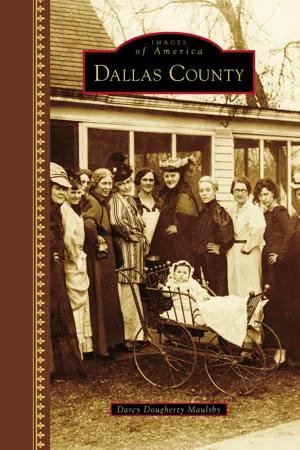
Dallas County
About this book
No Iowa county has influenced American history more than Dallas County. It propelled Harry Truman to an unlikely victory in the 1948 presidential campaign, following a fiery speech he delivered to 100,000 farmers on a sweltering September day at the National Plowing Match near Dexter. Just 15 years earlier, a shoot-out near Dexfield Park marked the beginning of the end for infamous outlaws Bonnie and Clyde and the notorious Barrow Gang. Dallas County, located just west of Des Moines, has produced several major-league baseball players (among them Bob Feller and Hal Manders), a US congressman (David Young), and Nile Kinnick, the 1939 Heisman Trophy winner and University of Iowa football legend whose grandfather George Clarke, of Adel, served as Iowa's governor from 1913 to 1917. Today, Dallas County is one of the fastest-growing counties in America and remains a region of opportunity with a rich heritage of small-town living, farming, coal mining, and the immigrant experience.
Trusted by 375,005 students
Access to over 1 million titles for a fair monthly price.
Study more efficiently using our study tools.
Information
One
ADEL
DALLAS COUNTY’S FIRST TOWN
History is inescapable in Adel, from the brick streets to the stunning Dallas County Courthouse. Founded in 1847, the town was originally called Penoach, a Native American name meaning “far away.” In 1849, the city’s name was changed to Adel in honor of a pretty young lady, according to local lore. The community has remained the county seat despite numerous efforts years ago to move the seat of government to Perry, Dallas Center, or Waukee.
The first courthouse in Adel, a log cabin, was built in 1848. The current courthouse, made of white Bedford stone, was completed in 1902 at a cost of $109,000. In September 1902, when Adel’s population was roughly 1,200 residents, 2,000 people attended the dedication of the courthouse, which is listed in the National Register of Historic Places.
Just a few years before this, on March 6, 1895, Adel witnessed one of the most violent events in Dallas County history. The robbery of the Adel State Bank left one man dead and six others wounded.
Located on the west side of the square, the bank was targeted by Orlando “Rowdy” Wilkins and Charles Crawford from Patterson, Iowa. On the morning of March 6, the criminals drove a team and buggy into Adel and entered the bank around 9:00 a.m. Wilkins shot cashier S.M. Leach and a customer. The robbers grabbed a bag and filled it with approximately $267.
The ruckus caught the attention of George Clarke, an attorney whose office was above the bank. When Clarke came down the stairs, Wilkins stuck his shotgun into Clarke’s chest and pulled the trigger. The gun clicked but did not fire. Clarke dashed back up the stairs. (Clarke later became the governor of Iowa and was also the grandfather of University of Iowa football star Nile Kinnick.)
Wilkins and Crawford took off at breakneck speed in their buggy but were soon captured. Wilkins was shot and killed, and his body was brought back to Adel. Before being taken to the undertaker, his body was displayed sitting in a chair in front of the bank so the public could view the dead outlaw.
The former bank building still graces downtown Adel. With a population of more than 3,600 residents today, Adel retains its small-town charm, from its town square to its historic buildings. Located just minutes from Des Moines, the community continues to grow and comes together each summer for the annual Sweet Corn Festival.

DALLAS COUNTY PIONEERS. A man named Mr. Lindsey built this log cabin southwest of Adel on a claim in Section 4 of Adams Township in southwest Dallas County in 1852. It was later the home of Anderson Van Cleave. The photograph shows members of the Van Cleave family, including Anderson and Thomas Van Cleave. (Courtesy of Dallas County Conservation.)

DALLAS COUNTY POOR FARM. Dallas County purchased 160 acres for $4,000 in 1869 to establish a poor farm to care for “paupers, the disabled and the feeble minded.” Residents were expected to work to help raise food and cover expenses. The farm, which expanded to more than 500 acres, still includes a spacious barn and a two-story brick building constructed in the 1930s through the Works Project Administration. The farm now houses the Dallas County Human Services campus. (Courtesy of Roy R. Estle Memorial Library, Dallas Center.)

FIRST SCHOOL IN ADEL. The first school in Adel opened in 1857 in this two-story brick schoolhouse, which served the community until the 1870s. From 1872 to 1898, the building was home to Adel banker and state lawmaker Leroy Lambert. The property became a boarding and rooming house that the Thornton family ran from 1898 to 1943. It then became a private home until the early 1970s. Located close to the town square, the structure remains one of Adel’s oldest buildings and houses the Adel Historical Museum. (Author’s collection.)

BRICK COURTHOUSE. Built in 1858, Dallas County’s third courthouse replaced the first one, a double log cabin built in 1848, as well as the second, a one-story frame structure built in 1853. The 1858 courthouse cost $20,000 and was located on the town square. Standing in front of the courthouse are, from left to right, J.M. Roland, W.L. Mitchell, and Ralph E. Joy. (Courtesy of Roy R. Estle Memorial Library, Dallas Center.)

STREETS PAVED WITH HISTORY. Adel features paved and brick streets. This crew paved Adel’s side streets sometime after 1897. In the mid-1920s, J.S. McLaughlin and Sons Construction Company received a contract to install more paved streets. City planners favored brick instead of concrete, because Adel had its own brickyard. Also, sand for concrete had to be shipped in from Des Moines, raising the cost to pave the streets. (Courtesy of Adel Historical Museum.)

BIRD’S-EYE VIEW OF ADEL. In 1890, Adel’s population was less than 1,000, although the town grew to 1,455 residents by 1920. As more homes and businesses were built, barns were also common throughout the town in the 19th century and into the early 20th century, before the age of the automobile. (Courtesy of Van Meter Public Library.)

MILLING IN DALLAS COUNTY. Thanks to the nearby Raccoon River, milling enterprises of various types t...
Table of contents
- Cover Page
- Half Title
- Title Page
- Copyright Page
- Table of Contents
- Acknowledgments
- Introduction
- 1. Adel: Dallas County’s First Town
- 2. Redfield: A Crossroads of Local History
- 3. Dexter: The Original One-Horse Town
- 4. Dallas Center: Nurtured by Banking and Agriculture
- 5. Van Meter: Baseball, a Mystery, and More
- 6. Perry: Northern Dallas County’s Largest Town
- 7. Waukee: The Key to Good Living
- 8. Woodward and Granger: Growing along Highway 141
- 9. Tiny Towns and Ghost Towns: Memories Live On
- 10. A Posse to a President: How Harry Truman, Bonnie and Clyde, and Dallas County Changed American History
- Bibliography
Frequently asked questions
Yes, you can cancel anytime from the Subscription tab in your account settings on the Perlego website. Your subscription will stay active until the end of your current billing period. Learn how to cancel your subscription
No, books cannot be downloaded as external files, such as PDFs, for use outside of Perlego. However, you can download books within the Perlego app for offline reading on mobile or tablet. Learn how to download books offline
Perlego offers two plans: Essential and Complete
- Essential is ideal for learners and professionals who enjoy exploring a wide range of subjects. Access the Essential Library with 800,000+ trusted titles and best-sellers across business, personal growth, and the humanities. Includes unlimited reading time and Standard Read Aloud voice.
- Complete: Perfect for advanced learners and researchers needing full, unrestricted access. Unlock 1.4M+ books across hundreds of subjects, including academic and specialized titles. The Complete Plan also includes advanced features like Premium Read Aloud and Research Assistant.
We are an online textbook subscription service, where you can get access to an entire online library for less than the price of a single book per month. With over 1 million books across 990+ topics, we’ve got you covered! Learn about our mission
Look out for the read-aloud symbol on your next book to see if you can listen to it. The read-aloud tool reads text aloud for you, highlighting the text as it is being read. You can pause it, speed it up and slow it down. Learn more about Read Aloud
Yes! You can use the Perlego app on both iOS and Android devices to read anytime, anywhere — even offline. Perfect for commutes or when you’re on the go.
Please note we cannot support devices running on iOS 13 and Android 7 or earlier. Learn more about using the app
Please note we cannot support devices running on iOS 13 and Android 7 or earlier. Learn more about using the app
Yes, you can access Dallas County by Darcy Dougherty-Maulsby in PDF and/or ePUB format, as well as other popular books in History & Political Biographies. We have over one million books available in our catalogue for you to explore.