- 96 pages
- English
- ePUB (mobile friendly)
- Available on iOS & Android
eBook - ePub
Oak Cliff
About this book
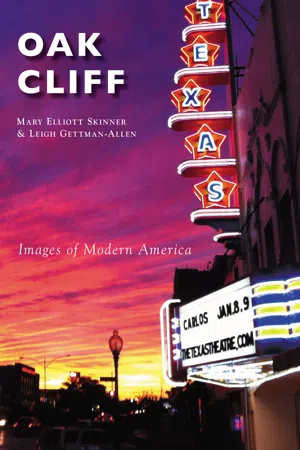
The community of Oak Cliff is one of progress and transformation, experiencing a "rebirth" over the last few decades. Covering approximately one fourth of Dallas County, Oak Cliff has become one of the most ethnically diverse and culturally opulent neighborhoods in the state of Texas. From the events surrounding the death of Pres. John F. Kennedy to the demographic shifts over the last 40 to 50 years, Oak Cliff has become a symbol of inimitability, re-establishing its image as one of the most desirable neighborhoods in the United States.
One
1960S
A NEIGHBORHOOD IN TRANSITION
The 1960s were a defining decade for the majority of the United States, but that especially held true for the transitioning community of Oak Cliff. For many, Oak Cliff in the early 1960s was the quintessential place to live in the Dallas Metroplex. Oak Cliff’s residents were mostly comprised of married couples with children, lending themselves to a very Norman Rockwellesque lifestyle. To put it into perspective, a public opinion survey held in 1963 by Belden Associates asked people what they mainly associated with Oak Cliff. The two main responses they received were: (1) It’s a dry area of Dallas and (2) It is an extremely religious area with many churches.
But by the mid-1960s, things were beginning to shift. The civil rights movement that was blowing through the country made a profound mark on Oak Cliff. An emerging “white flight” resulted in a drastic racial shift in many Oak Cliff neighborhoods, thus changing the image of the predominantly Caucasian community. The family dynamic was changing as well, as more mothers were heading to work and children and teenagers were being granted more freedoms that coincided with the liberal movement of the decade.
The many connections to the assassination of Pres. John F. Kennedy brought an entirely new spotlight to Oak Cliff. The boarding house on Beckley Avenue where Lee Harvey Oswald lived, his murder of Oak Cliff police officer J.D. Tippit, and his arrest at the Texas Theatre on Jefferson Boulevard all contributed to the ever-growing animosity towards Dallas that surrounded this American tragedy. Fortunately, the spirit of unity was still alive and well in the life of Oak Cliff schools, civic organizations, churches, and local businesses. It could be seen through the closeness of its residents and their desire to gracefully change the face of their community.

Established in 1927, Methodist Hospital of Dallas has brought quality health care to the southern sector of Dallas County for almost a century. Its first expansion occurred in the 1940s and continued steadily into the 1960s, when its first contemporary wing was built. In 2011, the Methodist Health System board of directors authorized a building expansion plan exceeding $135 million that directly benefitted Methodist Dallas Medical Center. (Courtesy of Alan Elliott.)

Jerry Haynes, dressed as his popular children’s television show character, Mr. Peppermint, visits a child in the pediatric wing of Methodist Hospital in the 1960s. On November 22, 1963, Haynes was at lunch a few blocks away from the Kennedy assassination and as a result was among the first to be interviewed giving his account on WFAA-TV. He is also the father of Gibby Haynes, the Butthole Surfers front man. (Courtesy of Methodist Health System.)

For more than 53 years, Aunt Stelle’s Sno-Cones has stood on the corner of Clarendon Drive and South Marlborough Avenue. After the death of Estelle Williams (Aunt Stelle), the business has continued with great success under the ownership of her daughter Freda Lee Albert. In recent years, Albert has shortened the hours the stand is open so she can spend more time with her family. (Courtesy of Gayla Brooks.)

Polar Bear Ice Cream was a popular teen hangout in the 1960s and 1970s. The first Polar Bear was opened on West Davis Street in 1941 by J.C. Brigham. It moved to 1215 North Zang Boulevard in 1946. By 1966, there were nine stores in Dallas. This photograph was taken at the Davis location in 1966 with various Sunset students enjoying their after-school treats. (Courtesy of Sunset Alumni Association.)

The Cuellar boys of the El Chico Restaurant family were commonly referred to as “Mama’s Boys” during the 1960s. The decade’s advertising theme for the restaurant was “Like Mama, Like Son—True Mexican.” Throughout the 1960s, El Chico’s Oak Cliff location on West Davis Street thrived as one of the community’s most popular restaurants. The restaurant has catered dinners for international royalty, such as Princess Grace of Monaco. (Courtesy of Sam Benson.)

Wynnewood Village Shopping Center, at the corner of Illinois Avenue and Zang Boulevard, was built in the late 1940s as the first open-air mall. As its name suggests, it was conceived as and functioned like a village with its sprawling single-story layout. By the early 1960s, Wynnewood was a thriving retail destination complete with shops, restaurants, a drugstore, a post office, and even a movie theater, the aptly named Wynnewood Theater. (Courtesy of Sandy Almand.)

The Dallas Symphony Orchestra appeared at Lake Cliff in the spring of 1967 as part of the spring series sponsored by the Dr Pepper Company in conjunction with the Dallas Parks and Recreation Department. This is a violinist’s view of the crowd. Hundreds of people of all ages attended the event. (Courtesy of Joe Whitney.)

Yvonne Craig (1937–2015), television’s original Batgirl, attended both Adamson and Sunset High Schools in Oak Cliff. She was known for her 90 television and 21 movie appearances, including two films with Elvis Presley. Craig guest-starred on the original Star Trek; she is seen here as a green-skinned Orion named Marta. She was the voice of Grandma on the animated children’s program Olivia. (Courtesy of Yvonne Craig.)

In the late 1940s, Gordan Lindsay established his ministerial publishing company in Shreveport, Louisiana. By 1952, he and his wife, Freda, had moved their organization to Dallas at 1600 Bonnie View Road in Oak Cliff. Because of their worldwide ministry of building churches in developing nations, they named their organization Christ for the Nations on March 30, 1967. The photograph above shows the campus in the 1960s. This later developed into what is currently known as Christ for the Nations Institute (CFNI). CFNI has trained nearly 40,000 students, reaching 120 nations and publishing books in 83 languages. Notable CFNI students include world-renowned worship leader Kari Jobe; gospel artist Nicole C. Mullen; the father of the famous boy band the Jonas Brothers, Kevin Jonas; and rock/folk music legend Bob Dylan. Part of the 2015 campus is pictured below. (Both, courtesy of Christ for the Nations Institute.)


Decatur College moved to Dallas under the name of Dallas Baptist College in 1965 (pictured above) and eventually changed its name to Dallas Baptist University (DBU) in 1985. Overlooking Mountain Creek Lake in one of the prettiest parts of Oak Cliff, University Hill consists of approximately 292 acres. ...
Table of contents
- Cover Page
- Title Page
- Copyright Page
- Dedication
- Table of Contents
- Acknowledgments
- Introduction
- 1. 1960s: A Neighborhood in Transition
- 2. 1970s: A Neighborhood of Restoration
- 3. 1980s: A Neighborhood Transformed
- 4. 1990s: A Neighborhood of New Beginnings
- 5. 2000s: A Neighborhood on the Rise
- 6. 2010s: A Neighborhood Reborn
Trusted by 375,005 students
Access to over 1.5 million titles for a fair monthly price.
Study more efficiently using our study tools.
Information
Publisher
Arcadia PublishingYear
2016Topic
HistoryPrint ISBN
9781467116268
Subtopic
North American HistoryeBook ISBN
9781439656525
Index
HistoryFrequently asked questions
Yes, you can cancel anytime from the Subscription tab in your account settings on the Perlego website. Your subscription will stay active until the end of your current billing period. Learn how to cancel your subscription
No, books cannot be downloaded as external files, such as PDFs, for use outside of Perlego. However, you can download books within the Perlego app for offline reading on mobile or tablet. Learn how to download books offline
We are an online textbook subscription service, where you can get access to an entire online library for less than the price of a single book per month. With over 1.5 million books across 990+ topics, we’ve got you covered! Learn about our mission
Look out for the read-aloud symbol on your next book to see if you can listen to it. The read-aloud tool reads text aloud for you, highlighting the text as it is being read. You can pause it, speed it up and slow it down. Learn more about Read Aloud
Yes! You can use the Perlego app on both iOS and Android devices to read anytime, anywhere — even offline. Perfect for commutes or when you’re on the go.
Please note we cannot support devices running on iOS 13 and Android 7 or earlier. Learn more about using the app
Please note we cannot support devices running on iOS 13 and Android 7 or earlier. Learn more about using the app
Yes, you can access Oak Cliff by Mary Elliott Skinner,Leigh Gettman-Allen in PDF and/or ePUB format, as well as other popular books in History & North American History. We have over 1.5 million books available in our catalogue for you to explore.