- 128 pages
- English
- ePUB (mobile friendly)
- Available on iOS & Android
eBook - ePub
Los Osos/Baywood Park
About this book
Los Osos and Baywood Park, on the south end of Morro Bay, were two independent areas that developed separately during different periods. Over time, they grew together. In 1974, the US Post Office eliminated the Baywood branch and declared the area as Los Osos. Residents, passionate about their neighborhoods, specifically refer to Cuesta-by-the-Sea, Baywood, or the 12 other housing areas, while nonresidents ascribe to the Los Osos name. This area, including the beautiful Los Osos Valley, has been home to artisans, fishermen, and hunters for centuries, and more recently, cattle ranchers and farmers. The town grew haphazardly in fits and starts. Quirky, rebellious, off the beaten path--all apply. People here are happy to be a bit undiscovered and prefer that it stays that way.
Trusted by 375,005 students
Access to over 1 million titles for a fair monthly price.
Study more efficiently using our study tools.
Information
One
THE NORTHERN CHUMASH
AND THEIR HOME
AND THEIR HOME
The Northern Chumash people inhabited the Los Osos–Montaña de Oro area for 10,000 years or more. They had a complex society of villages and trade that has left many traces on the land in this area, some hidden, others in plain sight. There was once a thriving populace with extended kinships and many artistic expressions. They thrived for thousands of years because they understood their environment, including the changing seasons, animal migrations, tides, the stars, and weather patterns. The Spanish and Mexican eras in the 18th and 19th centuries decimated this population by removing the people to the missions, by disease, and by scattering the people onto ranches and into towns. These survivors’ descendants still live in San Luis Obispo County and are revitalizing their elegant culture, language, songs, and dances.
The name “Chumash” is not the one the people themselves use today. Rather, they are Yak Tityu Tityu, “the People.” The Northern Chumash language is considered the oldest of the eight Chumash types, and while Obispeño is used to identify it, that is a Spanish word, not one used by the People today.
Many town names today were derived from Chumash words: pismu’ became Pismo Beach, lompo’ became Lompoc, nipumu’ became Nipomo, and wasna became Huasna. The basketwork of the Yak Tityu Tityu is regarded as among the finest of the native peoples of America. Unique to Native Americans, they built their beds high on bedsteads with a reed mat for a mattress and four other mats on posts to form curtains.
The People made the necessary tools to rely on hunting, gathering, and fishing to live, and they efficiently managed those resources. They processed shellfish in specific places, casting off the shells in refuse piles, called middens, so one can see what they ate for some of their meals. Other food included marsh birds, small animals such as rabbits, and deer. Written records from the Spanish era include oak acorn mush and roots.
The Northern Chumash peacefully survived on this land far longer than the 230 years of the current civilization; modern Californians might learn something from them.

The geology of the coastal region that underlies Los Osos/Baywood Park and the valleys is sand dunes and rock. But before that, there was molten magma, tectonic upheavals, sea level rises, erosion, and sedimentation. It is believed that the magnificent Nine Sisters Peaks, which line the Los Osos Valley right out into the ocean, originated at approximately the same latitude as Palm Springs, California. They were moved north, sitting on the shifting Pacific Plate. What one sees today are the degraded remains of the dacite volcanic plugs after 20–25 million years of erosion. There are really 14 peaks, but only nine have names: San Luis Mountain, Bishop Peak, Chumash Peak, Cerro Romualdo, Hollister Peak (originally called Cerro Alto), Cerro Cabrillo, Black Hill, Morro Rock, and the Davidson Seamount, which is underwater. The Sisters are of cultural significance to the Northern Chumash. (Photograph by Alvin Rhodes, courtesy of Joan Sullivan.)
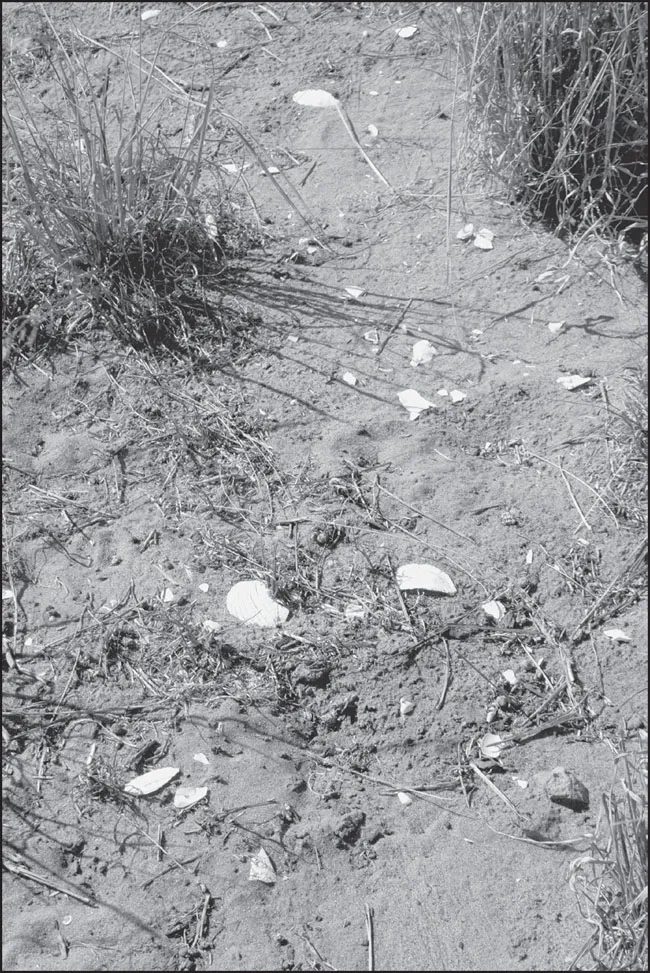
Evidence of Northern Chumash life spanning their occupancy for thousands of years abounds in Los Osos. These broken shells are along a path in town. The village itself in Los Osos likely ended around 1800. The town has been built on top of their civilization, and archeological assessments for Northern Chumash artifacts are often needed before construction is allowed. (Author’s collection.)

Tule balsas were used in protected areas like Morro Bay for fishing. They were made out of bullrush that was dried and made into bundles, which included one willow pole per bundle for strength. The bundles were then tied together to form a seatless boat. This 1817 print by Louis Choris depicts San Francisco Bay, but the local Morro Bay craft would have looked similar. (Courtesy of the University of California Berkeley, Bancroft Library.)

Sacred sites to the Northern Chumash were many and include Morro Rock and the horseshoe-shaped sandstone rock formation known today as Painted Rock at the Carrizo Plain National Monument. These sites remain sacred to the native people who are still around today. At one time, the paintings extended more than 40 feet in length. Chumash painted both representational and abstract images, with black, red, and white being the most common colors. Painted Rock was used as a meeting and gathering place for the Chumash and the Yokut people and possibly other native groups. Heavily worn footpaths on the large outcrop are evidence at the site of centuries if not thousands of years of native ceremonies. The polychrome paintings were more likely first put on the rock at least 1,000 years ago and continued to be repainted into historic times. This site has been heavily damaged by erosion, and in the last century, nearly totally destroyed by gunfire. Painted Rock is now a protected Bureau of Land Management site with limited visitation. (Photograph by Lorenzo Yates, courtesy of the Santa Barbara Museum of Natural History.)

The Northern Chumash are known for their superb basket making. This San Luis Obispo County coiled basketry jar is decorated in stair-step block cascades. The unusual designs of unknown meaning on the body and shoulder may have been copied from letters. These designs were woven in, using naturally colored plant materials—rush stems, sedge runners, and tule roots. A single white bead, its significance unknown, was woven into the side of this basket. Coiled baskets were used for preparing food, for storing seeds, as trays, as burden and trinket baskets, and as women’s hats. Twined baskets were used for fishing, harvesting seeds like chia sage, straining, leaching acorn flour, and water storage. Some cooking baskets were so tightly woven that they held water. Water storage baskets lined in asphalt ranged in size from a water bottle to one big enough to hold two or three gallons. Today the Northern Chumash are once again learning the intricate art of basket making and hope for access to traditional plant materials. (Courtesy of the Santa Barbara Museum of Natural History.)

Rosario Cooper, a Yak Tityu Tityu, is recognized as the last speaker of the Obispeño Chumash language in San Luis Obispo County. She lived from October 7, 1845, to June 15, 1917. The collaboration between Rosario Cooper and linguist and ethnologist John P. Harrington saved the language from likely extinction. They worked together for many weeks over several years recording her songs on wax cylinders. Because of this effort, specific details of a Northern Chumash woman’s life are known, and family kinships and culture that otherwise would have been lost are also understood. Rosario had one child who survived infancy, and his name was Francisco Olivas. Olivas has descendants who still live in San Luis Obispo County and throughout the state. Pictured from left to right are Mauro Soto, John P. Harrington, Frank Olivas Jr., and Rosario Cooper. (Both, courtesy of the National Anthropological Archives, Smithsonian Institution: above, 91-31415; below, 1976-95.)

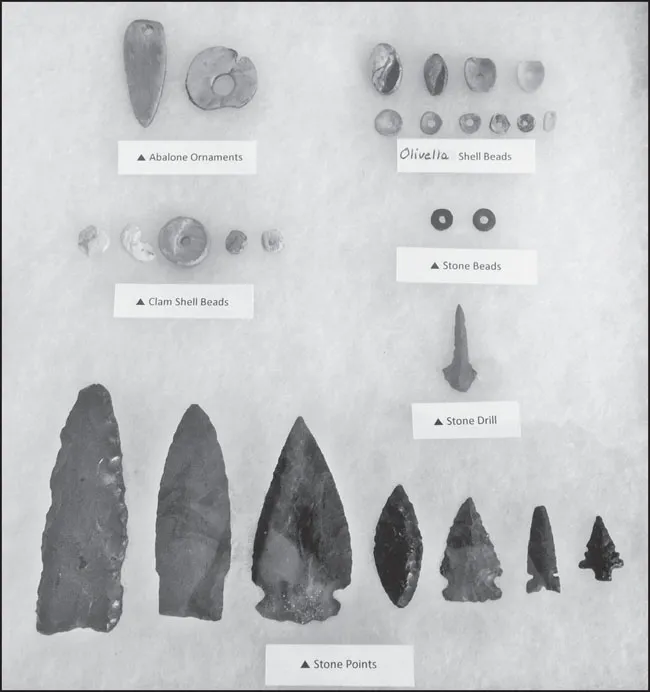
These handmade replicas of Northern Chumash artifacts (which were modeled from the originals) are used for teaching in schools and at public educational events. The projectile points were often made of chert and sometimes of imported obsidian. They were attached to arrows and javelins to hunt deer. Drills made holes in shells and stone for ornamentation and to string shell bead money. (Courtesy of the Yak Tityu Tityu, Northern Chumash tribe.)
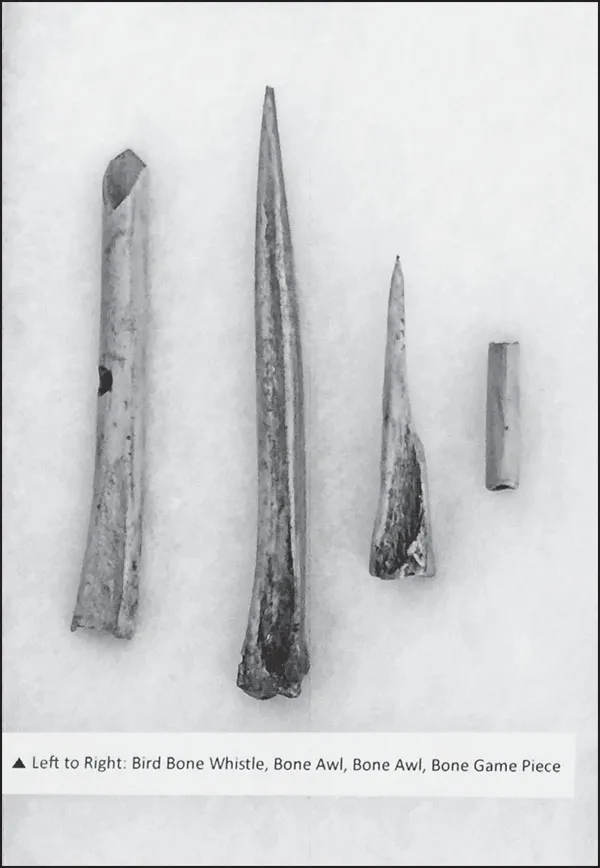
Awls were used in basket making. Flutes were one form of music making, but there were also various percussive instruments. Game pieces could be of bone or shell and could be used in games of skill and chance. Much research is ongoing, including research conducted by Northern Chumash scholars to discover the uses and dating of these artifacts. (Courtesy of the Yak Tityu Tityu, Northern Chumash tribe.)
Two
THE VALLEY OF THE BEARS,
PECHO COAST, AND
CLARK VALLEY
PECHO COAST, AND
CLARK VALLEY
The central coast of California was first seen by Europeans in 1542. The Los Osos Valley was explored in 1769 by Gaspar de Portolá and his men, and documented by Fr. Juan Crespí and Lt. Miguel de Costansó. They named the Valley of the Bears. The summary of the valley’s history from then on could be discovery, settlement/displacement, and changing economic models.
King Carlos III of Spain sent Capt. Gaspar de Portolá y de Rivera to Mexico to close down the Jesuit missions, to establish Alta California colonies and Franciscan missions for Spain, and to claim land before the English and Russians could claim more. Successful in his quest, padres, soldiers, and settlers soon followed, and the mission and pueblo San Luis Obispo de Tolosa was established in 1772. The Chumash population was subsumed into mission life, thus ending their 10,000-plus years of a singular lifestyle.
Mexico achieved independence from Spain, and the mission system was divested of its land...
Table of contents
- Cover Page
- Title Page
- Copyright Page
- Dedication
- Table of Contents
- Acknowledgments
- Introduction
- 1. The Northern Chumash and Their Home
- 2. The Valley of the Bears, Pecho Coast, and Clark Valley
- 3. Real Estate Bust, then Boom!
- 4. Los Osos, at Long Last
- 5. Community
- 6. Parks and Open Space
- 7. The Infamous Sewer and Self-Governance
Frequently asked questions
Yes, you can cancel anytime from the Subscription tab in your account settings on the Perlego website. Your subscription will stay active until the end of your current billing period. Learn how to cancel your subscription
No, books cannot be downloaded as external files, such as PDFs, for use outside of Perlego. However, you can download books within the Perlego app for offline reading on mobile or tablet. Learn how to download books offline
Perlego offers two plans: Essential and Complete
- Essential is ideal for learners and professionals who enjoy exploring a wide range of subjects. Access the Essential Library with 800,000+ trusted titles and best-sellers across business, personal growth, and the humanities. Includes unlimited reading time and Standard Read Aloud voice.
- Complete: Perfect for advanced learners and researchers needing full, unrestricted access. Unlock 1.4M+ books across hundreds of subjects, including academic and specialized titles. The Complete Plan also includes advanced features like Premium Read Aloud and Research Assistant.
We are an online textbook subscription service, where you can get access to an entire online library for less than the price of a single book per month. With over 1 million books across 990+ topics, we’ve got you covered! Learn about our mission
Look out for the read-aloud symbol on your next book to see if you can listen to it. The read-aloud tool reads text aloud for you, highlighting the text as it is being read. You can pause it, speed it up and slow it down. Learn more about Read Aloud
Yes! You can use the Perlego app on both iOS and Android devices to read anytime, anywhere — even offline. Perfect for commutes or when you’re on the go.
Please note we cannot support devices running on iOS 13 and Android 7 or earlier. Learn more about using the app
Please note we cannot support devices running on iOS 13 and Android 7 or earlier. Learn more about using the app
Yes, you can access Los Osos/Baywood Park by Lynette Tornatzky in PDF and/or ePUB format, as well as other popular books in History & North American History. We have over one million books available in our catalogue for you to explore.