- 128 pages
- English
- ePUB (mobile friendly)
- Available on iOS & Android
eBook - ePub
Brookhaven
About this book
Brookhaven has long benefited from its prime location. With two creeks running through it and the well-traveled thoroughfare that became Peachtree Road, Brookhaven was a familiar place to Native Americans, Civil War soldiers, and early settlers like the Goodwin family, whose home became a railroad stop. Adjacent to the city of Atlanta, Brookhaven grew into a community of gracious neighborhoods, parks, and lakes and became home to Oglethorpe University. In 2013, Brookhaven became a city, and it continues to benefit and grow as businesses and families are attracted by its proximity to Atlanta.
Trusted by 375,005 students
Access to over 1.5 million titles for a fair monthly price.
Study more efficiently using our study tools.
Information
One
THE EARLY YEARS
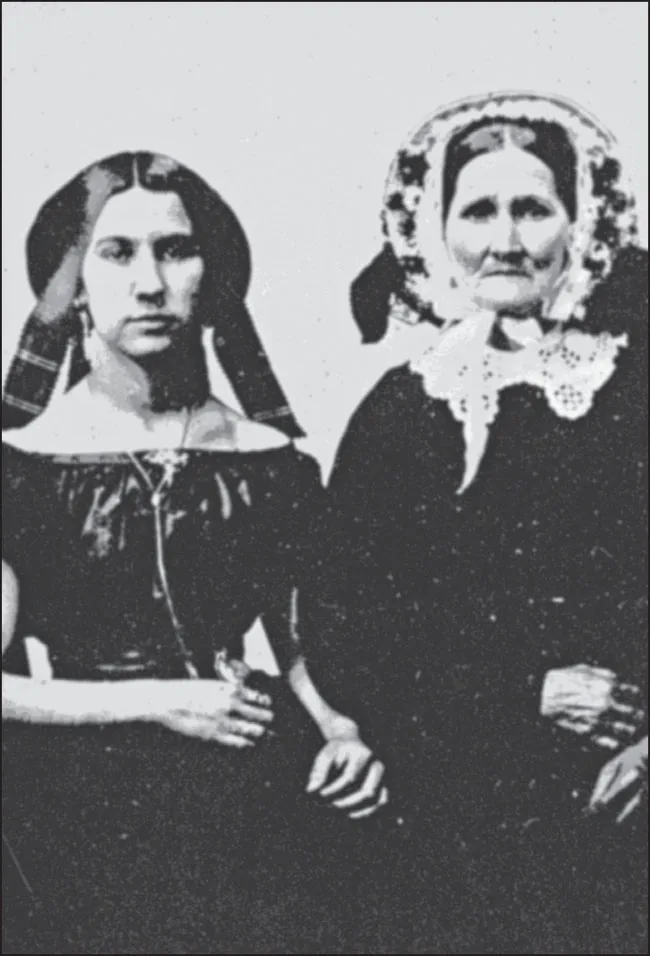
Nancy Baugh Evins and her husband, John, were some of the earliest settlers in what is now known as Brookhaven. They settled along a creek that became known as Nance’s Creek and, later, Nancy’s Creek. One of the stories behind this name is that when John was looking for his wife, he would often find her down by the creek fishing or cooling her feet, with the implication being that she would rather be at the creek than doing household chores. John was buried on the land of the old homeplace, and Nancy is believed to be buried at Nancy Creek Primitive Baptist Church Cemetery. Nancy is pictured here with her daughter, Georgia. (DeKalb History Center.)
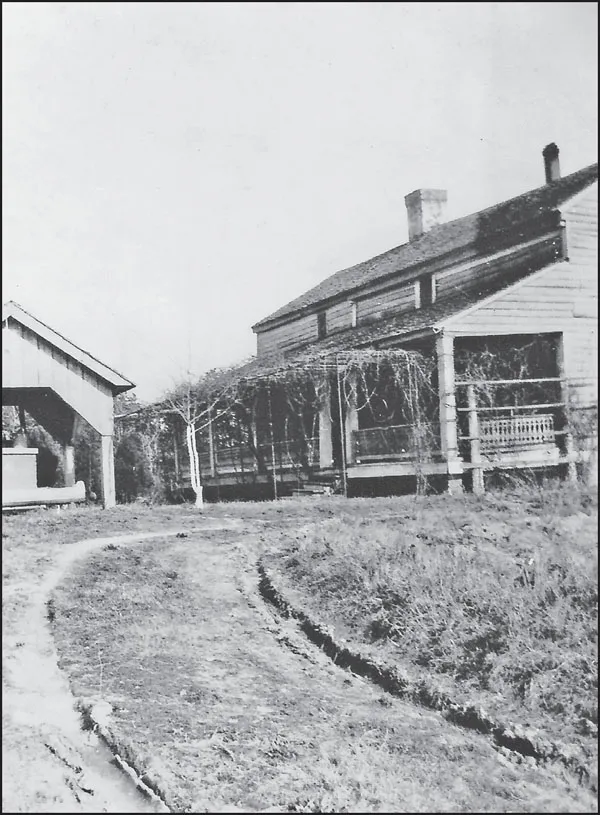
The Goodwin family were living in Laurens, South Carolina, when brothers Starling and Harris decided to travel to the Sixes, a gold-mining community now under Lake Allatoona in Georgia. Harris met and married Emily Dodgen in Forsyth County, Georgia, and they moved to the Cross Keys district of DeKalb County, where Harris worked as a tenant farmer for John Dobbs. Harris built a log cabin on the property, and it became a popular stopping place for travelers. This photograph of the Goodwin home in the early 1900s was taken at the original location at the corner of Peachtree Road and Decatur Road (now North Druid Hills Road). The house was moved in 1960 farther south on Peachtree Road and became known as the Solomon Goodwin Home, with a Georgia Historic Marker on the property. It was the oldest extant home in DeKalb County until development and high property taxes led to it being dismantled in 2016. (Albert Martin.)

Harris Goodwin lived in a log cabin on the John Dobbs property and worked as a tenant farmer. He told his father, Solomon Goodwin, who still lived in South Carolina, about the good farming in Georgia. The elder Solomon’s wife had recently died, so he sold his belongings and moved to Georgia. He then began purchasing property, including the land where Harris was working. Harris and Solomon Goodwin built their own log cabin, adding on to it through the years. (Albert Martin.)

People of the Upper Creek Nation lived in this area until their forced removal after the Treaty of Indian Springs in 1821. What was once a trail of the Creek Nation later became a wagon road connecting Fort Peachtree at Standing Peachtree and Fort Daniel at Hog Mountain, and then the well-known Peachtree Road. When the Goodwins came to the area in the mid-1830s, there were still Creeks living in the vicinity who helped clear the land and build the house. This photograph features Creek chief Opothle Yoholo. (Library of Congress.)

The Tullie Smith home was originally built around 1840, when her great-grandfather Robert Smith brought his family from North Carolina to Georgia. The story passed down from Tullie’s grandmother was that she could see Atlanta burning during the Battle of Atlanta. The Smiths were related to the Mason family, whose name is still part of DeKalb County in Mason Mill Road (off Clairmont Road). Tullie was the last of the family to live in the historic residence. It was moved to the Atlanta History Center in 1972 thanks to the generosity of Mills B. Lane and C&S Bank. The area where the Tullie Smith house once stood is now part of the Executive Park office complex and was annexed into the city of Brookhaven in 2013. (DeKalb History Center.)
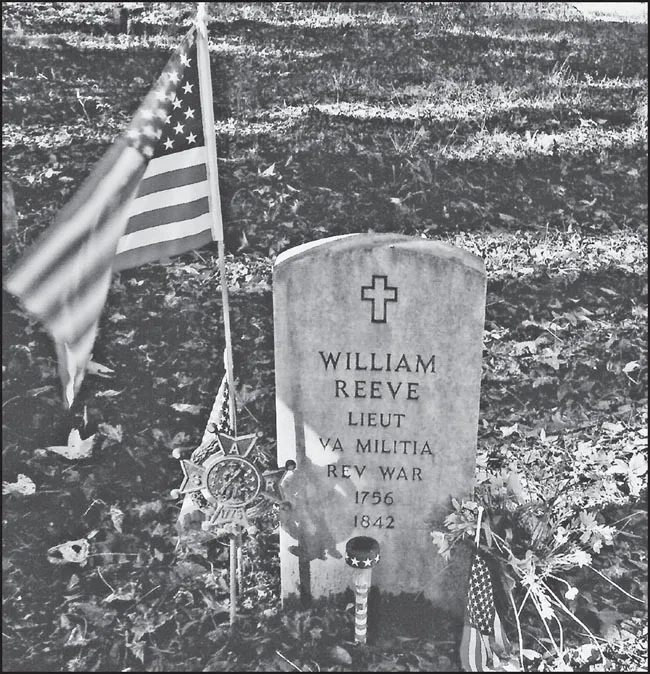
The Reeves were early settlers in what is now Brookhaven. William Reeve fought in the Revolutionary War and is buried at Nancy Creek Primitive Baptist Church Cemetery. His son James Reeve came to the area first and then encouraged his father to move here. James was one of the early postmasters for the area then known as Cross Keys. (Photograph by Valerie Mathis Biggerstaff.)
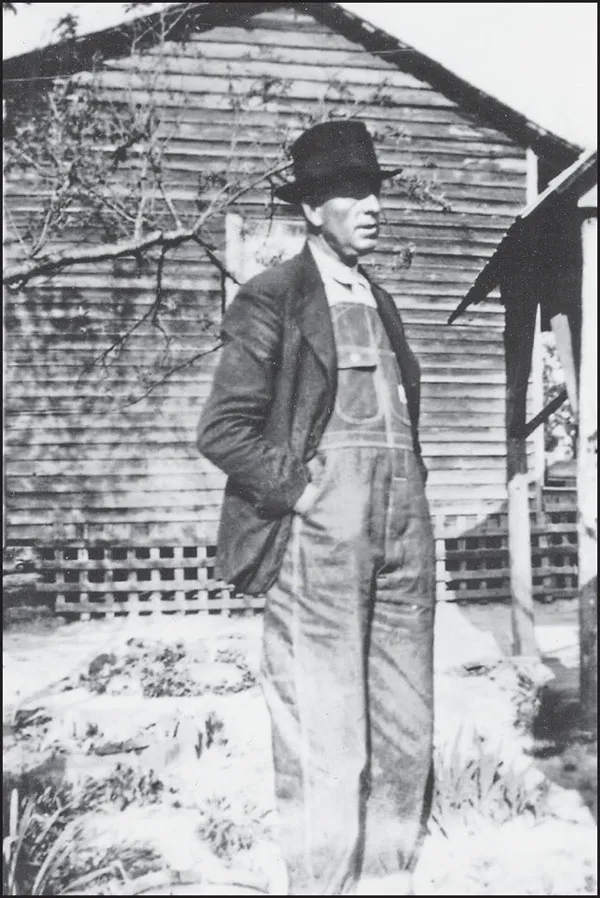
Francis Monroe Adams, pictured here at his home along what is now Dunwoody Club Drive, is one of the many descendants of Salathel Adams, who once owned the land where Murphey Candler Park is now located. Salathel was one of the justices of the peace for DeKalb County in 1844. The Adams family cemetery is now part of Nancy Creek Heights subdivision. There are many descendants of Salathel Adams still in the Atlanta area, including Richard Adams, who has campaigned for repair and upkeep of the family cemetery for many years. Among those buried in the cemetery are Salathel (1799–1862), Sarah Adams (1800–1896), and George W. Wilson, Confederate soldier, Company A, 10th Georgia Cavalry. (Richard Adams.)

When Solomon Goodwin came to Brookhaven on the recommendation of his son, Harris, he purchased a portion of land lot 200, all of land lot 239, and half of land lot 238. This totaled 450 acres, which he bought from John Dobbs for $1,200. This photograph was taken in 1909, and the family members pictured are, from left to right, A.J. Martin, Albert Martin, Ralph Martin, Neoma”Oma” Childress Martin, Evelyn Martin, Permelia Goodwin Childress (Neoma’s mother), Neoma’s sister and brother-in-law, Neoma’s two nephews, and Neoma’s younger brother. In 1906, A.J. formed the Goodwin’s Home Club to help preserve the old home and property; ten Goodwin family members paid $120 each to buy the home back after it had been out of the family since 1889. Family members would arrive in cars or carriages to picnic and maintain the cemetery. (Albert Martin.)

This photograph shows Albert Martin (right), descendant of Harris Goodwin, and local historian Ren Davis standing by Harris Goodwin’s grave monument. The grave was relocated to Nancy Creek Primitive Baptist Church Cemetery after being at the old Goodwin homeplace for many years. When Harris and other Goodwin family members were reinterred at Nancy Creek Primitive Baptist Church Cemetery, they were returning to their original place of burial; they were moved to the Goodwin property in the 1960s due to vandalism at the church cemetery. (Photograph by Valerie Mathis Biggerstaff.)
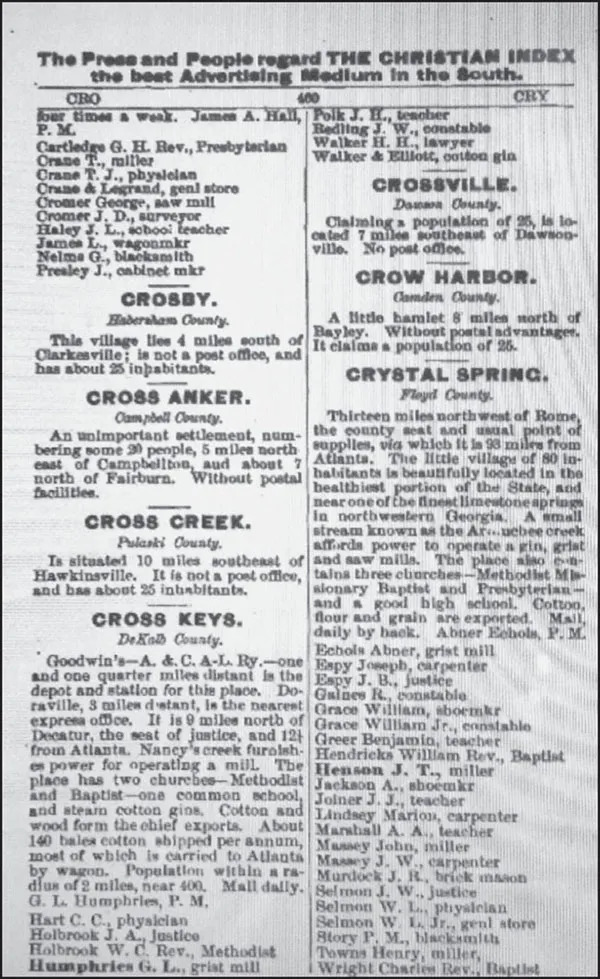
This page of the Sholes’ Georgia Gazetteer and Business Directory for 1879 and 1880 lists Cross Keys among the villages within DeKalb County. The description summarizes the location of the community and what type of businesses are located there. It also advises that 400 people live there, and approximately 140 bales of cotton are shipped mostly to Atlanta each year. Some of the names listed are C.C. Hart, physician; G.L. Humphries, grist mill; J.A. Holbrook, justice; and Rev. W.C. Holbrook, Methodist minister. (Digital Library of Georgia.)
Two
IMPACT OF THE CIVIL WAR
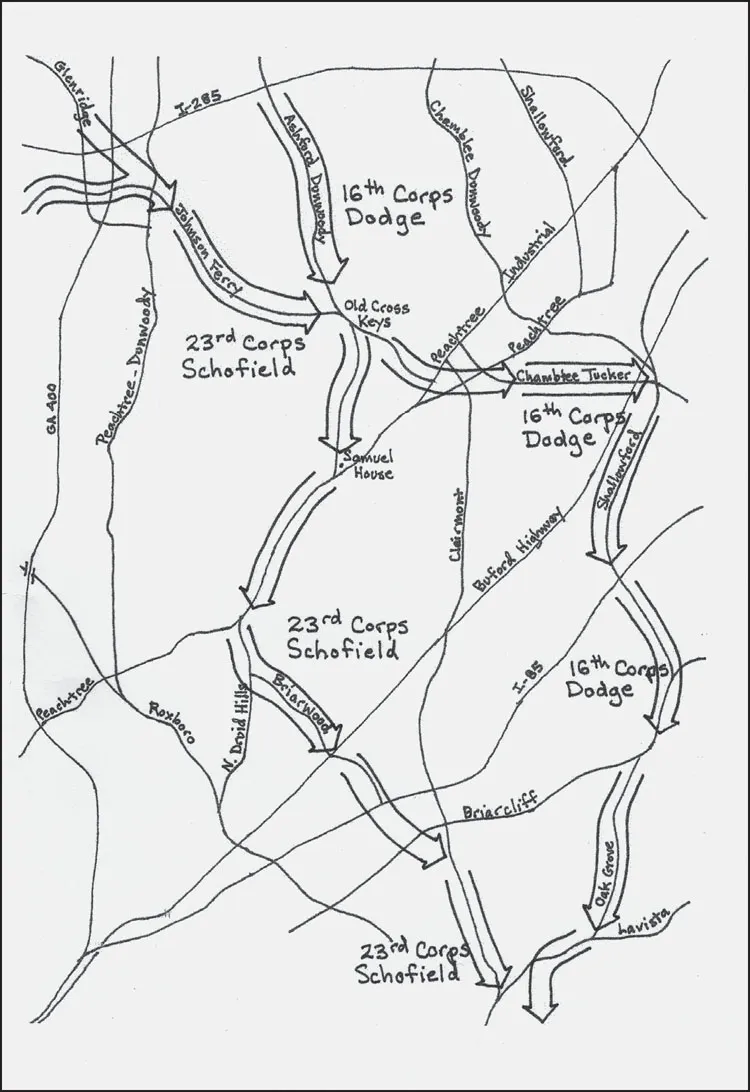
This map, drawn by Charlie Crawford, president of the Georgia Battlefields Association, shows the movement of the Union troops through Brookhaven (Old Cross Keys) in 1864. Gen. John Schofield’s 23rd moved from Sandy Springs by way of Johnson Ferry Road towards Old Cross Keys. From there, Schofield’s troops veered to the right at Peachtree Road and then left along what is now Briarwood Road. Gen. G.M. Dodge’s 16th came from Providence (Dunwoody) and followed the path of today’s Ashford Dunwoody Road, meeting up with the 23rd at Old Cross Keys. From this point, the 23rd marched along what is now Chamblee Tucker Road and Shallowford Road on their way to Decatur. (Charlie Crawford.)
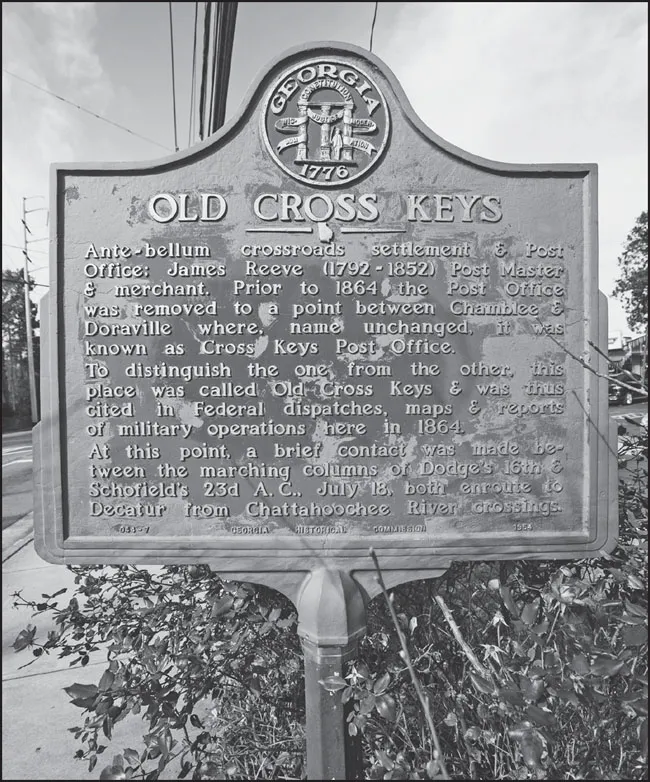
This marker sits at the old crossroads of Johnson Ferry Road and Cross Keys Road (now known as Ashford Dunwoody Road). Old maps reference Cross Keys, and Civil War dispatches refer to the area as Cross Keys. Gen. William T. Sherman refer...
Table of contents
- Cover Page
- Title Page
- Copyright Page
- Dedication
- Table of Contents
- Acknowledgments
- Introduction
- 1. The Early Years
- 2. Impact of the Civil War
- 3. The Rebirth of Oglethorpe University
- 4. Historic Homes and Neighborhood Landmarks
- 5. Camp Gordon and Military Hospitals
- 6. Schools
- 7. Churches
- 8. Parks
- 9. Brookhaven Becomes a City
- Bibliography
Frequently asked questions
Yes, you can cancel anytime from the Subscription tab in your account settings on the Perlego website. Your subscription will stay active until the end of your current billing period. Learn how to cancel your subscription
No, books cannot be downloaded as external files, such as PDFs, for use outside of Perlego. However, you can download books within the Perlego app for offline reading on mobile or tablet. Learn how to download books offline
Perlego offers two plans: Essential and Complete
- Essential is ideal for learners and professionals who enjoy exploring a wide range of subjects. Access the Essential Library with 800,000+ trusted titles and best-sellers across business, personal growth, and the humanities. Includes unlimited reading time and Standard Read Aloud voice.
- Complete: Perfect for advanced learners and researchers needing full, unrestricted access. Unlock 1.5M+ books across hundreds of subjects, including academic and specialized titles. The Complete Plan also includes advanced features like Premium Read Aloud and Research Assistant.
We are an online textbook subscription service, where you can get access to an entire online library for less than the price of a single book per month. With over 1.5 million books across 990+ topics, we’ve got you covered! Learn about our mission
Look out for the read-aloud symbol on your next book to see if you can listen to it. The read-aloud tool reads text aloud for you, highlighting the text as it is being read. You can pause it, speed it up and slow it down. Learn more about Read Aloud
Yes! You can use the Perlego app on both iOS and Android devices to read anytime, anywhere — even offline. Perfect for commutes or when you’re on the go.
Please note we cannot support devices running on iOS 13 and Android 7 or earlier. Learn more about using the app
Please note we cannot support devices running on iOS 13 and Android 7 or earlier. Learn more about using the app
Yes, you can access Brookhaven by Valerie Mathis Biggerstaff,Rebecca Chase Williams in PDF and/or ePUB format, as well as other popular books in History & Economic History. We have over 1.5 million books available in our catalogue for you to explore.