- 128 pages
- English
- ePUB (mobile friendly)
- Available on iOS & Android
eBook - ePub
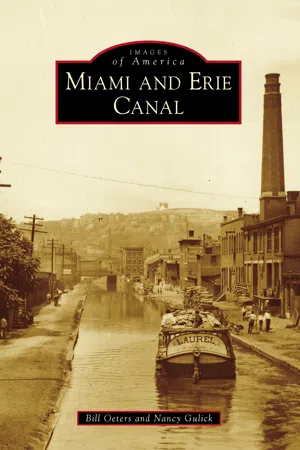
Miami and Erie Canal
About this book
Travel through the history of Ohio's historic canals and follow its growth throughout the years told with hundreds of photographs.
In the 1800s, the United States was a nation obsessed with finding a form of transportation that was the fastest, cheapest, and most reliable; at the time, canals were the answer. Canals broke through vast, open countryside, forested woodlands, and rolling hills to expose the heart of the nation to development. They took passengers and goods off of dusty or muddy roads and delivered them to their destinations faster and cheaper than by any other means. From Toledo to Cincinnati, the Miami and Erie Canal provided western Ohio with that sorely needed waterway and became part of the 1,000 miles of Ohio canals contributing to the national network of canals. Today, with the help of government, corporations, and citizens, many parts of the Ohio canal system have been preserved or restored and can be visited and experienced. Watered sections of canal quietly reflect a bygone era and lead an explorer down the towpaths of history.
Trusted by 375,005 students
Access to over 1.5 million titles for a fair monthly price.
Study more efficiently using our study tools.
Information
Topic
HistoireSubtopic
Architecture généraleOne
THE MIAMI CANAL
CINCINNATI TO DAYTON
On July 21, 1825, ground was broken south of Middletown, on the Daniel Doty farm, for the Miami Canal. Ohio governor Jeremiah Morrow was present, as well as New York’s governor, DeWitt Clinton. Costs were figured at $12,000 per mile, or an estimated total cost of $673,000. Months later, 1,000 laborers were hard at work on the canal, destined to reach Cincinnati and Dayton. Wages for common laborers began at $5 per month plus board, including a daily ration of whiskey. Blacksmiths earned $11 a month, carpenters earned $21, and a man with a team earned $40. The completed Miami Canal, fed by dams and feeders from the Mad and Miami Rivers, ran for 66 miles, with 24 locks and 10 aqueducts.
On November 28, 1827, two short years later, the first boats arrived in Middletown from Cincinnati to celebrate the opening of the first section of the Miami Canal. By January 1828, the first boats arrived from Cincinnati in Dayton on the completed Miami Canal. Although whiskey, flour, and pork were popular shipping items, wheat and corn were also staples of the shipping industry to Cincinnati. The residents of the interior could finally receive finished goods from Cincinnati, which had not previously been available locally. By 1830, the two fledgling canals on opposite sides of the state were bringing the state revenues of $100,000. The commercial promise of canal building was being fulfilled, as well as the development of the state itself. The canals were crowded with traffic; boats packed with freight floated alongside boats packed with immigrants coming to settle farther and farther inland, pushing the line of settlement faster and with more ease than at any time in history. During the 1831 shipping season, 7,065 passengers arrived in Dayton from Cincinnati. Canal-side towns and industries prospered and expanded in each succeeding year, offering solid evidence to any doubters that canals could indeed ensure growth and prosperity for Ohio.

The bridge in the right foreground crosses the Miami and Erie Canal at its terminus with the Ohio River. Ten stone locks, completed in 1834, ascended 110 feet in elevation to Lockport basin in downtown Cincinnati. These 10 locks were rarely used by boaters, who opted to offload their freight at the basin rather than spend the time and tolls necessary in locking down to the river. (Courtesy of the Canal Society of Ohio.)

Bicentennial Commons Park, at Cincinnati’s riverfront, commemorates Cincinnati’s founding in 1788. The brick structure shown here is an artist’s concept of the canal lock that would have sat at this very spot until the staircase of 10 locks was abandoned by the state in March 1863. After 1863, navigation on the canal would terminate at the Lockport basin. (Courtesy of Boone Triplett.)

The Ohio Boat Company was owned and operated by the Fox Paper Company. This c. 1905 photograph shows a portion of the company’s fleet docked in Cincinnati, near the canal’s southern terminus. The boats were steel-hulled and were powered by locally manufactured Carlisle & Finch inboard gasoline engines. The Ohio Boat Company fleet made daily trips between Cincinnati, Hamilton, Middletown, and Dayton. Fox initially operated two boats, the Ajax and the Monitor, which shuttled product between Hamilton and Middletown. Later boats added to their fleet were named after canal towns along their expanded route: Dayton, West Carrollton, Miamisburg, Hamilton, Middletown, and Lockland. Fox Paper was one of the last commercial boat operators on the Miami and Erie Canal. (Courtesy of David Neuhardt.)

The Miami and Erie Canal runs parallel with Main Street in this c. 1910 photograph. A streetcar is shown crossing the Vine Street Bridge. Streetcars began operation in Cincinnati in 1888. At their peak, there were over 250 miles of track servicing the city and its nearby suburbs. Operation ceased in 1951. Holy Cross Monastery crowns Mount Adams in the distance. (Courtesy of the Frank Wilmes collection.)

This 1915 photograph shows the Miami and Erie Canal flanked by Canal Street (present-day Central Parkway). The three-story Rashig School is to the near left. Cranes are shown building the Hamilton County Courthouse in the background. The tall building advertises the Cincinnati Process Engraving Company and the Rapid Electrotype Company. (Courtesy of the Frank Wilmes collection.)

Looking south from the Fourteenth Street Bridge, the Cincinnati Music Hall is on the left in this 1900 photograph. The twin-towered Cincinnati Commercial Hospital/Insane Asylum is on the right, and the Cincinnati City Hall is the tall spire structure in the background. (Courtesy of the Frank Wilmes collection.)

The Robert R. Reynolds was a Cincinnati-registered ice hauler. It is berthed outside of Machinery Hall in this 1888 image. Machinery Hall was built that year for the Cincinnati Centennial Exposition. Built over the canal, the hall was three city blocks long and 150 feet wide where it adjoined with the Music Hall. (Courtesy of the Canal Society of Ohio.)

These skinny-dippers are shown at the Wade Street Bridge “swimming hole” in Cincinnati’s Overthe-Rhine district. Swimming in the canal was illegal, and police often had to chase children away. The pollutants in canal water were appalling and posed a serious health risk. Rotting animal carcasses floating along the waterway were not an uncommon sight. Nevertheless, these children retained fond memories of the canal into adulthood. When the canal in Cincinnati was paved over in the mid-1920s, the Canal Swimmers Society was founded by a Times-Star newspaper columnist. Anyone who had swum the canal was eligible for membership. Former president and later Supreme Court chief justice William Howard Taft became an early and prominent member of the society. (Courtesy of the Frank Wilmes collection.)

The steam-powered Gem City was registered in Dayton in 1883. Boat owners hoped to remain competitive by replacing workers and animals with steam engines. These boats usually exceeded the canal’s strict four-mile-per-hour speed limit, resulting in damaging wave action on the banks. The boat is shown north of the Mohawk Bridge in the c. 1900 photograph above. This bridge was replaced by an iron lift bridge in 1909. The photograph belo...
Table of contents
- Cover Page
- Title Page
- Copyright Page
- Dedication
- Table of Contents
- Acknowledgments
- Introduction
- 1. The Miami Canal: Cincinnati to Dayton
- 2. The Miami Extension Canal: Dayton to Junction
- 3. The Miami and Erie Canal: Junction to Toledo
- 4. The Flood of 1913: Demise of the Miami and Erie Canal
- 5. After the Flood: Conservation, Restoration, and Interpretation
- About the Organizations
Frequently asked questions
Yes, you can cancel anytime from the Subscription tab in your account settings on the Perlego website. Your subscription will stay active until the end of your current billing period. Learn how to cancel your subscription
No, books cannot be downloaded as external files, such as PDFs, for use outside of Perlego. However, you can download books within the Perlego app for offline reading on mobile or tablet. Learn how to download books offline
Perlego offers two plans: Essential and Complete
- Essential is ideal for learners and professionals who enjoy exploring a wide range of subjects. Access the Essential Library with 800,000+ trusted titles and best-sellers across business, personal growth, and the humanities. Includes unlimited reading time and Standard Read Aloud voice.
- Complete: Perfect for advanced learners and researchers needing full, unrestricted access. Unlock 1.5M+ books across hundreds of subjects, including academic and specialized titles. The Complete Plan also includes advanced features like Premium Read Aloud and Research Assistant.
We are an online textbook subscription service, where you can get access to an entire online library for less than the price of a single book per month. With over 1.5 million books across 990+ topics, we’ve got you covered! Learn about our mission
Look out for the read-aloud symbol on your next book to see if you can listen to it. The read-aloud tool reads text aloud for you, highlighting the text as it is being read. You can pause it, speed it up and slow it down. Learn more about Read Aloud
Yes! You can use the Perlego app on both iOS and Android devices to read anytime, anywhere — even offline. Perfect for commutes or when you’re on the go.
Please note we cannot support devices running on iOS 13 and Android 7 or earlier. Learn more about using the app
Please note we cannot support devices running on iOS 13 and Android 7 or earlier. Learn more about using the app
Yes, you can access Miami and Erie Canal by Bill Oeters,Nancy Gulick in PDF and/or ePUB format, as well as other popular books in Histoire & Architecture générale. We have over 1.5 million books available in our catalogue for you to explore.