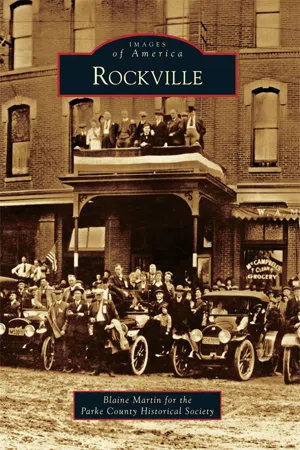
Rockville began in 1824 as the seat of justice for the newly established Parke County. A small brick courthouse was built, and a fledgling community soon sprang up around it. Within a short time, blacksmiths, furniture builders, harness makers, grocers, druggists, and dry goods salesmen were calling the new public square home. Then over a period of 13 years, beginning in 1870, the face of Rockville was drastically altered as fires destroyed the early buildings. The newly resurrected town would look quite different. As the rebuilding occurred, an exceptional example of small-town Italianate architecture emerged. This new Rockville looked much different than its haphazard Colonial-style predecessor. Three-story brick and stone buildings replaced haphazard one- and two-story wood frame structures; concrete sidewalks replaced wooden walkways; awnings, ornate cornices, and large architectural iron and glass storefronts became the standard. It was during these years that Rockville began to resemble the quintessential American small town it is today.
eBook - ePub
About this book
Trusted by 375,005 students
Access to over 1.5 million titles for a fair monthly price.
Study more efficiently using our study tools.
Information
Two
A TOWN GROWS UP ROCKVILLE AT WORK, 1871–1945
Over a period of 13 years, beginning in 1871, Rockville’s original pre–Civil War town square of fragile, wood-frame buildings was consumed by fire. Fine brick and stone examples of Italianate architecture, a style that was being adopted by many small towns throughout the Midwest, soon replaced those structures. In 1879, the cornerstone was laid for a magnificent new courthouse. The face of the town was altered dramatically.
During the closing decades of the 19th century, the town square was the center of rural life. It was where people purchased items they couldn’t make or grow themselves. It was where people caught up on important news, gossiped, mailed letters, and stocked provisions.
Roads were made of dirt or gravel, and they were rutted and muddy in the winter and dry and dusty in the summer. Most people never ventured farther than the nearest town, usually less than a half day’s ride away. Communication was mostly via word of mouth, the newspaper, telegraph, or information brought in by the railroad. Hand-painted signboards and large figural trade symbols in the form of locks, boots, watches, and razors appeared on the outside of the buildings. Canvas awnings, many adorned with the store owner’s name, dominated the street scene. Horse-drawn buggies and wagons were tied to the hitching posts surrounding the courthouse lawn. Things were still very similar to the way they had been nearly a century earlier.
Then, by the dawn of the 20th century, the world was beginning to change. Electricity was introduced in 1891. Running water was introduced in 1909. Roads were improved. Wooden plank and brick sidewalks were replaced by concrete walkways. Horse travel began its decline with the appearance of the automobile in 1908. Recessions, depressions, and world wars came and went. The radio, the telephone, and other technologies were introduced. The world was becoming smaller, but still, by the onset of World War II, the overall essence and character of Rockville had changed very little.
This chapter attempts to capture that wonderful period of time before distant travel, instant communication, and the demise of locally owned businesses forced many small towns to the edge of extinction.

ROCKVILLE DEPOT, C. 1910. The first train of the Evansville and Crawfordsville Railroad pulled into Rockville on Thursday, December 4, 1860, on a roadbed that was built between Terre Haute and Rockville. At that time, Rockville was the northern terminus for the railroad. The Logansport, Crawfordsville and Southwest Railroad was completed in 1871, linking the line to other railroads in the north. In 1881 the line sold to the Vandalia Company, which built this depot east of town in 1883. (Martin.)

JAIL AND SHERIFF’S RESIDENCE, C. 1900. The sheriff’s residence was designed and built at the same time as the courthouse. A boiler building was located behind the residence with a tunnel running to the courthouse to provide steam for heat. The previous residence and jail, built in 1832, still stands at the corner of High and Virginia Streets one block to the east. (PCHS.)

NORTH SIDE VIEW OF COURTHOUSE, C. 1900. The courthouse was designed by architect T. J. Tolan and Son of Fort Wayne, Indiana in 1879. Representing the ornate Second Empire style, it was originally planned to be constructed of red brick trimmed with limestone. This was soon changed and the red brick was substituted with Indiana limestone atop a native sandstone foundation. This photograph shows in detail the decorative iron cresting around the mansard roofs and the numerous finials protruding from the roof’s corners. Unfortunately these wonderful architectural details...
Table of contents
- Title Page
- Copyright Page
- Dedication
- Table of Contents
- ACKNOWLEDGMENTS
- INTRODUCTION
- One - A TOWN IS BORN ROCKVILLE IN THE BEGINNING, 1823–1870
- Two - A TOWN GROWS UP ROCKVILLE AT WORK, 1871–1945
- Three - A TOWN RESTS ROCKVILLE AT HOME, 1871–1945
- Four - A TOWN ON THE MOVE ROCKVILLE TRAVELS, 1871–1945
- Five - A TOWN RELAXES ROCKVILLE AT LEISURE, 1871–1945
- Six - A TOWN MATURES ROCKVILLE ADAPTS, 1946–1974
- BIBLIOGRAPHY
Frequently asked questions
Yes, you can cancel anytime from the Subscription tab in your account settings on the Perlego website. Your subscription will stay active until the end of your current billing period. Learn how to cancel your subscription
No, books cannot be downloaded as external files, such as PDFs, for use outside of Perlego. However, you can download books within the Perlego app for offline reading on mobile or tablet. Learn how to download books offline
Perlego offers two plans: Essential and Complete
- Essential is ideal for learners and professionals who enjoy exploring a wide range of subjects. Access the Essential Library with 800,000+ trusted titles and best-sellers across business, personal growth, and the humanities. Includes unlimited reading time and Standard Read Aloud voice.
- Complete: Perfect for advanced learners and researchers needing full, unrestricted access. Unlock 1.5M+ books across hundreds of subjects, including academic and specialized titles. The Complete Plan also includes advanced features like Premium Read Aloud and Research Assistant.
We are an online textbook subscription service, where you can get access to an entire online library for less than the price of a single book per month. With over 1.5 million books across 990+ topics, we’ve got you covered! Learn about our mission
Look out for the read-aloud symbol on your next book to see if you can listen to it. The read-aloud tool reads text aloud for you, highlighting the text as it is being read. You can pause it, speed it up and slow it down. Learn more about Read Aloud
Yes! You can use the Perlego app on both iOS and Android devices to read anytime, anywhere — even offline. Perfect for commutes or when you’re on the go.
Please note we cannot support devices running on iOS 13 and Android 7 or earlier. Learn more about using the app
Please note we cannot support devices running on iOS 13 and Android 7 or earlier. Learn more about using the app
Yes, you can access Rockville by in PDF and/or ePUB format, as well as other popular books in History & North American History. We have over 1.5 million books available in our catalogue for you to explore.