- 96 pages
- English
- ePUB (mobile friendly)
- Available on iOS & Android
eBook - ePub
Route 6 in Pennsylvania
About this book
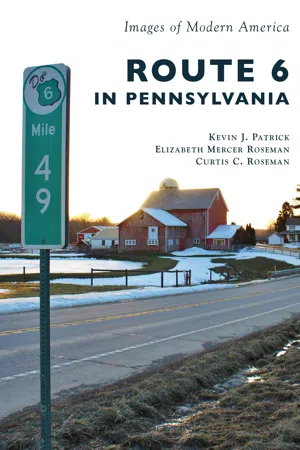
Pennsylvania's mid-20th-century Route 6 brought together appealing natural environments, historical events, and cultural landscapes. The eastern length of the route crosses an area featuring rolling mountains and tranquil valleys dotted by farms and towns. To the west, Route 6 traverses a more level landscape that also includes lakes. This book presents the 370-mile scenic drive as a destination in itself. It covers the secluded setting of northern Pennsylvania where Route 6 and its towns have experienced minimal changes associated with larger metropolitan regions and interstate highways. As a result, the mid-20th-century landscapes of Route 6 have lingered a little longer. The authors give the reader a peek of a past not entirely swept away.
Trusted by 375,005 students
Access to over 1.5 million titles for a fair monthly price.
Study more efficiently using our study tools.
Information
One
ASSEMBLING ROUTE 6
In 1903, the needs of the automobile triggered the creation of the Pennsylvania Department of Highways, which, in 1911, took over 8,000 miles of neglected wagon roads to rebuild and maintain as a primary network of state roads designed to connect every county seat in the commonwealth. Having originally been established to connect the northern tier county seats, the East-West Road was absorbed into this network and rebuilt with macadam. As cars became faster and more numerous, road improvement projects created new alignments of straighter, better-graded highway. Once bypassed, remnant bits of original road that did not continue to carry the name of the place they went to (like Old Milford Road, Owego Turnpike, Honesdale Road, Old Mainesburg Road, Old Bush Mill Road, Old Smethport Road, or Old Pittsfield Road) were commonly named Old State Road.
Dependable automobiles and publicly funded highways presaged the possibility of long-distance motoring but only if a reliable wayfinding system of well-signed routes was established over a network of all-weather roads. Before the state and federal government took up this challenge, private highway associations were formed by local chambers of commerce and cadres of businessmen to name, sign, and coerce improvements on certain pet highways linking towns and regions that stood to benefit from the increase in traffic. To generate popular appeal, many of these roads were named after the great and heroic, like Lincoln Highway, Jefferson Highway, Lee Highway, and across northern Pennsylvania, the Roosevelt Highway. Populist Teddy Roosevelt died in 1919 at the height of the private auto trail rage and, therefore, was honored with more than his fair share of roads. Within a month of his death, the Theodore Roosevelt International Highway Association was founded to mark out a road from Portland, Maine, to Portland, Oregon. The transcontinental Midland Trail, laid out by American Automobile Association pathfinder A.L. Westgard in 1912, merged with a fledgling Roosevelt National Highway mapped across New York from Long Island to Buffalo to become the Roosevelt Midland Trail. None of these crossed Pennsylvania’s northern tier.
Pennsylvania’s Roosevelt Highway resulted from a 1923 state law that gave the power to name and number highways solely to the Pennsylvania Department of Highways (DOH). This was done to end the confusion caused by dozens of private highway associations that named, marked, and then often relocated routes passing through the state. In 1924, the DOH introduced a network of cross-state highways that included nine named routes. Some, like the Lincoln Highway across the southern part of Pennsylvania and the William Penn Highway farther north, legitimized preestablished names and routes. Others used names and routes designated by the DOH. The Roosevelt Highway, incorporating the old East-West Road between Matamoras and Erie, was named by newly elected governor Gifford Pinchot, whose family estate, Grey Towers, was in Milford. The name honored his friend, the late president under whom he served as the first director of the US Forest Service.
Pennsylvania’s named highways were simultaneously numbered using a DOH system where odd numbered roads ran east-west and even numbered roads north-south in the opposite direction of the national system adopted by the American Association of State Highway Officials (AASHO) in 1926. In Pennsylvania, the Lincoln Highway was State Route 1, the William Penn Highway was Route 3, the Lakes-to-Sea Highway was Route 5, and the Roosevelt Highway was Route 7. In the AASHO system of federal routes, US 30 was marked along Pennsylvania’s part of the Lincoln Highway and the William Penn Highway became synonymous with US 22. This national interstate system also had a US 6 that crossed southern New England from Provincetown, Massachusetts, at the tip of Cape Cod, to Brewster, New York. In 1928, US 6 was extended west across the Hudson River and over Pennsylvania’s Roosevelt Highway to Erie. The expense of double marking these highways with state and federal route shields caused the DOH to abandon its original numbering scheme in the 1930s. Federal Route 6 was extended west to Greeley, Colorado, in 1931 by rerouting it away from Erie and through Meadville. In 1937, US 6 was extended to Long Beach, California, creating the longest transcontinental highway in the federal route system until it was cut back to Bishop, California, in 1964.
A twist in the identity of Route 6 occurred with the 1932 founding of the US 6 Roosevelt Highway Association in Scranton, Pennsylvania. Unlike the earlier highway associations whose intent was to promote the building of long-distance automobile roads, this association emphasized travel and tourism on roads already built and actively being improved as a result of federal highway legislation in 1916 and 1921. Publicly funded roads were now assured and incorporated into a national system of numbered highways that hastened the demise of the auto trails associations and the fading of their nurtured routes, including the Theodore Roosevelt International Highway and the Roosevelt Midland Trail. In their absence, this new organization spread the identity of the Roosevelt Highway across the country with the western extensions of US 6 over an alignment that now crossed and, in fact, originated from northern Pennsylvania.
The US 6 Roosevelt Highway Association promoted the road in Pennsylvania through the free distribution of maps by the Scranton Chamber of Commerce, under the leadership of Raymond Gibbs. After US 6 reached the shores of the Pacific Ocean in 1937, a transcontinental map of the route was distributed through the chamber of commerce in Des Moines, Iowa, through the association secretary, Alexander Fitzhugh. On its maps and brochures, the US 6 Roosevelt Highway Association also disseminated a new identity for the road: the Grand Army of the Republic (GAR) Highway. The GAR moniker was not a promotional device for road building or tourism, but an honorary memorial to the soldiers who fought to preserve the Union during the Civil War. The idea to apply this commemorative title to US 6 was conceived by US Army major William Anderson Jr. in 1934. Anderson gained the support of the Sons of Union Veterans who petitioned the state highway departments along US 6. Anderson’s home state of Massachusetts was the first to make the GAR dedication for its piece of US 6 in 1937, followed by California in 1943, Indiana in 1946, and Pennsylvania in 1948. The remaining US 6 states were on board by the time of the official dedication of the transcontinental Grand Army of the Republic Highway at the western terminus of US 6 in Long Beach, California, on May 3, 1953.
With the dedication of the Grand Army of the Republic Highway, the form and identity of Pennsylvania’s mid-20th-century Route 6 was complete. For almost 20 years, the time period emphasized in this book, Route 6 was the main road across the Appalachian Mountains midway between the Pennsylvania Turnpike and the New York State Thruway. Ironically, 1953 was also the year the Delaware Water Gap Bridge opened as the first link in what would become the Keystone Shortway, Pennsylvania’s part of transcontinental Interstate 80. Completed in 1970, Interstate 80 would eventually overshadow Route 6, preserving its mid-20th-century characteristics for a future generation of back roads explorers to discover.

The first road across northern Pennsylvania’s Allegheny Plateau was constructed as the East-West Road between 1806 and 1809 to connect the governmental seats of a new tier of counties established along the New York border. This 1822 map of Pennsylvania shows the central part of the East-West Road forerunner to Route 6, which was built between Erie and Montrose, where it intersected with the Milford and Owego Turnpike to Milford. (Mapsofpa.com.)

Route succession along northern Pennsylvania’s Route 6 corridor is well expressed at Laceyville in the Susquehanna River Valley. The North Branch Canal, opened in 1856, was bought by the Lehigh Valley Railroad in 1866 and replaced with tracks that were followed by the Roosevelt Highway in 1924 (to the right of the railroad), which became part of US 6 in 1928. (Curt Teich postcard.)

The major trans-Appalachian railroads avoided the route t...
Table of contents
- Cover Page
- Half-Title
- Title Page
- Copyright Page
- Table of Contents
- Acknowledgments
- Introduction
- 1. Assembling Route 6
- 2. Route 6 Road Trip East
- 3. Route 6 Road Trip West
- 4. Route 6 Towns
- Bibliography
Frequently asked questions
Yes, you can cancel anytime from the Subscription tab in your account settings on the Perlego website. Your subscription will stay active until the end of your current billing period. Learn how to cancel your subscription
No, books cannot be downloaded as external files, such as PDFs, for use outside of Perlego. However, you can download books within the Perlego app for offline reading on mobile or tablet. Learn how to download books offline
Perlego offers two plans: Essential and Complete
- Essential is ideal for learners and professionals who enjoy exploring a wide range of subjects. Access the Essential Library with 800,000+ trusted titles and best-sellers across business, personal growth, and the humanities. Includes unlimited reading time and Standard Read Aloud voice.
- Complete: Perfect for advanced learners and researchers needing full, unrestricted access. Unlock 1.5M+ books across hundreds of subjects, including academic and specialized titles. The Complete Plan also includes advanced features like Premium Read Aloud and Research Assistant.
We are an online textbook subscription service, where you can get access to an entire online library for less than the price of a single book per month. With over 1.5 million books across 990+ topics, we’ve got you covered! Learn about our mission
Look out for the read-aloud symbol on your next book to see if you can listen to it. The read-aloud tool reads text aloud for you, highlighting the text as it is being read. You can pause it, speed it up and slow it down. Learn more about Read Aloud
Yes! You can use the Perlego app on both iOS and Android devices to read anytime, anywhere — even offline. Perfect for commutes or when you’re on the go.
Please note we cannot support devices running on iOS 13 and Android 7 or earlier. Learn more about using the app
Please note we cannot support devices running on iOS 13 and Android 7 or earlier. Learn more about using the app
Yes, you can access Route 6 in Pennsylvania by Kevin J. Patrick,Elizabeth Mercer Roseman,Curtis C. Roseman in PDF and/or ePUB format, as well as other popular books in History & North American History. We have over 1.5 million books available in our catalogue for you to explore.