- 128 pages
- English
- ePUB (mobile friendly)
- Available on iOS & Android
eBook - ePub
East Chicago
About this book
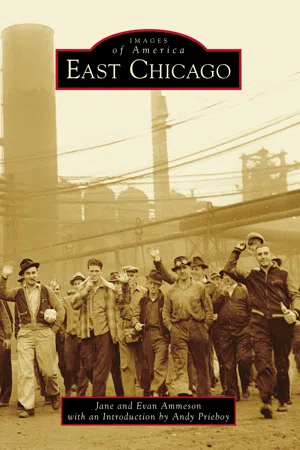
Once an almost impenetrable landscape of dunes, marshes, and woodlands hugging the southern shore of Lake Michigan, the land comprising what would become East Chicago was a developer's dream for the emerging steel industry. Considered one of the country's ultimate melting pots, four out of five of its citizens hailed from other countries, each bringing their valued cultures and traditions to this thriving metropolis. The industrial jobs, requiring hard work and much grit, provided a way out of poverty, but the area also offered beautiful parks and mansions along the waterfront, as well as great schools, neighborhoods, and civic organizations. East Chicago had a sense of vitality and the essence that the American dream was available for all.
Trusted by 375,005 students
Access to over 1 million titles for a fair monthly price.
Study more efficiently using our study tools.
Information
One
BEGINNINGS

Scenes of East Chicago, romantic in an urban industrial way, inspired locals to quote Henry Wadsworth Longfellow in describing the newly emerging city: “And far in the hazy distance / Of that lovely night in June, / The blaze of the flaming furnace / Gleamed redder than the moon.” (Courtesy of the Simon family.)

Inland Iron Works, the precursor to the gigantic Inland Steel Company, is pictured in 1888. What would be called the “Workshop of the World” began on inhospitable land—swales, dunes, and marshes. But the city’s closeness to Chicago and the visions of British financiers and local promoters turned the area into an industrial magnet. (Courtesy of the Calumet Regional Archives, Indiana University.)

Dominick Mutter, the first settler in Indiana Harbor, established a 120-acre farm in 1857. Six years later, Jacob Forsyth bought Mutter’s property, building a sawmill, trading post, and housing for his workers. It was named Casella (also spelled Cassello in some old records) after Ella Case, the wife of railroad president George Case. In 1871, just a day after the Great Chicago Fire, Casella burned down. (Courtesy of Andrew Prieboy.)

East Chicago became a city on March 14, 1893, when voters elected their first officers and councilmen. From left to right are (first row) Byron Cheney, justice of the peace; John M. White, alderman; Robert Ross, alderman; William H. Penman, mayor; Louis T. Loucks, alderman; and Jule C. Pepin, alderman; (second row) Edwin S. Gilbert, clerk; Frank W. Clinton, treasurer; Neil Patterson, police chief; and E.S. Yaste, alderman. (Courtesy of the Calumet Regional Archives, Indiana University.)

The fire department had to borrow horses from Maxwell’s livery stable whenever a fire alarm went off. It frequently took around 30 minutes to get the machinery ready and moving. In the time of wood buildings, that frequently meant an edifice was gone before the firemen (all men back then) arrived. (Courtesy of the Calumet Regional Archives, Indiana University.)

Though the source for this photograph identifies it as showing mounted members of the East Chicago Police Department, they may have been part of a cavalry unit based in Indiana. In 1890, East Chicago had about 1,255 citizens; by 1900, that number had increased to 3,441. With such a large influx of workers, many without the constraints of their families, a policeman’s job was a busy one. (Courtesy of the East Chicago Public Library.)

In this 1890 photograph, mules pull wagons and bricklaying equipment, turning the sandy and muddy terrain of East Chicago into streets and avenues. Col. Redmond D. Walsh is considered to be the “Father of East Chicago,” erecting many of its first buildings. To create streets, he bought 27 mules from Jacob Forsyth, but when he decided the animals were not worth the $10 he paid for them, Walsh sued Forsyth, and the two fought a long court battle. Eventually, Forsyth was ordered to pay Walsh $600. At right is the first building constructed in East Chicago. Located at the corner of Forsyth and Chicago Avenues, it was the home of George Neer, whose wife was the first woman to live in the new city. (Courtesy of the Calumet Regional Archives, Indiana University.)

In 1889, Andrew Wickey opened the Famous Manufacturing Company, supplying electricity to the town of East Chicago, which was not incorporated as a city until 1893. (Courtesy of the Calumet Regional Archives, Indiana University.)

On March 26, 1901, Albert DeWolfe Erskine offered the Block family, owners of Inland Steel, 50 acres of free land at Poplar Point if they agreed to construct a steel mill that would cost around $1 million. Their acceptance depended upon Erskine guaranteeing both a harbor and belt railroad be built to service their plant. (Courtesy of the Calumet Regional Archives, Indiana University.)

This early Indiana Harbor photograph looks northeast at the corner of 139th and Cedar (later Main) Streets. Board sidewalks, as seen here, made it easier to get around the city. Otherwise, the dirt streets were dusty in dry weather and muddy when wet. (Courtesy of the East Chicago Public Library.)

The Harbor Hotel is on the right in this photograph taken at the corner of Michigan and Commonwealth Avenues south of the Baltimore and Ohio railroad tracks in 1903. When Captain Friedrich opened the hotel, it had 66 boarders on opening night, despite the fact it was only partially finished and there were no beds. Friedrich had $4,000 worth of furniture on its way, but because of the swampy and stumpy terrain, delivery was slow. (Courtesy of the East Chicago Public Library.)

Built in 1901 and located at 3415 Michigan Avenue, the two-story Barker’s Fair Store (center right) was Indiana Harbor’s first store, opening before Inland Steel was built. It sold a mélange of merchandise, including home furnishings, sundries, baby buggies, stoves, pots and pans, and about everything else needed for a developing city. (Courtesy o...
Table of contents
- Cover Page
- Title Page
- Copyright Page
- Dedication
- Table of Contents
- Acknowledgments
- Introduction
- 1. Beginnings
- 2. Steel!
- 3. Getting Around
- 4. Our Community
- 5. The Melting Pot
- 6. Marktown
- 7. Our Town
- 8. Where We Lived
- 9. How We Had Fun
- 10. Street Scenes
Frequently asked questions
Yes, you can cancel anytime from the Subscription tab in your account settings on the Perlego website. Your subscription will stay active until the end of your current billing period. Learn how to cancel your subscription
No, books cannot be downloaded as external files, such as PDFs, for use outside of Perlego. However, you can download books within the Perlego app for offline reading on mobile or tablet. Learn how to download books offline
Perlego offers two plans: Essential and Complete
- Essential is ideal for learners and professionals who enjoy exploring a wide range of subjects. Access the Essential Library with 800,000+ trusted titles and best-sellers across business, personal growth, and the humanities. Includes unlimited reading time and Standard Read Aloud voice.
- Complete: Perfect for advanced learners and researchers needing full, unrestricted access. Unlock 1.4M+ books across hundreds of subjects, including academic and specialized titles. The Complete Plan also includes advanced features like Premium Read Aloud and Research Assistant.
We are an online textbook subscription service, where you can get access to an entire online library for less than the price of a single book per month. With over 1 million books across 990+ topics, we’ve got you covered! Learn about our mission
Look out for the read-aloud symbol on your next book to see if you can listen to it. The read-aloud tool reads text aloud for you, highlighting the text as it is being read. You can pause it, speed it up and slow it down. Learn more about Read Aloud
Yes! You can use the Perlego app on both iOS and Android devices to read anytime, anywhere — even offline. Perfect for commutes or when you’re on the go.
Please note we cannot support devices running on iOS 13 and Android 7 or earlier. Learn more about using the app
Please note we cannot support devices running on iOS 13 and Android 7 or earlier. Learn more about using the app
Yes, you can access East Chicago by Jane Ammeson,Evan Ammeson in PDF and/or ePUB format, as well as other popular books in History & North American History. We have over one million books available in our catalogue for you to explore.