- 128 pages
- English
- ePUB (mobile friendly)
- Available on iOS & Android
eBook - ePub
Natural Bridge
About this book
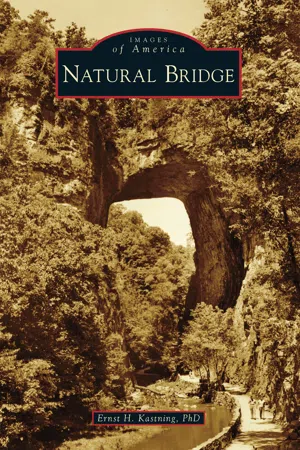
Natural Bridge, located in the historic Shenandoah Valley, is one of the most recognized and visited geologic landmarks in the country. The massive 90-foot-wide arch spans Cedar Creek, which runs 200 feet below. Legend says that George Washington, as a young land surveyor, carved his initials on its wall. In 1774, King George III granted ownership to Thomas Jefferson. Natural Bridge was often regarded as the ?Eighth Natural Wonder of the World? during the 19th and 20th centuries. The site became a popular venue for events, ranging from conventions to the annual Easter Sunrise Service. Hotels, inns, and cottages were built to accommodate travelers, and on-site attractions?including a show cave, a wax museum, and a Monacan Indian village?broadened visitor appeal. Natural Bridge remained privately owned until 2014, when the title was transferred, allowing it to become a state park; the bridge will now truly belong to the people, a concept that would have made Jefferson proud.
Trusted by 375,005 students
Access to over 1.5 million titles for a fair monthly price.
Study more efficiently using our study tools.
Information
One
WASHINGTON, JEFFERSON,
AND EARLY VISITATION
AND EARLY VISITATION
The rich recorded history of Natural Bridge begins in the late 18th century. It has been reported that the earliest written mentions of the bridge were made in 1742 by John Peter Salling, one of the first settlers in the area, and in 1759 by a Mr. Barnaby. The first known published description of the bridge, written by William Carmichael, appeared in the Pennsylvania Journal and the Weekly Advisor and in the Virginia Gazette, both published in late 1772. At that time, the bridge was within Botetourt County. In 1778, some of this land, including that of Natural Bridge, became part of what is now Rockbridge County, named after the bridge. Carmichael’s brief description was overshadowed 15 years later by more detailed discourses written by the Marquis de Chastellux and Thomas Jefferson in their landmark books.
At 18 years of age, George Washington participated in a survey to lay out a road through the Valley of Virginia from Winchester to Buchanan. He was selected as an assistant to Col. Peter Jefferson, a surveyor appointed in 1749 or 1750 by Lord Fairfax, representing King George III of England. Colonel Jefferson was the father of Thomas Jefferson, the future president. The road was laid out along the Old Indian Trail, or “Big Path.” Originally named Valley Pike, this later became the Lexington Road and US Route 11, known in Virginia today as the Lee Highway. The early surveyors routed this byway atop Natural Bridge and over Cedar Creek, where it remains today. In 1774, Thomas Jefferson applied for a grant, or patent, to acquire land surrounding and including Natural Bridge. King George III issued the grant to him later that year, a scant two years before the onset of the American Revolution. Thus, the future American president became the first landowner of Natural Bridge. A long string of private ownership continued until 2014, when the property was designated to become a Virginia State Park. The founding fathers Washington and Jefferson will always be associated with Natural Bridge.

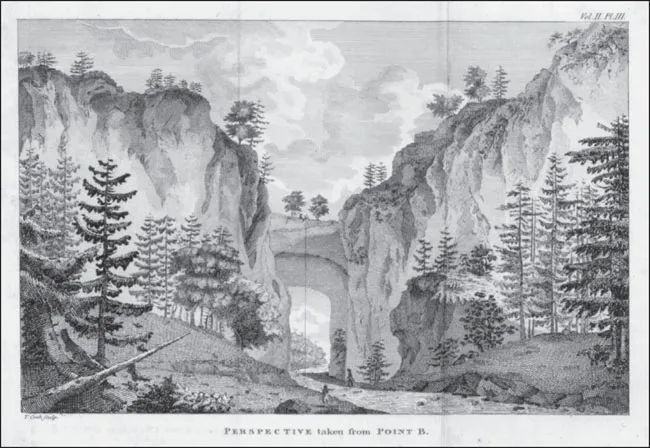
These perspective drawings are the earliest known depictions of Natural Bridge. They appeared as foldout plates in Travels in North-America, in the Years 1780, 1781, and 1782 by Marquis de François Jean Chastellux, published first in France in 1786 and then in London in 1787. The above drawing shows the bridge from the east, looking upstream on Cedar Creek. The drawing below was made from the west, looking downstream. Most early drawings of Natural Bridge include people, usually at stream level. Below, two people atop the bridge measure its height with a line. Chastellux served under Jean-Baptiste Rochambeau during the American Revolution and traveled extensively in New England and the mid-Atlantic region, including a visit to Monticello, the home of Thomas Jefferson, who urged him to visit the bridge. Chastellux did so in 1782. (Both, courtesy of Library of Congress.)

Chastellux, unable to make accurate sketches of the bridge, asked Rochambeau to send Baron de Turpin of the Royal Corps of Engineers to do so. The two perspective drawings and this plan-view map, also a foldout in the 1787 book, are based on Turpin’s measurements. This may be the earliest map illustrating the immediate vicinity of Natural Bridge. Taken together, the three drawings provide a remarkably accurate early portrayal of the bridge. Note that paths crossed the bridge and descended to Cedar Creek during this time. It is interesting to compare these drawings and the map with others in later chapters of this book. (Courtesy of Library of Congress.)
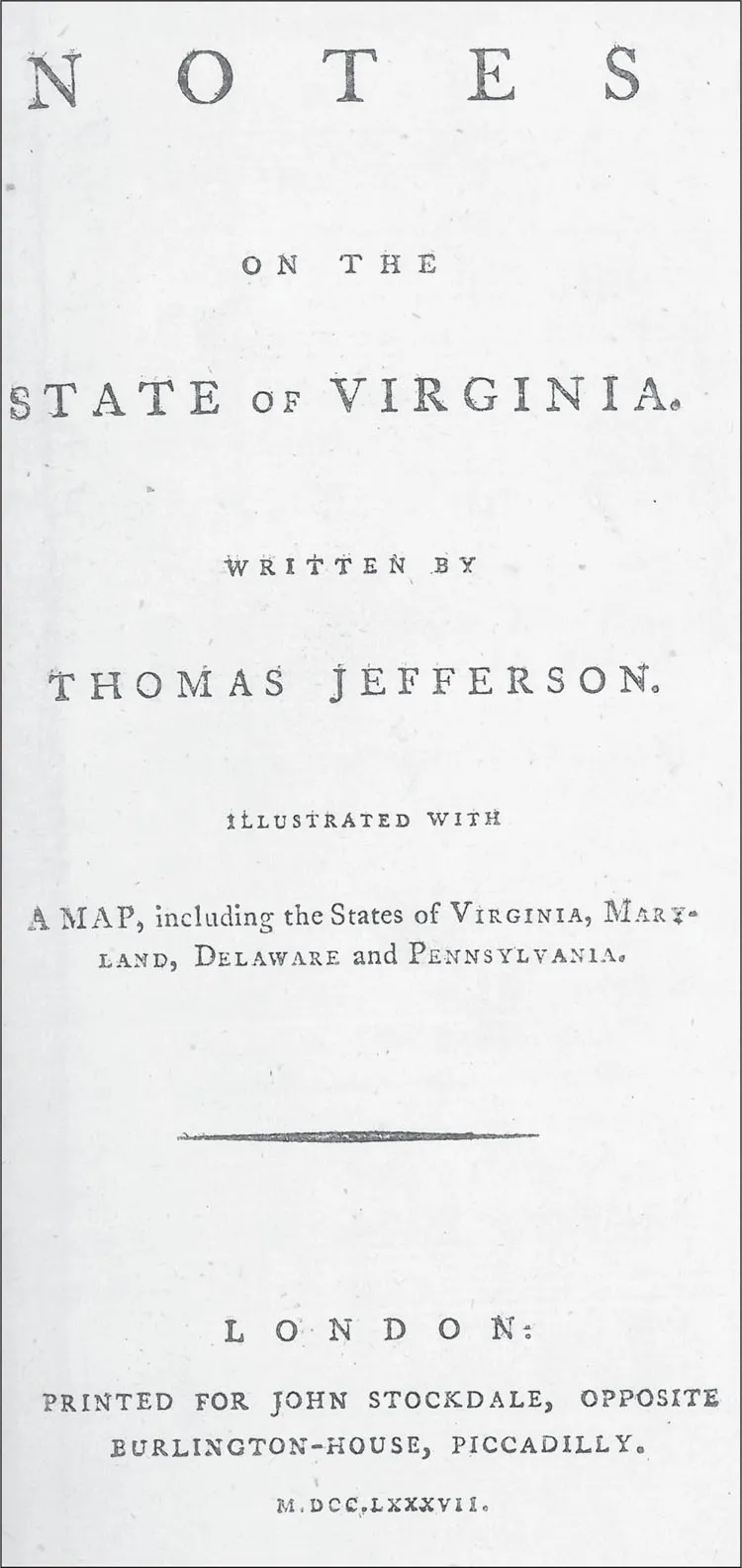
Notes on the State of Virginia is considered to be one of the most important books published in America prior to 1800. Thomas Jefferson wrote the manuscript in 1781 in response to questions posed to him about Virginia. It was expanded in 1782 and 1783 and was first published anonymously in France in 1785 in a limited, private edition. John Stockdale in England published the first public English-language edition in 1787. This, the only book by Jefferson published during his lifetime, was a compendium of the natural resources and economy of Virginia, and it promoted the virtues of a “good society” as embodied by the state. Beginning in 1788, the book appeared in several editions and revisions in the United States during Jefferson’s lifetime. This volume and that of Chastellux are widely considered to include the first detailed descriptions of Natural Bridge. The two men knew each other, and Chastellux references Jefferson’s Notes, so it is no surprise that the accounts of the bridge are similar. (Courtesy of Leyburn Library, Washington and Lee University.)

These words describing Natural Bridge are written in Thomas Jefferson’s hand. They are from page 14 of his original handwritten draft of Notes on the State of Virginia. The edits he made while writing are visible. This excerpt, beginning his description of the Natural Bridge, reads, “The Natural Bridge, the most sublime of nature’s works, though not comprehended under the perfect head must not be pretermitted.” He continues his description for three pages in the published book. The words “Natural Bridge, the most sublime of nature’s works” would continue to be quoted for over 225 years, right up to the present day. They still appear in literature promoting and extolling the bridge as a tourist destination. Jefferson’s Notes continues to be reprinted and is widely available, testifying to its importance in American literature. (Courtesy of the Massachusetts Historical Society.)

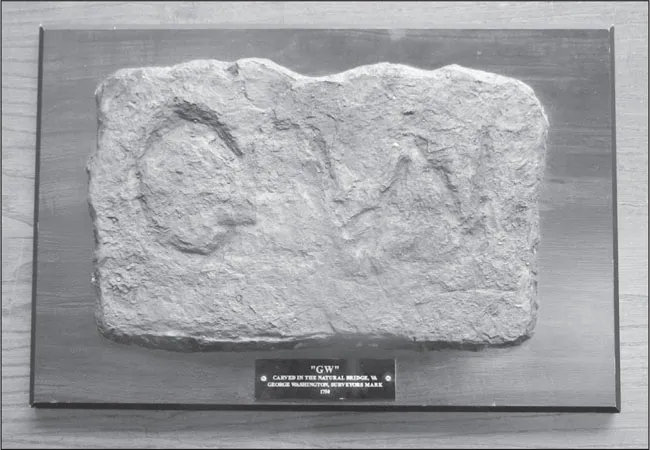
It has been noted that George Washington, as a young man, conducted the first land survey in the area around 1750. Surveyors often left marks as they went along. Tradition says that Washington may have carved his initials, “GW,” on the wall under Natural Bridge and about 25 feet above Cedar Creek. The initials have been marked with a rectangular painted box (above) so that visitors can easily spot them from the trail below. In 2007, local sculptor Mark Cline created a facsimile cast of the initials by climbing the wall on a ladder and taking an impression using flexible silicone rubber. He then made a mold from which positive casts could be made. This cast, mounted on a wooden plaque (below), allows a closer look at the details of the initials originally carved in the rock. (Both, photograph by Ernst H. Kastning.)
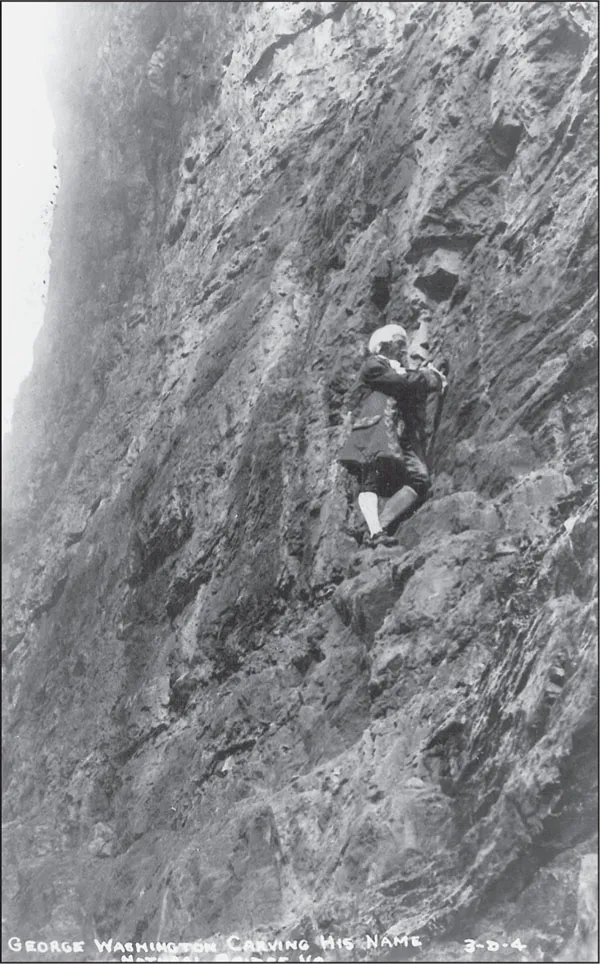
A reenactor dressed as George Washington scales the wall under Natural Bridge and carves his initials in the rock, as Washington, according to legend, may have 200 years earlier. This is one of a series of postcards of Natural Bridge published by the W.M. Cline Company of Chattanooga in the 1940s and 1950s. Walter Matson Cline Sr. and Jr. were known for high-quality, black-and-white postcards throughout the Southeast. (Author’s collection.)
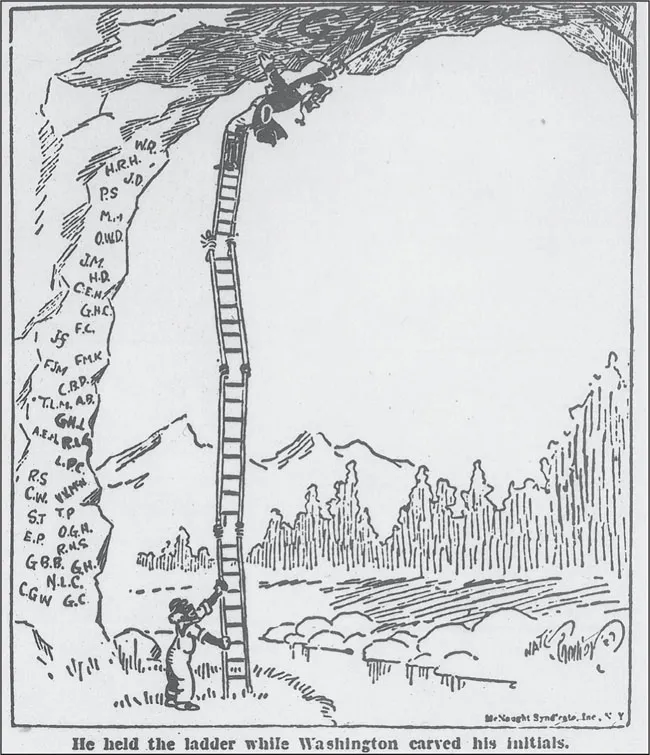
Nate Collier, a nationally known cartoonist, drew this fanciful rendition of George Washington carving his initials under Natural Bridge. For a time, Collier illustrated newspaper articles written by American humorist Will Rogers that were produced and distributed by the McNaught Syndicate. This cartoon accompanied a tongue-in-cheek article by Rogers, “When Jefferson Outsmarted the Father of his Country,” which ran on February 13, 1927. (Courtesy of Natural Bridge.)
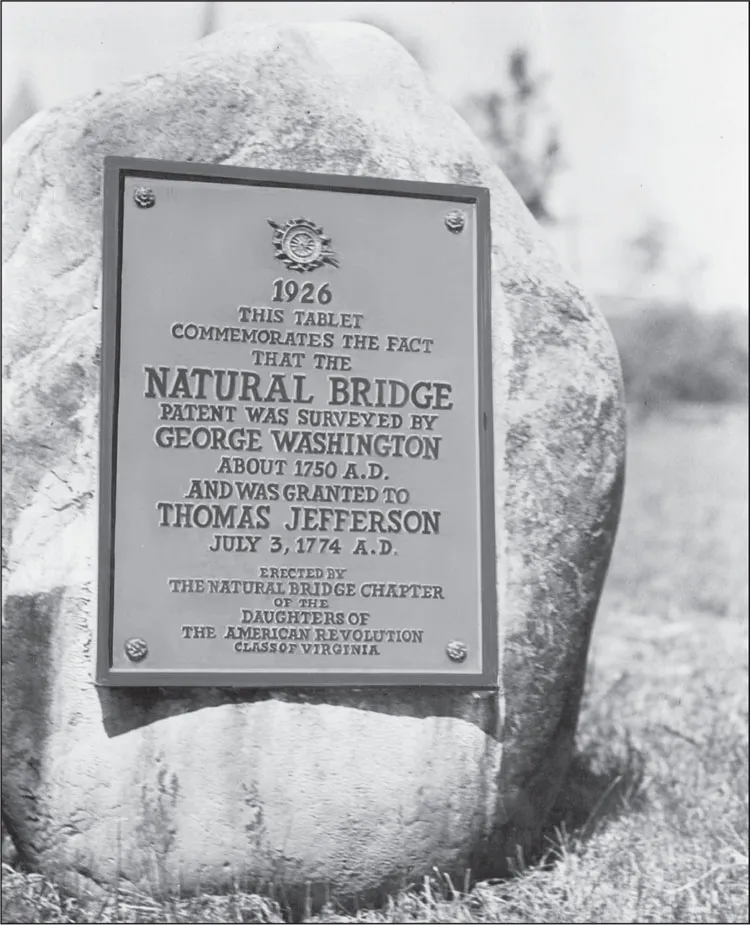
The roles of George Washington as a surveyor and Thomas Jefferson as the first owner have been an important part of the historic legacy at Natural Bridge for over 250 years. This bronze tablet, erected at the site by the Natural Bridge Chapter of the Daughters of the Revolution in 1926, attests to this heritage. (Courtesy of Natural Bridge.)

Natural Bridge blends history with the sublime. This special envelope, mailed in 1932 during the bicentennial year of George Washington’s birth, marks the first Pageant of Creation, an evening light show held at the bridge for over 80 years. It is interesting to note that the stamps depict both a youthful and an older Washington. The inspirational aura of the towering arch is illustrated in chapter seven. (Author’s collection.)
Two
A NEW
NATURAL WONDER
NATURAL WONDER
Writers and artists began to arrive at Natural Bridge in the early 19th century. Accounts of the newly recognized natural wonder appeared in magazines and books in Europe as well as in North America. Artists produced paintings, drawings, and sketches of the bridge, and many of these became illustrations for a variety of publications. As a result, attention was drawn to the magnificence of the vaulted archway, and this increased tourism in the 1900s.
Of the many published drawings, seven are reproduc...
Table of contents
- Cover Page
- Title Page
- Copyright Page
- Dedication
- Table of Contents
- Acknowledgments
- Introduction
- 1. Washington, Jefferson, and Early Visitation
- 2. A New Natural Wonder
- 3. By Carriage to an Emerging Resort
- 4. Autotourism along the Lee Highway
- 5. Renewal and Expansion of a State Icon
- 6. Let’s Meet at the Bridge!
- 7. A Spiritual Place
- 8. Eclectic Happenings at the Bridge
- 9. A Bridge for the People
- Bibliography
Frequently asked questions
Yes, you can cancel anytime from the Subscription tab in your account settings on the Perlego website. Your subscription will stay active until the end of your current billing period. Learn how to cancel your subscription
No, books cannot be downloaded as external files, such as PDFs, for use outside of Perlego. However, you can download books within the Perlego app for offline reading on mobile or tablet. Learn how to download books offline
Perlego offers two plans: Essential and Complete
- Essential is ideal for learners and professionals who enjoy exploring a wide range of subjects. Access the Essential Library with 800,000+ trusted titles and best-sellers across business, personal growth, and the humanities. Includes unlimited reading time and Standard Read Aloud voice.
- Complete: Perfect for advanced learners and researchers needing full, unrestricted access. Unlock 1.5M+ books across hundreds of subjects, including academic and specialized titles. The Complete Plan also includes advanced features like Premium Read Aloud and Research Assistant.
We are an online textbook subscription service, where you can get access to an entire online library for less than the price of a single book per month. With over 1.5 million books across 990+ topics, we’ve got you covered! Learn about our mission
Look out for the read-aloud symbol on your next book to see if you can listen to it. The read-aloud tool reads text aloud for you, highlighting the text as it is being read. You can pause it, speed it up and slow it down. Learn more about Read Aloud
Yes! You can use the Perlego app on both iOS and Android devices to read anytime, anywhere — even offline. Perfect for commutes or when you’re on the go.
Please note we cannot support devices running on iOS 13 and Android 7 or earlier. Learn more about using the app
Please note we cannot support devices running on iOS 13 and Android 7 or earlier. Learn more about using the app
Yes, you can access Natural Bridge by Ernst H. Kastning PhD in PDF and/or ePUB format, as well as other popular books in History & North American History. We have over 1.5 million books available in our catalogue for you to explore.