eBook - ePub
Milford
About this book
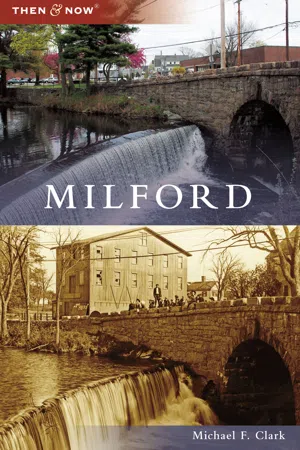
On August 22, 1914, Milford, Connecticut, celebrated its 275th anniversary. An estimated crowd of 20,000 celebrated on the Milford Green alongside open-air horseless buggies.
The celebration started at sunrise with a cannon salute and the sounding of church bells and factory whistles. Milford just recently celebrated its 375th anniversary.
Trusted by 375,005 students
Access to over 1.5 million titles for a fair monthly price.
Study more efficiently using our study tools.
Information
Topic
GeschichteSubtopic
Nordamerikanische Geschichte1
CHAPTER
WORSHIP AND
EDUCATION
EDUCATION

Looking west toward West Main Street on October 31, 1907, one sees the Plymouth Church in the foreground, which was razed in 1951 and replaced with the current Plymouth building, and the First United Church of Christ in the background. Between the two churches over the Wepawaug River is the Meetinghouse Bridge, Milford’s very first bridge, built in 1640. Most of the early settlers to Milford fled England to avoid religious persecution. From 1707 to 1719, the Rev. Samuel Adams, pastor of the First United Church of Christ, was also the first rector pro tempore of Yale College. During those 12 years, he provided personal supervision to the Yale senior class in Milford. (NHM.)
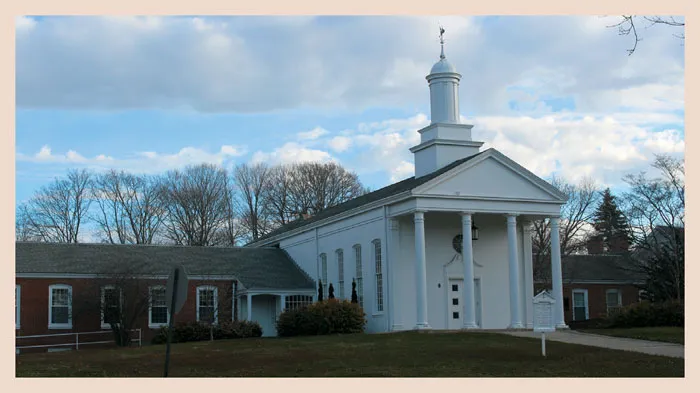
Due to dissension among a minority group of parishioners at the First United Church of Christ, this small group seceded and built a new meetinghouse in 1743. Named the Plymouth Church, it was only yards away from First United Church of Christ but on the other side of the Wepawaug River, shown here. The Rev. Job Prudden, great-grandson of Peter Prudden, one of Milford’s original settlers, was Plymouth Church’s first steady preacher. In 1926, after 185 years, the two congregations worshipped as one again. For the next 20 years, the Plymouth Church was used for plays and social events until the cost of maintaining the building was too much. It was razed in 1951. The new and current structure is now called the Plymouth Building. (DRM.)

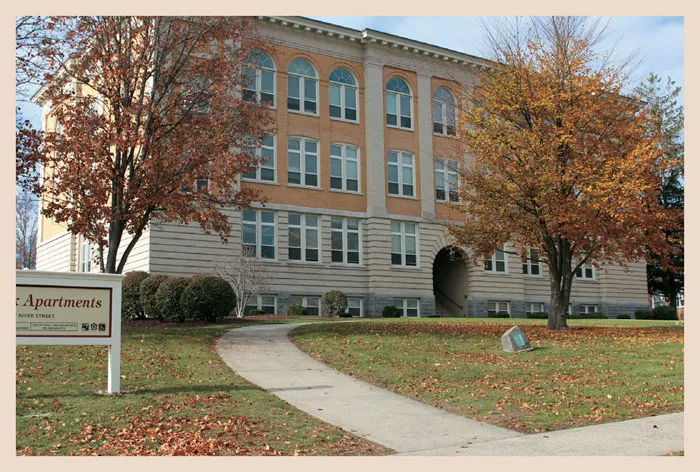
To ease overcrowding of the grade school housed in the town hall, this large 21-room central school, Milford High School, was built in 1908 to accommodate elementary and high school grades. The students loved the new school for the fact that school dances did not have to be held at the town hall anymore and now could be held at the new school’s science lecture hall. In 1951, a new 1,350-pupil high school was opened next door at the former site of Clark’s Tavern and the Weylister Secretarial School. The old high school, shown here, formally called the Diane Toulson Building, was being used as a storage facility, children’s public library, and overflow classrooms for the new Milford High School until 1993, when it became the River Park Apartments for the elderly and disabled. (TC.)

Shown here in 1908, Lauralton Hall was originally called “Island View” and was built in 1864 by Charles Hobby Pond, Milford’s third contributing governor to the state of Connecticut. Henry Taylor later purchased the estate and renamed it Lauralton Hall in honor of his daughter Laura, who died at the age of five. Yet again, in 1905, the property was purchased by Rev. Mo. Mary Augustine Claven of the Sisters of Mercy from Meriden, Connecticut, who established a boarding school for girls called the Academy of Our Lady of Mercy. More commonly known as Lauralton Hall, the high school sits on a 30-acre campus, enrolls over 450 students in grades 9 through 12, and was the state’s regular season champions in field hockey in 2015 with a record of 10-1. (DRM.)
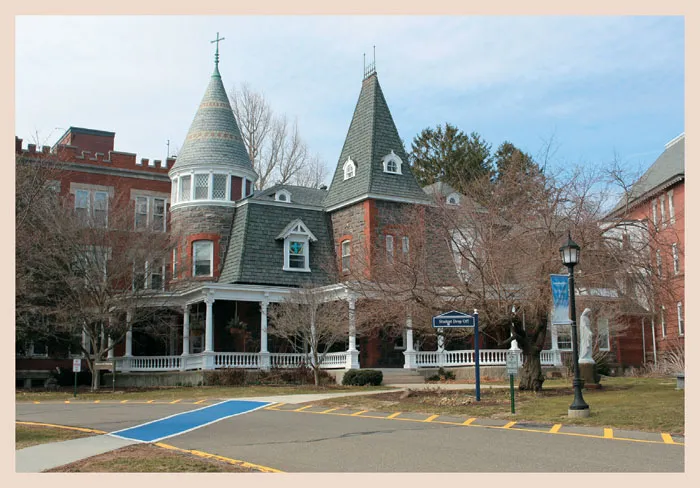

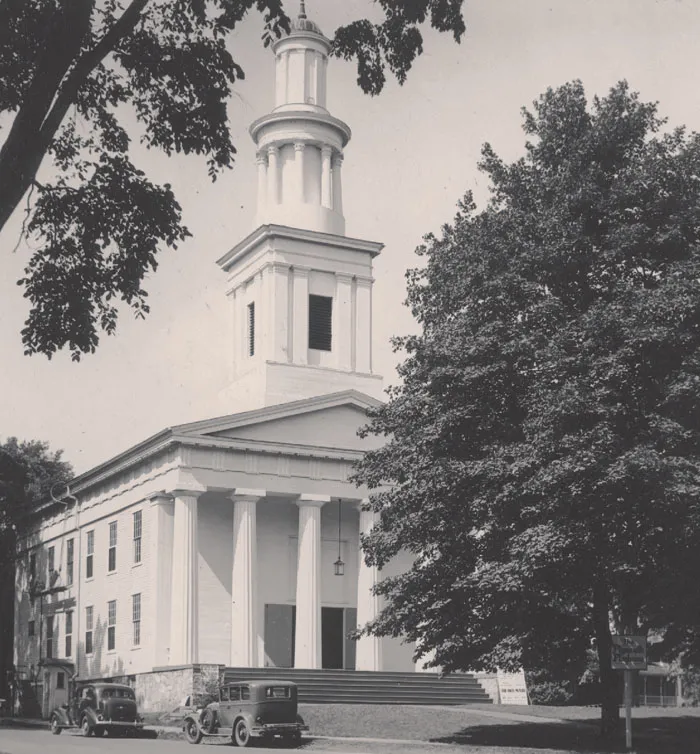
The First United Church of Christ held its first service in New Haven, Connecticut, in 1638 and was organized by the Rev. Peter Prudden. The congregation’s first church was constructed in Milford and held services starting in 1641. Until a bell was installed, the congregation was called to worship by the beating of a drum. Due to fear of Indian attacks, when early services took place, a sentinel was stationed in the turret, and guards with muskets were stood at the rear of the church. The church was eventually torn down and replaced with a three-story building in 1728. The church has had only four pastors since 1945, the fourth being Rev. Adam E. Eckhart, who has served as senior pastor since January 7, 2015. (NHM.)


The Mary Taylor Memorial United Methodist Church, shown here in 1920, is located at 168 Broad Street. Area Methodists conducted the first services in a private home in 1789. From 1835 to 1841, services were held at the Bristol shoe shop. A wooden church was dedicated on River Street but had no regular pastor until 1852. On June 25, 1893, a new church was dedicated by the children of Mary Meyer Taylor, who died in 1878 and was the wife of Henry Augustus Taylor. The church still provides services, Sunday school, and a wealth of other services for the community. Mary and Henry Taylor’s daughter Laura can be seen in a stained-glass image at the church. (Both, author’s collection.)


The original name of Milford’s St. Peter’s Episcopal Church was St. George’s, in honor of St. George Talbot, who was the principal financial donor; 28 years after Episcopal services were first conducted in Milford by English missionaries. The original church was constructed of wood in 1769, and pews were not added until 1775. The cornerstone of the current church was laid in 1849, and the building was completed in 1851, with some of the wood used having been salvaged from the old church. Services were scheduled on June 29, 1851, during the feast of St. Peter. During the dedication, the name was changed from St. George’s to St. Peter’s. The Victorian Gothic design was built with brownstone brought from the quarries in Portland, Connecticut. (Both, author’s collection.)


After construction of the New Haven railroad in the 1840s, a large number of Irish families moved to Milford. Because of the absence of a Catholic church, many of those families had to travel to New Haven for Sunday Mass. In 1850, the Rev. Edward J. O’Brien purchased land ...
Table of contents
- Cover Page
- Title Page
- Copyright Page
- Dedication
- Table of Contents
- Acknowledgments
- Introduction
- 1. Worship and Education
- 2. Fort Thumbull Beach
- 3. Coastal Scenes
- 4. The Woodmont Borough
- 5. Historic Milford
- 6. The Village of Devon
- 7. Myrtle-Walnut Beach
- 8. Memory Lane
Frequently asked questions
Yes, you can cancel anytime from the Subscription tab in your account settings on the Perlego website. Your subscription will stay active until the end of your current billing period. Learn how to cancel your subscription
No, books cannot be downloaded as external files, such as PDFs, for use outside of Perlego. However, you can download books within the Perlego app for offline reading on mobile or tablet. Learn how to download books offline
Perlego offers two plans: Essential and Complete
- Essential is ideal for learners and professionals who enjoy exploring a wide range of subjects. Access the Essential Library with 800,000+ trusted titles and best-sellers across business, personal growth, and the humanities. Includes unlimited reading time and Standard Read Aloud voice.
- Complete: Perfect for advanced learners and researchers needing full, unrestricted access. Unlock 1.5M+ books across hundreds of subjects, including academic and specialized titles. The Complete Plan also includes advanced features like Premium Read Aloud and Research Assistant.
We are an online textbook subscription service, where you can get access to an entire online library for less than the price of a single book per month. With over 1.5 million books across 990+ topics, we’ve got you covered! Learn about our mission
Look out for the read-aloud symbol on your next book to see if you can listen to it. The read-aloud tool reads text aloud for you, highlighting the text as it is being read. You can pause it, speed it up and slow it down. Learn more about Read Aloud
Yes! You can use the Perlego app on both iOS and Android devices to read anytime, anywhere — even offline. Perfect for commutes or when you’re on the go.
Please note we cannot support devices running on iOS 13 and Android 7 or earlier. Learn more about using the app
Please note we cannot support devices running on iOS 13 and Android 7 or earlier. Learn more about using the app
Yes, you can access Milford by Michael F. Clark in PDF and/or ePUB format, as well as other popular books in Geschichte & Nordamerikanische Geschichte. We have over 1.5 million books available in our catalogue for you to explore.