- 128 pages
- English
- ePUB (mobile friendly)
- Available on iOS & Android
eBook - ePub
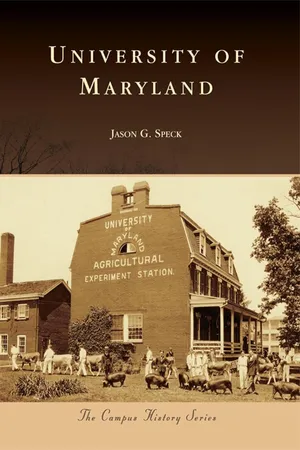
University of Maryland
About this book
Begun 5 years rior t the start of the Civil Way, from a "cow college" to an internationally recognized academic, artistic, and athletic powerhouse in the 21st century, this is the story of the University of Maryland.
Only 5 years before the start of the Civil War, the State of Maryland granted a charter for the creation of Maryland Agricultural College in 1856 and opened its doors to 34 eager young men in 1859. The college survived a disastrous fire in 1912, becoming the University of Maryland in 1920. Today the school is a top-ranked, public research land-grant university with over 100 undergraduate majors, 120 graduate programs, and 35,000 students. Campus History Series: University of Maryland honors the history of the university and all who have contributed to its progress: faculty, staff, students, and alumni. From its earliest years, their labors and love for the institution have led to the creation of an intellectually vibrant and culturally diverse university that serves proudly as the flagship campus of the University System of Maryland. Images in this collection have been obtained from the University of Maryland Archives and other campus sources, many never before published.
Trusted by 375,005 students
Access to over 1.5 million titles for a fair monthly price.
Study more efficiently using our study tools.
Information
Six
PEOPLE AND PLACES

FOUNDER’S GATE, 1920S. Cars file in for a campus event, parking on the lawn at left. These gates were built with the stone left from the ruins of the fire of 1912. The plaques on each side commemorated the founding of the campus. Originally located close to the Rossborough Inn, the plaques were moved to the campus’s main entrance in 1941 when a new gate and gatehouse were constructed.

PEACH ORCHARD SPRAYING, 1926. Part of the Agricultural Experiment Station, these peach orchards helped scientists prepare several important studies, including the effects of pectin content on ripening and proper pruning techniques. Ultimately the orchard became the site for the current Byrd Stadium.

GREENHOUSES, 1901. Maryland Agricultural College’s greenhouses were located close to Route 1, along with the experiment station (back left) and the horticulture building (back center). The university completed a new greenhouse complex in 2003, located behind the Comcast Center. That complex serves the research needs for several campus departments, including entomology, biology, and plant science and landscape architecture.

UNIVERSITY DAIRY HERD, 1933. A university employee stops traffic on Route 1 to allow the dairy herd to cross from its pasture to the barns. Cows have long been housed on campus, and milk from the animals was used to make the ice cream sold at the Dairy. The building with the smokestack in the background is part of the university’s heating plant.

FARMER’S DAY, 1923. Called “the greatest day in the history of the University of Maryland” by the Baltimore Sun, the event in 1923 drew an estimated 10,000 people to campus. Maryland governor Albert C. Ritchie gave a speech defending the needs of farmers, and the university laid the cornerstones for two campus buildings, the Dairy and Ritchie Coliseum. The day’s final event was a baseball game held near the Agricultural Experiment Station.

DR. HARRY CLIFTON “CURLEY” BYRD, 1920s. No person influenced the direction of the University of Maryland in the early to mid-20th century more than “Curley” Byrd. A member of the class of 1908, Byrd returned to the campus in 1911 as head football coach, a position he occupied for 23 years, and as an instructor in English. He was the university’s first director of athletics and served as assistant to the president and vice president before assuming the top role himself in 1935. President for 19 years, Byrd was a powerful figure on campus and statewide. He greatly increased the size of the campus and of the student body, gradually shaping Maryland into the state’s flagship university. His tenure was not an unmitigated success, however. Declining academic standards, over-emphasis on athletics, and resistance to the racial integration of the campus also define his tenure.

GERNEAUX HALL. Originally called the President’s House, it was used as a temporary men’s dormitory after the fire of 1912 and as a women’s dormitory after 1916. Later renamed Gerneaux after the wife of university president Albert F. Woods, it ultimately became the “practice house” for the domestic sciences program. The current President’s House was completed in 1956 and was first occupied by Wilson H. Elkins and his family.

AERIAL VIEW OF CAMPUS, 1926. In the period between 1926 and 1959, the university underwent a tremendous expansion, due to both the efforts of Pres. Harry Clifton “Curley” Byrd and the post–World War II expansion necessary to educate returning veterans. “Old” Byrd Stadium, constructed in 1923, is visible parallel to Route 1 in the lower right corner. The Skinner Building (constructed in 1917) and Taliaferro Hall (built in the late 1890s) are at the center of the photograph.

INFIRMARY AND GARDENS, 1930s. The infirmary (at right) was constructed in 1901 and was renamed Terrapin Hall in 1964 before being razed in 1980. The garden and pool in the center of the photograph no longer exist but may again soon. In 2009, the senior class gift was the beginn...
Table of contents
- Title Page
- Copyright Page
- Dedication
- Table of Contents
- ACKNOWLEDGMENTS
- INTRODUCTION
- One - THE EARLY YEARS
- Two - STUDENT LIFE AT MARYLAND
- Three - ARTS AND ACTIVITIES
- Four - ACADEMICS AND RESEARCH
- Five - ATHLETICS
- Six - PEOPLE AND PLACES
Frequently asked questions
Yes, you can cancel anytime from the Subscription tab in your account settings on the Perlego website. Your subscription will stay active until the end of your current billing period. Learn how to cancel your subscription
No, books cannot be downloaded as external files, such as PDFs, for use outside of Perlego. However, you can download books within the Perlego app for offline reading on mobile or tablet. Learn how to download books offline
Perlego offers two plans: Essential and Complete
- Essential is ideal for learners and professionals who enjoy exploring a wide range of subjects. Access the Essential Library with 800,000+ trusted titles and best-sellers across business, personal growth, and the humanities. Includes unlimited reading time and Standard Read Aloud voice.
- Complete: Perfect for advanced learners and researchers needing full, unrestricted access. Unlock 1.5M+ books across hundreds of subjects, including academic and specialized titles. The Complete Plan also includes advanced features like Premium Read Aloud and Research Assistant.
We are an online textbook subscription service, where you can get access to an entire online library for less than the price of a single book per month. With over 1.5 million books across 990+ topics, we’ve got you covered! Learn about our mission
Look out for the read-aloud symbol on your next book to see if you can listen to it. The read-aloud tool reads text aloud for you, highlighting the text as it is being read. You can pause it, speed it up and slow it down. Learn more about Read Aloud
Yes! You can use the Perlego app on both iOS and Android devices to read anytime, anywhere — even offline. Perfect for commutes or when you’re on the go.
Please note we cannot support devices running on iOS 13 and Android 7 or earlier. Learn more about using the app
Please note we cannot support devices running on iOS 13 and Android 7 or earlier. Learn more about using the app
Yes, you can access University of Maryland by Jason G. Speck in PDF and/or ePUB format, as well as other popular books in History & Education General. We have over 1.5 million books available in our catalogue for you to explore.