- 128 pages
- English
- ePUB (mobile friendly)
- Available on iOS & Android
eBook - ePub
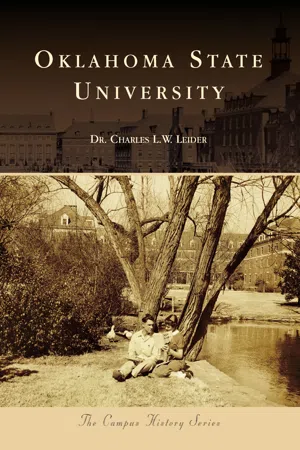
Oklahoma State University
About this book
Oklahoma State University was founded in 1889--18 years before statehood--as Oklahoma A&M College (OAMC), under the Morrill Land Grant Acts that allowed for the creation of land grant colleges. By midcentury, OAMC had a statewide presence with five campuses and a public educational system established to improve the lives of people in Oklahoma, the nation, and the world by adhering to its land grant mission of high-quality teaching, research, and outreach. On July 1, 1957, Oklahoma A&M College became Oklahoma State University (OSU). With more than 350 undergraduate and graduate degrees, OSU and its nine different colleges provide an unmatched diversity of academic offerings. Today, OSU has students enrolled from all 50 states and nearly 120 nations. There are more than 200,000 OSU alumni throughout the world.
Trusted by 375,005 students
Access to over 1 million titles for a fair monthly price.
Study more efficiently using our study tools.
Information
One
PRAIRIE VICTORIAN
1891–1905
James C. Neal was appointed director of the agricultural experiment station in August 1891 and selected the site for the agricultural experiment station and college campus. In the spring of 1892, early construction on the campus included that of a two-story barn, station laboratory, and houses for the farm superintendent and the president of the college.
In 1893–1894, Frank A. Waugh, the school’s first professor of landscape design, worked with Neal in preparing a site plan for the campus. Waugh previously worked at Kansas State University; there, he introduced elements of a naturalistic curvilinear design to be used in Kansas State’s campus plan, in its road system. OAMC’s plan, which was initially developed by Waugh with Neal, resulted in a combination of curvilinear and rectangular design for the campus through a broad curved drive and walk to Old Central.
After examining two sites, the board of regents decided to locate the first permanent structure, Old Central, in the center of the site on a broad U-shaped drive off College Avenue, present-day University Avenue, 120 feet from the southern boundary between the campus and the residential area of the community. (Please note going forward in the book that College Avenue will be referred to by its present-day name of University Avenue to avoid any possible confusion.) In June 1893, the board of regents retained Herman M. Hadley, an architect form Topeka, Kansas, to design Old Central in Prairie Victorian design style with a bell tower, which depicts the Richardsonian Romanesque design, with an arch in distinctive Roman Empire style over the main entrance. Old Central, dedicated in 1894, dominated the early campus.
As the campus developed, the board of regents did not favor one architectural building style over others; however, during this early period, Neo-Gothic design was decided on for the imposing library building. In the early years, almost every building on campus presented a different style.
After two years, Waugh left OAMC to take a faculty position and become head of the secondoldest landscape design program in the United States that later became the Department of Landscape Architecture at the University of Massachusetts; therefore, after his departure the curvilinear design diminished when the campus plan was revised in 1910 by J.D. Walters.
From 1891 to 1905, the major accomplishments were the establishment of the agricultural experiment station and a campus plan and the construction of Old Central, the library, Chemistry Building, Civil Engineering and Gymnasium Building, greenhouse and dairy building, and the athletic courts and fields.

Pictured is the original 200-acre site for the future campus of present-day Oklahoma State University, Stillwater. The land was acquired in 1891. (Courtesy of Oklahoma State University Archives.)
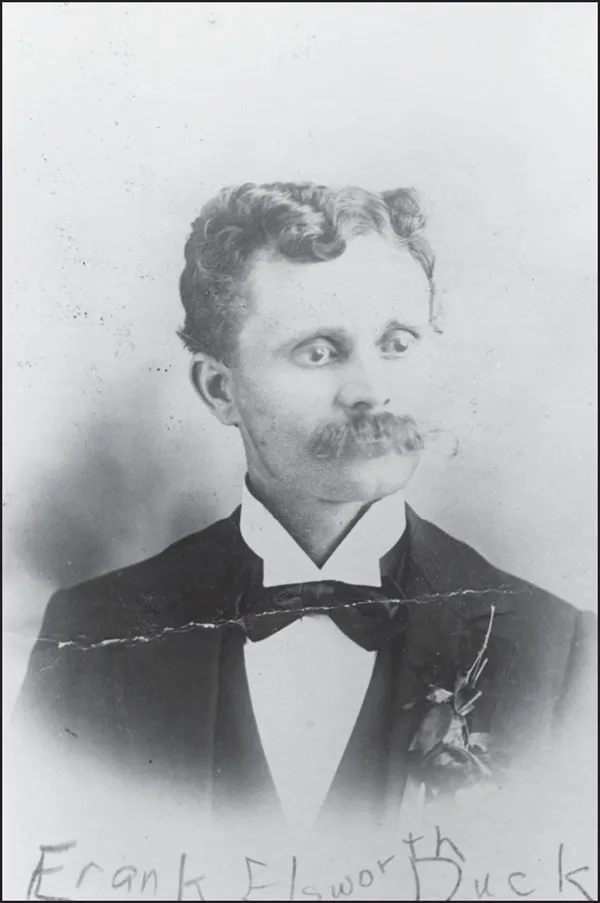
The town of Stillwater in Payne County, Oklahoma, was legally established in 1889; therefore, when the future site of the Oklahoma A&M College was selected in the spring of 1891, most of the property still belonged to the original homesteaders. Portions of four homesteads were transferred to the college’s board of regents for the use of the college and agricultural experiment station. A section of the southern portion of the 200-acre tract came from Frank E. Duck, pictured. Duck, as a member of the class of 1896, became one of the first graduates of the college. (Courtesy of Oklahoma State University Archives.)
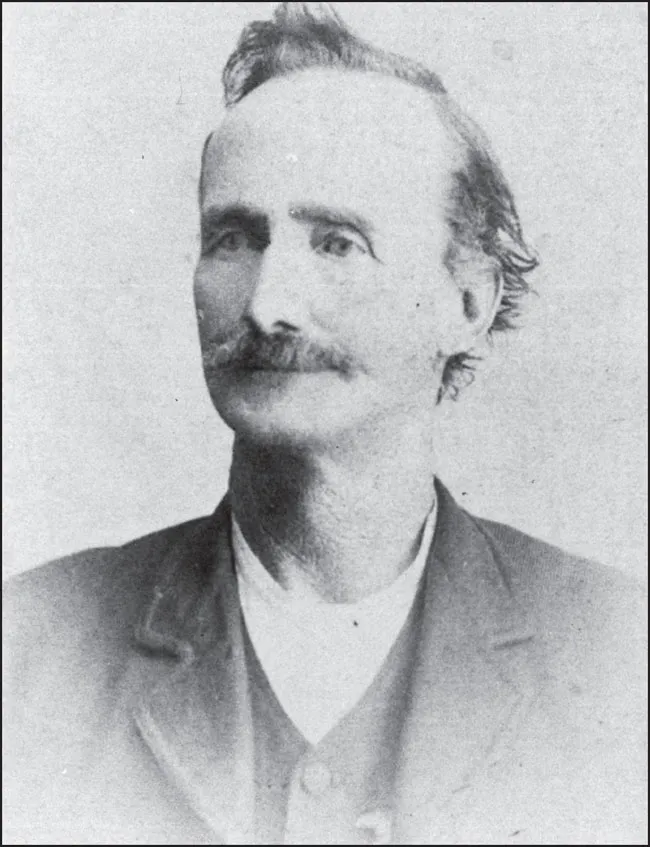
The other section of the southern portion of the 200-acre tract came from Alfred N. Jarrell, pictured. (Courtesy of Oklahoma State University Archives.)

Once the former homestead lands were transferred to the Oklahoma A&M College Board of Regents in November 1891, James C. Neal, the first agricultural experiment station director, led a crew to mark the corners of the 200-acre property and drew the first campus plan. Crops, orchards, and gardens replaced the virgin prairie. Though a wheat trial was established in the southwest corner of the property and ponds were dug, most of the land was set aside as pasture for livestock. The first buildings, which included the director’s house, a barn, and laboratory, were located on 10 acres in the southeast corner of the campus. (Courtesy of Oklahoma State University Archives.)

Pictured in the foreground is Old Central, the first permanent structure on campus. It was constructed in 1893 and dedicated in 1894. Today, it is Oklahoma State University’s oldest campus building. (Courtesy of Oklahoma State University Archives.)

In 1893, Herman M. Hadley, an architect from Topeka, Kansas, designed Old Central. The foliated-metal ornamentation of the roof of the bell tower depicts the overall heaviness of Richardsonian Romanesque style. (Courtesy of Oklahoma State University Archives.)

During the 1893–1884 academic year, Prof. Frank A. Waugh with James C. Neal proposed the first plan for the campus. The plan included several new buildings and landscaping for the eight-acre campus. (Courtesy of Oklahoma State University Archives.)

The college’s original library was located on the first floor of Old Central. It occupied one side of a room that was also used for English and literature classes. Student George Bowers, wearing an official cadet uniform, is pictured on the left. (Courtesy of Oklahoma State University Archives.)

The Mechanical Arts Building and the power plant were built of native stone and were located northwest of Old Central. Due to structural problems caused by the continuous vibrations of mechanical equipment, the Mechanical Arts Building was condemned 12 years after its construction. (Courtesy of Oklahoma State University Archives.)

Under college president Angelo C. Scott’s administration, the enrollment increased from 219 students in 1898 to 366 in 1899. Joseph P. Foucart, an architect from Guthrie, Oklahoma, who not only designed several commercial buildings in Guthrie but also worked on the Palais Garnier in Paris, France, was retained to design and supervise construction of the new Prairie Gothic Revival–style library building. Native sandstone was used for the base of the building, and a locally produced, smooth-faced brick was used for the American bond upper portion of the structure. The building, named Williams Hall, was completed in November 1900. Besides housing the library on ...
Table of contents
- Cover Page
- Title Page
- Copyright Page
- Dedication
- Table of Contents
- Acknowledgments
- Introduction
- 1. Prairie Victorian: 1891–1905
- 2. Gothic Revival Period: 1906–1919
- 3. Neoclassical Period: 1920–1929
- 4. Neo-Georgian Period: 1930–1959
- 5. Faux Georgian Period: 1960–1979
- 6. Modern Period: 1980–1999
- 7. Millennial Period: 2000–Present
- Bibliography
- About the Author
Frequently asked questions
Yes, you can cancel anytime from the Subscription tab in your account settings on the Perlego website. Your subscription will stay active until the end of your current billing period. Learn how to cancel your subscription
No, books cannot be downloaded as external files, such as PDFs, for use outside of Perlego. However, you can download books within the Perlego app for offline reading on mobile or tablet. Learn how to download books offline
Perlego offers two plans: Essential and Complete
- Essential is ideal for learners and professionals who enjoy exploring a wide range of subjects. Access the Essential Library with 800,000+ trusted titles and best-sellers across business, personal growth, and the humanities. Includes unlimited reading time and Standard Read Aloud voice.
- Complete: Perfect for advanced learners and researchers needing full, unrestricted access. Unlock 1.4M+ books across hundreds of subjects, including academic and specialized titles. The Complete Plan also includes advanced features like Premium Read Aloud and Research Assistant.
We are an online textbook subscription service, where you can get access to an entire online library for less than the price of a single book per month. With over 1 million books across 990+ topics, we’ve got you covered! Learn about our mission
Look out for the read-aloud symbol on your next book to see if you can listen to it. The read-aloud tool reads text aloud for you, highlighting the text as it is being read. You can pause it, speed it up and slow it down. Learn more about Read Aloud
Yes! You can use the Perlego app on both iOS and Android devices to read anytime, anywhere — even offline. Perfect for commutes or when you’re on the go.
Please note we cannot support devices running on iOS 13 and Android 7 or earlier. Learn more about using the app
Please note we cannot support devices running on iOS 13 and Android 7 or earlier. Learn more about using the app
Yes, you can access Oklahoma State University by Dr. Charles L. W. Leider in PDF and/or ePUB format, as well as other popular books in History & Education General. We have over one million books available in our catalogue for you to explore.