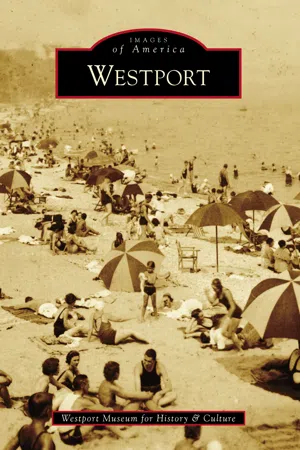
Westport
  1. 128 pages
  2. English
  3. ePUB (mobile friendly)
  4. Available on iOS & Android
eBook - ePub

About this book

Westport, Connecticut, started as a 17th-century colonial English settlement. Nestled on the shores of Long Island Sound and at the mouth of the Saugatuck River, the area was ideally placed for farming, fishing, and commerce. Westport was formally incorporated as a distinct municipality in 1835 and would evolve into a factory town, a bucolic retreat for both the wealthy and the common man, an enclave for artists and performers, and finally, a bedroom community for New York City. Notable townsfolk have included E.T. Bedford, a Standard Oil executive and philanthropist; inventor Benjamin Toquet; and William Phelps Eno, the "father of traffic safety." F. Scott Fitzgerald penned The Great Gatsby while summering in Westport in 1920. Silent film star W.S. Hart called the town home, as did Paul Newman and Joanne Woodward, Bette Davis, and many more. Artists George Hand Wright, Robert Lamdin, Tracy Sugarman, and others were part of a vibrant art community that spanned nearly 100 years. The town retains its cultural flair with several institutions, such as the Westport Country Playhouse and Museum of Contemporary Art.

Frequently asked questions

Yes, you can cancel anytime from the Subscription tab in your account settings on the Perlego website. Your subscription will stay active until the end of your current billing period. Learn how to cancel your subscription.
No, books cannot be downloaded as external files, such as PDFs, for use outside of Perlego. However, you can download books within the Perlego app for offline reading on mobile or tablet. Learn more here.
Perlego offers two plans: Essential and Complete
  • Essential is ideal for learners and professionals who enjoy exploring a wide range of subjects. Access the Essential Library with 800,000+ trusted titles and best-sellers across business, personal growth, and the humanities. Includes unlimited reading time and Standard Read Aloud voice.
  • Complete: Perfect for advanced learners and researchers needing full, unrestricted access. Unlock 1.4M+ books across hundreds of subjects, including academic and specialized titles. The Complete Plan also includes advanced features like Premium Read Aloud and Research Assistant.
Both plans are available with monthly, semester, or annual billing cycles.
We are an online textbook subscription service, where you can get access to an entire online library for less than the price of a single book per month. With over 1 million books across 1000+ topics, we’ve got you covered! Learn more here.
Look out for the read-aloud symbol on your next book to see if you can listen to it. The read-aloud tool reads text aloud for you, highlighting the text as it is being read. You can pause it, speed it up and slow it down. Learn more here.
Yes! You can use the Perlego app on both iOS or Android devices to read anytime, anywhere — even offline. Perfect for commutes or when you’re on the go.
Please note we cannot support devices running on iOS 13 and Android 7 or earlier. Learn more about using the app.
Yes, you can access Westport by Westport Museum for History & Culture in PDF and/or ePUB format, as well as other popular books in History & North American History. We have over one million books available in our catalogue for you to explore.

Information

One
LIBERTY TO SET DOWN
In 1648, English-born Thomas Newton, Henry Gray, and John Green, later known as the Bankside Farmers, were granted ā€œliberty to set down and inhabitā€ the land that would later be commonly known as ā€œGreen’s Farmsā€ā€”the core of Westport.
The area had been called Machamux, or ā€œbeautiful land,ā€ by the Paugusset Nation natives from the Saugatuck and Machamux tribes who had lived there. Most of the tribe’s members had been massacred 11 years earlier in the Great Swamp Fight between themselves and the English in the Sasco Creek marshlands between Westport and Fairfield. According to local lore, the remaining captives were moved to the area of Westport at Clapboard Hill Road in what was one of the earliest Indian reservations in the state. Others were enslaved, joining Africans as a key commodity for the Bankside Farmers as well as for others in the parts of Norwalk and Fairfield that would come together to form the town of Westport in 1835. These forced migrants from Africa labored in the fields, on the shores, and in the homes of early Westport, bringing prosperity to those who held them captive.
Colonial Westport, like other harbor towns, was active in the trade between the North American colonies and the Caribbean. Crops such as corn, wheat, and flax were grown and milled at the Sherwood Mill. From there, they were sent to warehouses lining the river in the town of Saugatuck—now downtown Westport. Goods were then loaded onto small ships headed for New York or Boston and then on to trade in the Caribbean or Europe in return for sugar, rum, and enslaved peoples.
Like their counterparts in other colonies, Westport men were loyal Britons, and many served in the French and Indian War (Seven Year’s War) only to return to face higher taxes from Parliament to pay for the extended military engagement. Westport’s businessmen and farmers suffered the economic hardships of higher taxes on paper, sugar, and tea, which would eventually lead them to support the War for Independence.
Image
This 1933 map shows the location of the original ā€œlong lotā€ farms given to the Bankside Farmers in 1648. Over the decades, these holdings spread northward toward Weston and west to the Saugatuck River.
Image
This rock in Machamux Park marks the location of one of the native villages of the Paugusset Machamux people, one of the indigenous tribes that lived in the area of Green’s Farms for at least 7,500 years prior to colonization by Europeans.
Image
Capt. John Mason’s firsthand account of the July 1637 fight between English colonists and Pequots, including Paugusset natives from various local tribes, is pictured here. The Sasco swamp between Green’s Farms and modern-day Southport was the site of the final battle of what was known as ā€œthe Pequot Warā€ by European colonists. This printed version of Mason’s handwritten account was published nearly 100 years later.
Image
The Osborn family lived on a family compound awarded to ancestor Richard Osborn for serving in the Pequot War. Like other prominent Westport families, they used the labor of enslaved people to manage their large farm. In this deed, Hannah Osborne sold her ā€œnegro manā€ Caesar to fellow Westporter Ebenezer Banks.
Image
Originally located on what is today the Sherwood Island Connector, across the street from the still extant Colonial Cemetery, the Green’s Farms Meeting House (later Green’s Farms Congregational Church) was burned to the ground by British soldiers in 1779 during the Revolutionary War. (Courtesy Green’s Farms Congregational Church.)
Image
Green’s Farms Church Lower Cemetery, also called Colonial Cemetery, was founded in 1725 and stood across from the Green’s Farms Meeting House of the West Parrish of Fairfield. It is situated close to Long Island Sound between the Post Road and Interstate 95. Abigail Andros’s 1730 burial is the oldest interment with a headstone in the graveyard.
Image
The saltbox-style building at the corner of Main Street and Gorham Island Road in this 1930s-era picture was likely built in the late 18th century and was the site of Ebenezer Coley’s Saugatuck store and dock. In 1962, it became the Remarkable Book Shop, a beloved town site that closed in 1994.
Two
WESTPORT IN THE REVOLUTION AND EARLY REPUBLIC
In April 1775, George Washington, newly minted commander of the Continental Army, passed through Westport en route to Boston to lead the colonial militia that succeeded in beating back the British at the Battles of Lexington and Concord. He stopped at West Parish Meeting House (Green’s Farms Church) to rest and speak with Rev. Hezekiah Ripley about the impending war.
With the Revolution properly begun, Westporters enlisted on both sides. Reverend Ripley would go on to be a chaplain in Washington’s army. He ministered to soldiers at Valley Forge. In 1777, British warships moored off Compo beach, landing soldiers en route to Danbury, where patriot munitions and food supplies were stored, ultimately meeting a hostile citizenry and burning the city.
Upon leaving Danbury, the Patriots attacked the British column as it approached Ridgefield, and patriot Brig. Gen. Benedict Arnold temporarily slowed their progress in Ridgefield with a force of 500 men.
The following day, Arnold desperately tried to block the raiders’ return to their ships. In a white-knuckle showdown, the British outwitted Arnold by crossing the Saugatuck River at Ford Road and made a mad dash for their ships as Arnold’s troops pursued them before being scattered by British bayonet charges on Compo Hill. Included among the 37 patriot soldiers buried at Green’s Farm Church is Ebenezer Jesup, a surgeon serving the Continental Army at Valley Forge, as well as Reverend Ripley. In 1779, the British returned and burned the church and parsonage, which stood at what is now the corner of Sherwood Island Connector and Green’s Farm Road.
Image
Benjamin Weed of Stamford was injured in a skirmish with British regulars returning to their ships moored at Compo Beach after the raid in Danbury in 1779. This document certified that his injuries prevented him from further service.
Image
The Disbrow Tavern stood on what is now the grounds of Christ & Holy Trinity Church in downtown Westport, its location marked by a plaque. George Washington stopped at the tavern on his way to Lexington and Concord, Massachusetts, in the summer of 1775 to take control of militia forces there.
Image
Cast in bronze by Tiffany & Co., The Minuteman statue near Compo Beach was sculpted by Westport artist H. Daniel Webster, who lived on Sylvan Road. It commemorates the patriot resistance to British forces who landed at Compo on April 25, 1777. This photograph, taken around 1920, shows a sparsely populated neighborhood around the statue, a far cry from how densely developed it is today. The statue was a prominent feature of the final episode of the popular television show I Love Lucy.
Image
Green’s Farms Congregational Church minister Rev. Hezekiah Ripley met with George Washington in the spring of 1775 when the latter was en route to take command of colonial forces in Massachusetts. Reverend Ripley later served the Continental Ar...

Table of contents

  1. Cover Page
  2. Title Page
  3. Copyright Page
  4. Dedication
  5. Table of Contents
  6. Acknowledgments
  7. Introduction
  8. 1. Liberty to Set Down
  9. 2. Westport in the Revolution and Early Republic
  10. 3. Westport Becomes an Independent Town
  11. 4. Industry, Innovation, and Industrialists
  12. 5. Around the Town
  13. 6. Recreation
  14. 7. Westport in the Arts