- 128 pages
- English
- ePUB (mobile friendly)
- Available on iOS & Android
eBook - ePub
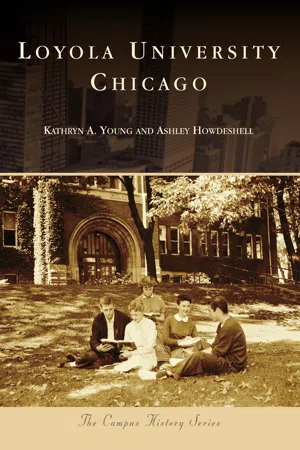
Loyola University Chicago
About this book
For the past 150 years, since its founding in 1870 as St. Ignatius College, Loyola University Chicago has served and educated both the immigrant and established residents of Chicago, excelling in providing a comprehensive liberal arts education. One of the largest Jesuit universities in the United States, Loyola Chicago offers over 80 undergraduate and 170 graduate and professional programs in the humanities, sciences, medicine, nursing, social work, law, business, and communications on four campuses--three in Chicago and one in Rome, Italy. Now in its second century of service, and with an enrollment of over 17,000 students and 150,000 alumni, half of whom live in Chicago, Loyola continues its mission of preparing people to lead extraordinary lives.
Trusted by 375,005 students
Access to over 1 million titles for a fair monthly price.
Study more efficiently using our study tools.
Information
One
FATHER DAMEN’S DREAM
When St. Ignatius College opened its doors on September 5, 1870, it was the culmination of over a decade’s worth of work in Chicago by Arnold J. Damen, SJ. In 1856, Chicago’s Bishop Anthony O’Reagan invited the Missouri Province of the Society of Jesus to establish a Jesuit presence in the city after being impressed by Father Damen’s missions. Father Damen was sent to Chicago and established Holy Family Church in 1857 on the west side, an area with an influx of Irish and German immigrants and near where Jacques Marquette, SJ, wintered in 1674–1675. He then worked on establishing primary schools for boys and girls, a precursor to a Jesuit higher education system in Chicago culminating in a college. A new school, St. Ignatius College, became the embodiment of that goal.
Father Damen purchased land next to Holy Family Church stretching west to Blue Island Avenue and north to Eleventh Street for the college campus. Through the efforts of alderman John Comiskey, father of Charles Comiskey of Chicago White Sox fame, a petition to close Aberdeen Street, which ran through the land purchased by Damen, was passed by the city council. This enabled Damen to begin building St. Ignatius College in 1869 with a unified parcel of land for the campus. Opening for classes on September 5, 1870, to male students only, St. Ignatius College became a place where students from many different backgrounds learned and interacted. Following the Great Chicago Fire of 1871, both the college and Holy Family Church became a refuge for people who were left homeless, including many members of religious orders.
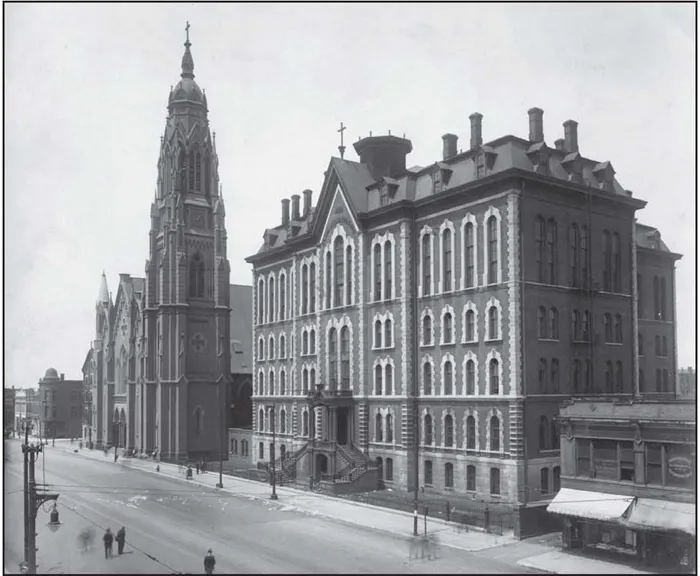
On September 5, 1870, St. Ignatius College opened its doors to Chicago for the first time. According to the opening entry in the vice president’s diary, the college building was still incomplete, although there were enough rooms finished to begin classes. Twenty-six students started the classical course, nine were in the commercial course, and two were in the preparatory course.

While conducting a series of missions in Chicago, Arnold Damen, SJ, so impressed the bishop of Chicago, the Right Rev. Anthony O’Reagan, that he requested Father Damen be assigned to the city to establish a Jesuit church and schools. This photograph shows Father Damen (seated second from left) along with several other Jesuits who traveled to Chicago with him to establish Holy Family Church and its related schools.
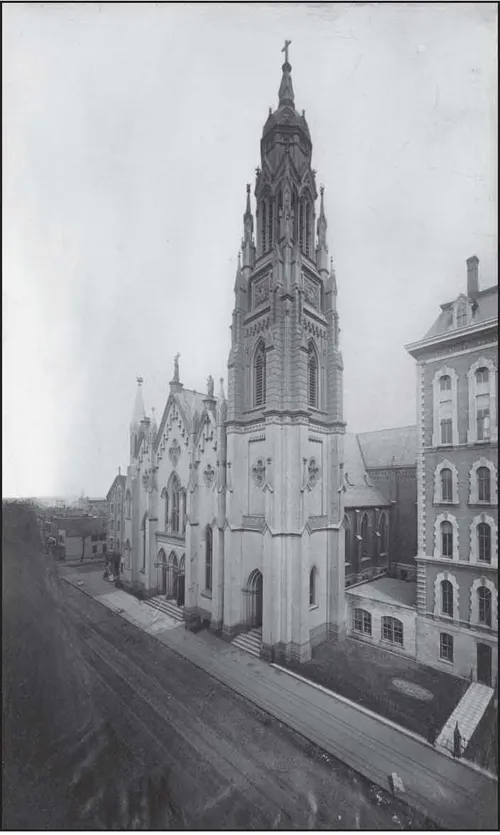
Founded in 1857 by Arnold Damen, SJ, Holy Family Church soon became the heart of a growing community. The first church was a wooden structure built for $1,600; however, construction of a stone Gothic cathedral featuring the work of German immigrant artisans was soon begun. Soon, several primary schools were established to serve the Holy Family community.

This picture, taken by the St. Ignatius College Camera Club, shows the interior of Holy Family Church in 1895. Although the Great Chicago Fire started only a few blocks away from Holy Family Church and St. Ignatius College, both were spared the flames and became a place of shelter for those who lost everything, including the archbishop of Chicago.
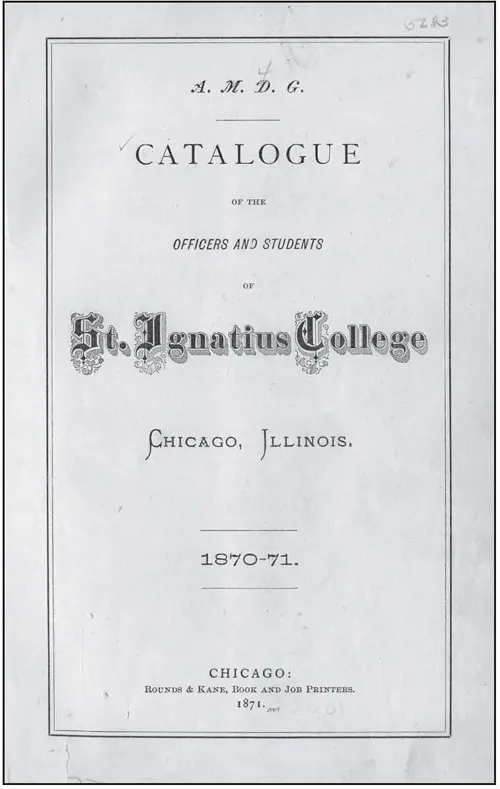
The first course catalog of St. Ignatius College was issued for the 1870–1871 school year and listed seven faculty members teaching two courses, the classical course and the commercial course of studies. Tuition for a school year, which ran from September to June, was $60, equivalent to $1,228 in 2020.

A scientific course was offered at St. Ignatius College beginning in the 1890s, following the long history of Jesuit education in the sciences. Students learned chemistry, physics, and the natural sciences and had access to a natural history museum and mineralogy collection. Some of the specimens from St. Ignatius College became part of the collections at the Field Museum of Natural History and Benedictine University.
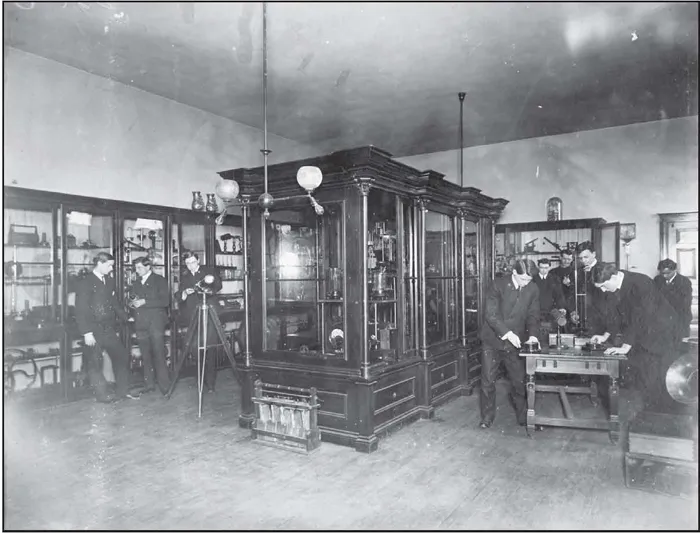
Equipment for the science course was kept in cabinets in a room that was known as the “physical cabinet.” This room was located next to the generator room and was used to run physics experiments. The students in this photograph are checking their equipment under the watchful eye of their Jesuit instructor.

The blackboard in this lecture room announces an upcoming lecture and demonstration on X-rays at St. Ignatius College on February 25, 1896. The Jesuit faculty of St. Ignatius kept track of current scientific theory and breakthroughs and often presented them in public lectures for the education of the community, in addition to classroom lectures.

St. Ignatius College was home to two libraries: the students’ library and the main, or House, library. The students’ library served the everyday needs of the students and included works such as grammar and literature. The House library was reserved for the Jesuit faculty and included numerous works on theology and philosophy in addition to the classics. Permission was sometimes given to exceptional students to use the House library. When Loyola University moved from the St. Ignatius College building to the north-side campus, many books from both libraries were relocated. Approximately 2,000 volumes remain in the Loyola University Libraries collection, some of which can be found in the rare book collection.
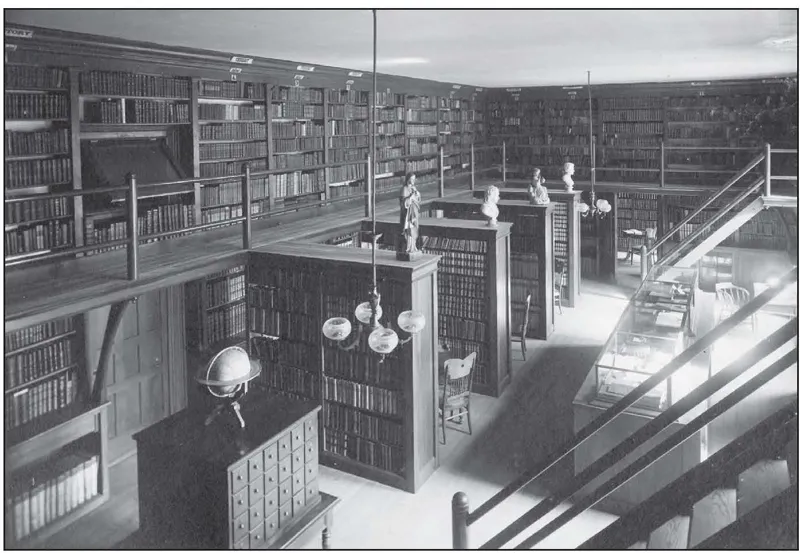

St. Ignatius College originally offered a six-year course with a focus on either the classics or commercial studies. In 1877, Fr. Rudolph J. Meyer, SJ, reorganized the structure and divided the course between grammar school, the equivalent to high school, and college. In addition, a scientific course was added to the classical and commercial courses. A further reorganization occurred at the end of the 19th century to meet national standards.
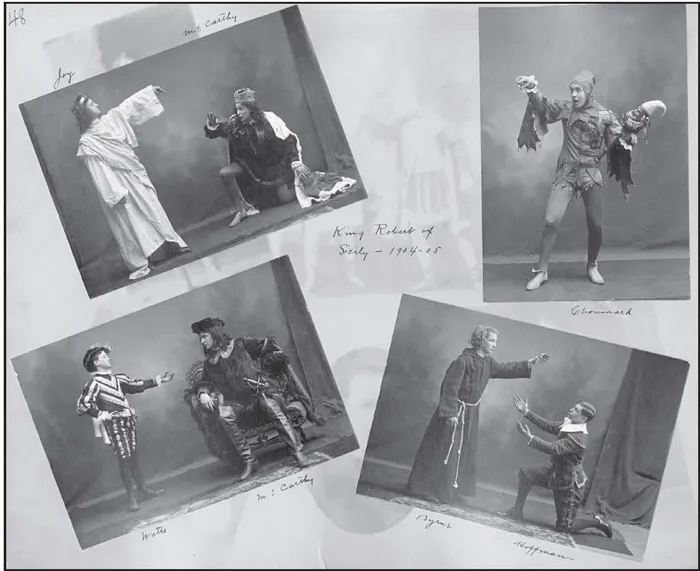
Traditional Jesuit education based on the Ratio Studiorum required that Jesuit schools provide a way for students to exercise and practice rhetorical self-expression. This was most often done through drama and debate, with several of each occurring throughout the scholastic year. During the 1904–1905 school year, the students of St. Ignatius College performed several plays, including King Robert of Sicily.
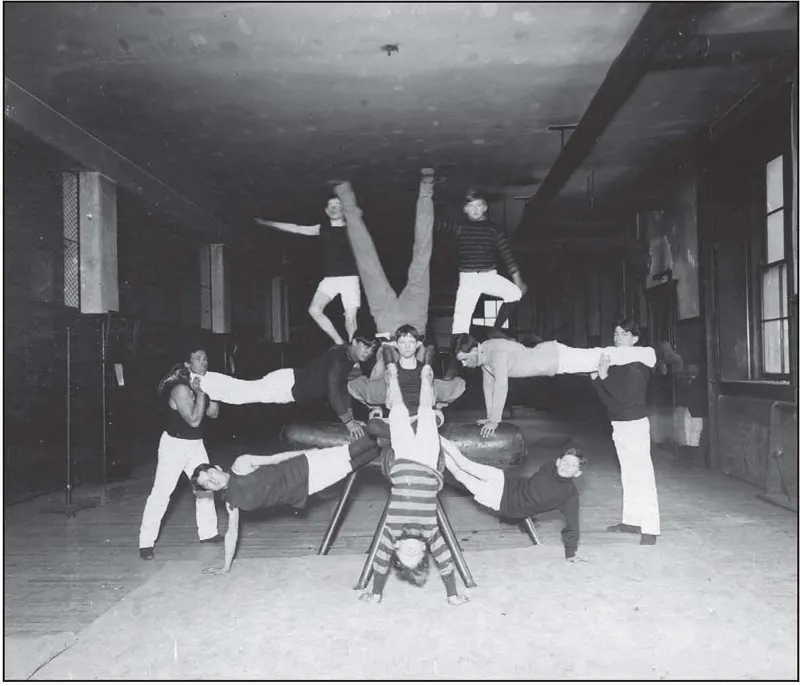
Physical education was recognized as an important part of education in the 19th century. The St. Ignatius College gymnasium included some of the latest gymnastic equipment, and exhibitions were a frequent occurrence. This tradition continued after the college department moved north to Rogers Park, when a gymnasium featuring the best swimming pool ...
Table of contents
- Cover Page
- Title Page
- Copyright Page
- Dedication
- Table of Contents
- Acknowledgments
- Introduction
- 1. Father Damen’s Dream
- 2. Home on the Lake
- 3. Downtown College to Water Tower Campus
- 4. Creating a Medical Campus
- 5. A Campus in the Eternal City
- 6. Loyola in the 21st Century
- Bibliography
Frequently asked questions
Yes, you can cancel anytime from the Subscription tab in your account settings on the Perlego website. Your subscription will stay active until the end of your current billing period. Learn how to cancel your subscription
No, books cannot be downloaded as external files, such as PDFs, for use outside of Perlego. However, you can download books within the Perlego app for offline reading on mobile or tablet. Learn how to download books offline
Perlego offers two plans: Essential and Complete
- Essential is ideal for learners and professionals who enjoy exploring a wide range of subjects. Access the Essential Library with 800,000+ trusted titles and best-sellers across business, personal growth, and the humanities. Includes unlimited reading time and Standard Read Aloud voice.
- Complete: Perfect for advanced learners and researchers needing full, unrestricted access. Unlock 1.4M+ books across hundreds of subjects, including academic and specialized titles. The Complete Plan also includes advanced features like Premium Read Aloud and Research Assistant.
We are an online textbook subscription service, where you can get access to an entire online library for less than the price of a single book per month. With over 1 million books across 990+ topics, we’ve got you covered! Learn about our mission
Look out for the read-aloud symbol on your next book to see if you can listen to it. The read-aloud tool reads text aloud for you, highlighting the text as it is being read. You can pause it, speed it up and slow it down. Learn more about Read Aloud
Yes! You can use the Perlego app on both iOS and Android devices to read anytime, anywhere — even offline. Perfect for commutes or when you’re on the go.
Please note we cannot support devices running on iOS 13 and Android 7 or earlier. Learn more about using the app
Please note we cannot support devices running on iOS 13 and Android 7 or earlier. Learn more about using the app
Yes, you can access Loyola University Chicago by Kathryn A. Young,Ashley Howdeshell in PDF and/or ePUB format, as well as other popular books in History & Education General. We have over one million books available in our catalogue for you to explore.