- 128 pages
- English
- ePUB (mobile friendly)
- Available on iOS & Android
eBook - ePub
New Jersey's Masonic Lodges
About this book
Across New Jersey, thousands of men have entered through the doors of Masonic Lodge buildings, also known as "temples," over the fraternity's more than 250-year history in the Garden State. These buildings, from humble meeting spaces to elaborate single-purpose centers, stand tribute to the memory and influence of one of the oldest fraternities in the world, founded on the tenets of faith, hope, and charity. From governors and US Supreme Court justices to carpenters and stonemasons, Freemasonry has welcomed men from all walks of life, and the temples they built have played important roles in the civic, social, and charitable life of many towns. Although some lodges have been lost, many still remain and are presented here for the first time through photographs and images collected from various historical societies, museums, libraries, and Masonic organizations. This book attempts not to serve as an encyclopedic source but rather to catalog and organize the development of the Masonic temples in New Jersey.
Trusted by 375,005 students
Access to over 1.5 million titles for a fair monthly price.
Study more efficiently using our study tools.
Information
One
COLONIAL AND EARLY
REPUBLIC NEW JERSEY
REPUBLIC NEW JERSEY
For the first several decades of Freemasonry in New Jersey, the craft met in rented spaces in taverns and inns. These spaces proved to be conveniently located, and the availability of food and drink (sometimes even served during meetings) would have added to the fraternal spirit of Masonic events. It would not be until after the establishment of the Grand Lodge of New Jersey that Freemasons in the state would have the first purposed built meeting spaces. Yet even these early structures often contained spaces open to the public or in support of Masonic-led charitable causes.
Over the ensuing centuries, however, only a few buildings remain from the pre–Morgan Affair Era. As for the taverns and inns, the spaces would have been both loud and undecorated. With a bustling business below and with food and drinks provided for travel-weary members, meetings in the Colonial period were very different from the somber and serious affairs they became by the 19th century. The best glimpse into what one of these meetings would have looked like survives in painter John Ward Dunsmore’s The Petition (1926). Furnished with tables and chairs with a makeshift altar at the center, the limit of decorations may included a trestle board or other symbols drawn in chalk on the floorboards.
But exceptions did occur: a few Lodges built a handful of early lodge buildings. These earliest Masonic structures were largely indistinct and in a vernacular architectural style. In terms of size, the buildings were characteristically small, containing the pure essentials of a lodge room and collation room.
Very few buildings from this period of Masonic history survive, and few records remain that can verify the exact locations of Masonic meetings held in taverns and inns. This lack of records and the sometimes-cloudy memory of Lodges and their histories means that it is impossible to map out all the earliest meeting places. These ensuing pages provide a flavor of the fraternity’s earliest days.

Perhaps the most well-known Masonic building among New Jersey Freemasons is the Old Masonic Temple in Trenton. Built in 1793, the two-story five-bay stone structure was the first purpose-built Masonic temple in the state. Trenton Lodge No. 5 had been founded in 1789, and the members had previously met at each other’s homes or in local taverns. Mark Thompson donated a plot of land along Front and Barrack Street (known now as Willow Street) to the Lodge for the construction of a building. On the second floor of the building, a lodge room spans the length and width of the space. (Courtesy of the Collection of Erich Morgan Huhn.)


For a brief period in the 1830s, the members of Trenton Lodge No. 5 offered the space to be used as a free school, purportedly the first of its kind in the state. By the 1860s, the Lodge had outgrown the building, and an addition briefly alleviated some of the stress. The building was sold in 1868 and served as a series of shops until it was bought back in 1915. The small building was of little use to the burgeoning fraternity, but antiquarian spirits led to the building being moved to the corner of Barrack and Lafayette Streets. After being moved, the building was extensively restored, and new stonework was needed on some of the original walls. The building reopened as a museum with the intent to display objects of Colonial Masonic history, although the lack of Colonial-era Masonic objects led to the expansion of the museum’s interpretation. (Courtesy of the Grand Lodge of New Jersey, 1915.)
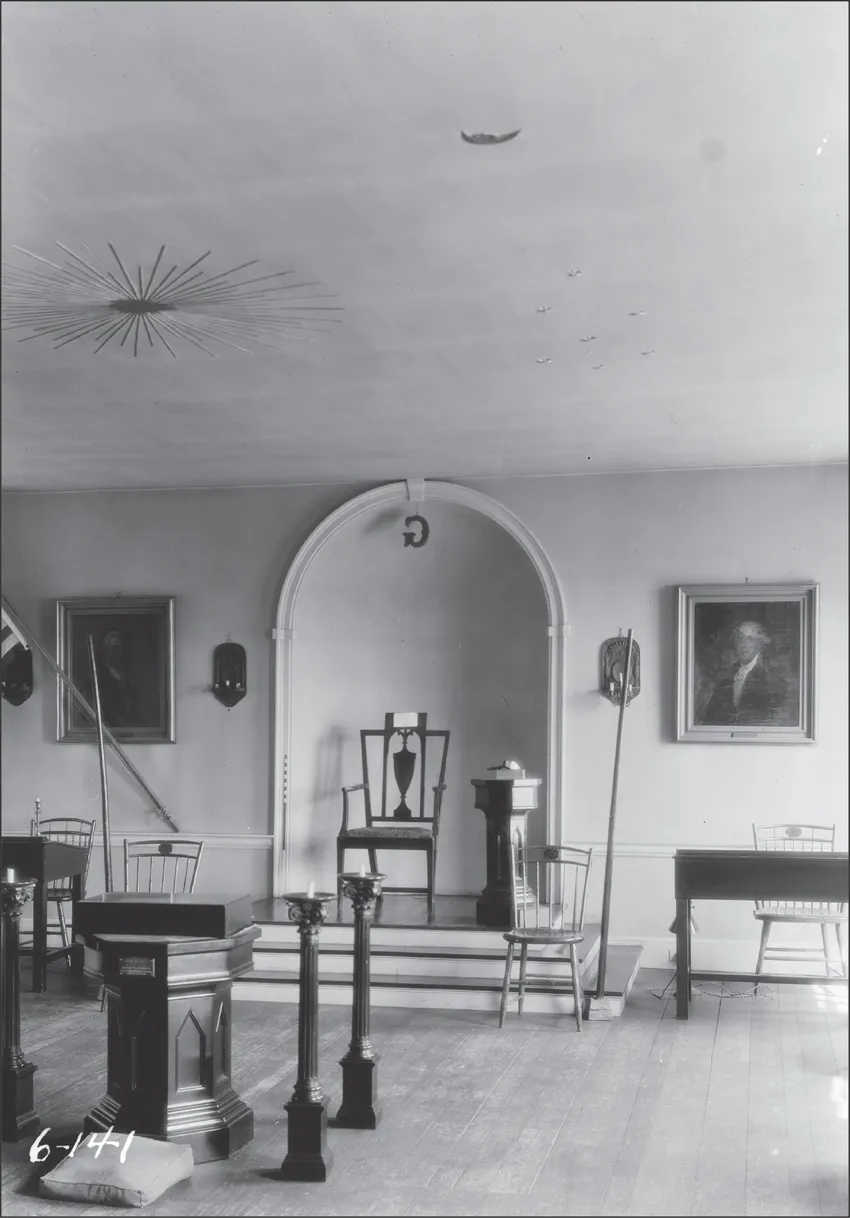
The Lodge Room in the Old Masonic Temple, Trenton, has been preserved to its appearance at the time of the building’s completion in the 1790s. Simple wooden furniture decorated the room, and still does. Lodges in New Jersey can organize with the Grand Lodge to meet in the old Lodge Room and continue the traditions of Masonic rituals. The ceiling is decorated with stars, the moon, and the sun in reference to points of Masonic ritual. The niche in the “East” of the room has the chair for the Worshipful Master of the Lodge. While the simple ornamentation presents a plain atmosphere, the 18th-century Freemason would have been impressed with the detailing. Masonic lodge rooms would have looked much like this one throughout the 18th and early 19th centuries. (Courtesy of the Library of Congress.)

Although the museum exhibit no longer exists, the building continues to educate the public, serving as the Greater Trenton Visitor Center. The Old Temple is listed as a contributing property to the State House Historic District in both the State and National Register of Historic Places. The Old and New Masonic Temple are part of the Historic Trenton Masonic Temple, a 501c(3) nonprofit organized to preserve both Trenton temples. (Courtesy of the Collection of Erich Morgan Huhn.)

This postcard of the Newark Academy building shows the school’s original building. With education and enlightenment as key tenets of Freemasonry, it is not surprising that the fraternity was once a major contributor to educational efforts throughout the state. The third floor of the building was owned and occupied by a Masonic Lodge and fitted with a lodge room. (Courtesy of the Collection of Erich Morgan Huhn.)

The Petition (1926), by John Ward Dunsmore, depicts one of the most important meetings in American Masonic history. Over the winter of 1779–1780, brothers serving in the Continental Army encamped in Morristown met to discuss the future of Freemasonry in the rebellious colonies. The resulting Morristown Convention led to calls for the creation of a Grand Lodge to administer the Craft throughout the new nation. George Washington was rumored to be the favorite candidate for “Supreme Grand Master.” The ensuing petition, which was sent to the various Provincial Grand Lodges, did not gain traction, and the idea ultimately failed. In the following decade, new Grand Lodges were established, and Provincial Grand Lodges declared themselves independent. (Courtesy of New York Historical Society.)

Munn Tavern, on Valley Road in Montclair, was built by Joseph Munn, who opened a tavern here in the first decade of the 19th century. The tavern became popular and Masonic meetings occurred in the public rooms. Bloomfield Lodge, named after Continental Army major and governor Joseph Bloomfield, was supposedly founded in the tavern. The building is now a private residence. (Courtesy of the Library of Congress.)

Built around 1740, Three Tun Tavern was operated by Samuel Briant in Mt. Holly. In 1805, the tavern became the home of a Masonic Lodge, likely Mount Holly Lodge, and changed names to Square and Compass Tavern. By the 1820s, the name had changed again, likely signaling the end of Masonic patronage. The building survives and is now a restaurant. (Courtesy of the Library of Congress.)

Although the postcard below claims Washington Lodge No. 9 as the oldest Masonic Hall in the state, no evidence exists to corroborate the claim. Washington Lodge No. 9, which has since consolidated to form Navesink Lodge No. 9, was established as Washington Lodge No. 34. In the aftermath of the Morgan Affair, many Lodges were renumbered, at which time Washington Lodge No. 34 became No. 9 and moved to Eatontown. The Masonic Hall is still intact, including the addition shown in the postcard. Although the beautifu...
Table of contents
- Cover Page
- Title Page
- Copyright Page
- Dedication
- Table of Contents
- Foreword
- Acknowledgments
- Introduction
- 1. Colonial and Early Republic New Jersey
- 2. 19th-Century Mixed-Use Lodge Buildings
- 3. 20th-Century Mixed-Use Lodge Buildings
- 4. Adaptive Reuse
- 5. Golden Age
- 6. Grand Designs
- 7. Postwar Boom
- 8. Beyond the Blue Lodge
- Bibliography
- Index
- About the Organization
Frequently asked questions
Yes, you can cancel anytime from the Subscription tab in your account settings on the Perlego website. Your subscription will stay active until the end of your current billing period. Learn how to cancel your subscription
No, books cannot be downloaded as external files, such as PDFs, for use outside of Perlego. However, you can download books within the Perlego app for offline reading on mobile or tablet. Learn how to download books offline
Perlego offers two plans: Essential and Complete
- Essential is ideal for learners and professionals who enjoy exploring a wide range of subjects. Access the Essential Library with 800,000+ trusted titles and best-sellers across business, personal growth, and the humanities. Includes unlimited reading time and Standard Read Aloud voice.
- Complete: Perfect for advanced learners and researchers needing full, unrestricted access. Unlock 1.5M+ books across hundreds of subjects, including academic and specialized titles. The Complete Plan also includes advanced features like Premium Read Aloud and Research Assistant.
We are an online textbook subscription service, where you can get access to an entire online library for less than the price of a single book per month. With over 1.5 million books across 990+ topics, we’ve got you covered! Learn about our mission
Look out for the read-aloud symbol on your next book to see if you can listen to it. The read-aloud tool reads text aloud for you, highlighting the text as it is being read. You can pause it, speed it up and slow it down. Learn more about Read Aloud
Yes! You can use the Perlego app on both iOS and Android devices to read anytime, anywhere — even offline. Perfect for commutes or when you’re on the go.
Please note we cannot support devices running on iOS 13 and Android 7 or earlier. Learn more about using the app
Please note we cannot support devices running on iOS 13 and Android 7 or earlier. Learn more about using the app
Yes, you can access New Jersey's Masonic Lodges by Erich Morgan Huhn in PDF and/or ePUB format, as well as other popular books in Social Sciences & Architecture General. We have over 1.5 million books available in our catalogue for you to explore.