eBook - ePub
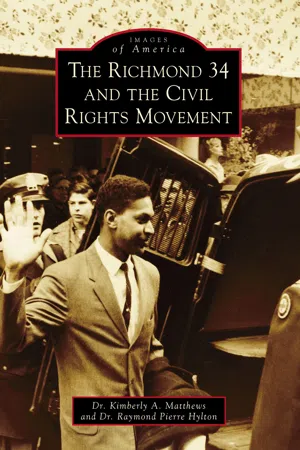
The Richmond 34 and the Civil Rights Movement
- 128 pages
- English
- ePUB (mobile friendly)
- Available on iOS & Android
eBook - ePub
The Richmond 34 and the Civil Rights Movement
About this book
February 22, 1960, bore witness to an event that would forever change the social, political, and economic life of a city, a state, and millions of inhabitants. The arrest of 34 Virginia Union University students during a sit-in protest at the most upscale department store in Richmond, Virginia, heralded the upending of a long-established way of life and a change of direction from which there would be no turning back. The students would see their actions galvanize a community into effecting wide-ranging reforms in desegregation and play a significant role in ending the nearly 70-year grip on power of one of the nation's strongest political machines. Bafflingly, their achievement faded into obscurity, and only in recent years has its importance been recognized.
Trusted by 375,005 students
Access to over 1.5 million titles for a fair monthly price.
Study more efficiently using our study tools.
Information
One
RICHMOND AND THE BYRD
MACHINE, TO 1960
MACHINE, TO 1960
On April 3, 1865, one chapter in history ended for Richmond when Federal troops marched in and planted the flag of the United States on the state capitol building. Richmond’s time as the capital of the Confederacy was over, and so too was slavery in the city.
After a brief Reconstruction period, conservative Democrats and Lost Cause advocates reasserted their political control over state and municipal government, and by the 1890s, a white supremacist system combining racial segregation with minority disfranchisement was firmly rooted. From 1893 to 1960, a powerful conservative political machine, led first by Sen. Thomas S. Martin and after 1919 by Harry F. Byrd Sr. (governor from 1926 to 1930 and US senator from 1933 to 1965), exerted dictatorial control and maintained segregated schools, public facilities, restaurants, lunch counters, waiting rooms, and movie theaters.
In Richmond, the African American community established an enclave on the north side of the city called Jackson Ward, which thrived and prospered well into the 1950s. Though there was some progress in race relations in the aftermath of World War II, the grip of the Byrd Machine seemed strong as ever. From 1954 to 1958, the construction of Interstate 95 cut a swath that bisected Jackson Ward and diminished it as a community. In response to the 1954 Supreme Court ruling in Brown v. the Board of Education, the Byrd Machine defiantly launched its “Massive Resistance” campaign to maintain the status quo. Before suburban malls became popular, the strip of Broad Street stretching between First and Tenth Streets was known as “Exciting Downtown Richmond,” and shoppers converged from far afield. It was clustered with department stores, restaurants, drugstores, specialty shops, movie houses, two bus stations, and barbershops, and was anchored by two swanky establishments: Thalhimers and Miller & Rhoads. In all these businesses, the color line was drawn, with black customers not allowed seating in white-only restaurants and lunch counters.

PART OF THE “BURNT SECTOR” OF RICHMOND, 1865. The Evacuation Fire of April 2–3, 1865, was set by retreating Confederate soldiers acting under orders of Gen. Richard S. Ewell to destroy the tobacco stores. A stiff wind sent it out of control, and 30 blocks of the city were engulfed, amidst chaotic scenes of fleeing residents and pillagers. Although Union troops marching into the city on the morning of April 3 had nothing to do with causing the fire, and even tried to keep it from spreading, embittered white Southerners could not be mollified in their resentment against what they viewed as the imposition of “Yankee” government. This festering hatred would help fuel a later backlash against the newly freed slaves and their descendants that would manifest in the infamous Jim Crow laws. (LOC.)

LINCOLN’S VISIT TO RICHMOND. Ignoring his advisors, who feared for his safety, Pres. Abraham Lincoln was determined to journey to the fallen Confederate capital and walk its streets one day after it had been liberated. Sailing upriver from City Point, the president, his 10-year-old son Tad, and a small Marine escort walked to the former White House of the Confederacy. Along the way, hundreds of freed slaves turned out to cheer him. Many white residents sullenly stayed in their homes but, contrary to fears, did not attempt to harm Lincoln. While the president’s visit kindled hope for a better future for the four million emancipated African Americans, Lincoln himself had not much longer to live. Ten days later, on April 14, 1865, he was shot at Ford’s Theatre in Washington by John Wilkes Booth and died the following morning. (LOC.)

FIRST AFRICAN BAPTIST CHURCH. As the oldest African American church in Richmond, its foundation dates to July 1, 1841. After Nat Turner’s Rebellion in 1831, it was against state law for an African American to pastor a church or for black worshippers to assemble without a white person present. Not until after Richmond was liberated on April 3, 1865, was this restriction lifted, and shortly thereafter, the white minister, Dr. Robert Ryland, handed the pastorate to former slave James Henry Holmes. First African Baptist was joined by other black churches, such as Ebenezer and Sixth Mount Zion, to form one of the pillars of solidarity for the revitalized African American communities of Richmond. This photograph shows the church at its original site at College and Broad Streets. The congregation relocated to 2700 Hanes Avenue in 1955. (LOC.)

DEDICATION OF THE LEE STATUE ON MONUMENT AVENUE. On May 29, 1890, a statue of Gen. Robert E. Lee, the first in a series of Confederacy-inspired statuary on Monument Avenue, was unveiled with considerable fanfare. It was followed by likenesses of prominent Confederate figures: Gen. J.E.B. Stuart (1907), Confederate president Jefferson Davis (1907), Gen. “Stonewall” Jackson (1919), and Comdr. Matthew Fontaine Maury (1929). Coming during a period of history when the ultraconservative Virginia Democratic Party was solidifying its domination of Virginia politics and imposing racial segregation, the statues were a highly visible manifestation of the Lost Cause mentality, which sought to glorify the former Confederacy and foster white supremacy. The placing of a statue honoring African American tennis champion Arthur Ashe (1996) on Monument Avenue generated a heated controversy. The Confederate statues and their fate are the subject of an ongoing local and statewide debate. (VHC.)

DAVIS AND LINCOLN MONUMENTS. Statues, monuments, and differing opinions over the presentation and interpretation of history have been very much in the news recently. In Richmond, an intense community discussion arose over all monuments relating to the Confederacy, with a special mayor’s commission recently proposing a “middle path” of taking down the Jefferson Davis statue on Monument Avenue and placing historical context notice on the others. Davis, a Mississippian, was deemed to have only a slight connection with Virginia. The decision of the National Civil War Museum to place a statue of Abraham Lincoln and his son Tad at the former Tredegar Iron Works site occasioned protests prior to its dedication on April 6, 2003. (Both, Dr. Kimberly A. Matthews.)


THOMAS S. MARTIN, 1847–1919. Born in Scottsville, Albemarle County, Virginia, Martin fought for the Confederacy and practic...
Table of contents
- Cover Page
- Title Page
- Copyright Page
- Dedication
- Table of Contents
- Acknowledgments
- Introduction
- 1. Richmond and the Byrd Machine, to 1960
- 2. Virginia Union University, to 1960
- 3. The “Oil” on the “Flame,” February 1–22, 1960
- 4. The Campaign for Human Dignity, 1960–1963
- 5. The Forgetting and the Rediscovery, to 2010
- 6. The “34/50” Commemoration and Beyond, 2010–2019
- Bibliography
Frequently asked questions
Yes, you can cancel anytime from the Subscription tab in your account settings on the Perlego website. Your subscription will stay active until the end of your current billing period. Learn how to cancel your subscription
No, books cannot be downloaded as external files, such as PDFs, for use outside of Perlego. However, you can download books within the Perlego app for offline reading on mobile or tablet. Learn how to download books offline
Perlego offers two plans: Essential and Complete
- Essential is ideal for learners and professionals who enjoy exploring a wide range of subjects. Access the Essential Library with 800,000+ trusted titles and best-sellers across business, personal growth, and the humanities. Includes unlimited reading time and Standard Read Aloud voice.
- Complete: Perfect for advanced learners and researchers needing full, unrestricted access. Unlock 1.5M+ books across hundreds of subjects, including academic and specialized titles. The Complete Plan also includes advanced features like Premium Read Aloud and Research Assistant.
We are an online textbook subscription service, where you can get access to an entire online library for less than the price of a single book per month. With over 1.5 million books across 990+ topics, we’ve got you covered! Learn about our mission
Look out for the read-aloud symbol on your next book to see if you can listen to it. The read-aloud tool reads text aloud for you, highlighting the text as it is being read. You can pause it, speed it up and slow it down. Learn more about Read Aloud
Yes! You can use the Perlego app on both iOS and Android devices to read anytime, anywhere — even offline. Perfect for commutes or when you’re on the go.
Please note we cannot support devices running on iOS 13 and Android 7 or earlier. Learn more about using the app
Please note we cannot support devices running on iOS 13 and Android 7 or earlier. Learn more about using the app
Yes, you can access The Richmond 34 and the Civil Rights Movement by Dr. Kimberly A. Matthews,Dr. Raymond Pierre Hylton in PDF and/or ePUB format, as well as other popular books in Politics & International Relations & Civil Rights in Politics. We have over 1.5 million books available in our catalogue for you to explore.