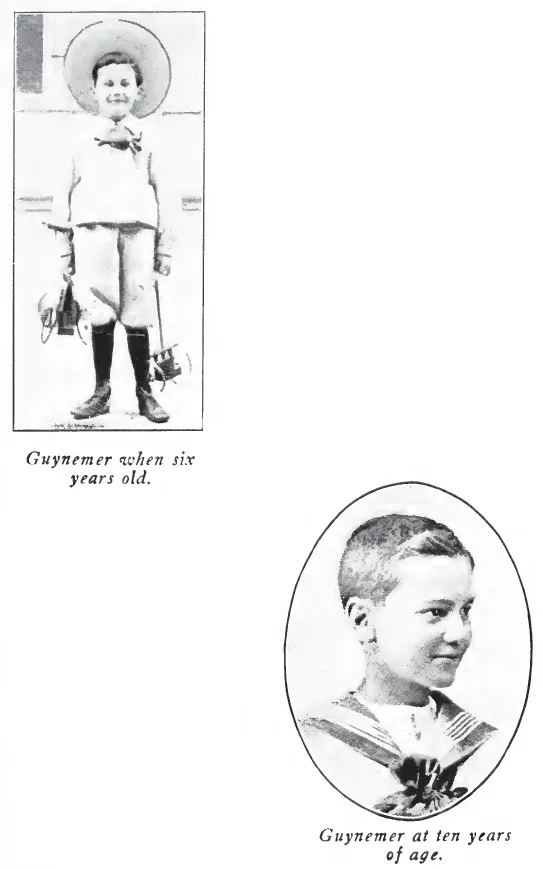
The title of "Ace" in the air war above France in the First World War was the coveted dream of all the daring flyers of the French, German British, and other armies. It was not an easily won honour, in order to be so recognized the airman would have to down five of the enemy aircraft, these experts of the air war would become the most lethal exponents of the airwar. However should the pilot achieve this rare feat he could become a national hero, feted by his comrades, respected and feared by his opponents. Even among these elite sky warriors there are a handful of men that stand out, German's Red Baron, von Richtofen, Canada's Billy Bishop, Britain's Albert Ball; but to all France Georges Guynemer was their idol and lionized as a national hero. With his 53 victories he stands in the first rank of the fighter aces of the First World War.One of France's foremost aeronautical authors Jacques Mortane undertook to write the biography of this legend, recording his famous victories and exploits with the Stork squadron and seeking to shed light on the shy national hero. Author — Mortane, Jacques, 1883-1939.Translator — Levy, Clifton Harby, 1867-Text taken, whole and complete, from the edition published in New York, Moffat, Yard & Company, 1918.Original Page Count – xxxii and 267 pages.Illustrations — 12 illustrations.
![Guymeyer — The Ace Of Aces. [Illustrated Edition]](https://img.perlego.com/book-covers/3017789/9781782890812_300_450.webp)
- 139 pages
- English
- ePUB (mobile friendly)
- Available on iOS & Android
eBook - ePub
Guymeyer — The Ace Of Aces. [Illustrated Edition]
About this book
Trusted by 375,005 students
Access to over 1.5 million titles for a fair monthly price.
Study more efficiently using our study tools.
Information
Subtopic
Military BiographiesIndex
HistoryGUYNEMER—THE ACE OF ACES
CHAPTER I—THE FIRST FIGHTS
I KNEW the future Ace by name for several months. But I exaggerate, for they did not always pronounce his name the same: sometimes it was Guynemer, at others Guynemer. But I knew from his comrades that this young man, this youth called for admiration from all who came near him or saw his work. Writing a series on “The Stirring Flights of the War” at that time, I had but one desire—to know this pilot of whom every one already spoke only with respect. He had known how to impress himself upon all by his mastery and boldness.
Thanks to some common friends, I was introduced to him one day when he came to get some apparatus at the “General Aviation Reserve.” In order to converse we went to a small café of Bourget. I must admit that then as now it was forbidden to the military to take alcohol, so our first interview took place back of the shop, with a small glass of Cinchona cordial: the violation, you see, was quite innocuous!
There were several present. Sergeant Guynemer talked very little before so many. He made vague statements, telling of his fights piecemeal. I was interested but far from satisfied. By trade I required more precision. But my talker seems indisposed to speak before so many.
“I want to write an article about you,” I said to him.
He looked at me with those piercing eyes of his, as if he were taking counsel with himself, and after several seconds, said:
“All right, but on condition that you do not mention my name!”
Such was his modesty. He would not let me publish a name which soon thereafter was to be pronounced with veneration by the entire world.
“With that understanding let us get close together at another table, where we shall be perfectly at ease as we converse.”
He consented, and seemed to be relieved at not having to talk so publicly. Difficult as he had seemed to interview before, and slow of speech, when we were smoking in each other’s faces, he went into all details, told me stories, not omitting a single fact by which we could follow completely his earlier combats. And every time I saw him afterwards, I found him thus: rather silent and even taciturn before a gallery, but a brilliant, precise talker when alone with me.
As soon as he began to talk aviation, and especially pursuit, he did not stop and I was always charmed with his conversation. He was inexhaustible, passing from one subject to the other, citing a fight of one of his comrades, admiring the courage of another, protesting with conviction and anger against the lack of knowledge of others, returning to the subject of conversation and then taking up another. With inexhaustible energy he seemed to be afraid that he would not have time enough to tell me all that he wanted to tell. He advised me to write an article upon a certain subject, suggested an idea to begin with, begged me to urge a reform and finally consented to take up again the purpose of our conversation, which interested me most: his victories. When I left him, I had a note-book almost filled, one pencil worn down and...a cramped hand. But what a harvest!
CHAPTER II—THE ACE OF ACES IN ACTION
OUR first interview dates from December, 1915. Guynemer had just come from his fourteenth fight. I transcribe here faithfully the notes which I took that very day at his dictation:
“My first meeting with a Boche took place on July 19th. I was on a two-seated ‘Parasol’ with Guerder, my mechanic, as passenger. I had promised myself for some time to undertake a pursuit in my aeroplane, but I had always been ordered on reconnaissances, photographic missions, and that kind of work did not suit me at all. It is not that it is lacking in interest, but it is less stirring. It is useful, of course, but how monotonous. And, besides, it is always set aside for the newcomers in the squadrons, and I wanted to show that grit was not the exclusive possession of the older men.
“A Boche had been sighted at Cœuvres, and so I took flight with Guerder and was soon in pursuit of the enemy. Shortly afterwards we saw him just over Pierrefonds, but he saw us at the same moment and fled precipitately. As his plane was faster than ours there was no possibility of catching him. Nevertheless, the joy of finding our first adversary made us attempt the most impossible things. From a great distance, a very great distance, we fired at him, possibly without any real hope of hitting him, but steadily nevertheless. We pursued him as far as the Coucy aerodrome, where we saw him alight. He must have been well satisfied with his performance: as a ‘fleer’ he was most remarkable. But this displeased us greatly. We had gone out to beat down a Boche (and when we left we had no doubt of success), but we had to go back empty-handed.
“There we were, with these sad thoughts, when suddenly another black point appeared on the horizon. Oh, joy, hurry with all speed towards him. As we came nearer the point became larger and was soon plain, as a Boche: it was an Aviatik sailing at about 3,200 meters. He was moving towards the French lines, thinking only of what he might find ahead, but appearing not to think for a moment that an enemy bent upon destroying him was in his wake. Poor fellow, he did not dream that on his track were two young fellows determined not to return to the squadron without performing their task, two young fellows who, in total ignorance of hunting, were convinced that all game met with was to be beaten down, and believing that to return to headquarters without a Boche would mean derision.
“And we hurried towards that plane, which really belonged to us, we thought. It was not until Soissons was reached that we came up with him, and there the combat took place. During the space of ten minutes everybody in the city watched the fantastic duel over their heads. I kept about fifteen meters from my Boche, below, back of and to the left of him, and, notwithstanding all his twistings, I managed not to lose touch with him. Guerder fired 115 shots, but could not fire precisely, as his gun jammed continually. On the other hand, in the course of the fight my companion was hit by one bullet in the hand and another ‘combed’ his hair. He answered with his rifle, shooting well. We began to ask ourselves how this duel was going to end, but at the 115th shot fired by Guerder, I had a feeling, very sweet I will admit, at seeing the pilot fall to the bottom of his car, while the ‘lookout’ raised his arms to heaven in a gesture of despair and the Aviatik did a nose spin, and plunged down into the abyss in flames. He fell between the trenches. I hastened to land not far away, and I can guarantee that I never felt a greater elation than at that moment.
“At last I was able to live my dream! I, who had so long desired to join in the fighting, had managed to gain a victory. What shall I say about the reception given me by the troops on the ground: ovations, congratulations, all under the vengeful cannon of the enemy. I have beaten down other Boches since that time, but when I think over my aerial duels my recollections always fly back to that first one.
“Two days later I received a letter which gave me the highest satisfaction, for it proved to me the friendliness of the infantry. They have so often said that the infantry is jealous of the aviators that I was happy at this testimony of sympathy. It proved to me that if at times the ‘Poilu’ does not love the pilots, it applies to certain exceptions of which the ‘fifth arm’ is not over-proud.”
With charming modesty Guynemer did not wish me to make a copy of the letter of which he had spoken with such deep emotion. He explained that the one who signed it might not be pleased to see it given publicity. He added that if it were printed his comrades might think that he was trying to get unfair publicity. It was only after I had promised that I would not use it that the hero allowed me to make a copy of it for my personal collection. The Ace of Aces is no more. Those who honor his memory are no longer restrained by the discretion which he showed, hence I quote the following:
“July 20, 1915.
“Lieutenant-Colonel Maillard, commanding the — regiment of Infantry, to Corporal Pilot Guynemer and Mechanician Guerder, of Squadron M. S. 3, at Vauciennes. The Lieutenant-Colonel, the Officers, all the Regiment:
“Witnesses of the aerial combat in which you took part above their trenches, with a German Aviatik, have applauded spontaneously at your victory which terminated by the vertical fall of your adversary, and they address to you their warmest felicitations and share the joy which you must have felt after so brilliant a success.
“MAILLARD.”
The official recognition followed on the next day. The Military Medal recompensed the two victors. Here is the trans-script of the one to the Pilot: “Corporal Guynemer, a Pilot full of spirit and boldness, volunteering for the most dangerous missions, after a sharp pursuit, has met a German aeroplane in a combat, which ended by setting it on fire and bringing it to earth.”
Guynemer, not forgetting his friends, added to his report:
“Vedrines, who up to this time had shown me a fine spirit of fellowship, was one of the first to congratulate me. He had come up in an automobile, and seeing me so happy, so overjoyed, did not wish me to go back piloting the aeroplane: as he was afraid that I might refuse or feel hurt in some way, he explained his purpose with such fine delicacy that I could not refuse. He said that as he had been, as it were, my mentor in the squadron up to this day, he was very anxious to escort the victor of the day to the aerodrome. It was impossible for me to reject so friendly a suggestion, so it was as Vedrines’ passenger that I went back to the station of M. S. 3 on the plane which had just brought me my success.”
CHAPTER III—SPECIAL MISSIONS
EAGER for all the facts, I persuaded Guynemer to consult his note-book of flight, so that there be no mistake of memory, and not to omit one interesting story. He submitted gracefully to this journalistic exigency.
“It is true,” said he, “I was about to forget to tell you that I had performed two special missions on September 29th and October 1st.”
The special mission at that time was all the fashion. The fashion is only a mode of speech, for we never find many amateurs. It is an ungrateful task, dangerous, with many terrible results, and is executed only by volunteers. Vedrines was the great Ace: he executed seven of these. Guynemer, belonging to the same squadron, did not hesitate an instant. He offered at once to serve.
What is a “Special Mission”? The enemy having published the story of two men who have performed these missions, we are telling him nothing when we say that it has to do with two aviators departing together, going over the territory of the enemy and returning separately.
“The first,” said Guynemer, “was hard enough, for the weather was execrable. I had the wind at my back on the way out, but when coming back it blew straight against me, and I was afraid I would never get back. It took three hours to complete my task, and I thought all the time that I would never be able to regain our lines.
“The second was even more fertile in incidents, and after it I swore never to try anything like it again. They had told me the place which I was to study. I left and everything went without incident, until I reached the place pointed out to me. I stopped my motor so as not to attract any notice, and descended in spirals. Two fields were beneath my wings: one magnificent, a real billiard-table, seeming to make despairing appeals to me; the other filled with ruts, rough, all cut up into furrows, the very last place that any one would think of landing. I did not hesitate, selecting the former. And I continued to descend. While planing downward I could not help reflecting. That green earth which seemed to have put on festal garments to receive me, was it not too beautiful to be hospitable? Attention! I looked carefully, and what did I see? Steel wires all across it in treacherous fashion. It was a ruse of the Boches—a trap for pilots!
“What chance had I to be distrustful? Quickly I turned on the gas and climbed upwards, and all the more did I decide to land on the other ground, the bad place which I had just disparaged a moment before. Now it seemed most favorable. So it was, and notwithstanding several disquieting bumps on landing I had the satisfaction of finding that not a bit of my plane was damaged. Some seconds later I rose without trouble and began my flight anew. All ended well, but I had come near being singed. Really, the special mission is a mean job.”
A second citation recompensed the Pilot:
“He has proved his valor, energy and coolness by accomplishing as a volunteer an important and difficult mission during stormy weather.”
And we came back to hunting expeditions, for I did not dare ques...
Table of contents
- Title page
- DEDICATION
- TABLE OF CONTENTS
- PREFACE
- A FOREWORD-ADVICE TO BOCHE-HUNTERS
- LIST OF ILLUSTRATIONS
- CHAPTER I-THE FIRST FIGHTS
- CHAPTER II-THE ACE OF ACES IN ACTION
- CHAPTER III-SPECIAL MISSIONS
- CHAPTER IV-BATTLES IN THE AIR
- CHAPTER V-A BATTLE ROYAL
- CHAPTER VI-THE BEGINNINGS
- CHAPTER VII-FROM SUCCESS TO SUCCESS
- CHAPTER VIII-A GAME WITH THE BOCHE
- CHAPTER IX-CONVALESCENCE IN THE OPEN
- CHAPTER X-GUYNEMER PLAYS A NEW GAME
- CHAPTER XI-CITATIONS OF VICTORY
- CHAPTER XII-STRUCK BY A SHELL AT 3,000 METERS
- CHAPTER XIII-A LONG CHASE
- CHAPTER, XIV-GUYNEMER CELEBRATES HIS BIRTHDAY WITH A BOCHE
- CHAPTER XV-A BATTLE WITHOUT A GUN
- CHAPTER XVI-THE OUTRAGES AT NANCY
- CHAPTER XVII-A FIRST TRIPLE
- CHAPTER XVIII-VENGEANCE IS STRONGER THAN DEATH
- CHAPTER XIX-THE MAGIC QUADRUPLE
- CHAPTER XX-AN ENEMY PICTURE OF GUYNEMER
- CHAPTER XXI-AN OFFICER OF THE LEGION OF HONOR
- CHAPTER XXIII-A MODEST HERO
- CHAPTER XXIV-VICTORIES OF THE NEW AEROPLANE
- CHAPTER XXV-NEVER AT THE REAR
- CHAPTER XXVI-THE LAST FLIGHT
- CHAPTER XXVII-THE FIFTY-THREE VICTORIES WON BY GUYNEMER AS TOLD BY HIMSELF IN HIS NOTE-BOOKS OF FLIGHT
- CHAPTER XXVIII-RECORD AT VERDUN
- CHAPTER XXIX-FROM NOTE-BOOK, VOLUME II
- CHAPTER XXX-SIX FIGHTS IN TWO HOURS
- CHAPTER XXXI-THE FATAL YEAR
- APPENDIX
Frequently asked questions
Yes, you can cancel anytime from the Subscription tab in your account settings on the Perlego website. Your subscription will stay active until the end of your current billing period. Learn how to cancel your subscription
No, books cannot be downloaded as external files, such as PDFs, for use outside of Perlego. However, you can download books within the Perlego app for offline reading on mobile or tablet. Learn how to download books offline
Perlego offers two plans: Essential and Complete
- Essential is ideal for learners and professionals who enjoy exploring a wide range of subjects. Access the Essential Library with 800,000+ trusted titles and best-sellers across business, personal growth, and the humanities. Includes unlimited reading time and Standard Read Aloud voice.
- Complete: Perfect for advanced learners and researchers needing full, unrestricted access. Unlock 1.5M+ books across hundreds of subjects, including academic and specialized titles. The Complete Plan also includes advanced features like Premium Read Aloud and Research Assistant.
We are an online textbook subscription service, where you can get access to an entire online library for less than the price of a single book per month. With over 1.5 million books across 990+ topics, we’ve got you covered! Learn about our mission
Look out for the read-aloud symbol on your next book to see if you can listen to it. The read-aloud tool reads text aloud for you, highlighting the text as it is being read. You can pause it, speed it up and slow it down. Learn more about Read Aloud
Yes! You can use the Perlego app on both iOS and Android devices to read anytime, anywhere — even offline. Perfect for commutes or when you’re on the go.
Please note we cannot support devices running on iOS 13 and Android 7 or earlier. Learn more about using the app
Please note we cannot support devices running on iOS 13 and Android 7 or earlier. Learn more about using the app
Yes, you can access Guymeyer — The Ace Of Aces. [Illustrated Edition] by Jacques Mortane, Clifton Harby Levy in PDF and/or ePUB format, as well as other popular books in History & Military Biographies. We have over 1.5 million books available in our catalogue for you to explore.