eBook - ePub
Air Power In North Africa, 1942-43: An Additional Perspective
- 36 pages
- English
- ePUB (mobile friendly)
- Available on iOS & Android
eBook - ePub
Air Power In North Africa, 1942-43: An Additional Perspective
About this book
The hastily mounted invasion of French Northwest Africa in November of 1942 was a gamble. It exposed American inexperience. That inexperience went from Roosevelt on down to the soldier in the foxhole. Half-trained men were pitted against Vichy France and didn't know whether to expect open arms or open fire. Later, those same inexperienced men would meet Rommel at the Kasserine Pass. This naivete was exhibited by both men and leaders. Torch was Eisenhower's first major operation--a gigantic airlift and sealift preceded by months of intrigue. The outcome of the campaign settled several air power issues and revealed many lessons. The battles fought by the United States forces during the North African Campaign of 1942 and 1943, particularly the Battle for the Kasserine Pass in February 1943, were a breaking and testing ground for much of the employment of those forces during the remainder of the Second World War. Three air power key lessons were learned on the North African battlefield. First was the need for coordination between air and ground forces. Second was the folly of sending untrained airmen into combat. Third was the importance of tactical air targeting by ground force commanders.
Tools to learn more effectively

Saving Books

Keyword Search

Annotating Text

Listen to it instead
Information
THE NORTH AFRICA CAMPAIGN
North Africa’s Importance
“North Africa played an important role in (World War II). It was the only area, other than the British Isles, from where the Western Allies could approach the German-controlled continent. Its possession was necessary for the control of the Mediterranean, the vital Suez Canal, and the Middle East with its oil.” {2}

The Mediterranean also held special importance for Mussolini. His dream was to return the Roman empire to its original state. His invasion of Greece brought Great Britain, already stretched thin in North Africa, into the fight in Greece. Additionally, “…the British Eighth Army had been driven far into Egypt and had taken its stand on what was known as the El ‘Alamein line.”{3} It was from El ‘Alamein that Montgomery would build up his supplies and defensive positions, await Rommel’s offensive attacks, and then counterattack.
American aviators, sent to Egypt to observe Montgomery, gained experience with the unique British air-ground cooperation system for the first time. The combined forces of General Montgomery’s Eighth Army and the air units of Air Vice Marshal Sir Arthur Coningham’s Western Desert Air Force shared a great victory in the desert west of Cairo. “Montgomery and Coningham mutually decided that ground and aviation command components functioned best as equal partners at the army level. Air and ground field staffs also had the same headquarters and living quarters.”{4} It was a true joint command, as neither Montgomery, the ground forces commander, nor Coningham, the air component commander, demanded final authority from the theater commander. More important, however, they trusted each other’s judgment and respected each other’s decisions.
Another important element of the British strategy was the use of Malta. Malta enabled the Royal Air Force to attack Axis shipping, disrupting the supply line from Italy to North Africa. The use of aircraft carriers from Gibraltar to ferry planes within flying distance of Malta aided as did the submarine attacks from Malta.{5}
The Torch Landing
An Allied landing in North Africa offered many advantages over a cross-channel invasion. First, and most important, the landings would not be directly opposed by seasoned German troops “Victory would help to open the Mediterranean shipping lanes, facilitate the flow of supplies to Russia through the Persian Gulf, and might draw German strength away from the Russian front.”{6}
For political reasons, President Roosevelt believed that American troops must fight the Germans on the ground in 1942. The United States was too weak to make a cross channel invasion on the continent. Because most of the force for Torch would be American, and with General Marshall’s recommendation, General Eisenhower would be the overall commander-in-chief. Ground forces were organized into British and American task forces, supported by the Allied Naval Expeditionary Force, the British Eastern Air Command, and the American 12th Air Force.{7}
“The land-based aviation in the Allied Force was first organized in two portions corresponding to the initial arrangement of task forces and to the prospective consolidation into British First and American Fifth Armies. The eastern Air Command consisted of Royal Air Force (RAF) units under the command of Air Marshal Sir William L. Welsh. A Western Air Command (12th Air Force) was put under Brigadier General James H. Doolittle.”{8}
Twelfth Air Force Organization
The Eighth Air Force was the theater air force for the European Theater of Operations and was placed in general support of Torch in July 1942. It was Eisenhower’s intention to stand down the Eighth in Europe so that its full air power could be used in Africa--an intention that General Carl “Tooey” Spaatz (commander of Eighth Air Force) successfully resisted.
Eisenhower agreed not to stand down the Eighth Air Force and to support Spaatz’s call for reinforcing units, thus allowing air support to both theaters. He did this by creating a second numbered air force in the theater, the 12th Air Force. However, this arrangement did not provide for a senior air commander subordinate to Eisenhower in the African Theater. In September 1942, this dilemma was eased when General Arnold told Spaatz to place his subordinate, Major General Ira C. Eaker, in command of Eighth Air Force and designated Spaatz as Commanding General, Allied Air Force in Europe. Arnold reasoned that Africa and England constituted only one air theater and that”. . .the strategic bombing effort (against Germany) could be protected by securing for one of its outstanding exponents a command position at theater headquarters.”{9}
Spaatz initially rejected that advice, with Eisenhower’s approval, since 12th Air Force was subordinate to him and he was in fact the senior air advisor to the commander-in-chief.
Eisenhower was not particularly receptive to the notion of an overall air force commander, although he appreciated the concept of an overall air theater throughout which assets could be flexibly employed. This latter appreciation led him to approve the theater air force concept in late October with Spaatz in command. Eisenhower intended to postpone the implementation of this concept until Tunisia had been captured to ensure that sufficient air bases would be available to support it. He remained concerned about Axis air power and its capability to interdict naval forces in the Mediterranean. He was convinced that final success depended upon land advance and the establishment of a growing number of air support bases.{10}
But in mid-November, Arnold wrote Spaatz and Eisenhower of his concern that”. . .unless we are careful, we will find our air effort in Europe dispersed the same way we are now dispersed all around the world.”{11} Thus the groundwork was laid for the merging of all air forces in Africa, and Torch was begun with the Twelfth Air Force in general support.{12}
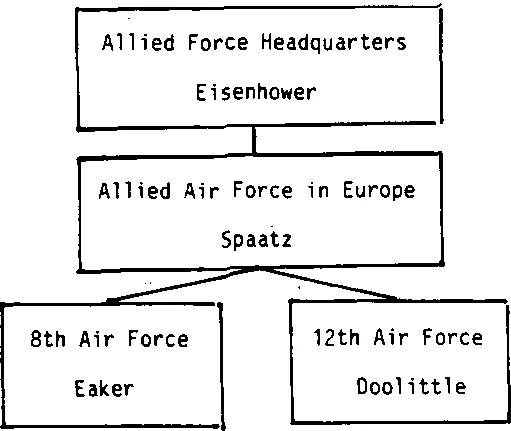
Doolittle, fresh from the April 1942 raid on Tokyo, was selected to command the 12th Air Force. Planners expected him to command the 12th from Gibraltar during the first phase of Torch and then move East with the other forces.
According to the Torch plans, in subsequent phases the 12th’s mission would be determined for various contingencies. It is important to note that the 12th had to be prepared for each of these contingencies. This included ...
Table of contents
- Title page
- TABLE OF CONTENTS
- ABSTRACT
- Preface
- Introduction
- THE NORTH AFRICA CAMPAIGN
- REQUEST FROM THE PUBLISHER
- BIBLIOGRAPHY
Frequently asked questions
Yes, you can cancel anytime from the Subscription tab in your account settings on the Perlego website. Your subscription will stay active until the end of your current billing period. Learn how to cancel your subscription
No, books cannot be downloaded as external files, such as PDFs, for use outside of Perlego. However, you can download books within the Perlego app for offline reading on mobile or tablet. Learn how to download books offline
Perlego offers two plans: Essential and Complete
- Essential is ideal for learners and professionals who enjoy exploring a wide range of subjects. Access the Essential Library with 800,000+ trusted titles and best-sellers across business, personal growth, and the humanities. Includes unlimited reading time and Standard Read Aloud voice.
- Complete: Perfect for advanced learners and researchers needing full, unrestricted access. Unlock 1.4M+ books across hundreds of subjects, including academic and specialized titles. The Complete Plan also includes advanced features like Premium Read Aloud and Research Assistant.
We are an online textbook subscription service, where you can get access to an entire online library for less than the price of a single book per month. With over 1 million books across 990+ topics, we’ve got you covered! Learn about our mission
Look out for the read-aloud symbol on your next book to see if you can listen to it. The read-aloud tool reads text aloud for you, highlighting the text as it is being read. You can pause it, speed it up and slow it down. Learn more about Read Aloud
Yes! You can use the Perlego app on both iOS and Android devices to read anytime, anywhere — even offline. Perfect for commutes or when you’re on the go.
Please note we cannot support devices running on iOS 13 and Android 7 or earlier. Learn more about using the app
Please note we cannot support devices running on iOS 13 and Android 7 or earlier. Learn more about using the app
Yes, you can access Air Power In North Africa, 1942-43: An Additional Perspective by Colonel F. Randall Starbuck in PDF and/or ePUB format, as well as other popular books in History & European History. We have over one million books available in our catalogue for you to explore.