[Includes 19 tables, 7 figures, 41 maps]
To be successful, a strategic military operation requires careful planning and meticulous execution. History applauds the commander who orchestrates the operation, and major subordinate commanders share in the glory. In reality, however, commanders and soldiers at the operational and tactical levels play an even more critical role in achieving battlefield success. History often accords them little attention.
Practitioners of war must study war at all levels. An understanding of the strategic aspects of military operations is essential in order to provide a context for a more detailed and equally critical understanding of precise operational and tactical techniques. Few officers practice war at the strategic level. The majority wrestle with the myriad of problems associated with implementing those strategic plans.
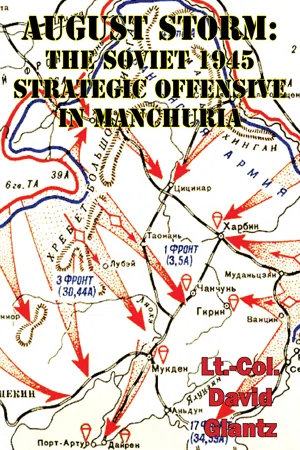
Leavenworth Paper no. 8. through the medium of detailed case studies, examines the operational and tactical aspects of a major strategic operation—the Soviet offensive m Manchuria in 1945. The case studies, which involve army, corps, division, regimental, and battalion operations, focus on the many problems commanders and soldiers at that level face. Constrained by time, a desperate enemy, rugged terrain, and severe climatic conditions—the realities of war— Soviet commanders devised find implemented techniques that produced victory. This paper highlights those techniques in the knowledge that Soviet theorists have likewise studied them in detail, both historically and in a contemporary context.
eBook - ePub
August Storm: Soviet Tactical And Operational Combat In Manchuria, 1945 [Illustrated Edition]
- 157 pages
- English
- ePUB (mobile friendly)
- Available on iOS & Android
eBook - ePub
August Storm: Soviet Tactical And Operational Combat In Manchuria, 1945 [Illustrated Edition]
About this book
1 — Preparations for the Manchurian Strategic Offensive
Soviet planning for the Manchurian campaign began in March 1945, when operations in the west were in their final phase. Shifting of men, materiel, and equipment to the Far East began in April 1945. In general, the Soviets transferred combat units and their equipment separately. Thus, at first they stockpiled equipment in the Far East and reequipped units already located in that region.{2}
Massive regrouping of forces to the east occurred from May through July of 1945, with units still arriving when the campaign opened in August. To provide command and control for the expanded forces, the Soviet High Command shifted experienced headquarters staffs from eastern Europe to the Far East and Trans-Baikal areas. Two front headquarters (the Karelian Front and 2d Ukrainian Front) and four army headquarters (5th, 39th, 53d, and 6th Guards Tank) provided this leavening of combat experience. The 39th and 5th Armies moved from the Königsberg area in East Prussia; the 6th Guards Tank Army and 53d Army, from the Prague region.{3} The High Command decided to move those units whose past experience suited them to the peculiarities of planned operations. Thus, the 39th Army, experienced in fighting for the heavily fortified area of Konigsberg, would deploy to attack the Halung-Arshaan Fortified Region of Manchuria. The 5th Army, also engaged in reducing Konigsberg, would conduct attacks in the heavily fortified Japanese defensive zone in eastern Manchuria. The 6th Guards Tank Army, fresh from fighting its way through the Carpathian Mountains, would traverse the Grand Khingan Mountains of western Manchuria. The 53d Army, also experienced in the Carpathian campaign, would engage Japanese forces in the mountains of western Manchuria.
In addition to these major headquarters, the High Command shifted many separate tank, artillery, and engineer units eastward to provide the support necessary for operations in the varied terrain of Manchuria. Redeployment of forces had the cumulative effect of doubling the strength of Soviet forces in the Far East from forty to more than eighty divisions.{4}The volume of rail traffic involved in the move best illustrates the complexity and magnitude of the redeployment. For the 9,000- to 12,000-kilometer move, the Soviets used 136,000 rail cars. In June and July of 1945, twenty-two to thirty trains used the Trans-Siberian railroad each day.{5} Units also made extensive use of roads to reach final deployment areas. For example, the Trans-Baikal Front{6} deployed from the main line of the Trans-Siberian railroad to Choibalsan, Mongolia, a distance of some 500 to 600 kilometers, by both rail and road. Extensive redeployment also took place among units already within the Far East and Trans-Baikal region. From May to June; 1945, thirty divisions moved to new locations, a shift involving about one million men.{7}
The High Command also transferred to the Far East selected new commanders to organize and lead Soviet forces in the campaign. Again, experience and performance were primary criteria for selection. Two front commanders, Marshals R. Ya. Malinovsky and K. A. Meretskov, two front chiefs of staff, Generals M. V. Zakharov and A. N. Krutikov, and four army Commanders, Generals A. P. Beloborodov, I. M. Chistyakov, N. D. Zakhvatayev, and A. A. Luchinsky, received postings to the Far East. General I. A. Pliyev received command of the joint Soviet-Mongolian Cavalry-Mechanized Group.{8} Most of these commanders either had experience in the region or were associated with major headquarters that moved east. In June 1945, Marshal A. M. Vasilevsky became coordinator of overall operations in the Far East and Trans-Baikal regions. Vasilevsky’s major qualification for the position was excellent service as representative of the STAVKA (headquarters of the Supreme High Command) and as coordinator of major successful operations in the west. It soon became apparent, however, that the scope of operations in Manchuria was too great for mere coordination. Consequently, on 30 July 1945 the Soviets created the Far East Command under Vasilevsky, backed by a full staff.{9} In effect the Far East Command was a full-fledged theater of military operations{10} headquarters, the first of its kind in the Soviet World War II command experience.{11}


The movement of men and materiel eastward involved constant use of screening, cover, and secrecy. The Soviets relied heavily on night movement to deceive the Japanese as to the grand scale of redeployment. Use of assembly areas remote from the border masked attack intentions, but ultimately required units to move to the attack in August over a considerable distance. Many high ranking commanders moved into the theater under assumed names and wearing the rank of junior officers.{12} While the sheer size of Soviet movements made them impossible to mask, deceptive measures obscured the scale of Soviet redeployments and caused the Japanese to underestimate the Soviet ability to attack. Most Japanese believed that ‘the Soviets would be able to launch an attack only in the fall of 1945 or in the spring of 1946. Few saw August as a possibility. By 25 July, Soviet force deployments to the Far East were virtually complete. The Soviets had only to set the date to start the operations.
2 — Area of Operations
Manchuria covers 1.5 million square kilometers bounded on the south by Korea, the Liaotung Gulf, and China, on the east and north by the Soviet Far Eastern province and Siberia, and on the west by Outer Mongolia and Inner Mongolia. By virtue of its geographic location, its natural resources, and its population, Manchuria is an area of considerable strategic value. Its fertile central regions are both industrially and agriculturally important. Its geographical location gives to it a dominant position vis-à-vis China and the Soviet Far East. For this reason, the major powers of the region, China, Russia, and Japan, have long sought possession of Manchuria.


Because of its large size and its geographical and climatic diversity (see maps 1-6), Manchuria can best be described as a series of concentric circles. The inner circle contains the heartland of Manchuria, the large central valley. Around the valley runs another large circle of mountains of various size and ruggedness, protecting the central valley from the west, north, east, and southeast. To the south, this circle opens onto the Liaotung Gulf. Beyond this circle of mountains is a peripheral area abutting Mongolia, Siberia, and the Soviet Far East.
The central valley of Manchuria, containing the basins of the Liao, Sungari, Nen, Hsiliao, Choerh, and other rivers, extends 1,000 kilometers from north to south and 400 to 500 kilometers from east to west. In 1945 a well-developed road and rail network traversed the region, connecting the major industrial cities of Mukden, Changchun, Harbin, and Tsitsihar. Terrain in the central valley is generally flat, and cultivated areas predominate.
West of the central valley is the Grand Khingan mountain range. Running from north to south, this range extends from the Amur River region of northern Manchuria southward to a junction with the mountains of northern China. The mountains vary in height from 1,800 meters in the north, to 1,500 meters in the central region, and finally to 1,900 meters in the south. From the west the mountains rise less steeply than from the east. Land west of the mountains averages from 1,000 to 1,200 meters in altitude, thus the mountains rise from 300 to 900 meters. Land east of the mountains averages from 500 to 700 meters, thus the mountains loom at greater heights. The Grand Khingans form a belt of dissected mountains and broad swampy valleys varying in width from 500 kilometers in the north to eighty kilometers in the south. The mountains are heavily forested in the north, but these forests decrease in density to the south, finally giving way to brush and scrub grass. Of several passes and narrow valleys that traverse the Grand Khingans, in 1945 the two principal passes contained the railroad lines from Yakoshih to Pokotu and from Halung-Arshaan to Solun. Poor roads paralleled these rail lines, and elsewhere numerous pack and cart trails traversed the mountain range.


Bounding the northern portion of the central valley of Manchuria, the Lesser Khingan Mountains extend from northwest to southeast for a distance of 600 kilometers, with an average width from 100 to 300 kilometers. These mountains, a series of heavily wooded rounded hills, conical summits, and open valleys, range in elevation from 700 to 1,300 meters. In 1945, the main passages through the mountains contained the rail lines from Tsitsihar and Harbin to Aihun on the Amur River.
East of the central valley are the Eastern Highlands, extending for 1,500 kilometers from the Liaotung Peninsula in the south to the junction of the Amur and Ussuri river...
Table of contents
- Title page
- TABLE OF CONTENTS
- FOREWORD
- Illustrations
- Abbreviations
- Symbols
- Preface
- Introduction
- 1 - Preparations for the Manchurian Strategic Offensive
- 2 - Area of Operations
- 3 - The Opposition: Japanese Forces and Operational Planning
- 4 - Soviet Organization for Combat and Force Structure
- 5-Soviet Offensive Military Theory on the Eve of the Manchurian Offensive
- 6 - Conduct of the Offensive: Far East Command Plan
- 7 - Conduct of the Offensive: Trans-Baikal Front
- 8 - Conduct of the Offensive: 1st Far Eastern Front
- 9 - Conduct of the Offensive: 2d Far Eastern Front
- 10 - Analysis of the Offensive
- 11 - Conclusions
- Appendix 1 - Kwantung Army Order of Battle - 30 July 1945
- Appendix 2 - Soviet Far East Command Order of Battle -August 1945
- Appendix 3 - Operational Statistics -Soviet Far East Command Frontages: Widths, Depths, & Tempos
- Notes
- Bibliography
- FURTHER MAPS
- THE AUTHOR
- COMBAT STUDIES INSTITUTE
Trusted by 375,005 students
Access to over 1.5 million titles for a fair monthly price.
Study more efficiently using our study tools.
Information
Publisher
Verdun PressYear
2015Topic
HistorySubtopic
European HistoryeBook ISBN
9781786250414
Index
HistoryFrequently asked questions
Yes, you can cancel anytime from the Subscription tab in your account settings on the Perlego website. Your subscription will stay active until the end of your current billing period. Learn how to cancel your subscription
No, books cannot be downloaded as external files, such as PDFs, for use outside of Perlego. However, you can download books within the Perlego app for offline reading on mobile or tablet. Learn how to download books offline
Perlego offers two plans: Essential and Complete
- Essential is ideal for learners and professionals who enjoy exploring a wide range of subjects. Access the Essential Library with 800,000+ trusted titles and best-sellers across business, personal growth, and the humanities. Includes unlimited reading time and Standard Read Aloud voice.
- Complete: Perfect for advanced learners and researchers needing full, unrestricted access. Unlock 1.5M+ books across hundreds of subjects, including academic and specialized titles. The Complete Plan also includes advanced features like Premium Read Aloud and Research Assistant.
We are an online textbook subscription service, where you can get access to an entire online library for less than the price of a single book per month. With over 1.5 million books across 990+ topics, we’ve got you covered! Learn about our mission
Look out for the read-aloud symbol on your next book to see if you can listen to it. The read-aloud tool reads text aloud for you, highlighting the text as it is being read. You can pause it, speed it up and slow it down. Learn more about Read Aloud
Yes! You can use the Perlego app on both iOS and Android devices to read anytime, anywhere — even offline. Perfect for commutes or when you’re on the go.
Please note we cannot support devices running on iOS 13 and Android 7 or earlier. Learn more about using the app
Please note we cannot support devices running on iOS 13 and Android 7 or earlier. Learn more about using the app
Yes, you can access August Storm: Soviet Tactical And Operational Combat In Manchuria, 1945 [Illustrated Edition] by Colonel David M Glantz in PDF and/or ePUB format, as well as other popular books in History & European History. We have over 1.5 million books available in our catalogue for you to explore.