- 42 pages
- English
- ePUB (mobile friendly)
- Available on iOS & Android
eBook - ePub
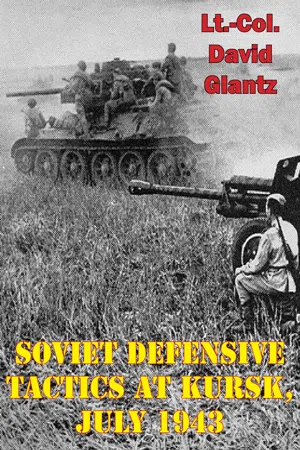
Soviet Defensive Tactics At Kursk, July 1943
About this book
In his classic work, On War, Carl von Clausewitz wrote, "As we shall show, defense is a stronger form of fighting than attack." A generation of nineteenth century officers, nurtured on the study of the experiences of Napoleon and conditioned by the wars of German unification, had little reason to accept that view. The offensive spirit swept through European armies and manifested itself in the regulations, plans, and mentality of those armiehe events of 1939, 1940, and 1941 in Poland, France, and Russia respectively again challenged Clausewitz' claim of the superiority of the defense and prompted armies worldwide to frantically field large armored forces and develop doctrines for their use. While blitzkrieg concepts ruled supreme, it fell to that nation victimized most by those concepts to develop techniques to counter the German juggernaut. The Soviets had to temper a generation of offensive tradition in order to marshal forces and develop techniques to counter blitzkrieg. In essence, the Soviet struggle for survival against blitzkrieg proved also to be a partial test of Clausewitz' dictum. In July 1943, after arduous months of developing defensive techniques, often at a high cost in terms of men and material, the Soviets met blitzkrieg head-on and proved that defense against it was feasible. The titanic, grinding Kursk operation validated, in part, Clausewitz' views. But it also demonstrated that careful study of force organization and employment and application of the fruits of that study can produce either offensive or defensive victory. While on the surface the events of Kursk seemed to validate Clausewitz' view, it is often forgotten that, at Kursk, the Soviets integrated the concept of counteroffensive into their grand defensive designs. Thus the defense itself was meaningless unless viewed against the backdrop of the renewed offensive efforts and vice versa. What Kursk did prove was that strategic, operational, and tactical defenses could counter blitzkrieg.
Tools to learn more effectively

Saving Books

Keyword Search

Annotating Text

Listen to it instead
Information
Tactical Defenses in the Summer of 1943
By the summer of 1943, Soviet tactical defenses had evolved from their non-contiguous nature to a dense, deeply echeloned trench defense system, providing greater protection for infantry and a more secure environment for maneuver of forces and fire support weaponry along the front and in the depth of the defense (see figure 8). The width of defensive sectors decreased, and the depth of the defense increased.

Figure 8. Rifle Corps/Division Combat Formation-Defense, Summer-Fall 1943
A rifle corps normally deployed with two rifle divisions in the first tactical defense belt and one rifle division in the second belt. Rifle divisions defended in one or two echelons of regiments, and rifle regiments in two echelons of battalions supported by artillery groups, antitank strong points and regions, artillery antitank reserves, and mobile obstacle detachments. A first-echelon rifle division in a main defense sector normally defended on a front of eight to fifteen kilometers, to a depth of five to six kilometers. On secondary directions, rifle divisions defended sectors twenty-five kilometers wide.{13}
Antitank defenses matured as the Soviets increasingly integrated antitank strong points and regions throughout the entire depth of the defense. Separate tank brigades, tank regiments, and self-propelled gun regiments, attached to the rifle division and kept in reserve, delivered counterattacks or reinforced first-echelon rifle regiments by deploying as mobile or fixed firing points. Defense, in general, became more durable and mobile in terms of bath rifle units and supporting fires. Above all, integration of all types of units and weapons was more thorough than before. Greater force availability permitted even army- and front-scale counterattacks in support of defending forces.
By the summer of 1943, the rifle corps provided the nucleus of an army’s tactical defense (the rifle corps command link was re-established beginning in late 1942) (see figure 9). Whereas rifle divisions had formed the tactical defense zone in the Moscow and Stalingrad operations, at Kursk the rifle corps performed that function. As a rule the rifle corps at Kursk deployed in two echelons, with two rifle divisions in the first echelon and one in the second echelon. So arrayed, the corps defended to a depth of fifteen to twenty kilometers (three to four times the depth of division defenses at Stalingrad), the corps had no support units. In addition to the rifle divisions, the rifle corps fielded only an antitank reserve, a tank reserve* and a mobile obstacle detachment.
The rifle divisions within the rifle corps normally deployed in two echelons of rifle regiments, with a combined arms and an antitank reserve (see table 1 and figures 10, 11.) {14} In addition, divisions formed infantry support artillery groups, a long-range artillery group of two to three artillery battalions, and a mobile obstacle detachment consisting of a sapper company equipped with mines. Some divisions also had tank reserves. For antitank defense, the division farmed nine to twelve antitank strong points and antitank regions throughout the depth of its combat formation, which, likewise, increased to from five to eight kilometers. ‘The division’s defensive sector correspondingly shrunk to a width of six to nine kilometers, increasing tactical densities to 0.7 to 1.3 rifle battalions, 18 to 30 guns and mortars, and 2 to 4 tanks per kilometer of front.{15}

Figure 9. Combat Formation 25th Guards Rifle Corps, 7th Guards Army, July 1943

Figure 10. Combat Formation 78th Guards Rifle Division, July 1943

Figure 11. Combat Formation 52d Guards Rifle Division Formation, Kursk, July 1943
Soviet tactical defenses at Kursk included a series of defensive positions and belts occupied by rifle companies, battalions, regiments, divisions, and corps that were linked together by engineer measures and tied in with the supporting fires of antitank and antiaircraft artillery; and tactically employed armored battalions, regiments, and brigades, backed up by infantry and armored operational reserves.
Engineer measures which glued the entire defensive structure together had been mandated by April 1943 Instructions on the Construction of Field Defenses issued by the General Staff on the basis of analysis of war experiences.{16} The instructions required the creation of battalion defensive regions, linked together by elaborate trench systems and laced with antitank defenses, as the basis for each defensive belt.
The tactical defense zone contained two defensive belts.{17} The first (main) defensive belt consisted of three defensive positions, cut-off positions (switch lines), and artillery firing positions occupied by the rifle corps’ first-echelon rifle division. The battalion defensive region (2 kilometers frontage and 1.5 to 2 kilometers depth) provided the basis for the three defensive positions. In turn, the battalion region was subdivided into company and platoon strongpoint.
The first defensive position, designated to engage the enemy in front of the defenses and to absorb the first enemy blows, engineer preparation (see figure 12). Involved the most thorough It consisted of two to three trench lines and communication trenches, interspersed with engineer obstacles, and was occupied by the two first-echelon rifle battalions of first-echelon rifle regiments. Infantry and heavy weapons in the second and third trenches, located 150 to 250 meters and 1 to 1.5 kilometers from the first trench respectively, provided covering fires for trenches to their front and gave depth to the battalion defensive region.
The second-echelon rifle battalion of the first-echelon rifle regiment occupied the second defensive position that consisted of one or two trenches, two to three kilometers from the forward edge of the battlefield. Deployed in company strong points or in battalion defensive regions, troops of the second defensive position covered those in the first position, contained supporting artillery and tanks, and provided a base from which to launch local counterattacks. Second-echelon rifle regiments of first-echelon rifle divisions manned the third defensive position that was composed of one or two trenches, four to six kilometers from the forward edge of the battlefield. The division reserve formed in the third defensive position or nearby. The third position, although less fortified than the first two, provided a basis for new defense lines against penetrating enemy forces, contained additional fire support, and provided a region from which to launch counterattacks. Cut-off positions, normally running diagonally or perpendicularly to the front, consisted of one or two trenches and served as interior defensive lines or routes for redeployment of forces between sectors. They also covered the flanks of defending units and threatened the flanks of penetrating enemy units.

Figure 12. 151st Rifle Regiment, 8th Rifle Division Defensive Position, 29 June 1943
The second defensive belt, less well prepared by the engineers than the first, was located ten to fifteen kilometers from the first belt. The second-echelon rifle divisions of the rifle corps occupied the second defensive belt and had the mission of preventing enemy units that penetrated the first belt from advancing into the operational rear of the defense. In addition, the second defensive belt covered the maneuver into combat of forces from the rear and provided another base from which to launch counterattacks. The depth of the second defensive belt forced the enemy, after overcoming the first belt, to regroup its forces and disperse its artillery prior to engaging the defenders of the second defensive belt.
The elaborate trench system provided increased security to rifle forces, improved the durability of the defense, and provided for freer maneuver of forces during combat. Engineer preparation of the battlefield also inhibited movement of the enemy, in particular the armored units. Antitank obstacles reinforced the natural barriers available, and liberal use of mines further threatened enemy personnel and tanks alike. A July 1943 Stavka order prescribed the laying of mines to the depth of the defense integrated with defensive fires of the infantry and artillery, with emphasis on main attack avenues into defensive positions,{18} Specifically, the order required that mines be employed in groups of over 100 mines sown six to ten meters apart in unequal rows. The rows themselves were to be fifteen to forty meters apart but not parallel. Accordingly, the minefields at Kursk achieved densities of 1,700 antipersonnel mines and 1,500 antitank mines per kilometer of front.{19} The highest density of mines was forward of and within the first defensive position. Thus at Kursk, each battalion defensive region of the 25th Guards Rifle Corps (of 7th Guards Army) had an average 1.6 kilometers of barbed wire covering its position, and 1,000 antitank mines emplaced per kilometer of their defensive frontage. On 15th Army’s 81st Rifle Division’s front, the 1,000 emplaced antitank mines accounted for the destruction or disabling of seventeen of forty enemy tanks which took part in the initial German assault.{20}
Artillery of all types and calibers provided resilience to the defense and produced the necessary attrition in enemy forces. Prior to Kursk, an absence of large quantities of artillery, together with Soviet lack of skill in properly integrating artillery into defenses and employing it when under assault, contributed to German success in penetrating Soviet defenses. By July 1943, new regulations, derived from the analysis of war experiences, and the improved skill of Soviet commanders produced more effective use of artillery.
Indirect artillery fire, under control of unit commanders at each echelon, was coordinated with the operations of infantry and armor. Rifle corps commanders designated artillery missions and the location of corps and division antitank regions. The rifle division commander organized the fires of divisional weapons covering the areas immediately forward of the forward defense, the depth of the division’s defenses, the division’s flanks, and in the gaps between units. Regimental commanders controlled regimental artillery support group fires and directed battalion fires covering the gaps in regimental defenses. Battalion commanders coordinated the fires of organic artillery and that of subordinate rifle companies. In addition, divisional artillery participated in the artillery preparation or the counter preparation fired under army control.{21}
Effective use of antitank artillery was critical for a successful defense against blitzkrieg tactics. Before July 1943, Soviet antitank fire had taken a toll of enemy armor but had never halted a major offensive spearheaded by massed armored units. The Soviets used the experiences gathered from numerous failures to create a thorough antitank defense at Kursk and thereafter. The antitank defense was based on the use of deeply echeloned antitank forces integrated into every level of command (see figures 13-15). The majority of antitank units and weapons performed an active role in the defense by occupying antitank regions or strong points scattered throughout the defense and massed on likely tank approaches into the defense. Other large antitank forces, supplemented by mobile obstacle detachments, served as antitank reserves at every level of command.{22} {23}

Figure 13. Combat Formation—Antitank Defense—Rifle Division, Kursk, July 1943

Figure 14. Antitank Defense, 375th Rifle Division, July 1943

Figure 15. Combat Formation—1241st Rifle Regiment, 375th Rifle Division Kursk, 5 July 1943
Antitank strong points (ATSPs) and antitank regions (ATRs) integrated antitank fire and the fire of infantry and artillery cloaked within the protection of engineer defenses. The ATSPs were formed in company defensive regions and combined their fi...
Table of contents
- Title page
- TABLE OF CONTENTS
- Introduction
- Soviet Tactical Defense Prior to Kursk
- Tactical Defenses in the Summer of 1943
- Strategic and Operational Context
Frequently asked questions
Yes, you can cancel anytime from the Subscription tab in your account settings on the Perlego website. Your subscription will stay active until the end of your current billing period. Learn how to cancel your subscription
No, books cannot be downloaded as external files, such as PDFs, for use outside of Perlego. However, you can download books within the Perlego app for offline reading on mobile or tablet. Learn how to download books offline
Perlego offers two plans: Essential and Complete
- Essential is ideal for learners and professionals who enjoy exploring a wide range of subjects. Access the Essential Library with 800,000+ trusted titles and best-sellers across business, personal growth, and the humanities. Includes unlimited reading time and Standard Read Aloud voice.
- Complete: Perfect for advanced learners and researchers needing full, unrestricted access. Unlock 1.4M+ books across hundreds of subjects, including academic and specialized titles. The Complete Plan also includes advanced features like Premium Read Aloud and Research Assistant.
We are an online textbook subscription service, where you can get access to an entire online library for less than the price of a single book per month. With over 1 million books across 990+ topics, we’ve got you covered! Learn about our mission
Look out for the read-aloud symbol on your next book to see if you can listen to it. The read-aloud tool reads text aloud for you, highlighting the text as it is being read. You can pause it, speed it up and slow it down. Learn more about Read Aloud
Yes! You can use the Perlego app on both iOS and Android devices to read anytime, anywhere — even offline. Perfect for commutes or when you’re on the go.
Please note we cannot support devices running on iOS 13 and Android 7 or earlier. Learn more about using the app
Please note we cannot support devices running on iOS 13 and Android 7 or earlier. Learn more about using the app
Yes, you can access Soviet Defensive Tactics At Kursk, July 1943 by Colonel David M Glantz in PDF and/or ePUB format, as well as other popular books in History & European History. We have over one million books available in our catalogue for you to explore.