- 90 pages
- English
- ePUB (mobile friendly)
- Available on iOS & Android
eBook - ePub
Rome In The Teutoburg Forest
About this book
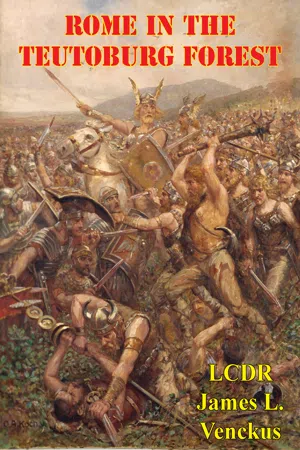
This paper examines the battle of Teutoburg (9 A.D.), its consequences on the Roman world, and the role cultural misunderstanding played on the tactical, operational, and strategic levels. The Roman commander's cultural misunderstanding of his enemy caused mistakes at the operational and tactical levels, while the Roman Emperor's cultural misunderstanding brought about mistakes at the strategic level and created poor policy decisions following the battle, which affected Rome like no other battle in its history. Chapter 2 examines the consequences of other Roman loses (with much higher casualties) to show how none of them carried the same impact as the Teutoburg loss. They were but temporary "setbacks", while Teutoburg was Rome's first military "defeat" in its history. The Roman direction of conquest into Germania and the image of the pre-Teutoburg Germanic barbarian (an image which changes greatly into an elevated status following the massacre) are also examined. Chapter 3 examines the commanders of both sides and the battle itself. Chapter 4 looks at the significance of this loss. This battle caused Rome to adopt its first permanent defensive boundary and set the first limit of the Roman Empire.
Tools to learn more effectively

Saving Books

Keyword Search

Annotating Text

Listen to it instead
Information
CHAPTER 1 — INTRODUCTION
In 9 A.D. Germanic “barbarians” slaughtered three Roman legions. The Germans ambushed and massacred these Romans as they marched through what the Romans believed friendly territory, at a location known as the Teutoburg Forest.{1} Eighteen thousand Romans died as a result of their commander’s mistakes.{2} The Roman commander, Publius Quinctilius Varus, misunderstood his Germanic enemy and the operational environment. Varus negligently assumed a lax marching order. He also failed to adjust to his situation and recognize multiple factors from terrain to weather, which negated his legions abilities and placed them in a vulnerable position, resulting in the Roman massacre.
However, Rome had suffered much greater defeats throughout its history. At Cannae in 216 B.C., Rome lost over three times the number of soldiers at Teutoburg.{3} The Carthaginians under Hannibal defeated Rome at this battle, yet this only spurred Rome to destroy Carthage and continue Roman expansion through Carthaginian territory and even further into North Africa for centuries. Cannae serves as the typical Roman response to a military loss. Traditionally, when the Romans lost they returned and continued their path of conquest. They regrouped and acquired both the province and the people through conquest and assimilation.
This Roman mindset carried forward to their frontier policies and mirrored itself time and time again in their conquest and assimilation of provinces for over 200 years. At the battle of Carrhae 53 B.C., the Romans lost twice as many soldiers than at Teutoburg. Yet, when the Parthians destroyed these 30,000 Romans, Rome responded the same as against the Carthaginians.{4} The Romans returned with a vengeance and continued to conquer Parthian territory expanding the Empire eastward for another 200 years.
Yet after Teutoburg in 9 A.D., Rome never acquired territory east of the Rhine, and of course this portion of Germania never became a Roman province (refer to figure 1 below). Teutoburg’s true significance does not rest in the defeat itself, nor in the number of Romans killed; but in Rome’s reaction, and particularly, Augustus’ reaction. For the first time in Roman history, Rome established a defensive mindset. Teutoburg literally drew the limits of the Roman Empire, an Empire which before 9 A.D. held none.

Figure 1. The Roman Empire
Source: Adrian Goldsworthy, The Complete Roman Army (London, England: Thames and Hudson, 2003), 14-15.
The question then becomes; why did the Roman mindset change because of Teutoburg? Where Varus’ cultural misunderstanding on the tactical and operational levels led to the Roman massacre, Augustus’ misunderstanding enacted policies which brought on strategic ramifications like no battle in Roman history.{5} This misunderstanding inflated the Germanic threat to the Roman Empire as Augustus enacted unsound post-Teutoburg policies, such as conscription. Couple the Emperor’s unpopular actions with the unique nature of the Germanic foe and this molded Roman perceptions of Germanic “barbarians” into an elevated image which affected Roman policy and society to an unparalleled level in Roman history.
Augustus and his advisors established an inaccurate image of the Germanic barbarians. The emperor made rash judgments immediately following the Teutoburg debacle, which, had he better understood his Germanic foe, he and his advisors would have recognized as unsound and the policy decisions based on them, unnecessary. Yet he created a perception that soon became a reality to the Roman world. This caused Teutoburg to produce strategic ramifications unlike any other battle in Rome’s history. Before Teutoburg, all other Roman loses proved to be merely temporary setbacks, but Teutoburg proved to be Rome’s real first military defeat in that it permanently halted Rome’s expansion in that area. Teutoburg established Rome’s first permanent defensive frontier along the Rhine.
This examination begins in chapter 2 and provides a juxtaposition of two other Roman battles, as well as their results, to demonstrate the increased significance of the Teutoburg battle. Cannae (216 B.C.) demonstrated the Roman mindset following a military loss, which united Roman will and continued their conquest of Carthage and their territories. This response established the Roman mindset which carried over to Rome’s frontier policies. One-hundred and fifty-years later, another Roman military loss against the Parthians on Rome’s eastern frontier mirrored the results in 216 B.C. After Carrhae in 53 B.C. the Romans again united and continued their expansion into Carthanian territories for centuries.
Roman and Germanic relations and events leading up to Teutoburg are also examined. Both the Roman historians and modern archeology reveal Roman settlements, construction projects and actions of the pre-Teutoburg Roman world which demonstrate that the Romans had every intention of making Germania a Roman province.{6} Germania would be no different from Gaul or Spain and Rome planned to assimilate the Germanic lands and people into the Roman Empire. Rome flourished both along the Rhine and east of the river until the Teutoburg massacre.
The literary record will also be examined through pre-Teutoburg writers, such as Julius Caesar, who portrayed the pre-Teutoburg Roman view of Germans as just another “barbarian.” A portrayal in striking contrast to post-Teutoburg Roman writers, such as Tacitus, who depicted German barbarians in an elevated status as the most dreaded of all Roman foes. In the post-Teutoburg Roman view, Germania took on a permanent existence in the eyes of the Romans, dividing a border which would always lie beyond the Roman Empire. The Teutoburg massacre created this mindset difference.
Chapter 3 will provide an examination of both the Roman and Germanic commanders, Publius Quinctilius Varus and Arminius. This analysis highlights Varus’ previous experience before his posting to Germania as well as Arminius’ abilities and his intricate planning of the Teutoburg ambush. Varus’ cultural misunderstanding of his Germanic foe is revealed through multiple instances from inadequate march security to over trusting his Germanic “allies.”
The massacre itself will be examined through the account of Cassius Dio, also comparing his account with modern historic views as well as what the archeological evidence has brought to light in shaping the battlefield. This chapter reveals Germanic warriors with the advantage of familiar surroundings, enhanced by Arminius’ detailed preparations of the ambush site. The massacre also shows a Roman side with soldiers whose commander sent them on a march in a relaxed state. Varus failed at multiple key decision points along his march by not modifying his formation based on the terrain features and the weather, causing Varus to lose the effectiveness of his Roman scouts and his cavalry. The Teutoburg environment continued to exacerbate Roman susceptibility by fatiguing the legionnaires, through the duties that came with these conditions, such as conducting counter-mobility operations clearing trees and keeping the road accessible.
This is followed in chapter 4 with an examination of the results of the Teutoburg massacre. Varus’ failure influenced the Roman strategic theater like no other battle in Roman history. Augustus and his advisors also failed to understand their Germanic foe’s culture immediately following Teutoburg and this resulted in Augustus enacting rash policy decisions. These unsound decisions negatively affected the Roman people to an extent that not only limited Augustus’ ability to deal with the Germans, but affected any potential for future Roman expansion. Augustus’ harsh post-Teutoburg policies included reinstituting conscription and extending veteran service. These policies alienated the Roman people. This alienation caused Rome to halt further conquest in the region which set the first real limit on the Roman Empire.
Yet Augustus could have avoided this by enacting more moderate post-Teutoburg policies. Augustus and his advisors failed to assess the Germanic situation following Teutoburg and, thus, they viewed the loss out of context. Augustus failed to analyze the Germanic tribes carefully (including their inability to engage the Romans in open battle, conduct sieges, or supply themselves logistically on an extended campaign against Rome). He also failed to examine other international players and viewed only one Germanic course of action of these barbarians attacking Rome (when in fact Arminius led his Germanic tribes against another barbarian leader in the East following Teutoburg).
The Roman reaction to the 9 A.D. defeat is examined in the context of both Roman military changes and governmental policies (especially assimilation). The image of the Germanic “barbarian” will also be placed in the framework of Teutoburg to show how Rome’s elevation of Germania stems from the contrasts of the Germanic barbarian with Roman society. This ties into Augustan policies that began and cemented this shift of the Roman mindset, a result of Teutoburg, which ultimately broke Rome’s perception of success. Augustus’ conscription actions suggest he attempted to continue Roman conquest of Germania, but recognizing the lack of Roman will and anti-conscription actions, Augustus needed to shift his strategic aim to internal control (against possible Roman Senate opposition). Rome halted conquest of Germania and shifted to a permanent defensive mindset for the first time in history, constructing a permanent border on the Rhine, when before Teutoburg there stood none
This study provides a clearer understanding of Teutoburg and the effects of this massacre. It addresses the military, political, social, and cultural issues that created great policy and mindset changes which ultimately shaped Rome greater than any battle in its history. This work also demonstrates historical lessons from both military (commander’s) and political (Emperor’s) viewpoints as well as the immense ramifications that result in the cultural misunderstanding of an enemy.
Sources
The sources for this research rely heavily on the Roman writers. Cassius Dio’s (150-235 A.D.) , Roman History, provides the only Roman surviving account of the Teutoburg battle. Julius Caesar provided an important account of the pre-Teutoburg Roman world and the Germanic barbarian in his account, The Conquest of Gaul (58 to 51 B.C.). While Cornelius Tacitus’ accounts, particularly, The Germania (98 A.D.) are instrumental as well for providing a post-Teutoburg Roman mindset of the Germanic barbarians. Yet multiple other ancient writers from Velleius Paterculus (30 B.C. to 37 A.D.), who provides information on Teutoburg’s participants, to Polybius(203 to 120 B.C.) and Psuedo-Hyginus (3rd century A.D.), who both give valuable descriptions of Roman camps all contribute to this research. Josephus’, The Jewish War (67 A.D.), Flavius Arrianus’, The Expedition Against the Alans (134 A.D.), and Vegetius, The Military Institutions of the Romans (379 A.D.), also help examine multiple Roman military issues, such as the details of the Roman march.
The Battle of Teutoburg has been addressed in two contemporary books. The first by the archeologist and professor of Anthropology Peter S. Wells in his book, The Battle That Stopped Rome: Emperor Augustus, Arminius, and the Slaughter of the Legions in the Teutoburg Forest. The second by historian Adrian Murdoch, Rome’s Greatest Defeat: Massacre in the Teutoburg Forest and both these modern accounts proved invaluable to this research.{7} For a better understanding of the Roman army, from strategy and tactics to its connections with Roman society, multiple sources were used. Several books by Adrian Goldsworthy including, The Complete Roman Army and The Roman Army at War 100 BC-AD 200 to Edward N. Luttwak’s, The Grand Strategy of the Roman Empire From the First Century A.D. to the Third proved insightful.
While for comparing previous battles, books such as The Defeat of Rome in the East: Crassus, the Parthians, and the Disastrous Battle of Carrhae, 53 B.C. by Gareth C. Sampson proved highly useful. Additional details of Germanic society and its interactions with the Roman Empire are accomplished through a final cornerstone to this research; and historian Kenneth W. Harl, Tulane University, with his lecture series in thirty-six parts entitled, Rome and the Barbarians, proved invaluable.
CHAPTER 2 — PRE-TEUTOBURG ROME
Historical Roman Reaction to a Battlefield Loss
To understand the unparalleled Roman response to Teutoburg and the Roman mindset shift, it is necessary to first examine pre-Teutoburg Roman defeats. Roman losses before 9 A.D. amounted to mere military setbacks, whereas Teutoburg marked Rome’s first military defeat. The examination of two battles will demonstrate this.
The Romans lost three legions in the Teutoburg forest. The Germa...
Table of contents
- Title page
- TABLE OF CONTENTS
- ABSTRACT
- ACKNOWLEDGMENTS
- CHAPTER 1 - INTRODUCTION
- CHAPTER 2 - PRE-TEUTOBURG ROME
- CHAPTER 3 - THE MASSACRE OF TEUTOBURG
- CHAPTER 4 - CONSEQUENCES OF THE TEUTOBURG MASSACRE
- CHAPTER 5 - CONCLUSION
- BIBLIOGRAPHY
Frequently asked questions
Yes, you can cancel anytime from the Subscription tab in your account settings on the Perlego website. Your subscription will stay active until the end of your current billing period. Learn how to cancel your subscription
No, books cannot be downloaded as external files, such as PDFs, for use outside of Perlego. However, you can download books within the Perlego app for offline reading on mobile or tablet. Learn how to download books offline
Perlego offers two plans: Essential and Complete
- Essential is ideal for learners and professionals who enjoy exploring a wide range of subjects. Access the Essential Library with 800,000+ trusted titles and best-sellers across business, personal growth, and the humanities. Includes unlimited reading time and Standard Read Aloud voice.
- Complete: Perfect for advanced learners and researchers needing full, unrestricted access. Unlock 1.4M+ books across hundreds of subjects, including academic and specialized titles. The Complete Plan also includes advanced features like Premium Read Aloud and Research Assistant.
We are an online textbook subscription service, where you can get access to an entire online library for less than the price of a single book per month. With over 1 million books across 990+ topics, we’ve got you covered! Learn about our mission
Look out for the read-aloud symbol on your next book to see if you can listen to it. The read-aloud tool reads text aloud for you, highlighting the text as it is being read. You can pause it, speed it up and slow it down. Learn more about Read Aloud
Yes! You can use the Perlego app on both iOS and Android devices to read anytime, anywhere — even offline. Perfect for commutes or when you’re on the go.
Please note we cannot support devices running on iOS 13 and Android 7 or earlier. Learn more about using the app
Please note we cannot support devices running on iOS 13 and Android 7 or earlier. Learn more about using the app
Yes, you can access Rome In The Teutoburg Forest by LCDR James L. Venckus in PDF and/or ePUB format, as well as other popular books in History & Ancient History. We have over one million books available in our catalogue for you to explore.