- 42 pages
- English
- ePUB (mobile friendly)
- Available on iOS & Android
eBook - ePub
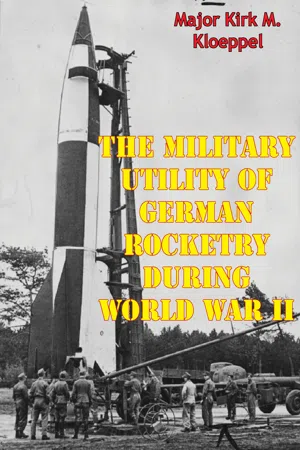
The Military Utility Of German Rocketry During World War II
About this book
The Tomahawk cruise missile, the conventional Air Launched Cruise missile, and the SCUD surface-to-surface missile each made an impact during the Gulf War. The cruise missiles were instrumental in incapacitating the Iraqi electrical network. The SCUD missile was not as successful, but did divert the coalition air campaign. Although never utilized, the sister of the SCUD missile, the intercontinental ballistic missile, was pivotal during the Cold War. Each of these weapons can trace their initiation to the development of the German V-1 flying bomb and V-2 rocket during World War II.
The German weapons were not as successful as their antecedents. This paper will inspect the military utility of the weapons during World War II. Initially, the paper will define the actors behind the development, and describe the resulting weapons. Next, the essay will examine the strategy in weapon utilization. The paper will quantify the damage caused by both weapons. Then, the document will describe offensive and defensive countermeasures employed by the Allies. The question of the weapons' military utility will be addressed. Finally, alternatives to the weapons development, production, and employment will be presented.
The German weapons were not as successful as their antecedents. This paper will inspect the military utility of the weapons during World War II. Initially, the paper will define the actors behind the development, and describe the resulting weapons. Next, the essay will examine the strategy in weapon utilization. The paper will quantify the damage caused by both weapons. Then, the document will describe offensive and defensive countermeasures employed by the Allies. The question of the weapons' military utility will be addressed. Finally, alternatives to the weapons development, production, and employment will be presented.
Tools to learn more effectively

Saving Books

Keyword Search

Annotating Text

Listen to it instead
Information
Chapter 1 — Description and Technical Development
“Since the enormous loss of bomber planes as a result of the attacks against England in 1940, my colleagues and I have been firmly convinced that a defeat in the air war on the western front could be prevented, if at all, only by the employment of guided missiles of very great range and effect.”—Gen. Walter Dornberger, V-2
An important aspect of understanding the development of the two German long-range weapons of World War II is the organizations orchestrating that development. The A-4, later known as the V-2 rocket, was spearheaded by the Ordnance Branch of the German Army. The Luftwaffe developed the V-1 flying bomb. Instead of a coordinated weapons development program, the High Command allowed the services to manufacture new weapons with little oversight or collaboration. More importantly, the military developed weapons with little strategic or operational vision for their eventual military use.
V-2 Rocket
Actors
Following World War I, a majority of artillery officers led the remnants of the German Army. During the war, both the Allies and the Central Powers used artillery to try to break the stalemate that developed with trench warfare. The influence of the Army’s artillery branch resulted in longer-range artillery pieces sending larger shells against a well-entrenched enemy.
General Walter Dornberger. Walter Dornberger was probably the single most influential individual for the development of the V-2 rocket. He was the chief salesman, marketer, and integrator of the rocket for the military. His involvement with the rocket program has its roots during World War I where General Dornberger was an artillery officer working on the Paris Gun. Next to the airplane, the Paris Gun was the most technologically advanced weapon of World War I. The gigantic gun sat on a railroad track lobbing shells with 22 pounds of explosives over 70 miles into Paris. The hope was that the shelling would affect the morale of the French and result in a shortening of the war. Unfortunately, the gun was at the limit of artillery capability resulting in a little over three hundred shells falling on Paris. His experience with the Paris Gun foreshadowed those to come with the V-2 rocket.
Walter Dornberger was also a space enthusiast. He began to postulate with others the possibility of using rockets for military success. The Treaty of Versailles limited the ability of the Germans to conduct military research after World War I. However, the treaty did not foresee the emergence of rocket technology after the war. For Dornberger, rockets were the next horizon for artillery. Sufficient numbers of accurate rockets raining down on cities would bring the civilian populace to its knees. What had not worked with the Paris Gun would be successful with the rocket.
Dornberger stated the requirements for the rocket program using the Paris Gun as an example. The rocket must have a warhead one hundred times the Paris Gun and traverse twice the distance. General Dornberger stated the accuracy requirements in artillery terms. Fifty percent of the missiles must fall within a circle of two to three “mils”—0.2 to 0.3 percent of total range. After traveling 200 miles, the rocket must be within a half a mile approximately. The final requirement was that the missile body must be transportable and fit within a standard European railroad tunnel.{1}
During World War II, General Dornberger would become the passionate advocate for the development and production of the rocket. He personally lobbied Albert Speer, Director of Armaments, and Adolf Hitler for increased priority. He championed program successes and downplayed delays resulting in Hitler conferring the highest priority for the program by 1943. The V-2 would not have finished development, besides reached production, without the General’s constant dedication.
Werner von Braun. The next most influential individual during the development of the V-2 was Werner von Braun. Von Braun was from an aristocratic family in Germany. Like General Dornberger, he shared an interest in space flight. He joined the rocket team in the early 1930’s while in his early twenties. Von Braun was the brains behind the technology that would make the V-2 a success. He oversaw the infancy of the liquid rocket program. His influence increased during the successes and successful “failures” of the A-1 through A-3.
Werner von Braun was instrumental in solving the three biggest technical obstacles facing the A-4. These obstacles were the development of the missile gyroscope, high speed aerodynamics, and rocket engine development. Although, the Germans shrouded the rocket development in secrecy, von Braun was able to incorporate the work of scientists throughout Germany. He basically taught himself aerospace engineering throughout the development of the rocket.
After the war ended, Werner von Braun brought his knowledge from the rocket program to the United States. His assistance plus his staff initiated the American military rocket programs and the National Aeronautics and Space Administration (NASA). His work resulted in the successful launch of astronauts to the moon, thereby satisfying a lifelong dream of space flight.
Werner von Braun was more than just a space enthusiast. While his contributions to NASA are immeasurable, von Braun also proudly served Germany. Although he did not initiate the use of slave laborers at the production facilities at Peenemünde and Mittelwerk, he did not press to discontinue their use. He continued to devote his time in solving the technical hurdles that befell the program. His expertise was pivotal in the deployment of the rocket during World War II.
Missile Description
Eventually, the V-2 surpassed most of its technical and bureaucratic (service and government agency rivalry) obstacles. The final product was a 46-foot tall rocket with a dry weight of almost 9,000 pounds and a warhead of over one ton (see Figure 1).
Launch crews would transport the rocket on a Meillerwagen (a trailer used to transport, erect, and launch the V-2) to the launch site. Once at the site, the crews would elevate the missile to vertical launch position. Final checks and gyroscope alignment would occur before launch. Once launched, the engine would mix alcohol (derived from potatoes) and liquid oxygen to propel the rocket to an apex of 50 miles. After approximately sixty seconds, the engine would stop. During the climb, the rocket would pitch to 45° and continue to the target. Approximately 200 miles down range and five minutes after launch, the V-2 would impact the target area. The rocket would impact with supersonic velocity with little warning to the inhabitants. (See Appendix A for further rocket specifications)

Source: US Strategic Bombing Sur...
Table of contents
- Title page
- TABLE OF CONTENTS
- Preface
- Chapter 1 - Description and Technical Development
- Chapter 2 - Operational Employment and Targeting Strategy
- Chapter 3 - Allied Countermeasures
- Chapter 4 - Assessment of Military Utility
- Chapter 5 - Conclusion
- Appendix A - V-1 Characteristics
- Appendix B - V-2 Characteristics
- Glossary
- Bibliography
Frequently asked questions
Yes, you can cancel anytime from the Subscription tab in your account settings on the Perlego website. Your subscription will stay active until the end of your current billing period. Learn how to cancel your subscription
No, books cannot be downloaded as external files, such as PDFs, for use outside of Perlego. However, you can download books within the Perlego app for offline reading on mobile or tablet. Learn how to download books offline
Perlego offers two plans: Essential and Complete
- Essential is ideal for learners and professionals who enjoy exploring a wide range of subjects. Access the Essential Library with 800,000+ trusted titles and best-sellers across business, personal growth, and the humanities. Includes unlimited reading time and Standard Read Aloud voice.
- Complete: Perfect for advanced learners and researchers needing full, unrestricted access. Unlock 1.4M+ books across hundreds of subjects, including academic and specialized titles. The Complete Plan also includes advanced features like Premium Read Aloud and Research Assistant.
We are an online textbook subscription service, where you can get access to an entire online library for less than the price of a single book per month. With over 1 million books across 990+ topics, we’ve got you covered! Learn about our mission
Look out for the read-aloud symbol on your next book to see if you can listen to it. The read-aloud tool reads text aloud for you, highlighting the text as it is being read. You can pause it, speed it up and slow it down. Learn more about Read Aloud
Yes! You can use the Perlego app on both iOS and Android devices to read anytime, anywhere — even offline. Perfect for commutes or when you’re on the go.
Please note we cannot support devices running on iOS 13 and Android 7 or earlier. Learn more about using the app
Please note we cannot support devices running on iOS 13 and Android 7 or earlier. Learn more about using the app
Yes, you can access The Military Utility Of German Rocketry During World War II by Major Kirk M. Kloeppel in PDF and/or ePUB format, as well as other popular books in History & European History. We have over one million books available in our catalogue for you to explore.