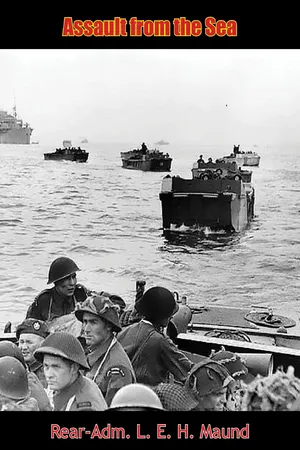
Assault from the Sea, first published in 1949, is Rear-Admiral Maund's account of the development of the Royal Navy's landing craft and their use operationally between 1939 and 1945.
"It is the purpose of this book to show how this knowledge and equipment were gradually collected. It starts in the days before the last war, when most people thought landing operations would be impossible, and traces their development to the days of the great awakening at Dunkirk and on to present times. It shows how developments in material, tactics and planning were evolved by original thought, training, planning operations and experiments and it indicates the influence of political and strategic considerations upon this development."—Preface
- 365 pages
- English
- ePUB (mobile friendly)
- Available on iOS & Android
eBook - ePub
Assault from the Sea
About this book
Trusted by 375,005 students
Access to over 1.5 million titles for a fair monthly price.
Study more efficiently using our study tools.
Information
Subtopic
European HistoryIndex
HistoryCHAPTER I — COMBINED OPERATIONS BETWEEN THE WARS
IT was a lovely summer’s day in 1938 and the Senior Officers’ Course, which I was attending at the Naval College at Greenwich, was drawing to a close when a message reached me in the lecture room that I was wanted on the telephone. The Naval Secretary at the Admiralty wished to see me that afternoon to tell me I had been appointed to a new post for the development of Combined Operations.
On a number of occasions during the course, strong views about our unpreparedness to undertake a landing attack of any kind had been voiced. That Japan had, not a year before, landed large armies in China with modern landing craft was said to be a reflection on Britain and her ability to keep abreast the times. The view, which was being widely accepted, that we should never need to land on enemy-held territory again was said to be ridiculous: our history told of a long sequence of landing attacks to capture or recapture places of importance to our strategy. To throw overboard the strategy of invasion and rely on investment to force our will on an enemy was declared to be as unreasonable as to throw away the belligerent rights which made investment possible, a policy keenly supported in the Foreign Office and Cabinet during the years 1928-9. Moreover, the reason given for the former policy, that air power would make landing attacks impossible in future, seemed as inadequate as the reason given for the latter, that it would please the United States—a view which the Americans exploded at the next Pan-American Conference.
It struck us at .Greenwich that so sweeping a statement was, to say the least of it, unwise, almost defeatist: hadn’t every weapon in the history of war found its antidote? True, it meant effort, but who was unwilling to make the effort 5 It had never been the habit of the Briton in the past to hold up his hands and say ‘It can’t be done’: or was it that Butter counted more than Guns at the hustings? All these views and many more, were voiced by the officers attending the course; they were certainly views which, if heard, would have shaken the confidence of those who saw no value in examining how an assault should be made from the sea.
So it was with good wishes that I set out to find out about my new appointment, though I sensed a slight threat behind some of their farewells! ‘I shall expect you to come and lecture at my Command twelve months hence to report progress,’ said Colonel J., ‘and don’t forget we shan’t be satisfied with just the promise of craft to be built in the future.’ That was splendid.
I discovered that my appointment was to be chairman of an Inter Service Training and Development Centre and that I would have with me Major M. W. M. MacLeod, R.A., Wing Commander Guy Knocker, and as adjutant, Captain Peter Picton-Phillips of the Royal Marines. We were to come directly under the Chiefs of Staff and our business was to study and advance the technique of combined operations. Our terms of reference were wide, and so it had every prospect of being good fun. I realized, however, that it meant saying goodbye to the early sea appointment which the First Sea Lord had promised me on my return from China in H.M.S. Danae. This was the one fly in the ointment, and the size of the fly can only properly be understood by a sailor whose one ambition since boyhood has been to command a ship. However, my previous experience of inter-Service work had always whetted my appetite for more. There had been four weeks inter-Staff College schemes for the capture of Singapore in 1923: there had been two combined-operations schemes of fourteen days with Quetta Staff College which my good master Admiral Richmond had sent me upon, yes and a landing of 1,000 men at Kasid, thirty miles south of Bombay, after the second Quetta scheme. I had learnt something of strategy standing beside my Admiral’s desk and with him at the 1925 Singapore Conference.
I had spent six months with an Air Force officer and an Army officer, writing the first Inter-Service Manual, on Coastal Operations and Command, a book that would never have been written but for the splendid work of our secretary, Colonel Ryan. This had been followed by two years as Assistant Director of Plans at the Admiralty, one of whose jobs it was to build up the naval aspect of future War Plans. I had just returned from China where I had watched the Japanese in battle with the Chinese at Shanghai and in the Yangtse with, their landing craft, and their ship which carried landing craft, about which we had known so little. This last experience had convinced me more than ever that an assault from the sea was as practicable today as it was 150 years ago, provided we would make the effort to overcome the difficulties which modern developments imposed. It was now for our little party, the Inter-Service Training and Development Centre (I.S.T.D.C.) to show that it was practicable, to indicate how the assault should go and to design and build the equipment that would make it practicable.
There is little doubt that the massacre on the beaches of Gallipoli played into the hands of those who could only conceive a strategy of attrition in France and Belgium. What was more, with the calling off of the attack against Turkey, there was no need to land on a coast against Germany as we were already in France. True we might have hastened the collapse of the Turks by landing behind them on the coast of Palestine, but would this advantage have justified the expenditure of effort demanded for a landing operation?.
The Gallipoli operations did, however, open our minds to the little we knew about landing operations, and you heard in discussions the reflection, ‘Well, what else could you expect if you land your men in craft not quite as suitable as those that were used by Julius Caesar in his attack on Britain?’ The operations were also much talked about in both the army and navy and discussions in and out of the staff colleges proceeded fiercely on the subject of what should or should not have been done during the Dardanelles operations: in a long war of attrition it was the one operation to show a flash of inspiration and strategic insight.
At the staff colleges, where thought is less rigid than in the Departments of State, inter-Staff College Combined Operation Schemes became the highlight of every course. For four weeks all three colleges worked hard at a set scheme, such as the capture or recapture of Hong Kong and Singapore—when such famous characters as Mr. Hoo-Flung-Dung, the sanitary inspector, were born—and to end up with all forgathered at Camberley and Sandhurst for a week and co-ordinated their proposals, listened to the Staff remarks on those proposals and got to know something of the problems and outlook of the other two Services. They were grand days, days of discussion about things entirely new, days with folk brought up in totally different atmospheres, and you went away, after a glorious last evening, realizing how ignorant you were about the whole business of making war. The need for a Combined Service Staff, like the German General Staff, for a single College of entry for all three Services and for all three staff colleges to share the same locality, were subjects that found enthusiastic supporters when the week at Camberley was over.
These meetings began in 1921 and it very soon became clear that they would have to be run on some accepted basis, some theoretical technique. And so, a Manual on Combined Operations was gradually built up year by year by the staff colleges. It was just a Roneoed document which grew and was altered and realtered as the result of experience at the yearly meetings. It was not an affair with which the Departments of State were much concerned, though, as time went by and landing practices on a small scale were undertaken by the fleet and the Army Commands, the Staff College Manual was found to be of considerable value.
On the material side, progress was even slower. The Dardanelles had impressed upon our staffs that something should be done. We should, for instance, produce a landing craft. The problem of the moment was who should pay for it. The War Office said that, being craft, they were a naval responsibility. The Admiralty pointed out that the craft had to carry soldiers not sailors so the money should be found by Army Votes: besides which the Naval Vote was insufficient to build the cruisers and destroyers essential to the security of our Empire, so how could Naval Votes be squandered on craft for soldiers? It was at last agreed that a Landing Craft Committee should be formed with representatives from all the authorities interested and that they should make recommendations on the design of landing craft. No policy for an assault was given the unfortunate committee to enable them to decide the type of craft they should build; all they could do was to listen to what the various members wanted to be able to land and then get the Director of Naval Construction to design accordingly. It was a large committee and so the demands were numerous. It met about once a year, had a yarn and went away again. But in the ten years ending 1930 they did produce three motor landing craft (M.L.C. later to be termed L.C.M.). With the wind in the right direction they would do five knots, the jet-propelling engine was a bit temperamental and much preferred a short journey to a long one, it would carry a 6-inch gun without its mountings, and a row of mules or ten tons of stores. Short wheel-based vehicles found it impossible to get out over the bow because of the acute angle of ramp with the deck, but that did not matter very much as the craft drew four feet six inches of water and vehicles in those days were not designed to land through any depth of water. From the personnel-carrying point of view it had no armour and was so noisy that no tactical surprise could be hoped for if the beach was manned by the enemy. She weighed twenty tons, and, because of her egg-like under-carriage, was not really at home on the flat deck of a merchant ship.
No, the Landing Craft Committee could not be very proud of their offspring, but why should they be; No one member was primarily concerned with the business of building the craft, it was everybody’s baby, and what was more it had been designed without an adequate tactical background.
However, by the year 1930 the Greatest Maritime Power in the world had three of these craft. Then something shocking happened. Italy made war on Abyssinia. The majority of people in England wanted to put Italy in her place, and stop aggression by the bullies at the outset. But the ten-year rule had only lately been rescinded and that rule required the Estimates of the three fighting Services to be based on there being no war for another ten years, day to day. So there wasn’t enough ammunition in the lockers to make war. It had been unpopular to point out that within two years, let alone ten, of every war we had been engaged in during the past 250 years, either our Prime Minister or Foreign Secretary had been able to tell the country that they could look forward to a long period of peace.
The Abyssinian war raised us from our lazy sleep and it was not long before the possibility of our having to land an expedition in the Red Sea or even in Italy was raised, and the Landing Craft Committee was called. The existing M.L.C. were given some bulletproof plates for the coxswain, and, still more stirring, an order was given for six more craft. We were clearly in earnest about this business of moving an expedition across the sea. Be that as it may, it was not till the winter of 1938, more than three years after Italy’s aggression, that the six poor little M.L.C. were built and could be stowed away in a shed at Gosport.
In 1937 came the next urge to get on with the job. The Japanese, coerced by their army in China and Manchuria, made war on China and, much to our surprise, the ‘Incident’ almost began with the arrival at Tientsin of 400 landing craft, and a 10,000-ton landing-craft carrier. Ingeniously, the carrier ejected landing craft two at a time out through her stern, while great ports in her side enabled vehicles or craft to be embarked and disembarked. The Maritime Power of the East had certainly been thinking originally and her views were clearly not those of Whitehall. Perhaps she had refused to accept glib statements about air power and landing attacks, and she had realized that where there was a will there was invariably a way.
I remember visiting some hundreds of these craft moored up in the Cut-off at Shanghai after the landings in the Yangtse and Whangpoo rivers. A Japanese sentry tried to be difficult, but we were really engaged in salving a houseboat belonging to a Briton which happened to be in the Cut-off. We had also enjoyed a stall’s view of the landing-craft carrier, as she was lying in the Yangtse off the entrance of the Whangpoo, the day in October 1937 when we sailed for England after our three months’ stay at Shanghai.
Authority was next worried by the question: why should the staff colleges spend so much of their time on combined operations if it was our accepted policy to rule out as impracticable any assault from the sea because of the advent of air power? It seemed a waste of time to give so much thought to the subject if we had not even the craft to carry out experimental work on a reasonable scale.
Then a proposal percolated up from the Director of the Naval Staff College that an Inter-Service Training and Development Centre should be set up to examine the whole problem and that two battalions of Royal Marines should be placed at the disposal of the Centre to carry out experiments. These proposals tipped the scales; at least they tipped them a good way. It was agreed that an Inter-Service Centre should be set up, but it need only consist of one officer from each Service and as the two battalions would cost money, the battalions would have to be cut out. Still, it was a decided step forward.
At this time, a landing operation was being planned at Portsmouth by the Admiral Commanding the Home Fleet Cruiser Squadron, Rear-Admiral Edward Collins, and by General Montgomery. The landing was to be made at Slapton, some six miles south-west of Dartmouth, and the beaches were to be defended. The attacking force went down Channel against a stiff west wind on board cruisers and destroyers. A trawler was anchored near a shoal off the beach to make sure the right beach was hit without anyone going ashore, and the oars of the pulling boats were muffled in the good Marryat style to prevent the defenders hearing the approach of the invaders. Complete tactical surprise could not be hoped for as the ships had to come close in to the beach, otherwise the boats would never have reached the shore, and, of course, the ships could be seen through glasses when they were manning and sending in their boats. There was a good deal of uncertainty about the weather on the beach during the journey down Channel, as it was blowing hard, but off shore, and it was not till an aircraft had been flown in and had reported the condition on the beaches to be good that it was decided to go ahead with the landing.
We steamed close in to the beach—it had been specially selected, because there was deep water close inshore—and quietly lowered our anchors on to the bottom at the northern end. The destroyers crossed ahead of us to land their troops near the hotel in the centre of the beach and capture the road bridge behind it; and were they glad to set foot on steady ground once more after their bucketing down Channel! The life of one colonel was saved by a flask of whisky brought to him as he floundered up the pebbly beach.
Standing on the bridge of the flagship, the future commander of the 8th Army and the Eastern Task Force in Sicily must have thought it strange to see the whalers and the cutters passing close under the ship on their slow, uncertain but muffled way to the shore. By the routes being taken it was clear the various boats’ compasses were undecided upon the real direction of the magnetic pole. This was not to be wondered at as rifles and mortars had become their boat-mates.
The small army of red tabs down from the War Office to witness the assault were of the opinion surprise had not been gained, though the imaginary gunfire of the cruisers on certain crossroads some miles inland ruled out the early arrival of reinforcements for the defenders. After daylight, the ferry service of ships’ boats brought in more of the attackers and their stores, in three lighters, appeared as from nowhere and helped in the task. Then, at about 4 p.m., the Admiral sent a signal in shore that his met. report made it clear that the wind would shift from off shore to on shore at about 6 p.m. and the wind would rise to almost gale force. The General responsible for the whole exercise, when brought the signal, pulled out a pocket aneroid from his pocket, which his staff said had been reading Fair for many years. Assured by the instrument that the Met. Officer in the cruiser was a pessimist, he ordered the game to continue. As a result we were ashore at 11 p.m. in rain and an easterly gale, unable to return to our ships. The Captain of the Naval College at Dartmouth, hearing of the parties’ dilemma, offered to house sailors and Soldiers too, and so, with the naval beach party shod in sea boots in the van, a weary trudge of six miles began.

This exercise was the I.S.T.D.C.’s introduction to the problem it had to tackle. The staff work had been excellent; the material Gilbertian.
The lessons stuck out like hat pegs. No better start could have been given us.
While we were away at Slapton, Picton-Phillips had been busy organizing the office, fitting telephones, scrounging a table-cloth and more furniture than the book of words thought necessary. The offices consisted of two quarters in the thick walls of Fort Cumberland near the Hayling Island ferry. The fort had been built in the years when we had French prisoners of war in the land, and was now the home of the Royal Marine organization known as the Mobile Naval Base Development Organization. The business of the M.N.B.D.O. was quickly to establish the defences of a captured port or base for the use of our fleet, a job that is closely allied to the ‘build up’ following an assault from the sea. So we found ourselves amongst friends as we looked out through the window of our semi-circular ground floor dungeon on to the gravel square of the fort outside.
We sat down around the green baize table-cloth and talked. How should we start; It seemed clear that the first thing to do was to establish the present position of Combined Operations to get the Roneoed Staff College bible on Combined Operations printed and circulated; next, to sketch out how an assault across the seas ought to go, and get the Chief of Staff to approve the picture. With the p...
Table of contents
- Title page
- TABLE OF CONTENTS
- PREFACE
- PLATES
- TEXT ILLUSTRATIONS AND MAPS
- CHAPTER I - COMBINED OPERATIONS BETWEEN THE WARS
- CHAPTER II - NARVIK OPERATION
- CHAPTER III - THE DIRECTORATE OF COMBINED OPERATIONS JUNE 1940 TO 1941
- CHAPTER IV - YEARS OF PRODUCTION-1941-3
- CHAPTER V - THE MEN WHO SAILED TO THE ASSAULT
- CHAPTER VI - TRAINING DURING 1940-2
- CHAPTER VII - LESSONS FROM OPERATIONS 1941-4
- CHAPTER VIII - PROTECTION OF OUR EXPEDITIONS CROSSING THE SEA
- CHAPTER IX - PROTECTION OF OUR EXPEDITIONS AGAINST AIR ATTACK
- CHAPTER X - THE SETTING FOR MIDDLE EAST OPERATIONS
- CHAPTER XI - MIDDLE EAST-RAIDS BEFORE ALAMEIN
- CHAPTER XII - TOBRUK AND CYRENAICA
- CHAPTER XIII - STRATEGY UNFOLDS
- CHAPTER XIV - D.C.O. MIDDLE EAST 1943-PREPARATIONS
- CHAPTER XV - THE BEACH ORGANIZATION
- CHAPTER XVI - THE PLAN AND TRAINING DEVELOP
- CHAPTER XVII - REHEARSALS
- CHAPTER XVIII - THE EXPEDITION SAILS FOR SICILY
- CHAPTER XIX - MAJOR LANDING CRAFT TO THE MEDITERRANEAN
- CHAPTER XX - TO TRIPOLI
- CHAPTER XXI - TO INDIA
- CHAPTER XXII - SHIPS FOR THE EAST
- CHAPTER XXIII - SUMMING UP AND LOOKING FORWARD
- REQUEST FROM THE PUBLISHER
Frequently asked questions
Yes, you can cancel anytime from the Subscription tab in your account settings on the Perlego website. Your subscription will stay active until the end of your current billing period. Learn how to cancel your subscription
No, books cannot be downloaded as external files, such as PDFs, for use outside of Perlego. However, you can download books within the Perlego app for offline reading on mobile or tablet. Learn how to download books offline
Perlego offers two plans: Essential and Complete
- Essential is ideal for learners and professionals who enjoy exploring a wide range of subjects. Access the Essential Library with 800,000+ trusted titles and best-sellers across business, personal growth, and the humanities. Includes unlimited reading time and Standard Read Aloud voice.
- Complete: Perfect for advanced learners and researchers needing full, unrestricted access. Unlock 1.5M+ books across hundreds of subjects, including academic and specialized titles. The Complete Plan also includes advanced features like Premium Read Aloud and Research Assistant.
We are an online textbook subscription service, where you can get access to an entire online library for less than the price of a single book per month. With over 1.5 million books across 990+ topics, we’ve got you covered! Learn about our mission
Look out for the read-aloud symbol on your next book to see if you can listen to it. The read-aloud tool reads text aloud for you, highlighting the text as it is being read. You can pause it, speed it up and slow it down. Learn more about Read Aloud
Yes! You can use the Perlego app on both iOS and Android devices to read anytime, anywhere — even offline. Perfect for commutes or when you’re on the go.
Please note we cannot support devices running on iOS 13 and Android 7 or earlier. Learn more about using the app
Please note we cannot support devices running on iOS 13 and Android 7 or earlier. Learn more about using the app
Yes, you can access Assault from the Sea by Rear-Adm. L. E. H. Maund in PDF and/or ePUB format, as well as other popular books in History & European History. We have over 1.5 million books available in our catalogue for you to explore.