![]()
THE
NARRATIVE OF CAPTAIN
COIGNET.
FIRST NOTE-BOOK.
MY CHILDHOOD.—I AM BY TURNS SHEPHERD, WAGONER, AND STABLE-BOY.—I LEAVE MY NATIVE VILLAGE A SECOND TIME.—I ENTER THE SERVICE OF M. POTIER.
I WAS born at Druyes-les-Belles-Fontaines, in the Department of the Yonne, August 16, 1776.
My father had three wives. The first left two daughters; the second, four children,— a girl and three boys. The youngest was six years old, my sister seven, I was eight, and my eldest brother nine, when we had the misfortune to lose our dear mother. My father married again the third time. He married his servant, who bore him seven children. She was eighteen years old, and was called a beauty. This stepmother ruled everything. We poor little orphans were beaten night and day. She choked us to give us a good colour. Every day, when my father returned from hunting, he would ask, "My dear, where are the children?" and my stepmother answered, "They are asleep."
Every day it was the same thing. We never saw our father. She took every means to prevent our finding an opportunity to complain. However, her vigilance was at fault one morning, and my father found my brother and me with tears on our cheeks. "What is the matter?" he asked.
—"We are dying of hunger. She beats us every day."
—"Come with me. I will see about this."
The result of this information was terrible. The whippings did not cease, and the bread was curtailed. At last, not being able to stand it any longer, my elder brother took me by the hand and said, "If you are willing, we will go away. Let us each take a shirt, and say good-by to no one."
Early in the morning we set out, and went to Étais, a place about an hour's walk from our home. It was the day of a fair. My brother put a bunch of oak leaves in my little hat, and hired me out for a shepherd. I earned twenty-four francs a year, and a pair of wooden shoes.
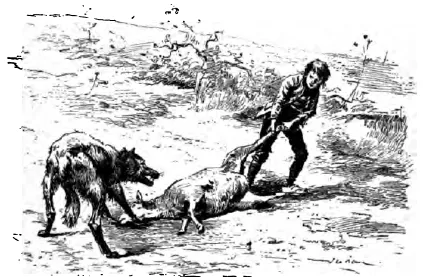
I went to a village called Chamois. It was surrounded by a forest. I served as a watch-dog for the shepherdess. "Go yonder," said the woman to me. As I was going along the edge of the wood so as to keep the sheep away from it, a big wolf ran out, drove the sheep back, and seized upon one of the finest in the flock. I had never had any experience with such a beast. The shepherdess screamed, and told me to run. I hastened to the spot. The wolf could not throw the sheep on his back, so I had time to catch hold of its hind feet, and the wolf pulled one way and I the other.
But Providence came to my assistance. Two enormous dogs, wearing iron collars, rushed out, and in a moment the wolf was killed. Imagine my joy at having saved my sheep, and seeing the beast stretched dead upon the ground.
I served the shepherdess as watch-dog for a year. From there I went to the fair at Entrains. I hired myself out, for thirty francs, a blouse, and a pair of wooden shoes, to two old farmers of Les Bardins, near Menon, who sold wood on the wharves, and who made from twelve to fifteen hundred francs by my labour.
They had twelve head of cattle, of which six were oxen. In the winter I threshed in the barn, and slept on the straw. I became covered with vermin, and was perfectly wretched. On the first of May I began hauling wood to the wharves with my three wagons, and always returned to the fields. Every evening my master came and brought me my piece of bread and an omelette made of two eggs cooked with leeks and hemp-seed oil. I only went to the house on Martinmas Day, when they did me the honour to give me a bit of salt pork.
In fine weather I slept in the beautiful wood belonging to Madame de Damas. I had my favourite, the gentlest of my six oxen. As soon as he lay down for the night I was beside him.
First I pulled off my sabots, and then I poked my feet under his hind legs and put my head down on his neck.
But about two o'clock in the morning my six oxen arose without noise and my comrade got up without my knowing it. Then the poor herdsman was left on the ground. Not knowing where to find my oxen in the darkness, I put on my wooden shoes and listened. I wandered along the edge of the young wood, torn by briers, which made the blood run down into my sabots. I cried, for my ankles were cut to the bone. Often, on my way, I used to encounter wolves, with eyes shining like sparks, but my courage never abandoned me.
At last I would find my six oxen, then I would make the sign of the cross. How glad I was! I led the deserters back to my three wagons, which were loaded with cordwood, and then waited till my master came, to hitch up and set off for the wharf. Then I returned to the pasture, and the master left me there in the evening. I received my piece of bread, and always the two eggs cooked with leeks and hemp-seed oil. And this happened every day for three years. The pot was empty under the kneading-trough{1}. But the worst of it was the vermin that had taken possession of me.
Not being able to endure it any longer, in spite of all possible entreaties, I left the village. I went back to my native place to see if they would recognize me, but no one remembered the lost child. Four years of absence had made a great change in me, and no one any longer knew me.
I reached Druyes on Sunday; I went to see its beautiful fountains which flowed near my father's garden. I began to cry, but after a moment's struggle with my grief, I determined what to do. I washed my face in the clear water where formerly I had walked with my brothers and sisters.
At last the hour sounded for mass. I went to the church, my little handkerchief in my hand, for my heart was swelling. But I held out. I went to mass, and knelt down. I said my little prayer looking down. No one paid any attention to me. However I heard a woman say, "There is a little Morvandian who prays earnestly to the good God." I was so changed that no one knew me, but I knew everybody. I spoke to no one; when mass was over I went out of the church. I had at once recognized my father who sung among the choristers; little did he know that one of his children whom he had abandoned was so near him.
I had walked three leagues, and was very hungry when I left the church after mass. I went to the house of my half-sister, the child of the first marriage, who kept an inn; I asked her for something to eat.
—"What do you want for dinner, boy?"
—"Half a bottle of wine and a little meat and bread, madame, if you please."
A bit of stew was brought to me; I ate like an ogre, and got into a corner so I could see all the country people who came in doing the same. When I had finished my dinner I asked, "How much do I owe you, madame?"
—"Fifteen sous, my boy."
—"There they are, madame."
—"You are from Morvan, are you not, child?"
—"Yes, madame, I have come to try to find a place."
She called her husband. "Granger," said she, "here is a little boy who wants to hire himself out."
—"How old are you?"
—"Twelve, sir."
—"Where do you come from?"
—"From Menon."
— "Ah, you are from Morvan?"
— "Yes, sir."
—"Do you know how to thresh in the barn?"
—"Yes, sir."
—"Have you worked at it already?"
—"Four years, sir."
—"How much do you ask by the year?"
—"In our country, sir, we are paid in grain and money."
—"Very well, if you like, you shall stay here, you shall be the stable-boy; all the tips shall be yours. Are you accustomed to sleep on the straw?"
—"Yes, sir."
—"If you suit me I will give you a louis a year."
—"That is sufficient, I will stay; shall I pay for my dinner?"
— "No," said he, "I am going to set you to work."
He took me into the garden, which I had known long before he had, and in which I had enjoyed all my childish frolics. I was the most boisterous one in the neighbourhood, and my companions used to throw stones at me and call me "red head." I always came out best, being never afraid of blows; our stepmother had accustomed us to them. I remember once my nose was dirty; she took hold of it with the tweezers to wipe it, and was wicked enough to hurt me. "I will pull it off," she said. Consequently the tweezers were thrown into the well.
My brother-in-law, then, took me into his garden and gave me a spade. I worked a quarter of an hour; then he said, "Well done; but that's enoug...