Few of Napoleon's Marshals have been involved in such controversy as the son of a cooper from Sarrelouis, Michel Ney. His reputation has been argued over fiercely by military historians, Bonapartists, revisionists and romantics for almost two centuries since his untimely demise at the hands of his own countrymen in the gardens of the Luxembourg.
This volume paints a sympathetic picture of Marshal Ney, drawing on the memoirs of his subordinates and Général Bonnal's Vie Militaire du Maréchal Ney to combine into the best single volume biography yet published in English. Atteridge writes concisely but vividly, and does not shy away with the controversies that have dogged Ney's reputation, whilst providing a clear framework of the events. The details are accompanied by numerous maps, including excellent details on the often overlooked Battle of Hohenlinden in 1800 which secured the French Republic.
From the early days of the French Republic, Ney fought fiercely and with much skill, through to the dark days of the retreat from Russia in 1812 in which he saved the remnants of the vast army Napoleon led to their destruction. His actions in the Hundred Days, for which he lost his life in a trial whose outcome was predetermined, are analyzed clearly and he deserved a better lot than he received for his efforts. Ney was a pivotal figure in an era of giants and Atteridge's book does him the justice his brave and valorous character demands.
Highly recommended.
Atteridge's book forms a companion to his other single volume biography of Marshal Murat and his work on the varied personalities on Napoleon's Brothers.
Author- Andrew Hilliard Atteridge (1844–1912)
Linked TOC and 8 Illustrations and 8 maps.
- 357 pages
- English
- ePUB (mobile friendly)
- Available on iOS & Android
eBook - ePub
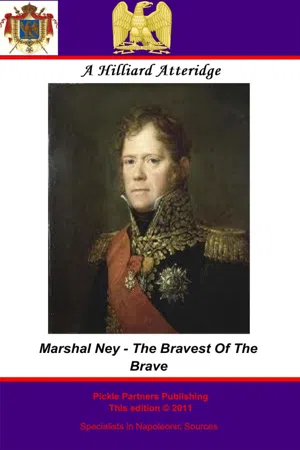
Marshal Ney - Bravest Of The Brave
About this book
Trusted by 375,005 students
Access to over 1.5 million titles for a fair monthly price.
Study more efficiently using our study tools.
Information
Subtopic
British HistoryIndex
HistoryCHAPTER I
FIRST YEARS (1769-1794)
Ney born in a year of great men—Family and birthplace—Education —Legal studies—Employed in the iron industry—Enlists in the hussars—First promotion to non-commissioned rank—A duel—Beginning of the Revolutionary Wars—Serves in campaign of Valmy—Promoted sub-lieutenant—Serves in Belgium—Jemappes-Aide-de-camp to General Lamarche—Treason of Dumouriez—Ney rejoins the hussars—Aide-de-camp to General Colaud—Promoted captain, Ney returns to his regiment—Serves under Kléber in Belgium—Selected as his staff officer.
THE year 1769 was fruitful in famous men. In that year were born Napoleon, Wellington, the younger Pitt, Humboldt, and Cuvier, Marceau, Lannes, Soult and Ney.
Michel Ney, whom Napoleon hailed as “the bravest of the brave," came of a soldier race. He was a son of that eastern borderland, which had been for centuries a debatable ground between France and Germany and repeatedly the scene of war. Every town had its traditions of siege and battle and the people had a kind of hereditary disposition for the life of a soldier.
Ney's birthplace, the town of Saarlouis, has now been German for nearly a century. In 1769 it was a French frontier fortress. It had been fortified for Louis XIV by Vauban some eighty years before that date, and the townsfolk, though a mixed race, many of them German in blood and speech, were thoroughly French in sentiment. It says something for the patriotic and military spirit of the place that, though its population numbered only four thousand, it gave nearly two hundred officers to the armies of the Republic and the Empire between the years 1792 and 1815, including, besides Marshal Ney, eleven generals.
Ney's family belonged to the lower rank of the bourgeoisie. When he had fought his way to a dukedom in the new military aristocracy of the Empire Napoleon's heralds invented an elaborate coat of arms for the Marshal Duke of Elchingen, but they could not find for him any historic link with the old feudal nobility of Lorraine and the Palatinate. In the first stages of his career under the Republic it was a gain for him that no one could question that he was "a son of the people ".
There had been soldiers among his ancestors. They were not knights and generals, but mere common pikemen and musketeers, and later privates and sergeants in royal regiments that fought under officers whose first claim to command was noble blood. His father, Pierre Ney, born at Ensdorf in 1738, had been a soldier, had fought in the campaigns of the Seven Years' War, and been an obscure unit in the ranks of the French Army that Frederick the Great routed at Rossbach.
He had been apprenticed to a cooper before he joined the Army. After his years of military service he set to work again at his old trade and settled at Saarlouis, where he married Margaret Grœvelinger. Her famous son always spoke of her with deep affection. After his marriage Pierre Ney was fairly prosperous but never well off. Popular tradition calls him a blacksmith perhaps because a forge was part of the equipment of his small cooperage. He earned enough to give his children a good education. German was the language of their home. They learned French at school.
There were four of them, three sons and a daughter. Jean, the eldest was born in 1767. He joined the first battalion of the National Volunteers of the Department of the Moselle, when the regiment was formed in 1791, and on 19 September of that year he was elected to the rank of sergeant by his comrades. He served for two years in the Army of the North and for two more in the Army of the Sambre and Meuse. In August, 1792, he was promoted to sergeant-major, and in April, 1794, he received his commission as sub-lieutenant. On 15 August he was promoted to lieutenant, transferred to the 55th demi-brigade of the infantry of the line, and sent to serve with it under Bonaparte in the Army of Italy. He was killed on 19 June, 1799, in Macdonald's disastrous battle against the Austrians on the Trebbia.
There were several branches of the family, and its name is variously spelt in registers of the eighteenth century, among its forms being Nau, Naye, New, Neu, Neuen, Nei, and Ney.
The second son was Michel, the future Marshal of the Empire. The third, Jacques, born on 7 March, 1771, died in childhood. The daughter, Marguerite Ney, was born on 7 October, 1772. She was twice married. Her second husband, Jean Claude Monnier, held lucrative posts in the Civil Service of the Empire, and was a wealthy man when he was forced to retire by the Bourbon Government in 1815. Madame Monnier died in 1819.
The house where Michel Ney was born and spent his first years is still standing at Saarlouis. It is a small, old-fashioned building, with one upper story, and three little dormer windows in the tiled roof. Three steps lead up to the door that opens directly on the street. A horseshoe is fixed above the lintel of the door, and over it, between two windows of the upper story, there is a large tablet of marble with the inscription:—
"ICI EST NÉ
LE MARÉCHAL NEY."{1}
The tablet was placed there in 1815 after the cession of Saarlouis to Prussia.
Pierre Ney's idea was that his eldest son, Jean, should carry on the business of the cooperage. He destined Michel for a professional career. It was through some branch of the legal profession that a bourgeois had the best chance of rising in the world, for it opened the way to employment by the Crown. Michel was therefore sent to the Collège des Augustins, a high-class day school at Saarlouis, directed by the Augustinian Fathers. But in those days the start in the work of life came earlier than it does now. Michel's college course ended in the summer of 1782, when he was only thirteen. Then as a boy clerk he entered the office of Maître Valette, the chief notary of Saarlouis.
It was not his choice, but his father's plans for him, that sent him to copy long-winded documents at a desk, and to learn the routine business of a notary. Michel had already other ideas. The sight of the military movements of a garrison town, the stories he had heard from his father by the winter fireside of the campaigns of Frederick the Great, the news of the war with England and of victories beyond the Atlantic that more than compensated for failure at Gibraltar, had turned young Michel Ney’s thoughts to a career like his father's. He could not hope to rise to high command, but he could dream of horse and sword, camp and march and battlefield, activity and adventure, instead of the endless task of handling dusty papers in the corner of an office.
For two years, however, he plodded on at his ungrateful occupation. Then, when he was fifteen, there came a change to a branch of the profession that offered more variety of interest. Pierre Ney obtained for his son an appointment as junior clerk in the office of the Procureur du Roi, the King's attorney, at Saarlouis. But Michel cared no more for serving summonses on defaulters in the payment of taxes, or copying the indictments of prisoners at the assizes, than he had cared for drawing up inventories of property, probates of wills, marriage settlements, and records of sales. He stayed only a few months with the Procureur du Roi. Then he begged his father to find him some more active employment, something that would take him away from the slavery of the desk. And Pierre Ney yielded to his son's wishes.
In the autumn of 1784 he left Saarlouis to be employed at the mines and ironworks of Appenweiler. He had still to spend part of his time in an office, but he was also employed at the works, and learned the processes of handling the ore, and turning it into cast and malleable iron. He proved such an apt pupil that next year he was attached to the staff of the superintendent at the ironworks of Saleck, where he had the opportunity of learning the further processes used in the manufacture of iron into machinery and goods for the market.
He worked at Saleck for three years, till the late autumn of 1788. Then at last the longing for a soldier's life tore him away from the forge and the workshop. Resigning his post at Saleck he tramped back to Saarlouis to pay a visit to his parents. Then he went on to Metz, where, on 6 December, 1788, he enlisted as a private in a regiment of hussars.
The first hussars in the French, or in any west European Army, were Hungarian deserters, who in 1692 left the Austrian flag for that of Louis XIV and were formed into a regiment. Until 1976 the French Hussars were bodies of irregular light horsemen, wearing an imitation of a Hungarian costume, the regiments being raised in time of war and usually disbanded at the peace that followed it. But a Royal Ordinance dated 25 March, 1776, gave the four regiments of hussars then in existence a permanent position in the French regular cavalry, under the names of the Regiment de Bercheny (No. 1), Regiment de Chamborant (No. 2), Regiment de Nassau (No. 3), and Regiment d'Esterhazy (No. 4). Three years later the boy Duke of Chartres was appointed "Colonel-General of the Hussars," and a fifth regiment was formed in his honour, of which he was to be titular commander. It was known as the "Regiment Colonel-Général," and it was in its ranks that Michel Ney enlisted.
The uniform of the regiment was a dark-blue tunic, frogged with yellow braid, with a red cloth pelisse lined with white sheepskin. The cloak was blue. The sabretache red, embroidered with arms of the Duc de Chartres. The saddlecloth was a white sheepskin bordered with red cloth. The shako was black with a red pendant and a white aigrette. The sword was brass hilted, with a leather scabbard mounted with the same metal. The new recruit had an attractive uniform.
He was above the middle stature, five feet eight inches in height, with the body rather short and the legs long, not a bad build for a hussar. He had a wide forehead and blue eyes set well apart, a short nose and a full chin. His complexion was ruddy, and his hair, which the hussars wore plaited into a queue, was the colour that might be called auburn or red, accordingly as the speaker wished to be more or less complimentary. His comrades nicknamed him "le rougeot". "Carrots" or "foxy" would be the English trooper's equivalent.
He was k...
Table of contents
- Title page
- NOTE
- LIST OF ILLUSTRATIONS
- LIST OF MAPS
- CHAPTER I
- CHAPTER II
- CHAPTER III
- CHAPTER IV
- CHAPTER V
- CHAPTER VI
- CHAPTER VII
- CHAPTER VIII
- CHAPTER IX
- CHAPTER X
- CHAPTER XI
- CHAPTER XII
- CHAPTER XIII
- CHAPTER XIV
- CHAPTER XV
- CHAPTER XVI
- CHAPTER XVII
- CHAPTER XVIII
- CHAPTER XIX
Frequently asked questions
Yes, you can cancel anytime from the Subscription tab in your account settings on the Perlego website. Your subscription will stay active until the end of your current billing period. Learn how to cancel your subscription
No, books cannot be downloaded as external files, such as PDFs, for use outside of Perlego. However, you can download books within the Perlego app for offline reading on mobile or tablet. Learn how to download books offline
Perlego offers two plans: Essential and Complete
- Essential is ideal for learners and professionals who enjoy exploring a wide range of subjects. Access the Essential Library with 800,000+ trusted titles and best-sellers across business, personal growth, and the humanities. Includes unlimited reading time and Standard Read Aloud voice.
- Complete: Perfect for advanced learners and researchers needing full, unrestricted access. Unlock 1.5M+ books across hundreds of subjects, including academic and specialized titles. The Complete Plan also includes advanced features like Premium Read Aloud and Research Assistant.
We are an online textbook subscription service, where you can get access to an entire online library for less than the price of a single book per month. With over 1.5 million books across 990+ topics, we’ve got you covered! Learn about our mission
Look out for the read-aloud symbol on your next book to see if you can listen to it. The read-aloud tool reads text aloud for you, highlighting the text as it is being read. You can pause it, speed it up and slow it down. Learn more about Read Aloud
Yes! You can use the Perlego app on both iOS and Android devices to read anytime, anywhere — even offline. Perfect for commutes or when you’re on the go.
Please note we cannot support devices running on iOS 13 and Android 7 or earlier. Learn more about using the app
Please note we cannot support devices running on iOS 13 and Android 7 or earlier. Learn more about using the app
Yes, you can access Marshal Ney - Bravest Of The Brave by Andrew Hilliard Atteridge in PDF and/or ePUB format, as well as other popular books in History & British History. We have over 1.5 million books available in our catalogue for you to explore.