Following the critical success of R. E. Lee: A Biography, for which he won the 1935 Pulitzer Prize, author Douglas Southall Freeman expanded his study of the Confederacy with the critically acclaimed three-volume Lee's Lieutenants: A Study in Command, originally published in 1942, 1943, and 1944.
Together, the three volumes present a unique combination of military strategy, biography, and Civil War history, and shows how armies actually work. Published during World War II, it had a great influence on American military leaders and strategists.
Lee's Lieutenants: A Study in Command established Freeman as the pre-eminent military historian in the country, and led to close friendships with United States generals George Marshall and Dwight D. Eisenhower.
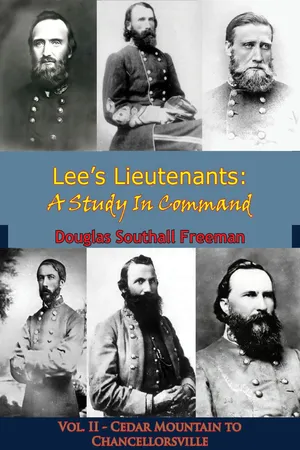
eBook - ePub
Lee's Lieutenants: A Study In Command
Vol. II - Cedar Mountain to Chancellorsville
- 846 pages
- English
- ePUB (mobile friendly)
- Available on iOS & Android
eBook - ePub
Lee's Lieutenants: A Study In Command
Vol. II - Cedar Mountain to Chancellorsville
About this book
Trusted by 375,005 students
Access to over 1.5 million titles for a fair monthly price.
Study more efficiently using our study tools.
Information
Subtopic
19th Century HistoryIndex
HistoryLEE’S LIEUTENANTS
CHAPTER I—NEW TROUBLES FOR “OLD JACK”
WAS IT A major change of Federal strategy with which “Stonewall” Jackson had to deal in mid-July, 1862? Had the enemy opened a “second front”? At the time of Jackson’s departure from the Richmond line, after the Seven Days’ Battles, the new Federal Army of Virginia appeared to be making ready for an advance to the “Gordonsville Loop” of the Virginia Central Railroad. The commander of this Army, Maj.-Gen. John Pope, was intent on assuming and holding the offensive. Another Federal force of unknown strength{1} was at Fredericksburg. This column, uniting with Pope, might overwhelm Jackson. Either one of the Union armies might push forward, cut the railway and sever communications between Richmond and the Shenandoah Valley.
Against the possibility of such a drive, Jackson had, first of all, to protect the long stretch of rail from Hanover Junction to Charlottesville. He had, also, to watch for an opening and, if he found it, to strike at once. The Southern cause could not wait on the leisured convergence of superior force. In this spirit, Jackson’s first counter-move was to place his Army at Beaver Dam, whence he marched a little westward to Frederickshall. When Jackson had satisfied himself that the greater part of the Union troops under Pope were North and West of Culpeper, the Confederate Army of the Valley advanced on the 19th of July to Gordonsville.{2}
Upon the arrival of Jackson at the town where he had halted a month previously it was observed that both he and his troops looked the worse for their adventures in the defense of the capital{3} Jackson may not have been aware of this, but he was conscious that his men needed a renewal of stiff discipline. Before he had left the scene of the battles around Richmond, he had prescribed for his troops the tonic of three drills a day and the prophylaxis of abstention from visits to the Confederate capital.{4} Now, as Jackson awaited developments, he sought vigorously to restore whatever might have been lost in soldierly qualities. It was an exacting task. Nine days after he reached Gordonsville, the General wrote Mrs. Jackson briskly: “My darling wife, I am just overburdened with work, and I hope you will not think hard at receiving only very short letters from your loving husband. A number of officers are with me, but people keep coming to my tent—though let me say no more. A Christian should never complain. The apostle Paul says, ‘I glory in tribulations!’ What a bright example for others!”{5} Among the “tribulations” he may have counted that of having no time to read a copy that Jeb Stuart had sent him of a new, Confederate edition of the strategist’s bible, Napoleon’s Maxims of War. Jackson put the volume carefully with his personal baggage, but neither then nor thereafter, so far as the pages indicate, did he ever read it.{6} If he had time for Holy Writ, that was all. Newspapers he still declined to peruse lest they destroy his Christian humility. They spoke too well of him.
For a few days, the General’s personal hard work meant ease for his subordinates. Maj. Franklin Paxton, who was then acting as a voluntary aide to Jackson, wrote cheerfully home: “Everything here seems so quiet. The troops are drilling, and there is every indication that [they] will rest here for some time. Considering the severe hardships through which they have passed since the war began, it is very much needed. Everything has a happy, quiet appearance, such as I have not seen in the army since we were in camp this time last year after the battle of Manassas.”{7}
The arrival of A. P. Hill’s Division did not disturb this calm or add to Jackson’s troubles. Quietly and in good order, though perhaps with more transportation than regulations allowed, the Light Division reached Jackson on July 29 and the days immediately following.{8} In dispatching Hill from Richmond Lee had written the commander of the Army of the Valley: “A. P. Hill you will, I think, find a good officer with whom you can consult, and by advising with your division commanders as to their movements much trouble can be saved you in arranging details, as they can act more intelligently. I wish to save you trouble from increasing your command.”{9} This was as pointed as it was tactful and it would be particularly apropos of the projected movement, which involved a large force for one man to handle unless he was willing to trust his subordinates and to reveal to them enough of his plans to assure swift, coordinated action. The event was to show that Lee’s counsel was lost on Jackson. If “Stonewall” was willing, as he had told Boteler, to follow Lee blindfolded, he required no less of his subordinates. Hill said nothing and asked nothing. Doubtless he was glad enough to be away from Longstreet.
If Hill kept the peace that Paxton had praised, others did not. Col. John F. Neff of the Thirty-third Virginia was involved in some unexplained clash with General Winder and was placed under arrest.{10} Some of Winder’s privates of the Stonewall Brigade had straggled badly on the march to Gordonsville and had wandered far in search of food at private homes. Winder decided that the one way of stopping this was to punish it severely. Thirty offenders were marched into the woods and were “bucked” for a day. Their resentment was worse than their straggling. About half of them deserted that night. Others were so embittered that their officers went to Jackson and acquainted him with the incident. He thought it politic to direct that men be not bucked again. This ended that humiliating form of punishment, but it did not cool the wrath of the sufferers. John Casler reported: “[General Winder] was a good general and a brave man, and knew how to handle troops in battle; but he was very severe, and very tyrannical, so much so that he was ‘spotted’ by some of the Brigade; and we could hear it remarked by someone nearly every day that the next fight we got into would be the last for Winder.”{11} That in the Southern Cromwell’s own Brigade of the Model Army!
Simultaneously with this unhappy affair in the Stonewall Brigade, Jackson’s cavalry was in the turmoil of reorganization. Following the death of Ashby, the Secretary of War had asked Lee, not Jackson, to suggest a possible successor, who would have the rank of Brigadier General. Lee had not been able to recommend a competent, available cavalryman. He had thought of Robert Ransom, but he did not feel he could spare that officer, nor did he believe the North Carolinian would care to exchange command of a strong infantry Brigade for the direction of Jackson’s horse. The name of Fitz Lee, which was urged by Stuart, was rejected by Lee on the ground that he did not know whether his nephew could win the support of Ashby’s men. Col. T. T. Munford had been mentioned by Lee as a possibility, as had been George H. Steuart.{12} Instead of Munford, who had shown much promise, and of “Maryland” Steuart, who had failed definitely in cavalry command, the President chose Col. Beverley H. Robertson and promoted him to the grade of Brigadier General.{13}
Colonel Robertson was a Midland Virginian, 36 years of age, a graduate of West Point in the Class of 1849,{14} a veteran of much Indian service and in person the embodiment of the fashionable French cavalry officer of the time. Somewhat bald, with unsmiling eyes, Robertson wore long, flowing mustaches and whiskers in the mode of Louis Napoleon. The month before the outbreak of war, while he was on duty in Utah, Robertson was promoted Captain of the Second Dragoons. After the attack on Sumter, he sent word to his friends that he would be in Virginia and ready to serve in her behalf as soon as he could get home; but he was not able to reach Richmond until Aug. 18, 1861. Ten days before his arrival there, he had been dismissed officially from the United States Army on the ground that he had “given proof of his disloyalty.”{15} By the time the order to this effect was published, he was a Captain in Confederate service{16} and soon he was Colonel of the Fourth Virginia Cavalry.{17} In command of that regiment he had gone with Stuart to the Peninsula, but because of sickness he had been denied any part in the skirmishing at Williamsburg.{18} His only engagement had been a brisk exchange at New Bridge on May 23-24.{19}
Because Robertson adhered sternly to the rigorous discipline of the regular Army, he was defeated for election as Colonel in the reorganization of his command.{20} That cancelled his commission, but it made him available for other service. The President’s hope, in promoting him in June, was that Robertson’s admitted abilities as a drill master could be well employed in the training of Ashby’s men. Col. William E. (“Grumble”) Jones, of the First Virginia, had shared Robertson’s fate in the election and had lost both his troops and his rank. For him, too, the War Department at length found a place. The loose, cumbersome organization of the cavalry in the Shenandoah area was conformed to army regulations. Ashby’s troopers were regimented as the Seventh and Twelfth Virginia, and the Seventeenth Virginia Battalion. With Munford’s Second and Flournoy’s Sixth, they constituted Robertson’s ‘“Laurel Brigade,” in which Jones was given the Seventh Virginia.
These regiments from the Valley, moving via Mechum River and Charlottesville,{21} joined Jackson at Gordonsville. Upon Munford’s arrival from the Richmond front with the Second, he was ordered to report to Robertson.{22} The organization thus was completed but it was not popular. Boys who had been accustomed to the easy-going, if adventuresome life under Ashby could not be reconciled overnight to “old army” Colonels and methods. The Valley troopers, moreover, had held an unofficial election of their own for the choice of officers and felt much resentment because their action had been disregarded.{23}
Had this been all, Jackson readily could have dealt with it. He who had made teamsters of the Dunkards and had laid an iron hand on mutineers and hiding conscripts would not have hesitated to curb the cavalry. Now that Ashby’s influence no longer could have been exerted against him, Jackson could have assured support for Robertson had he himself had faith in that officer. There was the barrier. Despite the devotion of Robertson to Jackson’s ideals of endless drill, “Stonewall” seems from an early date to have disliked his new chief of cavalry. It is impossible to say whether this was because Jackson may not have been consulted about the appointment or because he did not believe Robertson was qualified for the command. In either event, Jackson quickly concluded that Robertson lacked vigor in reconnaissance and outpost duty. On the 2nd of August, “Grumble” Jones had a brush with Federal cavalry in the streets of the town of Orange. Ten men were wounded, fifty were captured.{24} Jackson seemed to think the fault was Robertson’s, rather than Jones’s,{25} and, on August 7, he forwarded a request that he be rid of Robertson and that Jones be put in command. “That subject,” answered Lee, “is not so easily arranged, and without knowing any of the circumstances attending it except as related by you, I fear the judgment passed upon [Robertson] may be hasty.” With the frankness he always displayed in dealing with Jackson, the commanding General continued: “Neither am I sufficiently informed of the qualifications of Col. W. E. Jones, though having for him high esteem, to say whether he is better qualified.”{26} To Mr. Davis, prior to this episode, Lee had written: “Probably Jackson may expect too much, and Robertson may be preparing his men for service, which I have understood they much needed. With uninstructed officers, an undisciplined brigade...
Table of contents
- Title page
- TABLE OF CONTENTS
- ILLUSTRATIONS
- MAPS
- INTRODUCTION
- “DRAMATIS PERSONÆ”
- CHAPTER I-NEW TROUBLES FOR “OLD JACK”
- CHAPTER II-JACKSON FUMBLES AT CEDAR MOUNTAIN
- CHAPTER III-JEB STUART LOSES HIS PLUME
- CHAPTER IV-RAPPAHANNOCK: ACT ONE OF A NEW DRAMA
- CHAPTER V-JACKSON IS HIMSELF AGAIN
- CHAPTER VI-JACKSON DEFIES POPE AND THANKS GOD
- CHAPTER VII-THE GALLANT RIVALRY OF MANASSAS
- CHAPTER VIII-THE IMPONDERABLES OF INVASION
- CHAPTER IX-GENERALS ON DISPLAY
- CHAPTER X-HARVEY HILL’S BATTLE
- CHAPTER XI-THE TEST OF LAFAYETTE MCLAWS
- CHAPTER XII-THE “WAGON HUNTER’S” GREAT DAY
- CHAPTER XIII-DESPERATE HOURS ON THE ANTIETAM
- CHAPTER XIV-PENDLETON FAILS TO COUNT HIS MEN
- CHAPTER XV-LONGSTREET AND JACKSON STEP UP
- CHAPTER XVI-A CRISIS IN REORGANIZATION
- CHAPTER XVII-THE BALANCE OF THE TWO CORPS
- CHAPTER XVIII-HOW TO ACCOMPLISH “THE IMPOSSIBLE”
- CHAPTER XIX-CHIEFLY PERSONAL TO JACKSON
- CHAPTER XX-THE BATTLE OF THE PONTOONS
- CHAPTER XXI-ON THE RIGHT AT FREDERICKSBURG
- CHAPTER XXII-LONGSTREET WINS AN EASY VICTORY
- CHAPTER XXIII-THE NIGHT OF THE NORTHERN LIGHTS
- CHAPTER XXIV-AFTER FREDERICKSBURG-LAMENT AND LAURELS
- CHAPTER XXV-CAVALRY RAIDS AND QUARRELS
- CHAPTER XXVI-PROMOTION AND A FIERY RESIGNATION
- CHAPTER XXVII-THE DEVELOPING STAFF
- CHAPTER XXVIII-ARTILLERISTS GET THEIR STARS
- CHAPTER XXIX-LONGSTREET TRIES INDEPENDENT COMMAND
- CHAPTER XXX-”OLD JACK” PREPARES FOR SPRING
- CHAPTER XXXI-JACKSON GETS HIS GREATEST ORDERS
- CHAPTER XXXII-”YOU CAN GO FORWARD THEN”
- CHAPTER XXXIII-A NIGHT IN THE WILDERNESS
- CHAPTER XXXIV-THE YOUNG COMMANDERS’ DAY
- CHAPTER XXXV-“JUBE” EARLY HAS A RIGHT TO SWEAR
- CHAPTER XXXVI-PROMOTION FOR RODES AND FOR JACKSON
- CHAPTER XXXXVII-”HAVE NO FEAR WE SHALL NOT BEAT THEM!”
- APPENDIX I-TRANSMISSION OF THE “LOST ORDER”
- PRINCIPAL MANUSCRIPT SOURCES
- SHORT-TITLE INDEX
- REQUEST FROM THE PUBLISHER
Frequently asked questions
Yes, you can cancel anytime from the Subscription tab in your account settings on the Perlego website. Your subscription will stay active until the end of your current billing period. Learn how to cancel your subscription
No, books cannot be downloaded as external files, such as PDFs, for use outside of Perlego. However, you can download books within the Perlego app for offline reading on mobile or tablet. Learn how to download books offline
Perlego offers two plans: Essential and Complete
- Essential is ideal for learners and professionals who enjoy exploring a wide range of subjects. Access the Essential Library with 800,000+ trusted titles and best-sellers across business, personal growth, and the humanities. Includes unlimited reading time and Standard Read Aloud voice.
- Complete: Perfect for advanced learners and researchers needing full, unrestricted access. Unlock 1.5M+ books across hundreds of subjects, including academic and specialized titles. The Complete Plan also includes advanced features like Premium Read Aloud and Research Assistant.
We are an online textbook subscription service, where you can get access to an entire online library for less than the price of a single book per month. With over 1.5 million books across 990+ topics, we’ve got you covered! Learn about our mission
Look out for the read-aloud symbol on your next book to see if you can listen to it. The read-aloud tool reads text aloud for you, highlighting the text as it is being read. You can pause it, speed it up and slow it down. Learn more about Read Aloud
Yes! You can use the Perlego app on both iOS and Android devices to read anytime, anywhere — even offline. Perfect for commutes or when you’re on the go.
Please note we cannot support devices running on iOS 13 and Android 7 or earlier. Learn more about using the app
Please note we cannot support devices running on iOS 13 and Android 7 or earlier. Learn more about using the app
Yes, you can access Lee's Lieutenants: A Study In Command by Douglas Southall Freeman in PDF and/or ePUB format, as well as other popular books in History & 19th Century History. We have over 1.5 million books available in our catalogue for you to explore.