- 125 pages
- English
- ePUB (mobile friendly)
- Available on iOS & Android
eBook - ePub
About this book
The Eastern Front, 1941-1945, is one of the biggest and most decisive theaters of operation in modern history, and was the largest theater of war in World War Two. A total force of 9 million Germans and Russians battled on both sides with a combined strength of 590 divisions. Military losses approached 5 million German casualties, and 17 million Russian casualties. Altogether, both sides had an active strength of 13,000 tanks, 18,000 combat aircraft, and 50,000 artillery pieces. With the exception of the massive Allied Combined bombing campaign, the Allied effort of ninety-three divisions in Western Europe against seventy German division pales in comparison.
Another interesting point in the Eastern Front was initial nature of German operational maneuver, followed by the evolution of Russian operational maneuver. By 1944, the Russian Army had become experts on operational maneuver, and maximized the principals of war of mass, objective, offense, and maneuver. The German Army against an army four times its size eventually culminated, but not until after four years of intense fighting. Eighty percent of total German casualties were lost on the Eastern front, 4.7 million of 6 million casualties. Further, both sides lost an estimated 65,000 tanks and 60,000 combat aircraft, two-thirds being Russian.
The methodology of this analysis is chronological, based on the successive operational campaigns from June 1941 through May 1945. Each campaign lists the order of battle, and then the combat power using Lanchester equations (Frederich W. Lanchester) of military combat. In studying modern war, the Eastern Front is a case study in a maneuver oriented army versus a large attrition based army. With almost six hundred years' worth of German divisional combat on the Eastern Front, valuable lessons can be learned in studying this theater of war.
Another interesting point in the Eastern Front was initial nature of German operational maneuver, followed by the evolution of Russian operational maneuver. By 1944, the Russian Army had become experts on operational maneuver, and maximized the principals of war of mass, objective, offense, and maneuver. The German Army against an army four times its size eventually culminated, but not until after four years of intense fighting. Eighty percent of total German casualties were lost on the Eastern front, 4.7 million of 6 million casualties. Further, both sides lost an estimated 65,000 tanks and 60,000 combat aircraft, two-thirds being Russian.
The methodology of this analysis is chronological, based on the successive operational campaigns from June 1941 through May 1945. Each campaign lists the order of battle, and then the combat power using Lanchester equations (Frederich W. Lanchester) of military combat. In studying modern war, the Eastern Front is a case study in a maneuver oriented army versus a large attrition based army. With almost six hundred years' worth of German divisional combat on the Eastern Front, valuable lessons can be learned in studying this theater of war.
Tools to learn more effectively

Saving Books

Keyword Search

Annotating Text

Listen to it instead
Information
CHAPTER ONE-OPERATION BARBAROSSA

Figure 1. Operation BARBAROSSA.
SECTION I. THE GERMAN OFFENSIVE
The Germans approved the plan for Operation BARBAROSSA on 18 December 1940.{2}
It had been Adolf Hitler’s long term ambition, the Reich chancellor and Führer of Germany, to make Germany a continental power. In doing so, Germany needed the ability to feed itself and only Russia, the Ukraine in particular, could provide this. Hitler believed that he alone had learned the primary lesson of the “stab in the back” in the First World War when German domestic society collapsed in November 1918 due to lack of food because of the British naval blockade, while the Kaiserheer with 150 divisions was still relatively intact on the Western Front. Furthermore, Hitler envisioned that invading Russia would be a quick war like Poland in September 1939 and France in May 1940. Just as Czarist Russia had collapsed in 1917, the Soviet Union would collapse once Moscow was occupied and sign an armistice like the Brest-Litovsk Treaty of 1918 thus giving Hitler the Ukraine.
Hitler, as a decorated field soldier—“Frontkampfer” (front fighter), believed that he knew war and strategy better than his generals who were general staff officers in the First World War, and served safely in division and corps command posts far from the front, much like their British and French general staff counterparts. Furthermore, Hitler was a gambler, in addition to his alleged “messiah complex.” Hitler had gambled and won every time up to this point. He gambled in the 1923 Munich “beer hall putsch” and survived; he gambled in the 1932 election when he was offered the chancellorship by the Reich’s President von Hindenburg; he gambled in 1934 when he seized power through the “total decree” after Hindenburg’s death and the staged Reichstag fire; he gambled in 1934 when he sent the weak Reichswehr into Rhineland and the Allies did nothing; he gambled again in 1934 when he left the Versailles Treaty and started German rearmament; he gambled when in contradiction to the 1938 Munich accord he invaded all of Czechoslovakia, not just the Sudetenland as agreed to; and finally he gambled in Poland and France, against the advice of his generals, and succeeded. In June 1941, there were no indications that Adolf Hitler and Germany would fail in Russia. Four years later, the truth would be told.{3}
On 22 June 1941, the Wehrmacht attacked with three army groups. Army Group North advanced 320 kilometers in five days, and had to stop from 26 June to 5 July. In the first three weeks, the Germans destroyed twenty-eight Russian divisions, and reduced another seventy to fifty percent strength (the total equivalent of sixty-three divisions destroyed). Army Group North would be held up a month by Russian forces at the town of Luga. When it did finally advance towards Leningrad, all it had accomplished was to merely push the defending Russian forces back.
Army Group Center was the main effort of the Germans. In seven weeks, it conducted four envelopments. Two of which were Minsk and Smolensk which entailed 600,000 Russian prisoners. By 15 August 1941, Army Group Center had reached Smolensk. Army Group Center then spent one month stationary, 18 July – 5 August at Smolensk. During its drive to encircle Russian forces, Army Group Center did encounter some Russian opposition. For example, II Panzer Group (Army) under General Heinz Guderian was halted 3 July at Borisov by the Russian 20th Army, and did not resume advance until 10 July. Also, III Panzer Group (Army) was held up for two weeks in July. Again, in August 1941, III Panzer Group was held up for most of August by the Russian 22nd Army. Previous to this, in July, II Panzer Group was diverted south to encircle Kiev.{4}
At Smolensk, Russian forces put up heavy resistance. It seemed to the Germans that Russian tanks were as numerous as their panzers. The Germans were amazed at the endless Russian reserves of men and equipment. At the beginning of the war, the Germans estimated 200 Russians divisions; by August 1941, they had identified 360 Russian divisions. By late August 1941, Germans had suffered 440,000 battle casualties; however, the Germans had only 217,000 replacements available.
Armor losses for the Germans were no higher than that suffered during France, May 1940, twenty-five percent to combat. However, German units lost more tanks to maintenance. For example, by 25 August 1941, Army Group Center was sixty percent strength in tanks, 1,200 out of 1,800 authorized. Army Group South, which had further to travel across southern Ukraine, was forty percent, 400 out of 1,000 tanks authorized. In August, the Germans had received as replacements only 150 MK III engines, 70 MK III tanks, and 15 MK IV tanks. By the end of August 1941, the Germans had lost 1,478 tanks, the equivalent six months’ worth of tank production.
In the south in July 1941, Army Group South was stopped at Lwów by a Russian tank corps and Russian forces operating near the Pipet Marshes. Meanwhile, Army Group South conducted an envelopment at Uman and captured 100,000 Russians. As far as the Russian Air Force, eight hours into the war on 22 June 1941, the Luftwaffe destroyed 1,200 Russian aircraft, 800 of which were on the ground.
In August 1941, Army Group Center had been informed to wait for further orders. In September, Army Group Center received word to wait, and did not attack east until October during Operation TYPHOON. Meanwhile, in August, II Panzer Group was in the south assisting the Kiev encirclement. The Kiev pocket was not eliminated until 26 September, netting 665,000 Russian prisoners and 5,000 artillery pieces (fifty divisions or ten armies). Army Group Center now received II Panzer Group back and received the attachment of IV Panzer Group from Army Group North which had begun to lay siege to Leningrad on 14 September 1941.{5}
With the elimination of the Kiev pocket, Army Group South now advanced toward the Donets River and Kharkov. Overall, the encirclement operations had been time consuming and cost the Germans 232,000 casualties by 2 August. In a six week period, the Germans suffered twice the number of casualties they had lost in France. With the reduction of the pockets, the encircled Russians put up major resistance, and cost the Germans 208,000 casualties in less than one month. Another challenge in closing the pockets, the Panzer Groups had to hold defensive positions around the pockets waiting for German foot infantry supported by horse trains to catch up. The Wehrmacht relied on over 500,000 horses in the invasion of Russia. The lack of the German Wehrmacht mechanization was indicative by the fact that only thirty of its panzer and motorized divisions were totally mechanized, a mere one-fifth of the German Army.
The panzer groups lost valuable time, for example the two months that Army Group Center waited at Smolensk, the intermediate point to Moscow. Also, envelopments by the panzers were mere lines on a map. In actuality, the panzers left numerous gaps in the encirclement that allowed thousands of Russian troops to escape. Also, as the Germans advanced further into Russia their supply lines grew longer. A German division required 100 tons of supplies a day, but received only twenty tons due to lack transportation, roads and sufficient railroad support. Wargames by junior staff officers had presumably showed that failure to capture Moscow before winter would be a logistical defeat, but “Blitzkrieg” was still accepted as being invincible.
By 26 September, four months of combat, the Germans had lost 500,000 casualties. The Germans were now short 230,000 troops, the equivalent of enough infantry for forty of its 116 infantry divisions. In reality, fifty-four German infantry divisions were at half strength, and another thirty were at sixty percent strength. Meanwhile, on 4 September, the four panzer groups were forty-seven percent strength, 1,500 tanks out of 3,300 authorized. By 14 September, Guderian’s II Panzer Group which had travelled from Army Group Center to Army Group South and back was at twenty-five percent strength due to maintenance, 225 tanks out of 900. By October 1941, II Panzer Group would be back up to fifty percent, 450 tanks, in preparation for Operation TYPHOON.{6}
Operation BARBAROSSA: 22 June 1941 Order of Battle:
German: 116 infantry divisions (13,000 men), 1 cavalry division, 19 panzer divisions, (150 tanks, 16,000 men), 13 panzer grenadier divisions (50 tanks, 13,000 men).
A total of 149 divisions, 2,452,000 divisional troops, 3,500 tanks spread among 36 German corps: 26 infantry corps, 10 panzer corps. These corps were assigned to six infantry armies and four panzer groups (armies).
Army Group North (von Leeb)—assigned the operational objective of Leningrad. Assigned seven infantry corps, and two panzer corps which composed 17th Army, 16th Army, and the 4th Panzer Group. During Operation TYPHOON, October 1941, 4th Panzer Group would be attached to Army Group Center.
Army Group Center (von Bock)—assigned the operational objective of Smolensk and Moscow. Assigned eleven infantry corps, and five panzer corps which composed 9th Army, 3rd Panzer Group (Hoth), 4th Army (von Kluge), and 2nd Panzer Group (Guderian).
Army Group South (von Rundstedt)—assigned the operational objective of Kiev. Assigned eight infantry corps, and three panzer corps. Consisted of 1st Panzer Group (von Kleist), 6th Army (von Manstein), and 11th Army.
Operation BARBAROSSA, June 1941.
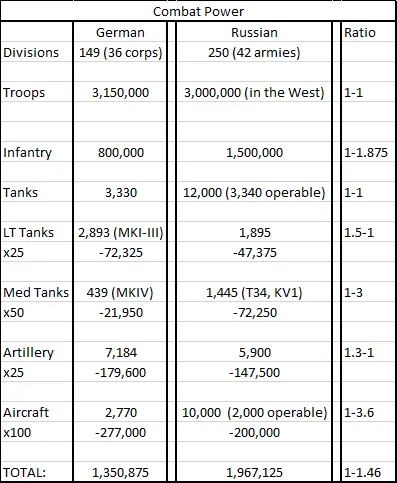
Note: In this and following combat power charts, combat power is calculated by giving each infantryman a combat value of one, artillery a value of twenty-five, light-tanks a value of twenty-five, tanks a value of fifty, and combat aircraft, when included, a value of one hundred.
Even though the Russian forces on the defense had a slight advantage over the Germans, 1.46 to one, the Germans were abl...
Table of contents
- Title page
- TABLE OF CONTENTS
- LIST OF ILLUSTRATIONS
- LIST OF ABBREVIATIONS
- INTRODUCTION
- CHAPTER ONE-OPERATION BARBAROSSA
- CHAPTER TWO-RUSSIAN COUNTER-OFFENSIVE
- CHAPTER THREE-OPERATION FALL BLAU
- CHAPTER FOUR-OPERATION CITADEL
- CHAPTER FIVE-RUSSIAN 1943 OFFENSIVES
- CHAPTER SIX-RUSSIAN 1944 OFFENSIVES
- CHAPTER SEVEN-RUSSIAN 1945 OFFENSIVES
- CHAPTER EIGHT-CONCLUSION
- APPENDIX ONE - CAMPAIGN STATISTICS
- APPENDIX TWO - GERMAN - RUSSIAN ARMAMENTS PRODUCTION 1940-1945
- BIBLIOGRAPHY
Frequently asked questions
Yes, you can cancel anytime from the Subscription tab in your account settings on the Perlego website. Your subscription will stay active until the end of your current billing period. Learn how to cancel your subscription
No, books cannot be downloaded as external files, such as PDFs, for use outside of Perlego. However, you can download books within the Perlego app for offline reading on mobile or tablet. Learn how to download books offline
Perlego offers two plans: Essential and Complete
- Essential is ideal for learners and professionals who enjoy exploring a wide range of subjects. Access the Essential Library with 800,000+ trusted titles and best-sellers across business, personal growth, and the humanities. Includes unlimited reading time and Standard Read Aloud voice.
- Complete: Perfect for advanced learners and researchers needing full, unrestricted access. Unlock 1.4M+ books across hundreds of subjects, including academic and specialized titles. The Complete Plan also includes advanced features like Premium Read Aloud and Research Assistant.
We are an online textbook subscription service, where you can get access to an entire online library for less than the price of a single book per month. With over 1 million books across 990+ topics, we’ve got you covered! Learn about our mission
Look out for the read-aloud symbol on your next book to see if you can listen to it. The read-aloud tool reads text aloud for you, highlighting the text as it is being read. You can pause it, speed it up and slow it down. Learn more about Read Aloud
Yes! You can use the Perlego app on both iOS and Android devices to read anytime, anywhere — even offline. Perfect for commutes or when you’re on the go.
Please note we cannot support devices running on iOS 13 and Android 7 or earlier. Learn more about using the app
Please note we cannot support devices running on iOS 13 and Android 7 or earlier. Learn more about using the app
Yes, you can access The Eastern Front Campaign by Major David S. Wilson in PDF and/or ePUB format, as well as other popular books in History & European History. We have over one million books available in our catalogue for you to explore.