- 160 pages
- English
- ePUB (mobile friendly)
- Available on iOS & Android
eBook - ePub
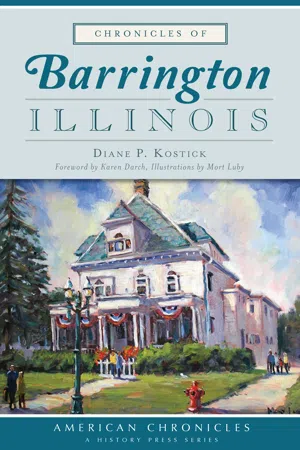
Chronicles of Barrington, Illinois
About this book
Nestled in the northwestern suburbs of Chicago, Barrington offers a treasure-trove of fascinating history and area lore. Meet the passionate guardians of this bucolic landscape who embody the pioneering midwestern spirit. While the community maintains a proud tradition of civic improvement and conservation, its citizens ably represent Barrington in the national arena. The town's record of military service and veteran care dates back to the Civil War. Floyd Bateman helped organize the 1933 World's Fair, while Christine O'Malley won acclaim at the Sundance Film Festival for her crossword documentary. Three members of the 1985 Bears championship squad called the enclave home. Author Diane Kostick paints a portrait of those whose vision, resourcefulness and dedication contributed to the strength and character of this proud community.
Trusted by 375,005 students
Access to over 1.5 million titles for a fair monthly price.
Study more efficiently using our study tools.
Information
Subtopic
North American HistoryIndex
History1
History
The history of the world is but the biography of great men.
–Thomas Carly
–Thomas Carly
In 1830, at the urging of President Andrew Jackson, Congress enacted his Indian Removal Act, giving him the authority to negotiate treaties with Indians in order to force them to relocate. Jackson’s tenacity in following this policy brought about a dramatic remapping of the nascent western lands.
In T. Andreas’s 1884 History of Cook County, Illinois—Earliest Period to the Present, the chapter on Barrington indicates:
Prior to 1834 very few, if any, white men visited Barrington. In that year, Jesse F. Miller and William Van Orsdal arrived. Much to their surprise there were 500 Potawatomi still living in the groves along the banks of the Spring Creek—an area recognized for its abundant wild game and fish, fruits and vegetables. In 1835, these men were joined by Benjamin Irick, Henry Clawson and Philip Hawley. Little is known beyond the names of these hearty souls.
Each year thereafter more settlers came and started homesteading.
Records show that, after the Blackhawk War of 1832, an agreement was signed by representatives of the Potawatomi, Chippewa and Ottawa tribes with the federal government. On September 26, 1833, at a powwow held on Ela Flat in Deer Grove, Native Americans agreed to move west of the Mississippi River. Government agents supplied the Indians with plenty of whiskey, persuading the Indians to relinquish their lands to Washington by August 1836 in return for an annual grant of $100,000.
On the heels of the treaty, the threat of Indian attacks subsided and people were encouraged to move westward. By the mid-1830s, white settlers began to arrive in Barrington Township. Miller and Van Orsdal chose the location to take advantage of the vast amount of timber in the area that they would saw down to build their houses, barns, sheds, corncribs and even fences. In addition, they would clear part of the tree groves to develop their farms, which are now located in Barrington Hills.

These Native American arrowheads found in the Barrington area are estimated to be 800 to 1,500 years old. Potawatomi, Ottawas and Chippewas lived in the area.
Upon their arrival, however, they were startled to see five hundred Potawatomi still residing in Miller Grove, land that would ultimately become Barrington Center. Ironically, fearful of the pioneers, the Indians fled, making way for more easterners to immigrate. These earliest pioneers included Benjamin Irick, Henry Clawson, A.C. Bucklin, E.N. Miller, Benjamin Richardson, Gilbert A. Applebee, William H. Otis, Homer Wilmarth, L.O.E. Manning, George S. Browning, Henry Smith, Alvah Miller and Philip Hawley. Some of the men came alone; others brought their families. They arrived overland in canvas-covered wagons or by longboats traveling along the Great Lakes river system and then overland. Their journeys were difficult and dangerous and took several months. But the lure of rich prairie soil, abundant water and reasonable land prices brought these industrious families to the area. Most of these men became the backbone of the community, serving in numerous capacities, including on school, government, social, church and planning boards. Their efforts set the tone and direction for the community. Some of these original settlers have descendants living in the community today, and many of them still have tales of Old Barrington to tell.
These early immigrants came with modest possessions: food, clothing and scant pieces of furniture. They also brought tools, bedding, kitchen utensils, kettles, rifles, tent supplies and farming equipment, including plows, hoes and bailing instruments. The pioneers had high hopes of a better life. The trip west was fraught with dangers of death, wagon wrecks and Indian attacks. Only the bravest succeeded and only by the grace of God. The time chosen to begin their journey was critical. If they left too early, they might not find enough spring grasses for their livestock; if they left too late, they could be dogged by winter snowstorms.

The Applebee House was constructed in 1855 and burned to the ground in 1888. It was rebuilt on top of the original foundation. Three families lived in the house: Applebee, Wiseman and Holtzee.

An undated postcard view of the Kraus Grocery Store, which served customers in Cuba, now Cuba Township. Postcard courtesy of Ken Gebhardt.
Many pioneers of the area were eastern Yankees followed by the English, German or Irish settlers. They were of a sturdy stock who came to put down roots and grow families. They cleared the prairie, planted crops, raised livestock and settled in, determined to carve out a prosperous future for themselves and their offspring.
The first frame house was constructed in 1841 by S.W. Kingsley, but by the mid-1840s, numerous log cabins dotted the countryside, built by John Catlow, Philip Hawley, Ebin Conant and others. The 1840 federal census showed that sixty-one families were living in the Barrington Precinct, as it was then called.
These Yankees planned to establish a new community that would unite the farmers. They built the first schoolhouse and formed Barrington Center, founding a village. At the direction of the county sheriff, the inhabitants assembled at the home of William Otis and selected the name Barrington for their township; the name chosen was probably influenced by the large number of people who originated from Greater Barrington, Massachusetts.
The Illinois and Wisconsin Railroad was extended to Deer Grove by 1852, and in 1854, the village hired Robert C. Campbell as its chief engineer. He was tasked with creating a city plan that would consider the impact of the extension of the railroad. His design allowed for the building of homes in an orderly manner once the rail lines became operational. The community continued to expand with the Illinois and Wisconsin Railroad situated at the intersection of Ela Road and Northwest Highway. Needing more property, the railroad acquired forty acres of land from Benjamin Felter in 1854 and began laying the new rail.
Engineer Campbell was commissioned to plot out a proper plan for the creation of the village. Familiar with the English measurement system of chains and links, he platted the village into blocks and lots within an eight-acre radius. The first plots sold were in the city center and became Barrington’s core. By the 1870s, the village promoted sales of lots ranging from $1 to $500. Ads promoted that the lots were “located on clean streets line with hardy maples.” In 1889, with the establishment of the Elgin, Joliet & Eastern Railroad (EJ&E) just west of the town center, the village continued to grow. Weary of city congestion, crime and decay, urban residents flocked to the open spaces and the fresh air of the bucolic countryside. Barrington burgeoned. Businesses sprang up near the railroads to serve local companies and to supply goods to the increasing number of farm families and townspeople flooding into the area.

A typical midwestern farmstead. The rich soil provided families with food and a place for friends to gather for picnics, barn dances and quilting bees.

Railroad Street in Barrington appears quite muddy in this postcard. It cost one cent to mail the card. Postcard courtesy of Tina Stoval.
After an election was held on November 18, 1863, documents necessary to establish a municipality were written for Barrington’s incorporation. The Illinois legislature granted the Town of Barrington a charter on February 16, 1865, but the Civil War delayed the charter’s completion. On March 20, the new village elected its first five trustees: Homer Wilmarth, M.B. McIntosh, A.K. Van Gorder, Oscar Lawrence and Gottleib Heimerdinder. Standing committees of trustees and clerks were set in place by a vote of 57 “yes” and 0 “no,” and by April 10, rules of order and regulations for governing the town were also adopted. Barrington’s first mayor, Homer Wilmarth, was appointed for a one-year term, and in 1866, Millius B. McIntosh was elected mayor by a vote of Barrington’s citizens. Barrington Station, as the village was first called, officially became the Village of Barrington.
Tom Creet established a blacksmith shop at the southeast corner of Baldwin and Schaumburg Roads. Later, Creet realized the advantage of being in the city center; his shop, the family home and their household possessions were moved on a flatbed rail car into the village, relocating to the corner of Cook and Station Streets. On their way to and from school, children often stood outside the building watching the blacksmiths in leather aprons hammer red-hot metal on enormous black anvils as they forged metal tools, farm implements and horseshoes, as well as latches and hinges of every sort. Blacksmiths kept the wheels of the community rolling. When farm tools broke down, obtaining repair parts might take days or weeks while grains stood in fields waiting to be harvested. Local blacksmiths, like Creet and Wichman, stepped in and could pull an obsolete repair part out of a junk pile and make it over to fit the needed repair. These artisans were in great demand and highly respected.
On long winter evenings, homeowners with a modicum of woodworking and carpentry skills fashioned door handles, drawer pulls, bowls, spoons, forks and other household necessities for their families’ needs. Farming wasn’t easy, but it was a good life.
By the end of the nineteenth century, Barrington boasted many shops and services. It became a trading and transportation center for people living in communities in the surrounding countryside. Shops included Louis Schroeder’s Hardware Store, Bela Abbott’s Carpentry Shop, Hank Abbot’s Drug Store and Watch Repair and Parker’s Drug and Jewelry Shop. The community soon added M.B. McIntosh’s Lumber Company, Leroy Powers’ General Merchandise Store, Chas Jahnke Livery Stable, Henning’s Saloon and John C. Plagge’s General Store. Plagge’s shop also hosted a dentist’s office upstairs for Dr. Charles Coltrin, in addition to an office for the justice of the peace, Homer Wilmarth, and an undertaker’s parlor.
In addition, the post office, which had been located in a home on the outskirts of town, was repositioned near the train station. On June 14, 1904, mail delivery began from the post office that is now on South Cook Street. Horse and buggy carriers included Charles Hutchinson, Samuel Landwer, Ben Freye and Herman Gieske. The horse-drawn mail routes were between twenty-five and twenty-eight miles long; with the advent of the automobile, routes increased to forty miles. These added amenities ensured a steady flow of new arrivals to the Barrington area.

Five generations of Wichmans have lived in Barrington. These blacksmith tools have been part of the family’s collection for years.
People from nearby villages moved into Barrington to be near the railroad station and close to stores that served their needs. Like most towns of the day, in wet weather, the village center morphed into a sea of muck and mud. Wooden crosswalks provided residents with some protection from the elements, but mud often rose between the plank sidewalks, rendering the walkways slippery and treacherous.
Horses provided transportation to and from town. Hitching posts lined the streets and were visible in front of most homes. Four town pumps and four troughs provided water for the waiting animals. Sometimes a runaway horse and buggy broke the quiet of the village as the team raced through the streets. Men flailing their arms attempted to quell the pair, but more often than not, the horse and buggy were upended and the contents of the wagon spilled onto the dirt road.
Businesses introduced two social necessities: benches and awnings. Benches allowed customers to sit and share news with neighbors and friends. Sturdy sailcloth awnings enabled shopkeepers to set their wares outdoors and also protected shoppers from inclement weather.

Twin Sister’s Painted-Lady home on Lake Street. Painting by Mort Luby.
Earlier houses were cottage-type or small one-and-a-half-story structures. Cackling hens and crowing roosters filled the morning air. Most families also kept a cow and a pig. Sometimes petitions were circulated asking the village board to banish a pig and its pen from the neighborhood as that odor quickly escalated to a stench on stifling hot summer days. Picket fences surrounded homes to keep animals confined. When animals did stray, they were housed in the village pound. Owners could reclaim their livestock or pets after they paid the pound master a set fee.
Settlers illuminated their homes with tallow candles and kerosene lamps and warmed the interiors with open fireplaces. Cooking was done in the fireplace or on a wood-burning stove. Iron kettles hung from movable rods that swung over the fire. Baked goods were prepared in a hole in the wall built into the fireplace.
Unfortunately, fires were common occurrences that struck most residents with terror. Firefighting equipment did not exist in the village. Water was available only from a nearby stream or well. Fires had to burn themselves out unless a bucket brigade could be formed in time to extinguish the flames. Many fires resulted in a total loss of the building and all of the property inside. In the business section, fires were disastrous as flames spread from one wooden structure to the next.
In 1890, a major fire erupted downtown, killing one and destroying an entire block of buildings. Just eight years later, a blaze swept east to the railroad tracks, consuming a second block of businesses. Aghast by the rash ...
Table of contents
- Front Cover
- Title Page
- Copyright
- Dedication
- Contents
- Foreword, by Karen Darch
- Acknowledgements
- Introduction
- 1. History
- 2. Churches, Schools and Cemeteries
- 3. Art and Culture
- 4. Sports and Recreation
- 5. Businesses and the People Who Own Them
- 6. Conservation and Preservation
- 7. Remembering Those Who Served, Those Who Sacrificed
- 8. Volunteers and Philanthropists
- Bibliography
- About the Author
- About the Artists
Frequently asked questions
Yes, you can cancel anytime from the Subscription tab in your account settings on the Perlego website. Your subscription will stay active until the end of your current billing period. Learn how to cancel your subscription
No, books cannot be downloaded as external files, such as PDFs, for use outside of Perlego. However, you can download books within the Perlego app for offline reading on mobile or tablet. Learn how to download books offline
Perlego offers two plans: Essential and Complete
- Essential is ideal for learners and professionals who enjoy exploring a wide range of subjects. Access the Essential Library with 800,000+ trusted titles and best-sellers across business, personal growth, and the humanities. Includes unlimited reading time and Standard Read Aloud voice.
- Complete: Perfect for advanced learners and researchers needing full, unrestricted access. Unlock 1.5M+ books across hundreds of subjects, including academic and specialized titles. The Complete Plan also includes advanced features like Premium Read Aloud and Research Assistant.
We are an online textbook subscription service, where you can get access to an entire online library for less than the price of a single book per month. With over 1.5 million books across 990+ topics, we’ve got you covered! Learn about our mission
Look out for the read-aloud symbol on your next book to see if you can listen to it. The read-aloud tool reads text aloud for you, highlighting the text as it is being read. You can pause it, speed it up and slow it down. Learn more about Read Aloud
Yes! You can use the Perlego app on both iOS and Android devices to read anytime, anywhere — even offline. Perfect for commutes or when you’re on the go.
Please note we cannot support devices running on iOS 13 and Android 7 or earlier. Learn more about using the app
Please note we cannot support devices running on iOS 13 and Android 7 or earlier. Learn more about using the app
Yes, you can access Chronicles of Barrington, Illinois by Diane P. Kostick,Mort Luby in PDF and/or ePUB format, as well as other popular books in History & North American History. We have over 1.5 million books available in our catalogue for you to explore.