Illustrated with 6 maps and numerous photos.
The Battle that ended Rommel's offensive in the Desert of North Africa, and the Axis hopes of Victory against the Allied forces by the Generals who commanded the two sides.
"The Battle of Alam el Halfa took place between 30 Aug. and 5 Sep. 1942 south of El Alamein during the Western Desert Campaign of the Second World War. Panzerarmee Afrika-a German-Italian force commanded by Generalfeldmarschall Erwin Rommel-attempted an envelopment of the British 8th Army, commanded by Bernard Montgomery. In the last major Axis offensive (Operation Brandung) of the Western Desert campaign, Rommel had planned to defeat the British 8th Army before Allied reinforcements made an Axis victory in Africa impossible.
Montgomery, who had been forewarned of Rommel's intentions by Ultra intelligence intercepts, left a gap in the southern sector of the front, knowing that Rommel planned to attack there, and deployed the bulk of his armour and artillery around Alam el Halfa ridge, 20 mi (32 km) behind the front. In a new tactic, the tanks were used in an anti-tank role, remaining in their positions on the ridge. Montgomery intended to hold the armour back, refusing to allow them to sortie out as they had in the past.
With the attacks on the ridge failing and his supply situation precarious, Rommel ordered a withdrawal. Montgomery failed to exploit his defensive victory, preferring to continue to build his strength for the his fall offensive, the Second Battle of El Alamein...
The price of the defeat to the Axis was not just a tactical defeat and retreat. With the Alam Halfa failure, Rommel was deprived not only of the operational ability to initiate offensives, he lost the operational and tactical ability to defend the German base in Africa. Axis strategic aims in the African theatre were no longer possible."
![THE BATTLE OF ALAM HALFA - A BATTLE REPORT [Illustrated Edition]](https://img.perlego.com/book-covers/3020826/9781782892656_300_450.webp)
eBook - ePub
THE BATTLE OF ALAM HALFA - A BATTLE REPORT [Illustrated Edition]
- 55 pages
- English
- ePUB (mobile friendly)
- Available on iOS & Android
eBook - ePub
THE BATTLE OF ALAM HALFA - A BATTLE REPORT [Illustrated Edition]
About this book
Trusted by 375,005 students
Access to over 1.5 million titles for a fair monthly price.
Study more efficiently using our study tools.
Information
Subtopic
European HistoryIndex
HistoryFROM THE BRITISH SIDE

THE BEGINNING OF AUGUST 1942 had the makings of a very trying month in the Western Desert. It was a period of disorganization and reorganization, of dust and flies, of orders and counter-orders, and of heat and ‘gyppy tummy” [amoebic dysentery].
The Eighth Army was licking its wounds and sorting itself out; pulling out as many units as possible to reform and maintaining as mud, strength in the Alamein line as its equipment and weapons would permit.
As far as the armor was concerned, the majority of the tanks that would run at all were grouped into one Armored Brigade–the 22nd, to which, at the end of July, I was posted to command. Individual units had bad heavy casualties so that all the armored regiments of the Brigade, with one exception, were composite units.
The order of battle of the Brigade was:
Royal Scots Greys (Greys)
1st/6th Royal Tank Regiment (1 RTR)
5th Royal Tank Regiment/Royal
Gloucestershire Hussars (5 RTR)
3rd/4th County of London Yeomanry (4 CLY)
1st Royal Horse Artillery Regiment (I RHA)
1st Battalion, Rifle Brigade (I RB)
Each Armored Regiment consisted of two squadrons of 12 Gen Grant tanks and one light squadron of either Crusader of Stuart tanks, with the exception of CLY which had only one Grant squadron of 15 tanks. In addition, it should be mentioned that there were 6 American tank crews dispersed throughout the Brigade who had come over for battle experience. They were the first American soldiers to fight on African soil. They certainly got their battle experience in a somewhat unorthodox battle and I am glad to say without serious casualties, though one or two had to bail out of burning tanks.
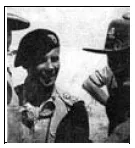
The author with Gen Montgomery during a visit to the 22d Armd Brigade
The other armored formations left in the Eighth Army were: a weak brigade of Valentine tanks (23d Armored Brigade) and the 4th Light Armored Brigade consisting of a regiment of Stuart tanks, 2 regiments of armored cars, a motor battalion and one artillery regiment. Being the main armored force available, many were the ideas of how 22d Armored Brigade should be employed. We spent our time reconnoitering different positions which we should occupy in varying tactical circumstances. It was all rather reminiscent of the situation in the Gazala line some 3 months earlier in May; then we had reconnoitered and planned our defensive positions in many areas which we might be required to occupy in a variety of circumstances. In any event, we had not been given sufficient time to occupy the one selected to deal with the German advance round Bir Hachiem and so were defeated in detail. Certainly on that occasion we recovered our balance and had the remainder of the battle been handled differently, might well have wrested the initiative from Rommel.
However, at Alam Halfa at the end of July 1942, the multiplicity of plans as far as the 22d Armored Brigade was concerned did not inspire the greatest confidence.
Early in August the Prime Minis, the Chief of the Imperial General Staff and others visited the Western Desert. As a result of their visit certain changes in the higher command were made. By August 13th, Gen Alexander was the new Gin-C Middle East and Gen Montgomery the new Eighth Army Commander.
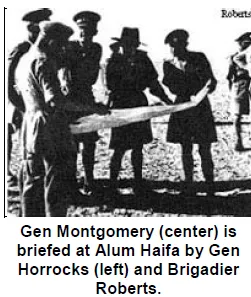
These changes were to have a marked effect within a few clays on our plans, on our life and on our outlook generally. Within two days of his arrival Gen Montgomery had toured the whole front and visited all the units in it. 1 well remember my first meeting with him; he and the new Corps Commander, Gen Horrocks, were to meet me at a certain point on the Alam Halfa ridge at 0845 hours. At 0830 being afflicted with gyppy-tummy I felt there was just time to disappear over the nearest ridge with a spade, and plodding my way back a few minutes later complete with spade I saw a large cortege arriving at the appointed spot and some 5 minutes ahead of schedule. There was Gen Horrocks, XIII Corps Commander, whom I saluted, there were Bobbie Erskine, Brigadier General Staff, XIII Corps, and Freddie de Guingand, Chief of Staff, Eighth Army and several other characters including a little man with white knobby knees, an Australian hat and no badges of rank who took to be a newly arrived war correspondent. Monty, whom I had not previously met was obviously going to arrive later. I was just about to ask Freddie de Guingand from which direction the Army Commander might be expected when the gentleman in the Australian hat said to me “Do you know who I am?”–”Yes, Sir,” was the prompt reply. It was quite clear that whoever he was it was better to know! And, of course, it was Monty.
Very soon Montgomery appreciated that Alain Halfa was the cornerstone of the defensive position. He ordered up 44 Division from the Delta to occupy the high ground itself, and within the perimeter of that Division’s defenses were to be located the 44th Divisional Artillery and certain Corps artillery units. The 22d Armd Brigade, then an independent armored brigade directly under XIII Corps, was ordered to select and to prepare static defensive positions on the southern and eastern slopes of Alam Halfa. It was considered, and quite rightly, that the Brigade was short of training as a Brigade and its mechanical condition, as a result of the mileage already done by the tanks, precarious, and therefore unsuited to mobile operations. In fact this Brigade, with its same equipment, took part in the battle of Alamein and at one time led the pursuit of the German army to Tobruk.
Gone were all the other plans and we gladly destroyed the mass of traces with different code names which had been prepared with laborious staff work to indicate the alternative positions. There was one rum plan and one position to occupy and we all felt better. (See sketch map No. 2.)
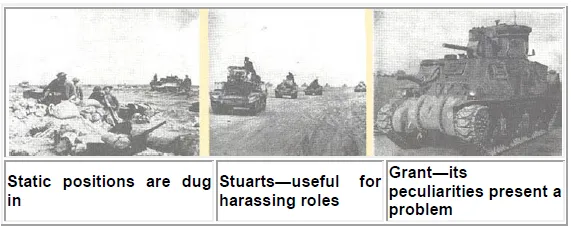
It would be relevant here to describe these positions and indicate the factors affecting their selection. First and foremost, it must be borne in mind that these were to be firm defensive positions and that the battle would be fought to a preconceived plan; there was to be little possibility of maneuver, so normal in armored tactics, to meet swiftly changing situations. The second important factor was the qualities and peculiarities of the Grant tank which was the mainstay of the defense. Its main armament was a ‘15 mm gun in a side front mounting. This prevented good, natural “bull down” positions being selected, and since the gum had only a very limited traverse only limited areas of fire were available for each tank. The tank was very high which increased the difficulty of concealment in anything but very broken ground. Thirdly, a very wide area had to be covered to deal with attack from the east, southeast and south; consequently there were no troops available purely as a reserve.
Very briefly these matters were resolved as follows. The 6 pounder AT guns of 1 Rifle Brigade and of an antitank battery from an artillery regiment, put under my command specifically for this operation, were given the area of flat and unbroken ground to cover; their concealment in such terrain being obviously easier than for Grant tanks. The Grant tanks were put into the broken foothills, and where suitable positions could not be found these were achieved by bulldozing. Finally, the Greys, being equipped with the newest Grant tanks were placed on the eastern slopes, from which direction attack was considered least likely, so that they would be the most likely to be available as a mobile reserve and were at the same time the most mechanically reliable.
The detailed positions having been decided upon, a careful artillery program was planned with SOS tasks, particularly some tasks close in front of the antitank guns.
It should be pointed out here that the Grant tank, in spite of the disadvantages already mentioned, was the only tank then in the Desert of any real value against the German PzKw III and IV. With its short-barrelled 75 mm gun in the side mounting it could be very effective against these German tanks at about 1,000 yards range. The other tanks, Valentine, Stuart and Crusader with 2 pdr or equivalent guns were of value in a harassing role, but no use in a “slugging match.”
This was, at any rate, the impression we gained in those days, but careful tests carried out after the war have shown that we were unduly pessimistic regarding the performances of our own tanks. At Alam Halfa, however, there was a surprise in store for us as will be seen later.
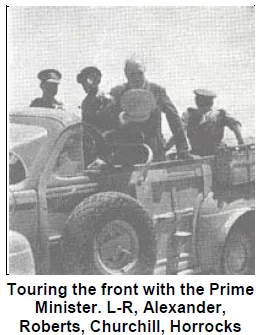
About this time the Prime Minister returned to the Desert on his way back to England from Moscow after seeing the gentleman he described as the “Old Bear.” Having spent the night in Monty’s caravan, the next day, 20 August, he toured the battlefield. It was with great pride that I squeezed myself into the cut-down station wagon in which lie was traveling with several senior officers, and showed him the 22d Armored Brigade concealed in their defensive positions which we had occupied as a rehearsal that morning. Ten days later the battle was fought over the very ground on which the plan was described to him, and which he remembered in some detail when I saw him again in Tripoli, 5 months later.
The day after Winston’s visit we had a “telephone battle” organized by Gen Horrocks and based on Monty’s conception of the lines the battle would take. A “telephone battle” is the same thing as an American CPX. Information maps were kept and, in accordance with the normal custom of those days, the enemy movements and positions were shown in blue and our own movements and positions in red. It may be thought that this telephone battle has not much bearing on a study of the actual battle, but suffice to say that on the day of the battle itself, the blue lines of the enemy’s movements–as put on the maps dining the exercise–required little alteration to conform to fact. The timing was different, but the general idea was there.
It must be explained that all this time 22d Armd Brigade was in what was called “leager areas” some one to two miles south of the selected defensive positions. Vehicles were in “air dispersion” and covering a wide area. Time was spent in improving the defensive positions by hand-digging, bulldozers and maintaining tanks and guns.
Meanwhile, in order to strengthen the armored situation, every effort was being made by the higher command to get forward the 10th Armd Div under Gen Gatehouse, with 8th Armd Brigade which was being reequipped with 3 regiments of new or reconditioned Grant tanks. 10th Armd Div Headquarters arrived in the Alam Halfa area on about 27 August and 22d Armd Brigade was put under its command. Advance parties of 8th Armd Brigade arrived on 29 August, but main bodies of this brigade didn’t arrive until 30 August.
At this time the positions of Eighth Army were as shown in sketch map No. 1. At the southern end of our line the 7th Armd Div, consisting of the 4th Light Armd Brigade and tire 7th Motor Brigade held the line of the minefield from the left of the 3rd New Zealand Div to tire southern edge of Deir el Munassib with 7th Mot Brigade. They guarded the remainder of the minefield and the open flank back as Car as Himeimat with 4th Light Armd Brigade. This part of the front was therefore rather lightly held.
Rommel’s attack was expected any night towards the end of the month. In the 22d Armd Brigade, elaborate preparations were made for alerting the Brigade and moving to our defensive positions during the night in “wireless silence.”
On 30 August I was personally not feeling my best; nothing serious, but just the effects of heat, sand and flies on top of the long summer battles and being slightly wounded during June. Being anxious to be as fresh as possible, I had got up a spare ambulance truck which could be made fly-proof and was a little cooler than a bivouac tent. I had a nap after lunch and went to bed early. Shortly after midnight I was awakened by gunfire in the distance and it was quite clearly more than some little affai...
Table of contents
- Title page
- TABLE OF CONTENTS
- EDITOR’S NOTE
- THE AUTHORS
- FOREWORD - By Capt B. H. Liddell Hart
- FROM THE BRITISH SIDE
- FROM THE GERMAN SIDE
- CRITIQUE
Frequently asked questions
Yes, you can cancel anytime from the Subscription tab in your account settings on the Perlego website. Your subscription will stay active until the end of your current billing period. Learn how to cancel your subscription
No, books cannot be downloaded as external files, such as PDFs, for use outside of Perlego. However, you can download books within the Perlego app for offline reading on mobile or tablet. Learn how to download books offline
Perlego offers two plans: Essential and Complete
- Essential is ideal for learners and professionals who enjoy exploring a wide range of subjects. Access the Essential Library with 800,000+ trusted titles and best-sellers across business, personal growth, and the humanities. Includes unlimited reading time and Standard Read Aloud voice.
- Complete: Perfect for advanced learners and researchers needing full, unrestricted access. Unlock 1.5M+ books across hundreds of subjects, including academic and specialized titles. The Complete Plan also includes advanced features like Premium Read Aloud and Research Assistant.
We are an online textbook subscription service, where you can get access to an entire online library for less than the price of a single book per month. With over 1.5 million books across 990+ topics, we’ve got you covered! Learn about our mission
Look out for the read-aloud symbol on your next book to see if you can listen to it. The read-aloud tool reads text aloud for you, highlighting the text as it is being read. You can pause it, speed it up and slow it down. Learn more about Read Aloud
Yes! You can use the Perlego app on both iOS and Android devices to read anytime, anywhere — even offline. Perfect for commutes or when you’re on the go.
Please note we cannot support devices running on iOS 13 and Android 7 or earlier. Learn more about using the app
Please note we cannot support devices running on iOS 13 and Android 7 or earlier. Learn more about using the app
Yes, you can access THE BATTLE OF ALAM HALFA - A BATTLE REPORT [Illustrated Edition] by Generalleutant Fritz Bayerlein a.D.,Major General G. P. B. Roberts C.B. D.S.O. M.C., Captain Basil Liddell-Hart in PDF and/or ePUB format, as well as other popular books in History & European History. We have over 1.5 million books available in our catalogue for you to explore.