- 56 pages
- English
- ePUB (mobile friendly)
- Available on iOS & Android
eBook - ePub
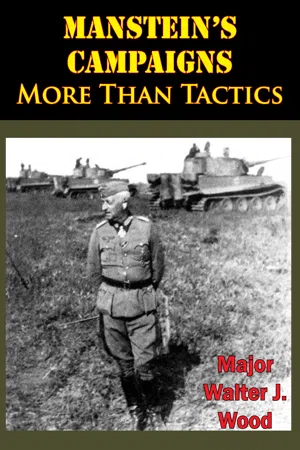
Manstein's Campaigns - More Than Tactics
About this book
The purpose of this paper is to analyze selected campaigns/operations of Field Marshal Erich von Manstein in order to draw lessons from those campaigns as they relate to command, control, communications (C3) and logistics — subjects of immediate and relevant interest to those who take up the profession of arms. But all too often, histories of battles, campaigns and entire conflicts neglect the treatment of these areas. And when these factors are dealt with, the treatment they receive is likely to be rather shallow, lacking the depth necessary for the student to analyze these factors/functions as they related to overall success or failure. This analysis will be conducted of specific, delineated functions as they relate to C3, but owing to the far reaching scope of logistics, this paper will be limited to treating a few critical aspects of logistics as they impacted on the campaigns of Manstein and the German Army. The second chapter will introduce Manstein to the reader and highlight his accomplishments. Chapter III will deal with C3 functions as they related, supported or were used by Manstein, and the fourth chapter will deal with key logistics issues as they influenced/impacted the campaigns of Manstein. The final chapter will present some conclusions and broad lessons derived from the German experience in general.
Trusted by 375,005 students
Access to over 1.5 million titles for a fair monthly price.
Study more efficiently using our study tools.
Information
Subtopic
European HistoryIndex
HistoryCHAPTER I — INTRODUCTION
On 1 September 1939, the German Army smashed into Poland and in five short weeks forced her to capitulate. But Poland was a backward nation with a poorly equipped and ill prepared army. France and her allies would be a different issue. The German war machine would surely be held in check by the French Army, by all accounts the largest and “best equipped” army on the continent. To the strategic calculus was added the seapower of Britain and her expeditionary forces deployed to France, and the victory of the allies appeared to be all but assured. At a minimum, if not thrown back to her original borders, the final German drive for European hegemony would assuredly be dashed on the Maginot Line. But to the dismay of France and Britain, the outcome was not to be decided by the prevailing conventional wisdom:
“Before the end of June 1940, Germany bestrode the continent of Europe like a colossus. She dominated the whole of western, central and south-eastern Europe — except for the small island of Britain on the western fringe.”{1}
In the late spring of 1940, the world was awe-struck by the apparent invincibility of the German war machine Subsequent to some lesser operations, Hitler unleashed his army on Russia in June 1941. After a few brief weeks the army was poised to seize Leningrad in the north, capture the Russian capital and wrest complete control of the Ukraine from the Soviets. However, now the fortunes of war turned, the German Army was held at bay and after some number of local victories in 1942 the German Army was driven steadily rearward and by 1945 Germany was helpless in front of the allied armies that fought against her. What had happened to the German Army and blitzkrieg? The answer is perhaps best provided by Gen F. W. von Mellenthin:
“By the end of 1941 [the] German war economy was in a serious plight. We did not have the oil supplies necessary for waging war on a world-wide scale; the Eastern campaign was making colossal demands for vehicles, armor, antitank guns, and spare parts... By the end of 1941 it had become impossible for Germany to win the war... The war dragged on into 1942, but the time for blitzkrieg tactics had passed, never to return.”{2}
It is not the intent of this study to investigate the operational art as practiced by the German Army during the Second World War. Libraries are full to bursting with accounts of German armies smashing and encircling their foes, or of German commanders countering the thrusts of numerically superior foes. The purpose of this study is to examine a few key areas of immediate and relevant interest to those who take up the profession of arms namely command, control, communications and logistics. For war is not simply a matter of doctrine, tactics, techniques and the subsequent fielding of armies. War is much more; it involves commanding and controlling forces to some political end, and perhaps most importantly, it includes the sustainment of those forces in the field. To this end, this all too brief study will deal with C3 and logistics as they were used, related and or impacted the campaigns of Field Marshal Erich von [Lewiniski] Manstein, who may well have been Hitler’s most brilliant general.
Manstein was one of the architects of blitzkrieg and perhaps its most successful practitioner. By following him during selected campaigns, one is provided key insights into how Manstein commanded and controlled his forces, and how his tactics and operations were impacted by the lack of German logistical capabilities. Many of these same considerations or broad aspects of the art of war must be dealt with today if we are to be successful on the battlefield of tomorrow.
CHAPTER II — FIELD MARSHAL ERICH VON (LEWINSKI) MANSTEIN THE MAN AND HIS ACCOMPLISHMENTS
If one is interested in examining command, control, communications and logistics from an historical perspective, why examine the campaigns of Manstein? The answer is quite simple; Manstein may arguably have been the most brilliant general of the Second World War. Captain B. H. Liddell Hart following his interviews with German generals at the end of the war observed:
“The general verdict among the German generals I interrogated in 1945 was that Field-Marshal von Manstein had proved the ablest commander in their Army, and the man they had desired to become its Commander-in-Chief ... In sum, he had military genius.”{3}
Erich von Lewinski was born on 24 November 1887 to a military family that produced seven general officers during the twentieth century.{4} The tenth child of Artillery General Edward von Lewinski, Erich was adopted by his natural mother’s sister Hedwig von Manstein for the Manstein’s had no children of their own. Following a typical childhood for a youngster of an old aristocratic family, Manstein entered the Royal Prussian Cadet Corps in 1900 and joined the Army in 1906. After seven years with the Third Foot Guards, he was assigned to the staff course of the Kriegsakademie and at the onset of World War I he was the adjutant of the 2d Reserve Regiment of the Guards.{5}
Participating in a number of major engagements to include the attack on the French fortress of Verdun in 1916, and once wounded, Manstein was taken into the Reichsheer{6} following the German collapse of 1918. In 1929 he became a member of the general staff. While on the general staff, Manstein made a number of enemies, “for he was not an easy man to serve over ... while he was charming to subordinates ... he was intolerably arrogant with his equals and superiors.”{7} A lesser man may well have had his career cut short, but Manstein’s military brilliance was evident to all who came into contact with him. But he was more than brilliant, he was a man who lived by the highest moral standard and had a pronounced sense of fairness. As a result,
“In 1934, when he was Chief of Staff of the Berlin Command, an order came through for the dismissal of certain officers because they had Jewish blood. Von Manstein refused to pass the order ... Blomberg (Minister of War) ordered Manstein’s dismissal but von Fritsch, who was commander-in-chief of the Army refused . . . .”{8}
Rather than being dismissed, Manstein retained his post and in 1936 became the Chief of Army Operations. However when his mentor, von Fritsch was removed from his position, Manstein was quickly transferred to the “relatively insignificant command of an infantry division.”{9} But by the time of his dismissal, he had already made a personal mark on the German Army. Through his thoughtful endeavors the 100,000 man Reichsheer had been trained so that each man could assume the next higher post; i.e., platoon commanders could command a company, company commanders a battalion and so on. As a result when Hitler decided to expand the Army, a highly qualified trained cadre was available to implement the expansion program. Similarly, as General Heinz Guderian was championing the cause of massed armored formations, potentially depriving the infantry arm of tank, support in the infantry battle, Manstein sponsored the development and use of the assault gun to provide assaulting infantry a mobile weapons system capable of engaging pin-point targets, infantry, gun-crews or tanks.{10}
Following his tour as the commanding general of the Eighteenth Infantry Division, Hitler appointed Manstein Chief of Staff, Army Group South, commanded by General Gerd von Rundstedt. Shortly thereafter, Army Group South participated in the conquest of Poland and once again his sense of honor and moral obligation was made manifest:
“During the campaign Manstein interceded asking that due consideration be shown to the Polish civilian population. He was strongly supported in this by his GOC. With Rundstedt he also tried to dissuade Hitler from bombing Warsaw, but in vain.{11}
Continuing to serve as Rundstedt’s Chief of Staff, Rundstedt became Commander of Army Group A for the planned offensive against France. It is during this period that Manstein’s reputation as a soldier of unparalleled military brilliance was firmly established, for it was he who significantly modified the original plan for the invasion of France.
The initial German concept for the invasion of France was derived from the conventional wisdom that the only possible course for such an invasion was through Belgium and Holland; the Maginot Line was too heavily fortified and the Ardennes was a natural barrier to mechanized forces. Therefore only a limited objective attack to the north could succeed. While seizing Belgium, Holland and the French Channel Coast, the plan conceded that French and allied forces would be able to fall back to the Somme. “Once there, he could draw on his powerful reserves to build-up a new front ... The operation planned by O.K.H. would bring partial victory ....”{12} Following his review of Army High Command’s (OKH) plan, Manstein realized its flaws; i.e., it would not lead to rapid, decisive victory over France. As a result Manstein met with Guderian and queried him as to the feasibility of moving mechanized forces through the Ardennes. As one of the fathers of German mechanization, Guderian’s views held great weight with both Manstein and Rundstedt. As Providence would have it, Guderian was familiar with the Ardennes as a result of experience there in World War I. After a careful map study, he confirmed Manstein’s view that a mechanized advance through the Ardennes was indeed feasible.{13} However repeated messages and correspondence from Rundstedt to Army Headquarters requesting the plan’s modification, as recommended by Manstein, were largely ignored.
After a series of incidents which postponed the offensive, the German Army High command inadvertently provided the catalyst for the approval of Manstein’s plan. On 27 January 1940, Manstein was transferred to an Infantry corps command. “It was decided to remove him from his post ... where he would be out of the main channel and not so well placed to push his ideas.”{14} But now, following a conference with Hitler for all newly appointed corps commanders, a private meeting was arranged between the two principals. The results of that meeting sealed France’s fate, for following the meeting Hitler directed O.K.H. to revise their plan in accordance with the views of Manstein — the “Manstein Plan”, as it came to be known, had been approved! Now the main attack would be launched through the Ardennes, its objective — to force French capitulation. The van of the offensive through the Ardennes consisted of an armored corps led by Guderian, who mercilessly drove his tanks forward shattering the French defenses. German forces quickly penetrated France below the Somme denying the French the opportunity to consolidate a secondary defensive line. Once the Somme had been breached, no major obstacle remained between the Germans and Paris. As a consequence, in six short weeks France was forced to capitulate and the military prowess of Manstein were now recognized by friend and foe alike.
During the French campaign, Manstein attacke...
Table of contents
- Title page
- TABLE OF CONTENTS
- ABSTRACT
- CHAPTER I - INTRODUCTION
- CHAPTER II - FIELD MARSHAL ERICH VON (LEWINSKI) MANSTEIN THE MAN AND HIS ACCOMPLISHMENTS
- CHAPTER III - COMMAND, CONTROL AND COMMUNICATIONS (C3)
- CHAPTER IV - LOGISTICS
- CHAPTER V - CONCLUSIONS/RECOMMENDATIONS
- BIBLIOGRAPHY
Frequently asked questions
Yes, you can cancel anytime from the Subscription tab in your account settings on the Perlego website. Your subscription will stay active until the end of your current billing period. Learn how to cancel your subscription
No, books cannot be downloaded as external files, such as PDFs, for use outside of Perlego. However, you can download books within the Perlego app for offline reading on mobile or tablet. Learn how to download books offline
Perlego offers two plans: Essential and Complete
- Essential is ideal for learners and professionals who enjoy exploring a wide range of subjects. Access the Essential Library with 800,000+ trusted titles and best-sellers across business, personal growth, and the humanities. Includes unlimited reading time and Standard Read Aloud voice.
- Complete: Perfect for advanced learners and researchers needing full, unrestricted access. Unlock 1.5M+ books across hundreds of subjects, including academic and specialized titles. The Complete Plan also includes advanced features like Premium Read Aloud and Research Assistant.
We are an online textbook subscription service, where you can get access to an entire online library for less than the price of a single book per month. With over 1.5 million books across 990+ topics, we’ve got you covered! Learn about our mission
Look out for the read-aloud symbol on your next book to see if you can listen to it. The read-aloud tool reads text aloud for you, highlighting the text as it is being read. You can pause it, speed it up and slow it down. Learn more about Read Aloud
Yes! You can use the Perlego app on both iOS and Android devices to read anytime, anywhere — even offline. Perfect for commutes or when you’re on the go.
Please note we cannot support devices running on iOS 13 and Android 7 or earlier. Learn more about using the app
Please note we cannot support devices running on iOS 13 and Android 7 or earlier. Learn more about using the app
Yes, you can access Manstein's Campaigns - More Than Tactics by Major Walter J. Wood in PDF and/or ePUB format, as well as other popular books in History & European History. We have over 1.5 million books available in our catalogue for you to explore.