- 139 pages
- English
- ePUB (mobile friendly)
- Available on iOS & Android
eBook - ePub
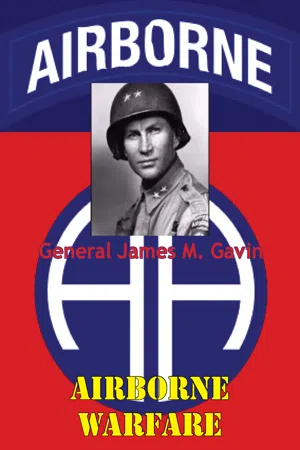
Airborne Warfare
About this book
To every member of the 82nd Airborne Division who dropped as part of the American paratroop landings during World War Two, they breathed a little easier knowing their commander "Jumpin' Jim" Gavin would be dropping with them. General Gavin would drop into the fierce fighting along with his men in Sicily, Normandy on D-Day and during the abortive attempt to capture the Rhine bridges during Operation Market-Garden. He shared the risks of all his men dropping into enemy territory, often only armed with his GI issue rifle and accompanied by a handful of men, leading from the front his memoirs are an outstanding addition to the literature of the Airborne in World War II.
General Gavin had been at the forefront advancing the use of airborne troops in the US army, writing the first field manual for their combat use. In this volume of memoirs General Gavin recounts his many experiences in the Airborne and also writes of the need and use of airborne troops in the future.
General Gavin had been at the forefront advancing the use of airborne troops in the US army, writing the first field manual for their combat use. In this volume of memoirs General Gavin recounts his many experiences in the Airborne and also writes of the need and use of airborne troops in the future.
Tools to learn more effectively

Saving Books

Keyword Search

Annotating Text

Listen to it instead
Information
CHAPTER 1 — PARATROOPS OVER SICILY
SICILY IN JULY OF 1943 was the birthplace of American airborne technique. It was, as well, the crucible into which were thrown the brain storms, the cocktail cerebrations, and the intensely cherished unorthodox combat tactics of a young army. Theories originally conceived, nurtured and brought to apparent maturity without the test of battle were exposed to their first test. How well they fared, how well they fought, and what our airborne forces accomplished are questions not even partially answered to date. But the toddling tot that later became the First Allied Airborne Army was born in Sicily and survived a very rugged delivery.
This Airborne Army was conceived in the planning staffs and headquarters of the North African Theater of Operations and the U. S. Seventh Army. The final Sicilian invasion plan envisioned an amphibious assault at Licata, Gela, and Scoglitti (map 1) by the U. S. 3d, 1st and 45th Infantry Divisions. The II Corps, commanded by General (then Major General) Omar N. Bradley, consisted of the two divisions on the right, the 1st and 45th. After landing, the airborne troops were to be attached to this corps.
The plan of invasion called for one parachute combat team of the reinforced 82d Airborne Division to drop between Caltagirone, where large enemy reserves were known to be, and the 1st Division’s beaches. After the D-day landings the CT was to be built up by successive air and sea lifts in the zone of the Seventh Army and participate in the conquest of the island.
The 505th Parachute Combat Team (reinforced) made the initial assault with orders to seize key terrain south of Niscemi for use as an airhead and to block enemy movement toward Gela from the north. It was to destroy enemy communications and deny by fire the use of Ponto Olivio airfield. Particular attention was to be paid to the strong point at “Y” (map 2). This locality, heavily wired and mined, consisted of sixteen mutually supporting reinforced concrete pillboxes and blockhouses. The strong point controlled all traffic on the Gela-Caltagirone and Gela-Vittoria roads. The road net at “X” also was to be seized, blocked, mined and held. Upon contact with the 1st Infantry Division, the CT was to assist it in its advance.

The 505th Parachute Combat Team (reinforced) consisted of the following:
505th Parachute Infantry Regiment; 3d Battalion, 504th Parachute Infantry; 456th Parachute Field Artillery Battalion; Company B, 307th Airborne Engineer Battalion; and Signal, Medical, Air Support, and Naval Support detachments. The force totalled 3,405 troopers, requiring 227 C-47s for transport.
The mission posed a number of problems never before encountered. Should the transports fly in formation as other American combat aircraft were being flown, or should they fly “bomber-stream” as the British were flying? Should the drop take place before or after the amphibious landing, or at the same time as the landing? Should the drop take place under cover of darkness, or in daylight hours? There were a number of opinions on these problems, all of them supported by strong statements and the firm belief of our critics in their own opinions.

Flying the transports in formation offered some advantages. It would permit a quick mass delivery of the troopers on their objectives. Offsetting this was the inflexibility of formation flying. This might prove costly in the event of hostile interception and heavy flak. Formation flying would require intensive pilot training. On the other hand, an accurate delivery of troops from a formation would require fewer skilled navigators and the troops would be delivered en masse, over the objective, and not by single drops. Even if delivered at the wrong area each unit would still be a complete force. It was finally decided to fly in nine-ship formations, with approximately one and one-half minutes between each flight. Serials contained up to fifty-two airplanes. The column was thirty-six minutes long.
The timing of a drop is always a difficult problem to decide. Training experience had led us to believe that at least a half-moon would be necessary both for the flight and the drop. Moonlight would greatly facilitate the assembly and reorganization of the troops. On the target date selected, July 10, 1943, the moon would be almost full. The ideal solution would be to complete the dropping of all units before the moon set. This would then give us several hours of darkness to carry out defensive organization and operations against the enemy. We believed that the risk of interception by hostile fighters eliminated the possibility of a daylight drop, and by day extensive enemy ack-ack would cause heavy casualties. Also, proper timing made it necessary for the parachute troops to land several hours before the amphibious troops.
The decision was made to drop the leading airborne elements three hours and fifteen minutes before the beach assault.
A night parachute operation had never before been attempted by any army so organization and training for it offered many new problems. The many intangible and indefinable difficulties of fighting at night in hostile territory when every object appears to be and often is the foe, all had to be overcome. Rapid assembly and reorganization of the troops appeared to be the greatest. Lacking combat experience, it was difficult to determine just how much security to sacrifice for speed. The actual combat proved that the assembly and reorganization were conducted too cautiously. Many visual aids could have been used to great advantage. Intensive, thorough training that built up boundless confidence in every man and in his unit was the only solution.
The basic load of combat equipment for the individual parachutist was checked and rechecked. Complete plane loads were weighed and checked in every detail. The complete loads of all units from squad to regiment were tried in all possible combinations, to arrive at the most efficient combat load. The complete lack of combat experience brought forth many original ideas. All were considered, tried, and either accepted or rejected.
Replicas of the operational areas, particularly strong point “Y,” complete to scale, were set up near Oudjda, French Morocco. Troops attacked with ball ammunition, and, as far as possible, realistically rehearsed their combat roles in every detail.
In the final combat team drop rehearsal token loads were dropped to check pilot accuracy.
If the spirit of the troopers and their desire to fight the German was any criterion, they looked like winners. But the actual mechanics of night assembly and reorganization and initiation of combat still left much to be desired. In the final pay-off, this requires intensive training and much experience to be done well.
On June 10, the CT commander, accompanied by two battalion commanders and three commanders from the 52d Troop Carrier Group, flew to Malta, where the group made a night reconnaissance of the operational area. The reconnaissance was flown under conditions exactly as they would be one month later, the night of D minus 1 and D-day. All check points and terrain showed up clearly in the moonlight, exactly as we had memorized them from the photographs. There was little reaction from the ground defenses. Considerable flak, however, came up from Ponto Olivio airdrome and vicinity, and several searchlights scanned the sky from around Biscart.
All units were dispersed in bivouacs in the Kairouan take-off area ready to go, by July 4. Final briefings were held and the planes took off exactly on schedule the evening of July 9. The final order included a paragraph that soon had real meaning. All pilots and troopers were told that every jumper and every piece of equipment would be dropped on Sicily. No one would be returned. If a pilot and jumpmaster could not locate the exact drop zone, the troops would jump and fight the best way they could. These orders were followed. What happened after the take-off can best be told by some of the participants.
This is the story told by Captain Edwin M. Sayre, who commanded Company A of the 505th, and was probably the first to land on the island:
“A Company took off at 2030 hours for the first check point at Malta. I do not know whether or not we saw Malta as I had never seen it before, but when we were due to arrive there I thought I saw a light. In any event, we continued and about fifteen minutes before the scheduled jump time we could see flashes of gunfire through the door of the plane, on the left. This surprised me, because I had expected to see Sicily appear on the right. There was considerable firing and the pilot turned to the right away from the island. We figured out later that we had hit the coast of Sicily somewhere between Noto and Siracusa. [As a matter of fact, 23 plane loads of this 1st Battalion of the 505th jumped near Noto where they met the British Eighth Army and joined in the ground fighting with it.]
“We circled to the right, going out to sea, and came back in toward the southern coast. We followed along the shore until we saw the lake which was a check point. The squadron then turned in toward the island. About one minute after the turn, we met heavy ack-ack, apparently coming from the Ponto Olivio airdrome. The squadron turned to the right to avoid this fire and shortly thereafter the green light was given. It was about 0035.
“The planes were under heavy machine-gun fire when we jumped and there was a lot of firing on the ground. By 0230 I had assembled fifteen men from the company and contacted the battalion executive officer. Company A was to attack a point from which about four machine guns were firing. We first attacked at 0300. The point from which the machine guns were firing was a garrison surrounded by pillboxes and was pretty strong. The attack was held up until about 0530, at which time fifty more men had been assembled. The attack was resumed and the garrison was killed or captured by 0615. It was held by one hundred Italians, with German noncoms from the Hermann Goring Panzer Division. We could hear a lot of fire in the valley—up toward Niscemi and down toward the beach. At about 0630, Lieutenant Colonel Gorham, the battalion commander, arrived with about thirty troopers from headquarters. He ordered us to consolidate our position, since it commanded the road leading from Niscemi to the beaches.
“At about 0700, a German armored column was seen about 4,000 yards away, coming from Niscemi. It was preceded by a point of two motorcycles and a Volkswagen. We let the point come into our position and then killed or captured the men. The armored column stopped about three thousand yards away when the point was fired on. Our position was then attacked from the front by two companies of Germans. We let them approach to within one hundred yards and then pinned them down in the open ground, Most of them were killed or captured. At the same time, tanks hit us from the flank. Two of six attacking tanks were knocked out and two more were damaged by a bazooka squad. The tanks withdrew. During this fight, Colonel Gorham sent patrols to the high ground which was the regimental objective, and to the ‘Y.’ They reported that the crossroads at the ‘Y’ was guarded by about thirty Italians in pillboxes surrounded by barbed wire. There was no one on the high ground.
“Colonel Gorham moved our force to the high ground, using about fifty prisoners to carry the wounded,
“After we had organized on the objective, a large part of our force moved out to capture strong point ‘Y,’ leaving about a squad and one officer to cover us from the north. When about four hundred yards from the strong point, heavy naval gunfire was seen falling about one hundred yards north of the pillboxes, but it could not reach the pillboxes which were in defilade. One of our Italian prisoners was told to go to the pillboxes and ask for their surrender. The occupants were told that if they did not surrender we would bring the naval gunfire right down on the pillboxes. We didn’t have any communication with the Navy, but the men in the pillboxes didn’t know that and surrendered. Our men moved into the pillboxes at about 1045.
“A few minutes later four German tanks approached from the north. When troopers in the pillboxes fired on them, they withdrew. At 1130, scouts from the 2d Battalion of the 16th Infantry, 1st Division, contacted us at strong point ‘Y.’ Colonel Gorham then attached all of our troops to the 16th Infantry and we advanced to the north. Shortly after this I [Captain Sayre] talked to Major General Ridgway by telephone and reported that the regiment had accomplished its mission, capturing strong point ‘Y’ and seizing the high ground northwest of it.
“We continued the attack with the 16th Infantry, finally capturing some high ground about a mile north of the crossroads, toward Niscemi, at 1900. The battalion remained in place that night and launched another attack at dawn, July 11, its objective being a hill to its immediate front. About one hour after the hill was taken, a strong German counterattack, consisting of about a battalion of infantry and about twenty tanks, hit our position. When it looked like the tanks would overrun us, a number of the men moved back. We drove the German infantry off but the tanks managed to get through us.
“The next morning we again attacked toward Niscemi and again, at about 0900, the Germans counterattacked, using several Mark VI tanks plus some Mark IVs. We had good artillery support from the 1st Division and the tanks were finally stopped about one hundred yards from our position. During this action Colonel Gorham was killed while engaging a tank. The following morning Niscemi was captured by the 1st Division and we were ordered to rejoin our combat team.”
The combat team commander told this story: “I flew in the lead ship of the 316th Troop Carrier Group, commanded by Colonel McCauley. All preparations went according to plan. Just before I boarded the plane a messenger from base operations informed me that the latest reports showed a 35-mile-an-hour wind over the target area. [Usually training jumps are cancelled if the wind exceeds 15 mph.] But there was nothing we could do about it. Our ships rendezvoused over the take-off area and we started for Sicily. I had memorized the route and times and knew we should pass the island of Linosa at 2230. But 2230 came with no sign of Linosa. I thought perhaps we were slightly off course and correction would be made before reaching Malta. Malta was a big target and certainly would not be missed. The lights would be on, so I expected no difficulty in recognizing it.
“The troops were resting easily, overloaded with equipment but anxious to go. A few were sleeping. It was 2300 but there was no sign of Malta. Up to this point we had seen no recognizable landmarks. The ocean appeared rather choppy. After flying on for some time I became concerned about our location, and after a discussion with the navigator, it was decided that we must have missed Malta, since it was long overdue. Figuring the course that would bring us to Sicily if the 35-mile wind had blown us eastward, we made a left turn and the flight continued. Around this time we saw a number of vessels, all apparently headed for Sicily. They gave us an anxious moment, since we knew that we would probably draw fire if we flew over any ships. Our route had been changed several times to avoid these convoys.
“About midnight the crew chief told me that land was in sight, evidently Sicily. Soon we could see occasional fires and tracers. We turned and flew parallel to the coast for some time. All troops prepared to jump and we turned in toward the coast. I had memorized all the terrain surrounding the landfall we should have passed. We were supposed to fly over a large lake, the one I had already flown over a month before. But we saw none of the recognizable landmarks. It was almost time to jump. Finally the green light in the plane came on and we went out. There was some scattered firing on the ground when we left the planes. One C-47 crashed and blew up on the drop area.
“The firing increased. Buildings and trees were moving by swiftly as we came in for the landing, a sure sign of a strong wind. Immediately after landing, reorganization and assembly were begun but many men were missing. After half an hour about 15 were assembled. We could hear a great deal of firing from all directions. We captured an Italian soldier but obtained no worthwhile information. We started to move toward where the drop zone should be. A few men were picked up during the night. My group finally consisted of myself, S-3, S-1, and several enlisted troopers. A number of the troopers had been injured in landing and fell by the wayside. Others were lost or engaged in small fights.
“Up to this point, just before daylight, we had seen no familiar landmarks and we weren’t sure whether or not we were actually in Sicily. Just before daylight heavy naval shelling opened up to the west and south. We were happy to see it, since it proved at least that we were actually in Sicily. Based upon the location of the shelling and my knowledge of the naval support plan, we started wes...
Table of contents
- Title page
- TABLE OF CONTENTS
- INTRODUCTION
- CHAPTER 1 - PARATROOPS OVER SICILY
- CHAPTER 2 - PLANS AND OPERATIONS IN THE MEDITERRANEAN
- CHAPTER 3 - BACK DOOR TO NORMANDY
- CHAPTER 4 - HOLLAND: AIRBORNE ARMY’S FIRST TEST
- CHAPTER 5 - THE AIRBORNE OPERATIONS OF 1945
- CHAPTER 6 - AIRBORNE ARMIES OF THE FUTURE
- CHAPTER 7 - ANTI-AIRBORNE DEFENSE
- CHAPTER 8 - THE USE OF AIRBORNE TROOPS IN THE FUTURE
Frequently asked questions
Yes, you can cancel anytime from the Subscription tab in your account settings on the Perlego website. Your subscription will stay active until the end of your current billing period. Learn how to cancel your subscription
No, books cannot be downloaded as external files, such as PDFs, for use outside of Perlego. However, you can download books within the Perlego app for offline reading on mobile or tablet. Learn how to download books offline
Perlego offers two plans: Essential and Complete
- Essential is ideal for learners and professionals who enjoy exploring a wide range of subjects. Access the Essential Library with 800,000+ trusted titles and best-sellers across business, personal growth, and the humanities. Includes unlimited reading time and Standard Read Aloud voice.
- Complete: Perfect for advanced learners and researchers needing full, unrestricted access. Unlock 1.4M+ books across hundreds of subjects, including academic and specialized titles. The Complete Plan also includes advanced features like Premium Read Aloud and Research Assistant.
We are an online textbook subscription service, where you can get access to an entire online library for less than the price of a single book per month. With over 1 million books across 990+ topics, we’ve got you covered! Learn about our mission
Look out for the read-aloud symbol on your next book to see if you can listen to it. The read-aloud tool reads text aloud for you, highlighting the text as it is being read. You can pause it, speed it up and slow it down. Learn more about Read Aloud
Yes! You can use the Perlego app on both iOS and Android devices to read anytime, anywhere — even offline. Perfect for commutes or when you’re on the go.
Please note we cannot support devices running on iOS 13 and Android 7 or earlier. Learn more about using the app
Please note we cannot support devices running on iOS 13 and Android 7 or earlier. Learn more about using the app
Yes, you can access Airborne Warfare by General James Maurice Gavin, William C. Lee in PDF and/or ePUB format, as well as other popular books in History & European History. We have over one million books available in our catalogue for you to explore.