This thesis analyzes the political role of the German General Staff as well as civil military relations in Germany from the late 19th century until 1933. Specifically, it examines the rise and fall of Kurt von Schleicher. Together with Generals Paul von Hindenburg, Erich Ludendorff, and Wilhelm Groener, Schleicher shaped the politics of the Weimar Republic, right up to the end that he—unintentionally—hastened when his intrigues paved the way for Adolf Hitler's dictatorship.
During World War I, the German army completed its control over the civilian administration and bureaucracy. In the Republic of Weimar 1919–1933, the military remained a powerful governmental player—as the self-anointed protector of the nation against external and internal threats, including democracy.
Thus, Germany's political situation in the winter of 1932–1933 and the activities of the key players stemmed from a long-term anti-democratic socialization process amid an entrenched civil-military imbalance. As the present thesis demonstrates, Schleicher's life—from his military background to his experience as a member of Prussia's noble Junker class—coincided with Germany's tumultuous modernization. The fateful lessons that he drew from this experience ultimately spelled the end of Germany's first democracy and ushered in the calamity of the Third Reich.
- 125 pages
- English
- ePUB (mobile friendly)
- Available on iOS & Android
eBook - ePub
Arracourt - September 1944
About this book
Information
Subtopic
European HistoryIndex
HistoryCHAPTER 1 — BACKGROUND
The battles of Arracourt during September 1944 were part of Patton’s Lorraine Campaign. The U.S. 4th Armored Division not only spearheaded an advance through France in its drive to Germany, but also conducted a mobile defense against major German counterattacks. Employing both traditional fire and maneuver tactics and some newly recycled techniques, units at Arracourt clashed in “the greatest tank battle on the Western front.”{1}
Strategic Objectives
Arracourt must be studied in both its strategic and tactical contexts. The Allied military strategy in Western Europe was to advance through France along two principal avenues of approach and defeat German forces (see map 1).{2} The main avenue of approach was given to British Field Marshal Sir Bernard Law Montgomery’s 21st Army Group.{3} He was to invade Germany through the low countries and capture the Ruhr industrial area from the north. General Courtney Hodges’ First Army was to make a Rhine crossing and capture the southern Ruhr area along the northern avenue while General George S. Patton’s Third Army was to move along the secondary avenue of approach, cross the Moselle River near Nancy, advance through Alsace-Lorraine and make Rhine crossings in the area of Mannheim and Mainz.{4} Thus, 12th Army Group, commanded by Lt. Gen. Omar N. Bradley, was split along both avenues of approach. This “broad front” advance had not been planned from the outset. During early August 1944 Montgomery and Bradley debated the pro and cons of a two-pronged or single-thrust advance. Montgomery proposed that the Allies concentrate all strength on a drive through the low countries by way of Amiens and Brussels over a path almost twice as long as the route through Alsace-Lorraine.{5}
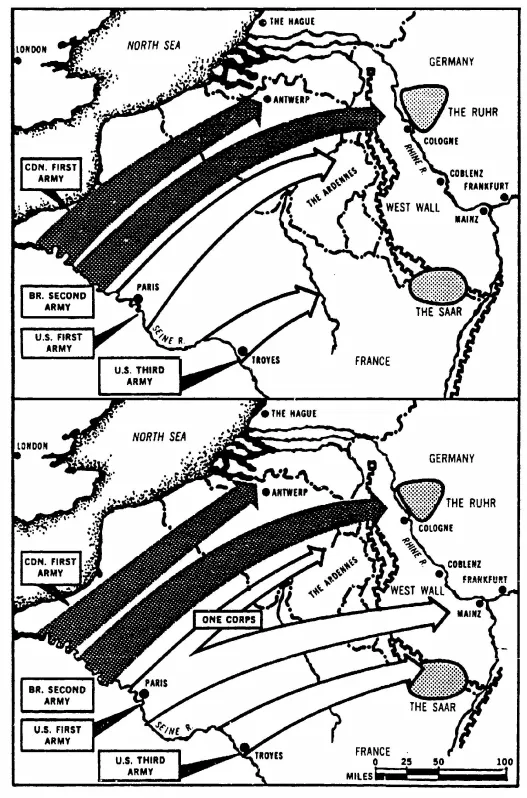
Map 1-Broad vs Narrow Front
The Allies needed strong forces in the north where Montgomery’s 21st Army Group still faced German divisions isolated along the English Channel at the port of Calais. If Montgomery could move quickly, he could capture Antwerp and the channel ports and seize the Belgian air fields, which would be used for short-range fighter support of heavy bombers engaged in daylight raids. In addition, such a move by Montgomery would clear the rocket belt from which the Germans were consistently harassing London.{6}
Bradley argued for a modified double thrust whereby the Third Army in the south would carry the 12th Army Group past Metz’s fortifications and penetrate the as yet unmanned defenses of the West Wall.{7} If the southern thrust went all the way to the Rhine, it would deprive the Germans of the industrially important Saar basin. Additionally, it would force them to spread their resources over a wider area, thereby reducing resistance to both advances.
On 23 August Eisenhower decided tentatively in favor of the single thrust: Montgomery making the main effort along the channel coast; Bradley supporting the British effort with all nine divisions of the First Army; and only the Third Army in the south with First Army having first priority on supplies. Bradley vigorously opposed the decision, and in a directive issued on 29 August Eisenhower amended the plan, leaving control of First Army under Bradley.{8}
On 2 September Eisenhower went to Versailles to meet with Bradley, Hodges, and Patton to plan their advances. At Versailles, Patton convinced Eisenhower that the opportunities on his front were too good to pass up, and the supreme commander agreed to allocate additional gasoline stocks to Third Army. In addition, he shifted the direction of First Army’s advance from northeast to due east, resuming the broad front advance.
Two days later, SHEAF found that Montgomery was moving easily after capturing Brussels and the port of Antwerp intact. So they decided not to stop Patton’s drive toward the Saar, because he could be supplied without handicapping Montgomery.{9}
On 5 September, Eisenhower was still confident that his armies could capture both the Ruhr and the Saar; that they could overrun the West Wall and cross the Rhine on a wide front before the Germans could recover; and, while this broad advance was in progress, that the ports of Antwerp and Le Havre could be opened in readiness for a final offensive into the heart of Germany. He still intended to give priority to the northern route of advance, but he did not think that redistribution of the existing supplies would enable the Allies to maintain a thrust to Berlin. This infuriated Montgomery, who felt he should get all available supplies.
To mollify Montgomery, Eisenhower flew to Brussels on 10 September. There, Eisenhower and Montgomery agreed on a combined airborne and ground attack, code named MARKET GARDEN, to cross the Lek River at Arnhem, seize a bridgehead over the Rhine, and flank the defenses of the West Wall. The British Second Army was designated to link up with the paratroopers near Arnhem. This would provide a bridgehead over the Rhine before the momentum of the offensive would be lost. The airborne troops could be supplied without further straining the overburdened transport lines.
Several problems surfaced. First, by concentrating on MARKET GARDEN, Montgomery could not immediately free Antwerp for much needed logistical support. Second, moving Second Army to the north would open a gap between its right flank and First Army’s left flank, and Hodges would have to slide his First Army divisions to his left to cover the gap. Third, the direction of the attack would carry Montgomery away from the Ruhr and give him another river to cross.
MARKET GARDEN was moved up from 26 September to 17 September. Although the airborne units achieved their objectives at Nijmegen and Arnhem, determined German resistance coupled with bad weather prevented reinforcement. The 9th SS Panzer Division and the Army Group B commander (Field Marshal Walther von Model) were in the Arnhem area on the 17th, so Montgomery lost his element of surprise. Operation MARKET GARDEN fell short of Montgomery’s expectations, resulted in the slowing down of Patton and delayed the opening of the Port of Antwerp. In mid-October, when Montgomery gave up on operations against the Ruhr and decided to give Antwerp first priority, a full month had been lost. The Germans had since strengthened their lines, laid mines, built fortifications, and established a formidable barrier, so that a major campaign cleared the estuary northwest of Antwerp only by 28 November, having tied up tremendous resources in the process.
Meanwhile, Patton had advanced faster than anyone had imagined. Thus far his offensive had been spectacular. Following activation in England on 28 July, Third Army participated in Operation COBRA{10} in Normandy and then moved swiftly through France to the banks of the Moselle, where critical supply shortages forced them to stop. Patton’s supply line stretched 313 miles from Verdun to Saarbourg, and the trucks of his Red Ball Express simply could not keep up. When the main supply center was moved to Nancy, the distance increased to 461 miles.{11} Only 3500 tons of supplies per day were supplied to the Third Army (including fuel), 1500 tons of which had to be diverted for use of Paris civilians.{12} This resulted in a shortage of 1600 tons per day. An underwater channel pipeline (nicknamed Pluto) was still 200 miles behind the Allied front and ineffective for Third Army use. Patton’s trucks were taken the end of August to replace those of First Army given to Montgomery. C-47 aircraft continued to supply much needed fuel until they, too, were diverted for a planned airborne operation on 3 September at Tournai, Belgium, which blocked the withdrawal of the German Fifteenth Army from the port of Calais. These aircraft were also used as part of Operation MARKET GARDEN.{13}
Patton wanted to maintain this momentum and continued to press Bradley for permission to do so. Meanwhile, captured supplies enabled him to move forward.{14} As a result of a meeting with his Army commanders on 12 September, Bradley wrote Eisenhower that Patton could continue all the way to Germany based on present and anticipated supplies. His letter read:
“Third Army states that they have enough ammunition on hand or in immediate sight for about four days’ fighting and enough petrol to carry them to the Rhine....”
“Patton has already launched a strong attack to force a crossing of the Moselle, which he believes will not only force this crossing but will open up the way for his rapid advance to the Rhine with his thrust directed on the axis Metz-Frankfurt.”{15}
In a more realistic vein, Bradley gave Patton two more days (until the evening of 14 September) to get across the Moselle; otherwise he would have to assume the defensive. This was explained in the same letter:
“.. .I have told Patton to continue his attack, that if by Thursday night (14 September) he has not been able to force a crossing of the Moselle with the mass of his forces, that he will discontinue that attack, assume the defensive along the southern flank and along the front from Nancy to the vicinity of Luxembourg, and make his main effort north of the Moselle River in conjunction with the attack now being carried out by the V Corps (of First Army)....”{16}
Unlike Bradley, Eisenhower, was convinced that the northern route was the way to go and did not want Patton to forge ahead of the 12th Army Group. Thus, he permitted Patton to push only far enough to hold adequate bridgeheads beyond the Moselle and thus create a constant threat to the German forces, preventing the enemy from reinforcing farther north.{17} Only after Montgomery’s forces and the First Army had succeeded in establishing a bridgehead across the Rhine would Eisenhower unleash Third Army to advance through the Saar and over the Rhine.
Montgomery had priority in supplies which infuriated Patton. After the capture of Antwerp on 4 September, Montgomery had demonstrated the Ruhr was vulnerable and convinced that if only Eisenhower would abandon his broad front and concentrate on a single thrust to the Ruhr, 10,000 tons a day could be provided for the First American and Second British Armies. This could maintain 20 divisions which would take him to the Ruhr and then on to Berlin.{18}
Eisenhower appeared indecisive, vascillating between single thrust and broad front strategy. But ...
Table of contents
- Title page
- TABLE OF CONTENTS
- ABSTRACT
- ACKNOWLEDGEMENTS
- LIST OF MAPS-ARRACOURT
- INTRODUCTION
- CHAPTER 1 - BACKGROUND
- CHAPTER 2 - THE ADVANCE OF CCA TO ARRACOURT AND THE LUNEVILLE DIVERSION
- CHAPTER 3 - FIRST ARRACOURT TANK BATTLE, 19-22 SEPTEMBER 1944
- CHAPTER 4 - The Battle Continues 24-29 September
- CHAPTER 5 - SIGNIFICANCE OF ARRACOURT
- APPENDIX 1 - GERMAN LAND COMMAND IN THE WEST
- APPENDIX 2 - ORGANIC AND ATTACHED UNITS OF THE FOURTH ARMORED DIVISION
- APPENDIX 3 - TABLES OF ORGANIZATION AND EQUIPMENT (TO&E’s) OF FIFTH PANZER ARMY DIVISIONS
- APPENDIX 4 - FIFTH PANZER ARMY ORDER OF BATTLE
- APPENDIX 5 - TANKS USED AT ARRACOURT*
- BIBLIOGRAPHY
Trusted by 375,005 students
Access to over 1.5 million titles for a fair monthly price.
Study more efficiently using our study tools.
Frequently asked questions
Yes, you can cancel anytime from the Subscription tab in your account settings on the Perlego website. Your subscription will stay active until the end of your current billing period. Learn how to cancel your subscription
No, books cannot be downloaded as external files, such as PDFs, for use outside of Perlego. However, you can download books within the Perlego app for offline reading on mobile or tablet. Learn how to download books offline
Perlego offers two plans: Essential and Complete
- Essential is ideal for learners and professionals who enjoy exploring a wide range of subjects. Access the Essential Library with 800,000+ trusted titles and best-sellers across business, personal growth, and the humanities. Includes unlimited reading time and Standard Read Aloud voice.
- Complete: Perfect for advanced learners and researchers needing full, unrestricted access. Unlock 1.5M+ books across hundreds of subjects, including academic and specialized titles. The Complete Plan also includes advanced features like Premium Read Aloud and Research Assistant.
We are an online textbook subscription service, where you can get access to an entire online library for less than the price of a single book per month. With over 1.5 million books across 990+ topics, we’ve got you covered! Learn about our mission
Look out for the read-aloud symbol on your next book to see if you can listen to it. The read-aloud tool reads text aloud for you, highlighting the text as it is being read. You can pause it, speed it up and slow it down. Learn more about Read Aloud
Yes! You can use the Perlego app on both iOS and Android devices to read anytime, anywhere — even offline. Perfect for commutes or when you’re on the go.
Please note we cannot support devices running on iOS 13 and Android 7 or earlier. Learn more about using the app
Please note we cannot support devices running on iOS 13 and Android 7 or earlier. Learn more about using the app
Yes, you can access Arracourt - September 1944 by Major Richard H. Barnes in PDF and/or ePUB format, as well as other popular books in History & European History. We have over 1.5 million books available in our catalogue for you to explore.