eBook - ePub
Willpower: A Historical Study Of An Influential Leadership Attribute
- 81 pages
- English
- ePUB (mobile friendly)
- Available on iOS & Android
eBook - ePub
Willpower: A Historical Study Of An Influential Leadership Attribute
About this book
This thesis investigates a single leadership attribute: willpower. Willpower is defined as the amalgamation of continuing in the face of adversity; the refusal to accept failure; and the power to affect a desired outcome in others. The central research question investigates how a leader generates willpower and transmits it to produce a desired effect. The methodology employed investigates three historical military leaders at the strategic, operational, and tactical levels of war over a sixty year period. The leaders analyzed are General Colin Powell, Admiral Chester Nimitz, and Lieutenant General Harold Moore. This analysis method was chosen to answer the three secondary research questions: Is there a common thread? Is willpower different at different levels of war? Has willpower transmission changed over time? To provide objectivity, a leader who possessed willpower and still failed, General Douglas MacArthur, is also studied. The historical leaders studied are found to have similarities in how they generate and transmit willpower. The willpower transmission techniques employed by the research subjects have not changed significantly over the period studied. However, willpower transmission techniques do reveal differences over the three levels of war.
Tools to learn more effectively

Saving Books

Keyword Search

Annotating Text

Listen to it instead
Information
CHAPTER 1 — INTRODUCTION TO WILLPOWER
——The will of leaders can make the difference between victory and defeat.{1} FM 22-100
The United States of America is currently at war against terrorism. During this conflict, the citizens of this country will rely on the success of their military to protect the nation and its interests. A large percentage of our nation’s military budget has been focused on obtaining better, more precise, or stealthy weapons systems in order to more easily defeat our enemies. However, it is always the soldier, sailor, marine, or airman that will ultimately utilize the latest high-technology weapon system. A military leader’s duty is to motivate his subordinates and make them as effective as possible. It then follows that a military leader must understand and be effective at training his subordinates and conditioning them to obey his will under stressful conditions. As a professional naval officer, the author has assumed responsibility for helping to protect the nation and is therefore keenly interested in developing skills that will aid him in that endeavor.
Since leadership is the key element of combat power that often makes the difference between success and failure, it is clearly worthy of further study.{2} This focus on leadership begs the question, what attributes must a good leader possess? LTC Edward Bowie, the Chief Instructor of the Combat Studies Institute at the Army’s Command and General Staff College (CGSC), has written that, “The key to leadership is resolve.” Bowie defines resolve, as fixity of purpose, firm determination, or will.{3}
With all due respect to LTC Bowie, the author does not believe his statement completely answers the question on leadership attributes. A leader must not only possess resolve, he also must strive to transfer his purpose to others in order to cause a desired outcome. The author contends this is more fully described as willpower, defined by Merriam-Webster as energetic determination.{4} Through willpower a leader translates his resolve into the desired action of others. The question then becomes, how does a great leader generate and transfer his will to others? This is the key question the writer proposes to investigate. How do great leaders generate their willpower and transmit their willpower to others in order to create a desired outcome?
For the purpose of this thesis, the author only partially accepts the Merriam-Webster’s definition of willpower as energetic determination. In a military context, willpower assumes an expanded context. The U.S. Army Field Manual, FM 22-100, Army Leadership, defines will as, “the inner drive that compels leaders to keep going when it would be easier to quit.”{5} FM 22-100 also defines the warrior ethos as “the refusal to accept failure.”{6} Refusing to accept failure is a working definition for determination. Merriam-Webster’s Dictionary defines power as, “the ability to produce and affect.”{7} A more appropriate definition of willpower therefore includes three specific ideas: continuing in the face of adversity; refusing to accept failure; and the power to affect a desired outcome in others. In a military leadership context, ‘others’ may be subordinates; it may also be superiors or individuals outside of the military organization. This broader definition of willpower describes the author’s vision for use in this thesis.
Having offered a suitable definition of willpower, it is time to discuss how this definition will be applied in this thesis. A leader translates his resolve into the desired action of others through the energetic application of willpower. This thesis will focus on the following primary research question: how does a leader generate willpower and then transmit it to others to have a desired effect?
In order to completely answer the primary research question of how leaders generate and transfer their willpower to their subordinates, the author must consider three secondary research questions. Since all humans are individuals, what motivates them individually is also unique. Similarly, all leaders are unique. However, is there a common thread that connects the methods of all successful leaders and how they have transmitted their willpower to their subordinates? Possible commonalities could include: a similar leadership style, upbringing or values, methods of communicating, goals, or treatment of their subordinates. The search for a “common thread” among the willpower transmission methods of different leaders will answer the first secondary research question.
Complicating any study of willpower, the challenges that face a leader vary with the size of the organization he leads and the complexity of the tasks the organization performs. It is generally accepted without argument that what works at one level may not necessarily work at another level. Therefore, the manner that a leader applies his willpower would vary as the size and complexity of the organization varies. For a small organization, a leader may utilize a direct or face-to-face leadership approach. As an organization grows in size, the leader is forced to use policies or procedures since it is no longer possible to interact with all of the individuals in an organization on a daily basis. For a simple task, a leader may focus his entire organization’s resources on the assigned task and seek a solution. As the level of complexity of the task increases, the leader may need to break the task down into smaller subtasks and manage the efforts of several organizations each working on a part of the larger problem.
The next secondary research question will focus on answering the following. How must a leader change his methods as the size of the organization increases? Army doctrine provides a convenient framework to clarify this change in leadership perspective and method as the organization grows in size. This doctrine has identified three levels of war: tactical, operational, and strategic. These levels roughly correspond to an increasing organizational size as shown in Figure 1: Levels of War. A small unit, company or platoon, will generally conduct their operations at the tactical level while an Army Corps will conduct the majority of its operations at the operational level. The National Security Strategy and Theater Security Cooperation plans are examples of discussions that define how resources will be employed at the strategic level of war.
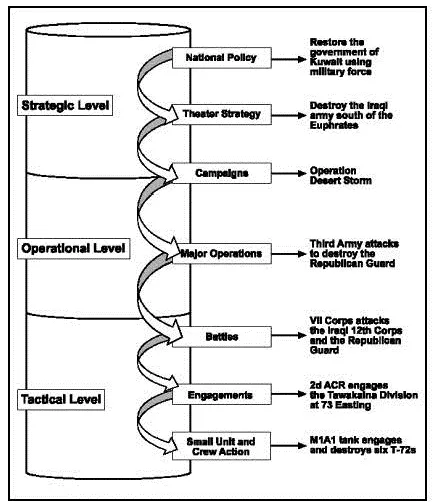
Figure 1: Levels of War. Reprinted from Department of the Army, U.S. Army Field Manual, FM 3-0 Operations (Washington, DC, June 2001), 4-7.
With regard to how a leader must change his methods as the complexity of the tasks assigned to his organization increases, Army doctrine provides a framework to clarify the discussion. As the level of complexity increases the type, or level, of leadership changes from direct, to organizational, to strategic (see Figure 2).
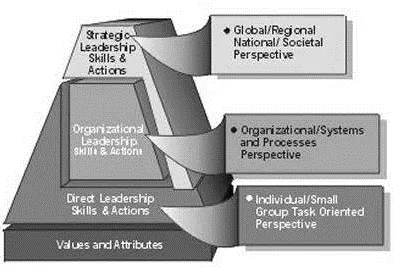
Figure 2: Army Leadership Levels. Reprinted from Department of the Army, U.S. Army Field Manual, FM 22-100 Army Leadership (Washington, DC, August 1999), 2-11.
Clearly there is overlap between the levels and there are no signposts delineating the borders between the levels of leadership or war. This overlap between the levels of leadership and the levels of war are not well depicted in these figures. However, there are elements of direct leadership at the higher levels of leadership (strategic) and tactical decisions are still made at the higher levels of war (strategic), and vice versa. However, by using the levels of war as a guideline, it will be easier to answer the question of how methods change with an increase in size or complexity of an organization.
The author will use the levels of war as a framework for this study of willpower. As a leader moves up the levels of war, from tactical to strategic, the size and complexity of the organization increases. Therefore this second research question maybe restated: how does willpower transmission change as the level of war changes? In order to answer this question, the author will need to study at least one example at all three levels of war. Selecting case studies of willpower generation and application related to each level of war and leadership allows a conclusion to be drawn that responds to this secondary question.
A third variable that affects a leader is time or historical context. Individuals are products of their society. Historically, society and its values have changed over time. It then follows that what motivates a soldier to fulfill a leader’s wishes may also have changed over a given time period. Has willpower and the method by which it is transmitted changed also? In order to answer this third secondary question, the author will need to investigate leaders over a finite time period to determine if successful willpower transmission has changed over time or if the principles are constant.
In an effort to successfully answer all three of the secondary questions, and draw a conclusion to the primary question, the author will examine the leadership and willpower transmission of four military luminaries: Lieutenant General Hal Moore, Fleet Admiral Chester Nimitz, General of the Army Douglas MacArthur, and General Colin Powell. Historically this will bound the study from World War II (when ADM Nimitz served as Commander in Chief, Pacific (CINCPAC) and Commander in Chief, Pacific Ocean Areas (CINCPOA)) to the present (when GEN Powell served as the Chairman, Joint Chiefs of Staff during operations Just Cause and Desert Shield/Desert Storm and Secretary of State during the Global War on Terrorism).
The sixty-year time period should provide an adequate gauge to determine if the passage of time has affected how willpower is employed to answer the final secondary research question. By including a contemporary leader (Secretary Powell) within the framework of the investigation, the author intends to draw valid conclusions for application by current leaders. It is assumed that three unique leadership styles is an adequate sample set from which to draw general conclusions.
As previously mentioned, there is overlap between the levels of war. This overlap may cause confusion, or engender subjective arguments, that could weaken the conclusions. To provide clarity and pre-empt these discussions, the author maintains that the three subjects proposed for this thesis represent all three levels of war. Specifically, LTC Moore operated at the tactical level, ADM Nimitz operated at the operational level, and Gen. Powell operated at the strategic level, during the indicated periods. This framework will be applied for this thesis and is depicted graphically in Figure 3: Levels of War—Applied to Willpower Thesis, provided below.
The underlying assumptions for the thesis is that it is possible for the author to successfully quantify willpower, identify how it is being applied, and establish a credible cause and effect relationship between the leader’s will and the actions of subordinates. The author will provide adequate examples of the actions of the subject leaders within a historical context. A proper understanding of the chain of events coupled with the author’s definition of willpower and deductive logic will convince the reader of the cause and effect relationship. Further, the author has assumed that the fundamental challenges of leadership and willpower application are the same in both the Army and the Navy. Regardless of the differences in operating environments and types of missions subordinates performs, leaders in both services most motivate their subordinates into accomplishing tasks to translate their vision into reality. Therefore case studies of leaders from either Armed Service that focus on how leaders apply willpower can produce valid general conclusions that can be applied by officers in either service.

Figure 3: Levels of War – Applied to Willpower Thesis
To make clear the focus of this thesis it is important to state what will not be covered. Many military operations have focused on the objective of destroying the enemy’s will to fight or power to resist. General William T. Sherman’s famous march to the sea during the American Civil War, or the firebombing of Dresden, Germany by the US Army Air Corps during World War II are two well-known examples. In order to limit this project to a manageable level appropriate for the Master of Military Arts and Science (MMAS) program, this thesis will not look at the destruction of an enemy’s will. Rather it is to be confined to how a leader imposes his will on his subordinates. To further narrow the focus, the thesis will deal only with how relatively recent American military leaders generated and applied their willpower during combat operation in the time period of 1941 to the present.
The general method planned for accomplishing the thesis is to review, analyze and interpret both primary and secondary sources of information on how the three subjects generated and applied their willpower within their unique historical context. Information gleaned will then be synthesized to answer the secondary questions, a...
Table of contents
- Title page
- TABLE OF CONTENTS
- ABSTRACT
- ACKNOWLEDGEMENTS
- LIST OF ABBREVIATIONS
- CHAPTER 1 - INTRODUCTION TO WILLPOWER
- CHAPTER 2 - WILLPOWER AT THE TACTICAL LEVEL OF WAR
- CHAPTER 3 - WILLPOWER AT THE OPERATIONAL LEVEL OF WAR
- CHAPTER 4 - WILLPOWER AT THE STRATEGIC LEVEL OF WAR
- CHAPTER 5 - DOES WILLPOWER GUARANTEE SUCCESS?
- CHAPTER 6 - CONCLUSIONS AND OBSERVATIONS OF WILLPOWER
- BIBLIOGRAPHY
Frequently asked questions
Yes, you can cancel anytime from the Subscription tab in your account settings on the Perlego website. Your subscription will stay active until the end of your current billing period. Learn how to cancel your subscription
No, books cannot be downloaded as external files, such as PDFs, for use outside of Perlego. However, you can download books within the Perlego app for offline reading on mobile or tablet. Learn how to download books offline
Perlego offers two plans: Essential and Complete
- Essential is ideal for learners and professionals who enjoy exploring a wide range of subjects. Access the Essential Library with 800,000+ trusted titles and best-sellers across business, personal growth, and the humanities. Includes unlimited reading time and Standard Read Aloud voice.
- Complete: Perfect for advanced learners and researchers needing full, unrestricted access. Unlock 1.4M+ books across hundreds of subjects, including academic and specialized titles. The Complete Plan also includes advanced features like Premium Read Aloud and Research Assistant.
We are an online textbook subscription service, where you can get access to an entire online library for less than the price of a single book per month. With over 1 million books across 990+ topics, we’ve got you covered! Learn about our mission
Look out for the read-aloud symbol on your next book to see if you can listen to it. The read-aloud tool reads text aloud for you, highlighting the text as it is being read. You can pause it, speed it up and slow it down. Learn more about Read Aloud
Yes! You can use the Perlego app on both iOS and Android devices to read anytime, anywhere — even offline. Perfect for commutes or when you’re on the go.
Please note we cannot support devices running on iOS 13 and Android 7 or earlier. Learn more about using the app
Please note we cannot support devices running on iOS 13 and Android 7 or earlier. Learn more about using the app
Yes, you can access Willpower: A Historical Study Of An Influential Leadership Attribute by LCDR David Schappert in PDF and/or ePUB format, as well as other popular books in History & Military & Maritime History. We have over one million books available in our catalogue for you to explore.