eBook - ePub
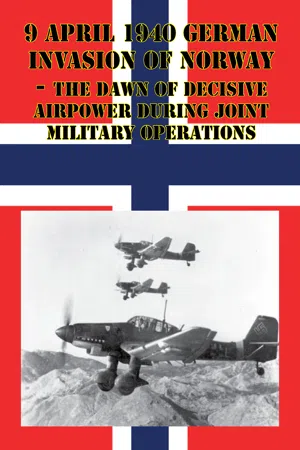
9 April 1940 German Invasion Of Norway - The Dawn Of Decisive Airpower During Joint Military Operations
- 39 pages
- English
- ePUB (mobile friendly)
- Available on iOS & Android
eBook - ePub
9 April 1940 German Invasion Of Norway - The Dawn Of Decisive Airpower During Joint Military Operations
About this book
Operation Weserübung, the German invasion of Norway during the Second World War, is considered by many military historians to be the first joint military operation involving the combined planning and execution of air, land, and sea forces. After a brief introduction and an explanation of the significance of Norway, Chapter Three will analyze the planning process and strategy used by the Germans in late 1939 and early 1940 for devising this joint operation. Chapter Four examines, primarily from an airpower perspective, the plan itself and its execution during the first day of the operation by the Germans, and the British response. Chapter Five determines how German airpower was used, and in particular, what effect the Luftwaffe attack on 9 April against the British Home Fleet had against Britain's campaign strategy to control the North Sea. The final chapter examines three important lessons United States military planners should extract from Operation Weserübung and apply to operations in the 21st century. They are: 1) the joint operation of air, land, and sea assets produce a synergetic effect greater than the sum of their parts; 2) a difficult part of joint operations is the air command and control; and 3) airpower can decisively deny the enemy use of the land or the sea.
Trusted by 375,005 students
Access to over 1.5 million titles for a fair monthly price.
Study more efficiently using our study tools.
Information
Subtopic
European HistoryIndex
HistoryChapter 1 — Introduction
“The Norwegian campaign was not only the first example of a large combined operation of all three Services, but in retrospect it can be said that all Services worked with the utmost understanding of each other, and that all demands on them were fully met.” —Kurt Assmann
Hitler knew by late 1939 it was critical Norway remain neutral throughout the Second World War. The fall of Norway to the British would mean the loss of vital iron ore supplies from Sweden shipped through Norway, and the intensifying of the British air campaign on Germany’s northern front. However, Hitler and the German Naval Staff (OKM) believed the occupation and control of Norway would require a huge concentration of troops, materiel, and money that Germany could not afford while simultaneously preparing for the invasion of France. Given these manpower and materiel constraints, they concluded the best solution for maintaining ore shipments and a secure northern front was to maintain status quo—keep Norway neutral. {1}
Britain, in particular Winston Churchill, quite aware of Germany’s dependence on iron ore, deliberately and methodically ratcheted up the pressure on German shipping in the North Sea. This culminated in the 16 February 1940 raiding of the German supply ship Altmark in the protected Norwegian Joessing Fjord. Hitler was finally convinced that Norway could not remain neutral even if Norway wanted to.{2} On 21 February 1940 Hitler ordered General Mikolaus von Falkenhorst to prepare for the invasion of Norway, giving it the name Operation Weserübung.
In the face of overwhelming British naval superiority, the German plan would have to base its operation on speed, maneuver, deception, and surprise in order to successfully seize Norway. The unintentional “joint staff” of planning officers were constrained by time and a German naval force considerably smaller than the British Royal Navy. Nonetheless, the officers built a campaign plan built on experience from joint training exercises held in the 1930’s that relied on coordination and cooperation between the three services. The use of disparate capabilities from the different services not only covered each other’s weaknesses, but also produced military results that no one service could have accomplished.
Despite its jointness, the plan had a military and strategic weakness. Militarily, the plan called for movement of German troops on transport ships that had to travel through the British-controlled North Sea. Strategically, there was a lack of a unified command structure because of bickering by Reichsmarschall Goering, Commander of the Luftwaffe.
The planning officers devised a two-phase plan for seizing and occupying Norway. This paper focuses on the airpower aspect of the first phase, the sudden occupation of Norway on 9 April 1940. In particular, what did airpower bring to the joint table, and how did this joint operation maximize airpower’s capability? The second phase of sustainment and enlargement of the initial positions was quite impressive from a logistical standpoint, but will not be considered in this study of airpower in a joint campaign.
The examination of the plan and its execution will reveal the following conclusions. First, the campaign not only showed joint operations can achieve what a sea or land only war cannot achieve, it highlighted the significance airpower can have in denying the use of the land or sea to a military force without sufficient airpower. The Germans clearly demonstrated airpower could neutralize a seapower if that seapower had little defensive air capability (either aircraft or guns), or if the ships were in confined areas (ports, fjords) and could not maneuver. {3}Second, how the Germans overcame the unique difficulties posed by jointness to achieve these successes is important. Operation Weserübung, as the first “joint operations” campaign, did not have a unified command and control system for the three services, a problem the United States still wrestles with today. Mission accomplishment was due to the coordination and cooperation at the tactical level. Through extraordinary effort they overcame personality and perspective conflicts and command questions at the strategic level. The lessons from Operation Weserübung are clear. The challenge is to learn from them.
Chapter 2 — Norway in 1940
“In occupying Norway and northern Finland Germany acquired economic assets of first-rate importance to its war effort, the Swedish iron and Finnish nickel. It also gained bases which were useful for submarine warfare in general and which were essential to the operation against the Allied convoys to Russia. A further advantage that Hitler, at least, ranked above all the others was the protection of Germany’s northern flank.” —Earl Ziemke
Strategic Significance
Why would a country with over half its land above 2000 feet, less than three percent of that land cultivated, and temperatures dropping to below freezing much of the year, be invaded by over 50 battalions, 30 ships, and 1000 plus aircraft? {4}The answer lies in the resources and geography Norway offered to the world.
Resources
The British had placed great importance on two perceived economic weaknesses of Germany’s imports: oil and high grade iron-ore. The genesis of this thought came from a report by the prominent German industrialist Fritz Thyssen, who told the Allies that he submitted a report to the German government demonstrating how important Swedish iron ore was to the German war effort. {5}This led the British Ministry of Ec...
Table of contents
- Title page
- TABLE OF CONTENTS
- Preface
- Abstract
- Chapter 1 - Introduction
- Chapter 2 - Norway in 1940
- Chapter 3 - German Plans and Strategy
- Chapter 4 - Operation Weserübung
- Chapter 5 - Decisive German Airpower during Operation Weserübung
- Chapter 6 - Lessons for Today’s Military
- REQUEST FROM THE PUBLISHER
- Appendix A - Units Involved in Operation Weserübung
- Bibliography
Frequently asked questions
Yes, you can cancel anytime from the Subscription tab in your account settings on the Perlego website. Your subscription will stay active until the end of your current billing period. Learn how to cancel your subscription
No, books cannot be downloaded as external files, such as PDFs, for use outside of Perlego. However, you can download books within the Perlego app for offline reading on mobile or tablet. Learn how to download books offline
Perlego offers two plans: Essential and Complete
- Essential is ideal for learners and professionals who enjoy exploring a wide range of subjects. Access the Essential Library with 800,000+ trusted titles and best-sellers across business, personal growth, and the humanities. Includes unlimited reading time and Standard Read Aloud voice.
- Complete: Perfect for advanced learners and researchers needing full, unrestricted access. Unlock 1.5M+ books across hundreds of subjects, including academic and specialized titles. The Complete Plan also includes advanced features like Premium Read Aloud and Research Assistant.
We are an online textbook subscription service, where you can get access to an entire online library for less than the price of a single book per month. With over 1.5 million books across 990+ topics, we’ve got you covered! Learn about our mission
Look out for the read-aloud symbol on your next book to see if you can listen to it. The read-aloud tool reads text aloud for you, highlighting the text as it is being read. You can pause it, speed it up and slow it down. Learn more about Read Aloud
Yes! You can use the Perlego app on both iOS and Android devices to read anytime, anywhere — even offline. Perfect for commutes or when you’re on the go.
Please note we cannot support devices running on iOS 13 and Android 7 or earlier. Learn more about using the app
Please note we cannot support devices running on iOS 13 and Android 7 or earlier. Learn more about using the app
Yes, you can access 9 April 1940 German Invasion Of Norway - The Dawn Of Decisive Airpower During Joint Military Operations by Major Brian T. Baxley in PDF and/or ePUB format, as well as other popular books in History & European History. We have over 1.5 million books available in our catalogue for you to explore.