"Many impressive books have been written about German horror camps where, from 1939 until 1945, human beings were subjected to degrading experiences, or were destroyed like swarms of helpless insects.
E
The camp where I stayed for several years has received less publicity than the larger and more smoothly run DACHAU and RAVENSBRÜCK camps where mass extermination was carried out with cold efficiency.
Our camp was called BRZEZINKI, in German BIRKENAU. Some prisoners nicknamed it RAJSKO. In literal translation this means "HEAVEN-LIKE".
In Brzezinki-Birkenau, mass murder was carried out on such a fantastic scale that the executioners had set up five crematories. Almost all the inmates were destroyed and only a few lived long enough to greet their liberators. Except for one book written by a Polish woman thus far, no report has been graved on flintstone by any of the liberated Polish Jobs.
I am not a writer and my story will be a plain and frank account of things which I have witnessed and experienced in nine prisons and in three concentration camps, from which I was miraculously saved by God. It is not my aim to evoke your pity, nor to arouse your wrath against the Germans. I wish only to help you to realize what happens when man rejects God and when his passions become his sole master. He will then commit every kind of inhuman crime, whereas if he follows the Golden Rule he will withstand the most ruthless pressure and even in the midst of inhuman sufferings will desperately cling to his faith.
I wish to stir the conscience of statesmen so that they may unify their efforts in preventing a repetition of the crimes committed in the name of an omnipotent and evil deity—the STATE."-Foreword
- 159 pages
- English
- ePUB (mobile friendly)
- Available on iOS & Android
eBook - ePub
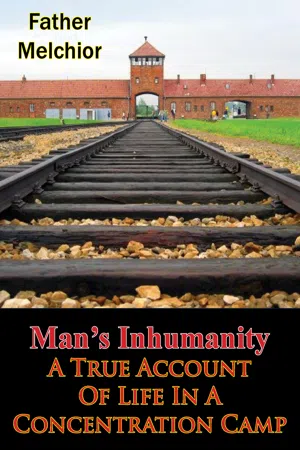
Man's Inhumanity - A True Account Of Life In A Concentration Camp
About this book
Trusted by 375,005 students
Access to over 1.5 million titles for a fair monthly price.
Study more efficiently using our study tools.
Information
Subtopic
Holocaust HistoryIndex
HistoryLIBERATION?
In 1942 the prison of Sieradz was crammed to capacity. In three blocks, where there was space for only 600 men, 4,000 prisoners had to live together. Small cells intended for five people had 52 tenants. Food was becoming scarce. Many prisoners developed dropsy, others became tubercular. One day when we felt hopeless and doomed, the guards announced a new regulation. Orders had come from Berlin. All prisoners who had been sentenced to more than three years would be liberated immediately. They would finish their sentence after the war was over. Lack of space—don’t you know. Prisoners cannot become a burden to the Almighty State …
The news spread like fire. Some prisoners would not believe it, others went wild with joyful expectation.
When the first group was “liberated” a few days later, some doubts were expressed by those who saw them handed over to a detachment of German policemen, who escorted them to the railway station.
“Where did they go? Somewhere, to be sure …”
Another convoy was organized the following week. Every prisoner had an identification card with the following information: “Released from the prison of … on the … Handed over to the Gestapo”.
Many prisoners objected to leaving the prison, but they had no choice.
Convoys left Sieradz and Lodz, Warsaw and Cracow. Thousands of men and women were released and sent “somewhere” in special trains. We learned later that German SS-men were rounding up hundreds of men in restaurants, in stores, in churches and in the streets. Many had been dragged during the night from their homes. They were taken prisoner and led away in their nightclothes.
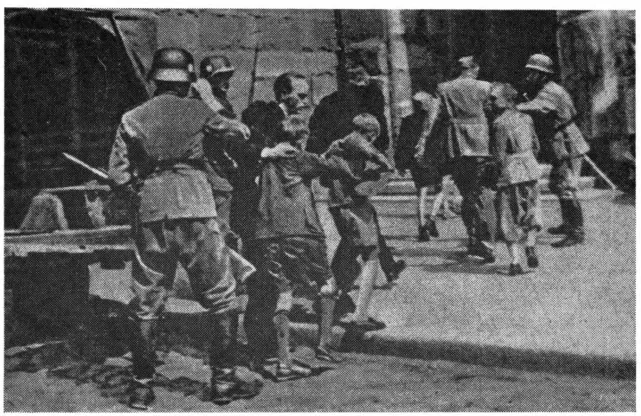
Street raid in Warsaw. Thousands have been thus imprisoned and sent to concentration camps. Photo by on underground tighter.
I learned subsequently that a stream of trucks and cars was proceeding in the direction of the concentration camps of Majdanek, Oswiecim, Dachau and Sachsenhausen. When my turn came I did not know where my journey would end, but I remember that I prayed to God not to be sent to Oswiecim.
* * *
On January 15, 1943, 628 of us waited in the prison yard for the departure signal. One hundred armed policemen surrounded us and one of them shouted angrily: “The first man who makes a move will be shot”.
It was 8 P.M. when the gates of the prison opened with a screeching noise.
* * *
The Germans liked to do their evil work during the night.
The night became their accomplice. It was the best time for every kind of evil: executions, searching parties, rounding up of innocent victims. After curfew when a Pole was not allowed to be in the streets, gangs of young Hitlerites desecrated small chapels and wayside shrines. They broke the beautiful wooden crosses on the highways and in the market places. During the night, too, they carried away their spoils and transported looted treasures.
It was a starless night when they arrested me in Sanok. Our Franciscan monastery and the church in Kalisz were searched by German policemen after midnight. Four brothers and one priest kidnapped by SS-men died later in a concentration camp.
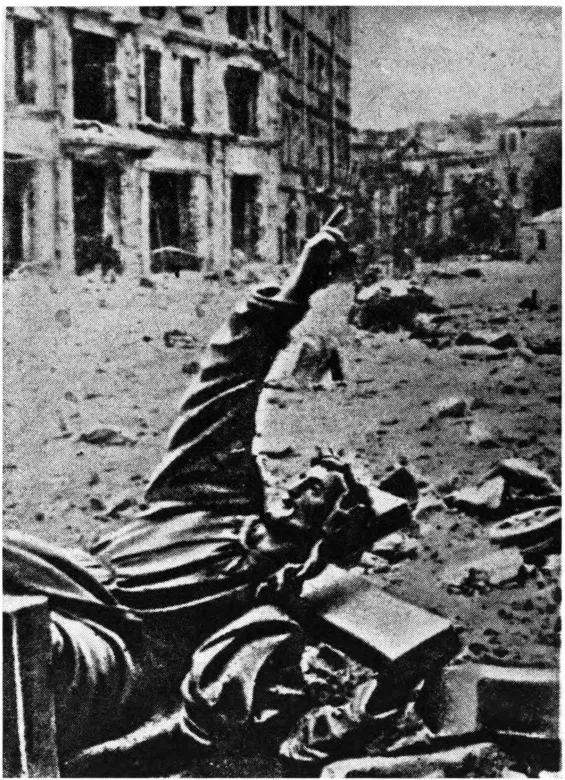
Statue of Christ, brutally cast upon the street by the Germans, still points to Heaven.
In the prison of Kalisz, twice at 3 A.M. we heard a roll call of prisoners sentenced to death.
On one night a group of helpless victims was loaded in a van and sent to the woods. I will never forget that terrible night. I remember some of the names: Maksymilian Niewiadomski, two lay brothers Ciesielski, Joseph Szymanski … A witness who was later released told me how they were ordered to kneel down in front of a ditch, and were shot in the back of the head.
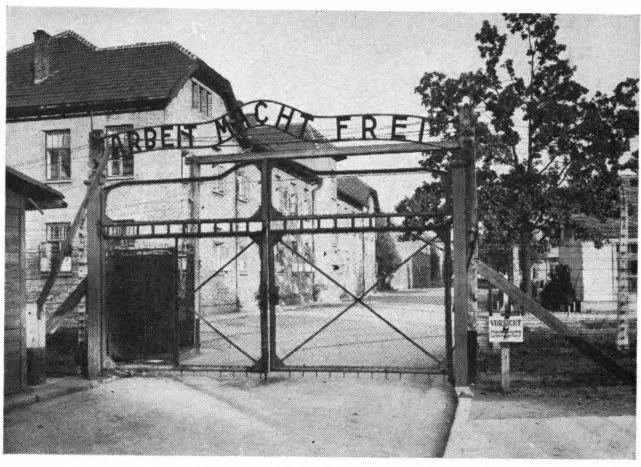
Main gate at the Oswiecim horror camp. Note inscription.
In Kalisz, Father Pawlowski was publicly executed on the Square of Liberty. Such shows were unusual; the Germans preferred to do their work behind the black curtain of the night.
It was also during the night that the prisoners were questioned by Gestapo torturers. During my short stay in the Cracow prison of Monteluppi I met a young girl, a student of a Cracow college. A Gestapo man was doing his best to make her betray her friends. He was courteous and kind while he tempted her with a promise of special privileges. The girl was adamant. She would not answer any questions. Just as I entered the room one of the agents of the Gestapo made an insulting remark. I had my Franciscan habit on me. He grabbed my cord and my rosary and jeered: “You could use them as a noose. The cord is strong enough.”
The girl could not stand it, she burst into tears. One of the men took a white chalk and drew a cross on my back, another German called a guard and ordered him to escort me to the railway station …
All these memories are still haunting me and I often get lost in day dreaming about the horrible past.
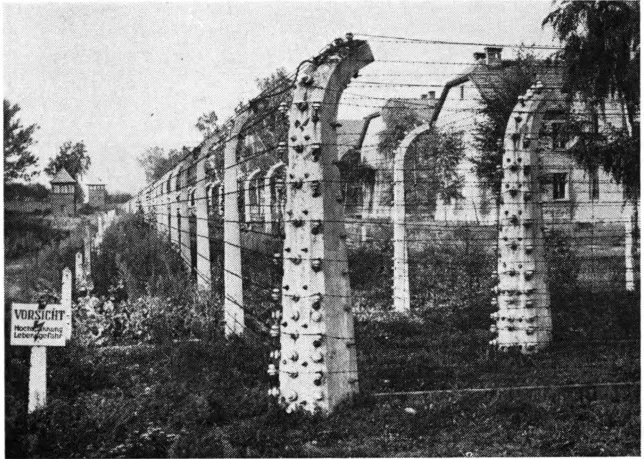
Barbed wire charge with high powered electricity encircled the camp at Oswiecim.
All concentration camps were surrounded by electric wires.
It was during a stormy night that I was “released” from the prison of Sieradz. We were a crowd of 628 men escorted by armed policemen.
In spite of the darkness I noticed the ghastly pallor of my frightened colleagues. When we boarded the train, no one knew where we were going. A few hours later someone whispered in my ear: “We just passed Lodz. The train is going to the East”.
“For Heaven’s sake, can it be that we are being sent to Oswiecim?”
Oswiecim, or Auschwitz, won the doubtful honor of being THE horror camp and its name alone had an ominous portent.
We did not sleep. We did not feel like talking, surrounded by armed guards who paced the cars all the time.
“Are you a priest?” I heard a voice coming from nowhere. Startled I turned my head. A German guard was standing behind me.
“Yes, I am.”
“Did you say Mass today?” he inquired. He stared at me intently and then, without waiting for a reply, quickly went away.
I never saw him again, but I do not doubt that he was at heart tired and disgusted. He did not have the courage to rebel, but he had enough decency to send to me a small package of tobacco through another prisoner.
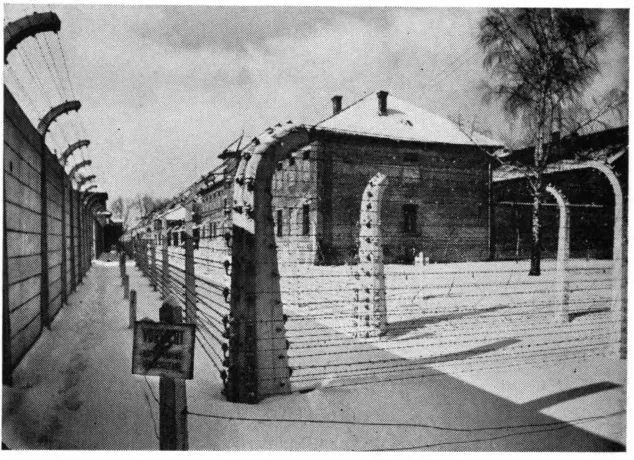
Section of the concentration camp at Oswiecim—Auschwitz.
The train stopped for a few minutes at Czestochowa, the Polish Lourdes. At dawn we saw the tall chimneys of Silesian iron works. The stations now had strange German names, distorted translations of historic Polish names.
The dreaded word AUSCHWITZ appeared on posters and on walls. The train was now running on a new side track. It stopped abruptly.
I gasped. It was Auschwitz.
In this flat country a ghost town made of barracks seemed to rise from the soil. It was Brzezinki-Birkenau an annex of the ill-famed Oswiecim (Auschwitz) camp.
Memories of days gone by come back to me. I was a boy of seventeen. I had just graduated from high school and m...
Table of contents
- Title page
- TABLE OF CONTENTS
- DEDICATION
- FOREWORD
- MY FIFTH PRISON
- LIBERATION?
- OSWIECIM-AUSCHWITZ
- BRZEZINKI-BIRKENAU
- NO. 88092
- ONE DAY’S TOLL
- THE ROLL CALLS
- THE STUBENFÜHRERS AND THEIR ACCOMPLICES
- DEGRADATION
- TYPHOID FEVER
- GRAVEDIGGER NO. 2
- DREAMS OF WATER
- OUR ENEMY-THE ELEMENTS
- WHEN DEATH COME
- “MEDICAL CARE”
- “BURN THE RUBBISH”
- THE OUTCASTS
- BIRKENAU-HECATOMB OF THE JEWISH PEOPLE
- THE HOLOCAUST
- OUR NEIGHBORS
- A TOWER OF BABEL
- “GERMAN MARTYRS”
- A JOURNEY WITHOUT END
- FIVE YEARS OR FIVE CENTURIES
- SACHSENHAUSEN
- THE MARTYRDOM OF PRIESTS
- “THE RECTORY”
- THE “PUFF”
- THEY COULD NOT CRY
- GOD IS PEACE
- ABYSSUS ABYSSUM INVOCAT
- WORDS THAT KILL
- HATRED AND LOVE
- “ORGANIZED RELIEF”
- OUR NEWS SERVICE
- THE LAST ACT
- FREEDOM
- TE DEUM LAUDAMUS …
- SOUVENIR HUNTERS
- A NARROW ESCAPE
- SUPERMEN
- “DEUTSCHLAND, DEUTSCHLAND ÜBER ALLES”
- “WE ARE NOT GUILTY”
- THE UNFINISHED SYMPHONY
Frequently asked questions
Yes, you can cancel anytime from the Subscription tab in your account settings on the Perlego website. Your subscription will stay active until the end of your current billing period. Learn how to cancel your subscription
No, books cannot be downloaded as external files, such as PDFs, for use outside of Perlego. However, you can download books within the Perlego app for offline reading on mobile or tablet. Learn how to download books offline
Perlego offers two plans: Essential and Complete
- Essential is ideal for learners and professionals who enjoy exploring a wide range of subjects. Access the Essential Library with 800,000+ trusted titles and best-sellers across business, personal growth, and the humanities. Includes unlimited reading time and Standard Read Aloud voice.
- Complete: Perfect for advanced learners and researchers needing full, unrestricted access. Unlock 1.5M+ books across hundreds of subjects, including academic and specialized titles. The Complete Plan also includes advanced features like Premium Read Aloud and Research Assistant.
We are an online textbook subscription service, where you can get access to an entire online library for less than the price of a single book per month. With over 1.5 million books across 990+ topics, we’ve got you covered! Learn about our mission
Look out for the read-aloud symbol on your next book to see if you can listen to it. The read-aloud tool reads text aloud for you, highlighting the text as it is being read. You can pause it, speed it up and slow it down. Learn more about Read Aloud
Yes! You can use the Perlego app on both iOS and Android devices to read anytime, anywhere — even offline. Perfect for commutes or when you’re on the go.
Please note we cannot support devices running on iOS 13 and Android 7 or earlier. Learn more about using the app
Please note we cannot support devices running on iOS 13 and Android 7 or earlier. Learn more about using the app
Yes, you can access Man's Inhumanity - A True Account Of Life In A Concentration Camp by Father Melchior in PDF and/or ePUB format, as well as other popular books in History & Holocaust History. We have over 1.5 million books available in our catalogue for you to explore.