- 276 pages
- English
- ePUB (mobile friendly)
- Available on iOS & Android
eBook - ePub
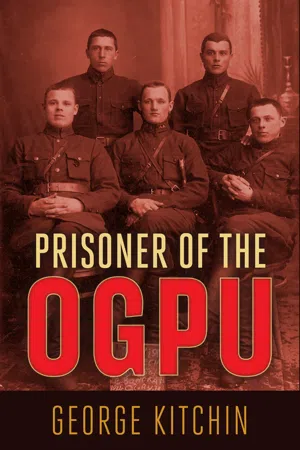
Prisoner of the OGPU
About this book
Prisoner of the OGPU, first published in 1935, is a firsthand, absorbing account of the author's 4 years in the Soviet gulag (1928-32) at the hands of the Soviet secret police (known as the OGPU at the time, later renamed the NKVD, MGB, and KGB). At the time of his arrest, George Kitchin, a Finnish citizen, was working in Russia as a representative for an American firm. He was charged with violating an obscure regulation, held in prison, and then sent to a labor camp located in northern Russia where he describes the brutalities he endured and witnessed. The book also offers excellent insights into the running of the camps as Kitchin was able to work in the camp's administration offices (in addition to sometimes being sent to work on the timber-cutting and road-building labor crews). Included are 5 pages of illustrations.
Trusted by 375,005 students
Access to over 1.5 million titles for a fair monthly price.
Study more efficiently using our study tools.
Information
Subtopic
Russian History1. THE NET
The doorbell rang in the dead of the night. It was an agent of the OGPU calling. He was accompanied by armed soldiers. The agent was polite, but taciturn. The soldiers stood there like statues.
The agent presented a warrant for search and arrest. The warrant had been issued by the counter-espionage department of the OGPU. What were they looking for? What did they want? The search was on. It lasted five hours.
I was in the living room, sitting by the fireside, while the search was being made. A soldier stood at the door and watched every move of mine. Luba was nearby, her eyes filled with terror. On my knee was our new-born baby, a tiny little being with violet eyes. A pink coverlet was wrapped around her, and she slept tranquilly through all those anxious hours.
Finally the search was over. Nothing incriminating had been found, as was to be expected. The OGPU agent stepped to the telephone.
“Hello, hello. Is this the OGPU? Extension 76, please. Is that you? There is a new-born baby here, what am I to do? What? Six weeks old. What? His wife? But she is a foreign subject. What is it? Yes, yes, all right.”
Luba’s lips were pale, her hands trembled.
“Will they take me, too? But how about Baby?” she whispered almost inaudibly. There was something unforgettable in the expression of her eyes. I tried to calm her, to assure her that she had nothing to fear.
The agent hung up the receiver. There was a long pause.
“Citizen,” he turned to my wife, “we shall leave you in peace, for the time being.”
What a relief! The agent made out his report and we quickly signed it. I packed a few things. I lifted the little being that I had already learned to love.
“Goodbye, little one.”
The moment of parting came. There was Luba. And here was the dark stairway. I turned back for a last glimpse. Her silhouette was in the lighted doorway. “Goodbye, my darling.”
The steel-shod boots of the soldiers echoed as they struck the stone steps:
“Goodbye, goodbye.”
The clock in the prison office pointed to a quarter past five. In half an hour I had passed from freedom to jail, leaving behind me a series of grilled and locked doors. Here I was thoroughly searched. My necktie, belt, shoelaces and towels were taken away. It was the routine, to guard against attempts at suicide.
I was then led to a damp and dreary cell on the “special” fifth floor of the notorious Shpalernaya prison. Attached to the wall of my cell were a bunk and a small iron table with a seat. There was a window beneath the ceiling. Under the window was a toilet seat, and adjoining it an iron basin with a faucet.
I sat down on the bunk and tried to collect my thoughts. I was in the Shpalernaya, on the special floor where the OGPU kept only grave offenders. What did it mean? Why had they arrested me?
It was March 26, 1928. The seven years I had spent in Soviet Russia raced past me in swift review. I was a citizen of Finland, a business man, lured by the promises of the NEP (New Economic Policy) proclaimed by Lenin in 1921. I had started out as the representative of a Finnish group seeking a concession in Russia, and within a year developed an import business on a large scale.
My offices were then in the Finnish Government Building in Leningrad which housed many foreign firms. It was a building kept under special observation by the OGPU, which suspected every foreigner of being a spy. That did not worry me, as I had no connection whatever with espionage.
I recalled my first contact with the OGPU. It was in the summer of 1921. A modestly dressed young man called on me at my office. He introduced himself as Troitsky, an official of the OGPU in charge of the Finnish section, and openly proposed that I become informer on all the activities of the Finnish Trade Delegation. He said that he had selected me because his agents had described me as cool and careful in my work. I thanked him for the honor and unceremoniously showed him the door.
“We shall meet again,” was his parting remark.
At the time I reported the incident to my headquarters, but forgot about it in the following years. It was not until after the death of Lenin in 1924 that my next contact with the OGPU occurred. There was a British consul in Leningrad, Mr. Preston, who occasionally entertained both foreigners and Russians at tea. Mr. Preston was a thorn in the flesh of the Soviet officials. He wore a monocle in the land of the Soviets, donned a silk hat when driving out on official visits, and his English manner irritated the comrades exceedingly. Moreover, he consistently ignored the local representatives of the Commissariat for Foreign Affairs whenever he sent out invitations to a reception.
My fiancée, Luba, frequented the Preston five-o’clocks. One day, there came an end to the fashionable receptions. There were wholesale arrests among the Russians who had attended them. Luba was one of the prisoners.
It was Luba’s second experience with the OGPU. She had been arrested two years earlier, together with her first husband, and had left the prison a widow. Now she was taken to the OGPU headquarters at the Gorokhovaya. Here she received a flattering offer to serve the OGPU as an informer on the British consulate. It was her duty as a loyal Soviet citizen, she was told, to accept the offer.
“Think it over carefully,” the examining official said to her. “Consider it well before you decide. If you do not consent, you will not leave these walls. It is not prudent to quarrel with the OGPU.”
Luba refused point-blank and was taken to the Shpalernaya, where I was now confined. At the time we sought the intervention of the higher Soviet authorities, but in vain.
Within a week after her arrest, I had my next direct encounter with the OGPU. I was having supper alone in a restaurant when Troitsky suddenly appeared at my table. He was the young OGPU official who had called on me two years before.
I got up and made a move to leave, but he stopped me. He had business which concerned my fiancée.
“Don’t you really want to help her?” he asked. I stayed.
Troitsky offered to release Luba in exchange for my services. It was the same proposal that he had made two years earlier. He sought information on the Finnish Consulate General.
“Say the word and this very evening a telegram will be sent ordering the release of your fiancée,” he concluded.
I refused the offer. He began to threaten me. He was vexed by his failure to enlist my services. He left in anger.
I went away filled with disgust. The threats were not to be taken lightly, but I would not be dragged into the net.
The Finnish consul advised me to leave the country at once, but I could not even think of leaving without Luba.
She was condemned, after five months in solitary confinement, to three years in Siberia. I continued my efforts to secure her freedom, but without avail.
It looked as if I would have to wait until Luba had completed her term in Siberia. Then something happened. There was an upset in the OGPU headquarters. A number of officials were dismissed or punished. Many of their victims were rehabilitated. Troitsky was among the banished officials. Luba was one of the fortunate prisoners to be set free.
We were married immediately upon her return to Leningrad. Two months later we received from Moscow the precious document canceling her Soviet citizenship. She was now the wife of a citizen of Finland. This was no mean achievement.
During Luba’s exile in Siberia, a New York firm, the Lidgerwood Manufacturing Company, appointed me as its representative in Russia. I had also established a plant for the manufacture of oil and candles for churches. There were sixty thousand churches in Russia at the time and I enjoyed a virtual monopoly of the business.
There was a quiet interlude. I was happy at home. Business was good. Luba was on the eve of becoming a mother.
It was January 1928. The shadow of the OGPU suddenly appeared again. I heard that Troitsky was back. He had been reinstated as chief of the Finnish counterespionage section.
“Let us leave the country immediately,” pleaded Luba.
“Leave everything and go?” I retorted. “Don’t let the thought of this scoundrel get on your nerves. We are foreigners and he will not dare to start anything.”
“But suppose he lays a trap for you with his agents-provocateurs?” she insisted.
Well, here I was in the Shpalernaya. If I had only heeded Luba’s warning! But why did they arrest me? It was useless to seek the reason. I had simply fallen into the second category of Soviet citizens. According to a popular saying in Russia, the population of the U.S.S.R. is divided into three categories, those who have been in prison, those who are in prison, and those who will be in prison.
My reflections were interrupted when the light went out in my cell. I threw myself on my bunk and sank into oblivion.
During the two following days I had all the time to consider my situation. I waited in vain to be taken before an examining official. I worried about my wife and child. Were they arrested, too?
They came for me in the night of the third day. I followed the armed guard who led me to the examination. In a small office, a man in the uniform of an OGPU official sat at his desk, bent over papers. He raised his head and smiled.
It was Troitsky. My worst apprehensions were confirmed.
Four years had passed since our last meeting but he had changed little. He greeted me sarcastically as an old acquaintance and proposed that we have a quiet little talk.
He asked me to keep in mind that I would face grave consequences in the event that we did not arrive at a satisfactory agreement.
I brushed all this aside and demanded that I be presented with a formal charge for my arrest.
“Don’t you worry,” he smirked, “a charge will be found, but that will be so much the worse for you. Let us settle matters amicably. Some important considerations demand that we be fully informed of everything that is going on in your consulate. Our present sources of information are not satisfactory and you will have to help us.”
He said that his department had caught a group of spies whom they had long suspected and that all the evidence pointed definitely at the consulate. It was imperative, he repeated, that they receive positive information as to whether it was the consul or his assistant who was directing this espionage.
This turn of events was utterly unexpected and I realized that even had I been willing I would not have been able to assist him.
“Do not forget,” said Troitsky, “that when we arrest a foreigner we do not fail to have on file enough evidence to justify such action.”
He supplemented this statement with the assertion that he was in possession of a signed confession by one of the arrested spies to the effect that the latter had called on me in connection with his work.
This was ridiculous. Never had I had any connection with any foreign intelligence department and no spy had ever called on me.
In order to dispel my doubts Troitsky then produced and showed me the confession of the arrested spy, which stated plainly that the latter had delivered to me a locked briefcase and a package of letters from the Finnish Intelligence Department.
This was such a preposterous lie that I expressed doubt of the very existence of the man who was supposed to have signed the confession. Troitsky offered to confront me with him and a few minutes later a man who was a total stranger to me was brought into the room. On Troitsky’s request he repeated the statements ...
Table of contents
- Title page
- TABLE OF CONTENTS
- PREFACE
- 1. THE NET
- 2. THE RED MILL OF JUSTICE
- 3. JAIL-ON-WHEELS
- 4. INSUBORDINATION
- 5. HUNGER
- 6. WHO STOLE THE BREAD?
- 7. “FOLDING UP”
- 8. “WE ARE LAZY LOUTS!”
- 9. HALF FREE
- 10. INSPECTORS OF DEATH
- 11. THE MANURE OF COMMUNISM
- 12. THE MARCH OF THE DAMNED
- 13. THE HUNGER MARCH CONTINUES
- 14. WORK POST NO. 6
- 15. “AT MIDNIGHT I SHALL HANG MYSELF”
- 16. REFORMS
- 17. BACK TO NORMALCY
- 18. THIN ICE
- 19. “THERE IS NO CONVICT LABOR!”
- 20. THE EARTH BELONGS TO ITS CHILDREN
- 21. PLANNING
- 22. IN THE SPIDER-WEB
- 23. “THE LAST OF THE MOHICANS”
- 24. THE ROAD TO FREEDOM
- POSTSCRIPT
- ILLUSTRATIONS
Frequently asked questions
Yes, you can cancel anytime from the Subscription tab in your account settings on the Perlego website. Your subscription will stay active until the end of your current billing period. Learn how to cancel your subscription
No, books cannot be downloaded as external files, such as PDFs, for use outside of Perlego. However, you can download books within the Perlego app for offline reading on mobile or tablet. Learn how to download books offline
Perlego offers two plans: Essential and Complete
- Essential is ideal for learners and professionals who enjoy exploring a wide range of subjects. Access the Essential Library with 800,000+ trusted titles and best-sellers across business, personal growth, and the humanities. Includes unlimited reading time and Standard Read Aloud voice.
- Complete: Perfect for advanced learners and researchers needing full, unrestricted access. Unlock 1.5M+ books across hundreds of subjects, including academic and specialized titles. The Complete Plan also includes advanced features like Premium Read Aloud and Research Assistant.
We are an online textbook subscription service, where you can get access to an entire online library for less than the price of a single book per month. With over 1.5 million books across 990+ topics, we’ve got you covered! Learn about our mission
Look out for the read-aloud symbol on your next book to see if you can listen to it. The read-aloud tool reads text aloud for you, highlighting the text as it is being read. You can pause it, speed it up and slow it down. Learn more about Read Aloud
Yes! You can use the Perlego app on both iOS and Android devices to read anytime, anywhere — even offline. Perfect for commutes or when you’re on the go.
Please note we cannot support devices running on iOS 13 and Android 7 or earlier. Learn more about using the app
Please note we cannot support devices running on iOS 13 and Android 7 or earlier. Learn more about using the app
Yes, you can access Prisoner of the OGPU by George Kitchin in PDF and/or ePUB format, as well as other popular books in Politics & International Relations & Russian History. We have over 1.5 million books available in our catalogue for you to explore.