The last great drama of the Cold War—the collapse of communism in the Soviet Union and Eastern Europe and the end of the four-decade-old East-West conflict—unfolded in three acts between 1989 and 1991. Even as the story began, Soviet leader Mikhail Gorbachev already had made the largest opening to the outside world in Russian history. To convince the West, and above all the new administration in Washington, of his sincerity, Gorbachev had made major concessions on arms control, withdrawn Soviet troops from Afghanistan, pledged to reduce Soviet ground forces by half a million, and rejected class warfare in favor of "pan-human values" as the basis of Soviet foreign policy...
The second act of the drama began in the fall of 1989 with peaceful revolutions in Eastern and Central Europe (except Romania) and the fall of the Soviet "outer empire." The de facto collapse of the Warsaw Pact (it would formally dissolve itself a year later) plus a new treaty that substantially reduced Soviet superiority in conventional forces in Europe resulted in a stronger Western alliance—so strong that the US could redeploy forces from Europe to the Persian Gulf for use against Iraq...
The third and final act closed with the 1991 dissolution of the USSR. The centrifugal forces in the "outer empire" stimulated and accelerated those in the "inner empire" as the Soviet republics sought sovereignty and then independence from Moscow. At the same time, Gorbachev's domestic reforms ran into serious trouble, and the economy went into a tailspin. Gorbachev's struggle with the old imperial elite in the communist party, the armed forces, and the military-industrial complex culminated in the August 1991 coup, which, when it failed, finished off the USSR—and Gorbachev himself...The USSR officially ceased to exist on 31 December.
eBook - ePub
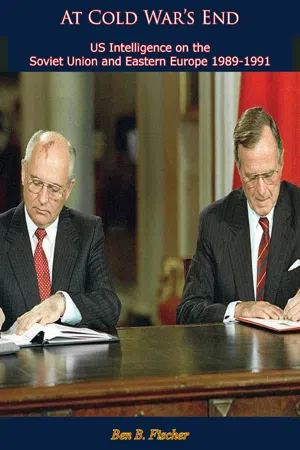
At Cold War's End
U.S. Intelligence on the Soviet Union and Eastern Europe 1989-1991
- 394 pages
- English
- ePUB (mobile friendly)
- Available on iOS & Android
eBook - ePub
About this book
Trusted by 375,005 students
Access to over 1.5 million titles for a fair monthly price.
Study more efficiently using our study tools.
Information
Subtopic
Military & Maritime HistoryIndex
HistoryThe Soviet Crisis — Gorbachev and the Perils of Perestroika

1. NIE 11-23-88, December 1988, Gorbachev’s Economic Programs: The Challenge Ahead
Gorbachev’s Economic Programs: The Challenges Ahead
National Intelligence Estimate
This National Intelligence Estimate represents the views of the Director of Central Intelligence with the advice and assistance of the US Intelligence Community.
NIE 11-23-88
Gorbachev’s Economic Programs: The Challenges Ahead (u)
Information available as of 20 December 1988 was used in the preparation of this National Intelligence Estimate.
The following intelligence organizations participated in the preparation of this Estimate:
The Central Intelligence Agency
The Defense intelligence Agency
The National Security Agency
The Bureau of Intelligence and Research,
Department of State
The Office of Intelligence Support,
Department of the Treasury
also participating:
The Office of the Deputy Chief of Staff
for Intelligence, Department of the Army
The Office of the Director of Naval
Intelligence, Department of the Navy
The Office of the Assistant Chief of Staff,
Intelligence, Department of the Air Force
The Office of the Deputy Assistant Secretary for
Intelligence, Department of Energy
The Director of intelligence, Headquarters, Marine Corps
This Estimate was approved for publication by the National Foreign Intelligence Board.
2. SOV 89-10077, Central Intelligence Agency, Office of Soviet Analysis, September 1989, Gorbachev’s Domestic Gambles and Instability in the USSR
Gorbachev’s Domestic Gambles and Instability in the USSR
Gorbachev’s Domestic Gambles and Instability in the USSR (U)
Key Judgments
Information available
as of 21 September 1989
was used in this report.
Gorbachev and other Soviet leaders are concerned about serious future breakdowns of public order in the USSR. This concern is well justified. The unrest that has punctuated Gorbachev’s rule is not a transient phenomenon. Conditions are likely to lead in the foreseeable future to continuing crises and instability on an even larger scale—in the form of mass demonstrations, strikes, violence, and perhaps even the localized emergence of parallel Centers of power. This instability is most likely to occur on a regional basis, not nationwide—although overlapping crises and a linking together of centers of unrest could occur.
Instability in the USSR is not exclusively a product of glasnost, and some of it is indeed a sign—as Gorbachev asserts—that reforms are taking hold. But Gorbachev’s claim that instability otherwise merely reflects the surfacing of problems that were latent or repressed under Brezhnev is only partly true. The current budget deficit and consumption crisis is largely due to policies Gorbachev himself has pursued since 1985. And the prospects for further crises and expanded turmoil in the future are enhanced by key policy gambles he is taking now:
• In the nationality arena, Gorbachev is gambling on defusing ethnic grievances and achieving a more consensual federative union through unrestrained dialogue, same concessions to local demands aimed at eliminating past “mistakes,” a constitutionalization of union/republic and ethnic group rights, and management of ethnic conflict to a substantial degree through the newly democratized soviets.
• In the economic arena, Gorbachev is gambling that, by putting marketization on hold through the postponement of price reform, and by pursuing a short-term “stabilization” program, he can avoid confrontation with the public and reengage in serious economic reform without steep costs at a later date.
• In the political arena, Gorbachev is gambling that, by transforming the Communist Party from an instrument of universal political, social, and economic management into a brain trust and authoritative steering organ, while empowering popularly elected soviets, he can create a more effective mechanism for integrating Soviet society and handling social tensions.
Gorbachev has no easy choices, and other approaches would not necessarily be safer or more successful. But these gambles, understandable and even desirable from a democratic standpoint, are based on questionable premises and wishful thinking:
• The aspirations of many non-Russians will never be satisfied within the framework of maximum rights the Soviet leadership could grant union republics or so-called autonomous ethnic formations within national republics while still preserving a strong federative USSR, Allowing these people freedom to protest without being able to redress their basic grievances is a recipe for escalating Crises.
• Because the deficit reduction plan is likely to fall far short of planned targets and because it is unlikely that supply can catch up with, consumer “needs” without a price-induced change on the demand side, Gorbachev’s emergency financial “stabilization” program more likely than not will fail. In the meantime, circumstances for introducing marketization of the economy will have become even less propitious than they were when this program was introduced, setting the stage for continued corruption, protracted economic crisis, and retreat to the old “command-edict” methods.
• Gorbachev’s attempt to reform the Communist Party is based on a visionary notion of what it could become, and is in practice undermining its ability to integrate Soviet society before new political institutions are capable of coping with mounting popular demands unleashed by glasnost and failing economic performance.
As Gorbachev’s various critics correctly contend, his gambles are likely to generate instability over both the near and the longer term.
The odds are high that labor unrest or ethnic strife will—perhaps even within the next six months—create strong pressures within the Soviet leadership to crack down much harder than it has to date. Soviet leaders have a broad range of instrumentalities they can employ to dampen instability, ranging from stronger threats, to new restrictions on human rights, to police intimidation, to imposition of martial law. We have evidence in at least one case of sharp disagreement within the Politburo over the use of violence. Gorbachev has sought to avoid widespread use of physical force, probably calculating that the fallout from repression would endanger his entire program of perestroyka as well as his foreign policy, while perhaps provoking more serious disorders that could lead to loss of control. Almost certainly he would be willing to escalate coercion somewhat to maintain order and isolate nationalist or other “extremists,” as he threatened to do in his report on nationality policy to the Central Committee plenum on 19 September 1989. Yet beyond a certain point, repression would mean abandonment by Gorbachev of his natural constituency and his entire political program. There is some evidence that he might choose to resign rather than assume responsibility for a crackdown involving a major imposition of martial law. Alternatively, the imposition of harsh measures could be associated with a coup d’état or legal removal of Gorbachev.
Provided he manages to hold onto power, two outcomes of Gorbachev’s rule are possible, depending on how successfully the economy is marketized. In both scenarios, Gorbachev’s retention of power depends upon avoidance of acute polarization of political forces and progress in reinstitutionalizing means of political integration. This process would be reflected in further democratization of the political order, the emergence of some form of multiparty competition, and a loosening of the Soviet multinational empire. If political reform were complemented by effective financial stabilization and marketization, there might be high instability in the near term (two to five years), but a course could be set toward long-term (10 to 25 years) social equilibrium. Without financial stabilization and marketization, on the contrary, there would be rising instability in the near-to-medium term, high instability in the long term, and likely movement of the Soviet system toward revolution, a hard-right takeover, or “Ottomanization”—growing relative backwardness of the USSR and a piecemeal breakoff of the national republics.
Gorbachev’s gambles and the centrifugal trends they have set in motion are already viewed with extreme alarm and anger by many members of the Soviet political elite. But Gorbachev’s major gains in the Politburo at the September 1989 plenum of the Central Committee demonstrated once again how difficult it is to translate conservative sentiment in the ranks into effective opposition to Gorbachev’s rule at the top. For the time being, his power looks secure, if, somehow, a successful challenge were mounted against him over the next year or so, the most likely outcome would be a traditionalist restoration that would attempt to “draw the line” in various areas—especially with respect to democratization of the party and soviets, glasnost in the media, the conduct of informal groups, and expression of “nationalist” views—but would accept the need for significant change, including reduction in military spending and decentralization of management, Unless such a regime chose to move ahead vigorously with marketization (not impossible, but highly unlikely) it would obtain possible stability in...
Table of contents
- Title page
- Foreword
- Preface
- The Soviet Crisis - Gorbachev and the Perils of Perestroika
- The End of Empire I - Eastern Europe
- The End of Empire II - National Secession and Ethnic Conflict in the USSR
- “New Thinking” - Soviet Foreign Relations
- The Military Balance I - Conventional Forces in Europe
- The Military Balance II - Strategic Nuclear Weapons
- Soviet Forces and Capabilities for Strategic Nuclear Conflict Through the Late 1990s
Frequently asked questions
Yes, you can cancel anytime from the Subscription tab in your account settings on the Perlego website. Your subscription will stay active until the end of your current billing period. Learn how to cancel your subscription
No, books cannot be downloaded as external files, such as PDFs, for use outside of Perlego. However, you can download books within the Perlego app for offline reading on mobile or tablet. Learn how to download books offline
Perlego offers two plans: Essential and Complete
- Essential is ideal for learners and professionals who enjoy exploring a wide range of subjects. Access the Essential Library with 800,000+ trusted titles and best-sellers across business, personal growth, and the humanities. Includes unlimited reading time and Standard Read Aloud voice.
- Complete: Perfect for advanced learners and researchers needing full, unrestricted access. Unlock 1.5M+ books across hundreds of subjects, including academic and specialized titles. The Complete Plan also includes advanced features like Premium Read Aloud and Research Assistant.
We are an online textbook subscription service, where you can get access to an entire online library for less than the price of a single book per month. With over 1.5 million books across 990+ topics, we’ve got you covered! Learn about our mission
Look out for the read-aloud symbol on your next book to see if you can listen to it. The read-aloud tool reads text aloud for you, highlighting the text as it is being read. You can pause it, speed it up and slow it down. Learn more about Read Aloud
Yes! You can use the Perlego app on both iOS and Android devices to read anytime, anywhere — even offline. Perfect for commutes or when you’re on the go.
Please note we cannot support devices running on iOS 13 and Android 7 or earlier. Learn more about using the app
Please note we cannot support devices running on iOS 13 and Android 7 or earlier. Learn more about using the app
Yes, you can access At Cold War's End by Ben B. Fischer in PDF and/or ePUB format, as well as other popular books in History & Military & Maritime History. We have over 1.5 million books available in our catalogue for you to explore.