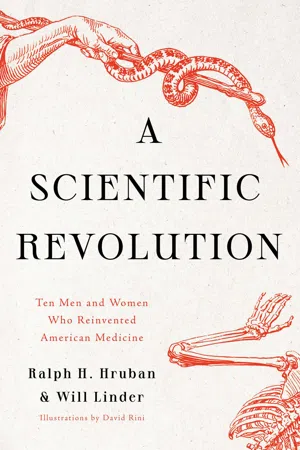
A Scientific Revolution
eBook - ePub

A Scientific Revolution

Ten Men and Women Who Reinvented American Medicine

  1. 304 pages
  2. English
  3. ePUB (mobile friendly)
  4. Available on iOS & Android
eBook - ePub

A Scientific Revolution

Ten Men and Women Who Reinvented American Medicine

About this book

A prismatic examination of the evolution of medicine, from a tradeto a science, through the exemplary lives of ten men and women.
Johns Hopkins University, one of the preeminent medical schools in the nation today, has played a unique role in the history of medicine. When it first opened its doors in 1893, medicine was a rough-and-ready trade. It would soon evolve into a rigorous science. It was nothing short of a revolution. This transition might seem inevitable from our vantage point today. Inrecent years, medical science has mapped the human genome, deployed robotic tools to perform delicate surgeries, and developed effective vaccines against a host of deadly pathogens. But this transformation could not have happened without the game-changing vision, talent, and dedication of a small cadre of individuals who were willing to commit body and soul to the advancement of medical science, education, and treatment. A Scientific Revolution recounts the storiesof John Shaw Billings, Max Brödel, Mary Elizabeth Garrett, William Halsted, Jesse Lazear, Dorothy Reed Mendenhall, William Osler, Helen Taussig, Vivien Thomas, and William Welch. This chorus of lives tells a compelling talenot just of their individual struggles, but how personal and societal issues went hand-in-hand with the advancement of medicine.
Frequently asked questions

Yes, you can cancel anytime from the Subscription tab in your account settings on the Perlego website. Your subscription will stay active until the end of your current billing period. Learn how to cancel your subscription.
No, books cannot be downloaded as external files, such as PDFs, for use outside of Perlego. However, you can download books within the Perlego app for offline reading on mobile or tablet. Learn more here.
Perlego offers two plans: Essential and Complete
  • Essential is ideal for learners and professionals who enjoy exploring a wide range of subjects. Access the Essential Library with 800,000+ trusted titles and best-sellers across business, personal growth, and the humanities. Includes unlimited reading time and Standard Read Aloud voice.
  • Complete: Perfect for advanced learners and researchers needing full, unrestricted access. Unlock 1.4M+ books across hundreds of subjects, including academic and specialized titles. The Complete Plan also includes advanced features like Premium Read Aloud and Research Assistant.
Both plans are available with monthly, semester, or annual billing cycles.
We are an online textbook subscription service, where you can get access to an entire online library for less than the price of a single book per month. With over 1 million books across 1000+ topics, we’ve got you covered! Learn more here.
Look out for the read-aloud symbol on your next book to see if you can listen to it. The read-aloud tool reads text aloud for you, highlighting the text as it is being read. You can pause it, speed it up and slow it down. Learn more here.
Yes! You can use the Perlego app on both iOS or Android devices to read anytime, anywhere — even offline. Perfect for commutes or when you’re on the go.
Please note we cannot support devices running on iOS 13 and Android 7 or earlier. Learn more about using the app.
Yes, you can access A Scientific Revolution by Ralph H. Hruban,William Linder in PDF and/or ePUB format, as well as other popular books in Medicina & Biografie in ambito medico. We have over one million books available in our catalogue for you to explore.

Information

Image

1 MARY ELIZABETH GARRETT
Equity and Excellence

Mary Elizabeth Garrett might seem an unlikely figure to ignite a revolution that transformed the way American physicians are educated and, indeed, what sorts of people become medical doctors in this country. Garrett walked with a limp and was lonely as a child. She never attended college, despite her keen intellect, and she was almost completely absorbed in her father’s business affairs from the time she was a teenager. Yet, Garrett was an extraordinary figure, possessed of both the vision to conceive an entirely new future for the education of women and the tenaciousness to make that future a reality.
To understand Garrett’s seismic impact on the teaching of medicine in the United States, we need to go back to the late nineteenth century, before the 1893 opening of the Johns Hopkins School of Medicine. In those days, as we noted, medical schools were essentially for-profit trade schools. One pundit quoted in the famous Flexner Report, which looked at the state of US medical education, opined that medical schools were filled with young men “too stupid for the Bar” and “too immoral for the Pulpit.”1 When Harvard’s president Charles Eliot proposed in 1869 to hold written examinations for the degree of doctor of medicine, he was quickly rebuffed by members of the school’s faculty. The renowned professor of surgery Henry Bigelow declared, “He [Eliot] knew nothing about the quality of Harvard medical students. More than half of them can barely write. Of course, they can’t pass written examinations.”2
Bigelow’s objection to written exams tells us a great deal about medical education at the time. At least one hundred medical schools would accept anyone willing to pay. Fewer than 20 percent required a high school diploma.3 In 1870, a Harvard medical student could fail four of nine courses and still get a degree.4 Medical schools in those days often offered two-year programs, and the first year’s curriculum was repeated in the second so that students who had failing grades after a year of study had another chance to earn a diploma. Even more alarming, most students could graduate without ever touching a patient, if only because it was the rare medical school that was affiliated with a university and rarer still one connected with a hospital. In 1893, only one medical school in the United States—the brand-new Johns Hopkins—required students to have a college degree.5 Hopkins also required students to be fluent in French and German and, notably, to have a strong background in science, but such requirements were almost unprecedented.
When it opened, largely due to the foresight and generosity of Mary Elizabeth Garrett, the Johns Hopkins School of Medicine created an entirely new path in medical education. High admission standards ensured that the best and the brightest students enrolled. These students routinely visited the wards, so they could see and learn from and about patients. New scientific discoveries were one of the school’s primary goals, and these, in turn, were systematically applied to the treatment of patients. In short, Hopkins rather quickly became “a model of its kind” in the training of physicians and the practice of scientific medicine across the nation and throughout the world.6 The full unfolding of these advances in science-based medicine still lay in the future at the end of the nineteenth century, but with this perspective on medical education at the time, we can turn our attention to Mary Elizabeth Garrett, the woman who made the Johns Hopkins School of Medicine possible and set it on its historic course.

A Lonely Childhood

Wealth and influence were Mary Elizabeth Garrett’s birthright. Yet, like many American success stories, the Garrett family saga had a humble beginning. Mary Elizabeth’s paternal grandfather Robert Garrett was a poor immigrant from northern Ireland. In 1790, when Robert was seven, the family sailed to America aboard the brig Brothers. Robert’s father died on the lengthy voyage, and his remains were buried at sea. (Ships like these, jammed with emigrants, were rightly dubbed “coffin ships.”)7 Despite this tragic start, Robert prospered in his adopted country. He made a fortune hauling goods in Conestoga wagons over the National Road, the first federal highway, which linked the Potomac and Ohio Rivers. The transition from wagons to railroads was swift. By 1858, Mary Elizabeth Garrett’s father, John Work Garrett, had been named president of the Baltimore and Ohio Railroad, the nation’s first commercial railroad. Through relentless hard work and keen entrepreneurial ability, he soon became the most powerful man in Maryland.8
Mary Elizabeth Garrett was born in 1854. If privilege was part of her inheritance, good fortune was not. As she later described it, “when I was about eight months old, a very serious trouble with the bone of the right ankle developed.”9 For some years, Garrett wore a brace, first made of iron and later of whalebone. The brace made her feel unattractive, and she became shy. She wrote, “I was heavy and the lameness made me less active than ordinary children and also more solitary”10 (figure 1.1).
Image
FIGURE 1.1. Mary Elizabeth Garrett as a young girl, circa 1865. (Photo by J. H. Dampf & Company, Baltimore.)
Garrett had a private education, studying mainly at Miss Kummer’s School for Girls on Baltimore’s desirable Mount Vernon Place and with private tutors when she traveled abroad with her family. She was an intelligent young woman, but as was typical in the nineteenth century, she was thwarted in her desire for a higher education. Mary’s two brothers were sent to Princeton, but she was prevented from going to college. “I begged my father that I should be allowed to go to college.”11 He was adamant in his refusal. When Johns Hopkins University opened its doors in 1876, Garrett again tried to pursue a higher education, but the school’s president, Daniel Coit Gilman, declined to admit her, allegedly on grounds of caution. Gilman had made up his mind that young women should “not be exposed to the rougher influences which I am sorry to confess are still to be found in colleges and universities where young men resort.”12

The Friday Night

Garrett joined forces with a group of friends, several of whom were similarly thwarted in their aspirations for an equal education. They were the daughters of prominent Baltimore leaders. All but one of their fathers were trustees of the newly founded Johns Hopkins University. M. Carey Thomas, Mamie Gwinn, Bessie King, Julia Rogers, and Mary Elizabeth Garrett met on the second Friday of each month for serious conversations. They called the group “the Friday Night,” or “the Friday Evening” (figure 1.2). Their focus, Garrett’s biographer Kathleen Waters Sander writes, was on the “woman question.”13 Could women succeed and contribute to society at the same level as men? According to one Thomas scholar, “The Friday Evening gave [the group] a context in which to think out some of the dilemmas of choice
 an occasion for these talented women, in their early twenties and living with their families, to meet and talk seriously about life, religion, vocation, and, not incidentally, marriage.”14 Thomas and Garrett would develop their own solution to the marriage dilemma, but not before Thomas had declared, “it is difficult to conceive [of] a woman who really feels her separate life work to give it all up when she marries a man.”15
Image
FIGURE 1.2. The Friday Night with Garrett in the center. The others are (clockwise from the upper right) Elizabeth King, Julia Rogers, M. Carey Thomas, and Mamie Gwinn.
Mary Elizabeth Garrett’s brothers, Harry and Robert, were given powerful positions in the Baltimore and Ohio Railroad, but they would ultimately fail to live up to their father’s expectations for carrying on his legacy.16 Mary was relegated, as she put it, to being “Papa’s secretary.”17 She often traveled with her father on railroad matters. Though she never attended college, Garrett readily absorbed the details of the family business and learned a great deal about the railway as her father met with his colleagues and contacts, including giants in American business like Andrew Carnegie, J. P. Morgan, and Cornelius Vanderbilt.18 In his later years, John Garrett may have come to regret his decision to deny his daughter a college education and a career. He was known to have remarked to a close friend, “I have often wished in these last few years that Mary was a boy. I know she could carry on my work, after I am gone.”19
Equally important were the lessons Garrett learned from her father about how to use great wealth and influence to shape the course of events. She would later draw liberally on these lessons to advance her goals.20 As her father’s health failed, Garrett took over more of his affairs. John Garrett died in 1884. At the age of thirty, Mary Elizabeth Garrett inherited one of the largest fortunes of the day. Though he had not made it known to his daughter before his death, John Garrett had bequeathed Mary one-third of his fortune, which included $2 million and three lavish estates.21
Garrett’s use of her huge inheritance was remarkable in its scope and impact. From the start, she set out to right the wrongs of unequal access and unfair treatment that society had imposed on women. Her gender had denied her a college degree. Step by step, she built a path for women’s education. In one of her first philanthropic acts, Garrett helped to fund the establishment of the Bryn Mawr School for Girls, an institution in Baltimore founded by the women of the Friday Night, whose purpose was to prepare girls for the rigors of a postsecondary curriculum. She wrote that “the prescribed course will be so arranged as to include the highest requirements for entrance made by any college.”22 Bryn Mawr was, in the words of the former headmistress who spoke at the school’s seventy-fifth anniversary celebration, “the only School for girls in those days from the Atlantic to the Pacific where every girl had to take the college preparatory course and every graduate had to pass the college entrance examinations.”23
Garrett and the other women of the Friday Night fought long and hard to create a school to prepare girls for a college education. With only rare exceptions, the men who controlled the levers of power and decision-making in Garrett’s day simply saw no purpose for such an institution. As we noted, Daniel Gilman had been named the first president of Johns Hopkins University a decade earlier. Garrett wrote t...

Table of contents

  1. Cover
  2. Title Page
  3. Dedication
  4. Epigraph
  5. Foreword
  6. Preface
  7. Introduction: A Revolution in American Medicine
  8. Chapter 1: Mary Elizabeth Garrett: Equity and Excellence
  9. Chapter 2: John Shaw Billings: Building Medicine for a New Century
  10. Chapter 3: William Henry Welch: Medicine through the Lens of Science
  11. Chapter 4: William Osler: Philosophy of Being a Physician and Patient-Centered Teaching
  12. Chapter 5: William Stewart Halsted: Victory Wrought from Defeat
  13. Chapter 6: Jesse William Lazear: The Ultimate Sacrifice
  14. Chapter 7: Max Brödel: Art Applied to Medicine
  15. Chapter 8: Dorothy Reed Mendenhall: Hardship and Discrimination
  16. Chapter 9: Helen Taussig: The Founder of Pediatric Cardiology
  17. Chapter 10: Vivien Thomas: Something the Lord Made
  18. Epilogue
  19. Photographs
  20. Acknowledgments
  21. About the Authors
  22. Bibliography
  23. Notes
  24. Index
  25. Figure Credits
  26. Copyright