eBook - ePub
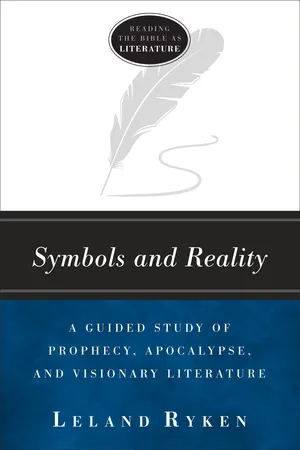
Symbols and Reality (Reading the Bible as Literature)
A Guided Study of Prophecy, Apocalypse, and Visionary Literature
- 128 pages
- English
- ePUB (mobile friendly)
- Available on iOS & Android
eBook - ePub
Symbols and Reality (Reading the Bible as Literature)
A Guided Study of Prophecy, Apocalypse, and Visionary Literature
About this book
In Symbols and Reality, Leland Ryken explores the intersection of the Bible and literature, and he shows pastors, students, and teachers of the Bible how to appreciate the craftsmanship of visionary literature and prophetic oracles and how to interpret them correctly. Symbols and Reality is part of the Reading the Bible as Literature series.
Trusted by 375,005 students
Access to over 1.5 million titles for a fair monthly price.
Study more efficiently using our study tools.
Information
Topic
Theology & ReligionSubtopic
Biblical Studies1
Defining Prophecy, Apocalypse, and Visionary Literature
The purpose of this chapter is to provide a preliminary overview of the three major literary forms covered in this book—prophecy, apocalypse, and visionary literature. My aim is to give the proverbial “lay of the land,” treating the three forms more as categories or branches of literature than genres, though it is not inaccurate to call them “genres.” Later chapters in this book scrutinize the specific genres that make up these parts of the Bible. This chapter is like an orientation meeting for a tour group in which the leader describes general features and traits of a country of destination, without getting into any of the specific places that the tour will visit within that country.
Prophecy
We need to begin with a statement of what prophecy is not: the primary trait of prophecy in the Bible is not that it foretells the future. Much less of the prophetic books is futuristic than is commonly thought. In saying that, I particularly have the distant and eschatological (end-times) future in view. It is true that prophets often predict imminent judgment or deliverance for people and nations, but we assimilate these soon-to-happen events much as we assimilate a prediction that someone who habitually exceeds the speed limit “will certainly get arrested.” We think of it as a comment on the status quo rather than the future. We can say without reservation that a biblical prophet is someone whose primary task is to speak or “tell forth” messages from God rather than foretell the future—forthtelling rather than foretelling.
Prophetic literature starts with a religious group in ancient Judaism known as prophets. Prophets were very prominent figures in Hebrew society. Their high stature is perhaps best seen in the easy access they had to the ruling king in his court. Even evil kings often took the initiative in inviting hostile prophets into their court to hear what they had to say. To catch the flavor of how prophets could trump even priests and monarchs, we need only picture the prophet Nathan standing in David’s inner chamber and proclaiming, “You are the man!” (2 Sam. 12:7).
Prophets fulfilled the task of speaking from God to his people (in contrast to priests, who represented people to God). The prophetic books of the Bible can be defined as the books that contain the messages of a prophet, which in their original form were uttered orally and later written down. To define a prophecy by its point of origin (a prophet) and its status as a message from God to people says nothing about the literary forms that appear in a prophetic book. Those forms occupy later chapters in this guide. The label of “prophecy” signals a broad category that by itself is less descriptive of a prophetic book than scholars often imply.
If the term “prophecy” thus mainly signals the content of a prophetic book rather than its literary forms, what characterizes the content of a prophetic book? The first answer is that prophets were primarily concerned with the moral and spiritual life of individuals and the nation or believing community in the here and now. The Old Testament prophets were keen observers of their own time. Today we would speak of social and moral critique as the overall category of much (not all) prophetic writing. As the prophets looked at the contemporary national and international scene, they were primarily critical of it. Delineation of evil accompanied by denunciation of it and prediction of divine judgment against it account for the bulk of prophetic writing. The dominant harshness of prophetic discourse is balanced by consolation and the promise of God’s favor. The latter gets somewhat less space, but together the twin themes of judgment and consolation make up the prophetic books of the Bible.
| LEARNING BY DOING |
The following passage (excerpts from Ezekiel 34) is a typical example of prophetic literature. You can test your mastery of the preceding description of prophecy by applying the generalizations to this passage. The word of the LORD came to me: “Son of man, prophesy against the shepherds of Israel; prophesy, and say to them, even to the shepherds, Thus says the Lord GOD: Ah, shepherds of Israel who have been feeding yourselves! Should not shepherds feed the sheep? You eat the fat, you clothe yourselves with the wool, you slaughter the fat ones, but you do not feed the sheep. The weak you have not strengthened, the sick you have not healed, the injured you have not bound up, the strayed you have not brought back, the lost you have not sought, and with force and harshness you have ruled them. So they were scattered, because there was no shepherd, and they became food for all the wild beasts … “For thus says the Lord GOD: Behold, I, I myself will search for my sheep and will seek them out. As a shepherd seeks out his flock when he is among his sheep that have been scattered, so will I seek out my sheep, and I will rescue them from all places where they have been scattered on a day of clouds and thick darkness … I will feed them with good pasture, and on the mountain heights of Israel shall be their grazing land. There they shall lie down in good grazing land, and on rich pasture they shall feed on the mountains of Israel.” |
Apocalypse
Apocalyptic writing at first glance seems similar to prophecy, but the differences between the two are more extensive than the similarities. What is similar is the authoritative voice of the writer or speaker. Prophecy and apocalypse are both a revelation from God. They strike us as coming from a world beyond and as disclosing a type of truth that human imagination by itself would not produce. Additionally, there is overlap of the general content of the two types of discourse. Both denounce evil as it exists in the world, and both predict God’s punishment of it now and in the future.
But if we look more closely, the two genres begin to reveal their differences. For example, the prophet’s portrayal of contemporary evil tends to be direct and specific, yielding a picture of what is happening in a specific society of the prophet’s time. The portrayal of evil in apocalyptic writing tends to be more generalized and symbolic. A prophet denounces contemporary evil this way:
The daughters of Zion are haughty
and walk with outstretched necks,
glancing wantonly with their eyes,
mincing along as they go,
tinkling with their feet. (Isa. 3:16)
Apocalyptic portrayal of evil is a universalized picture of cosmic evil, as in the following passage:
And I saw a beast rising out of the sea, with ten horns and seven heads, with ten diadems on its horns and blasphemous names on its heads. (Rev. 13:1)
More important than the differing ways of portraying life on earth is the futuristic orientation of apocalyptic writing. We can loosely identify apocalyptic writing as end-times discourse, also called “visions of the end.” A qualification that immediately needs to be made is that the end-times in Christian apocalypse extend for a very long time. In fact, there is a strand in the New Testament that views the entire time after the incarnation of Jesus as “the last days” (or “the latter days”). The following is a typical apocalyptic passage portraying what will happen in the future:
When he [the Lamb] opened the second seal, I heard the second living creature say, “Come!” And out came another horse, bright red. Its rider was permitted to take peace from the earth, so that people should slay one another, and he was given a great sword. (Rev. 6:3–4)
One of the things that make prophecy and apocalypse difficult to keep separate is that there are apocalyptic visions in the Old Testament prophetic books. In fact, a prophetic book like Zechariah is primarily an apocalyptic vision. On the other hand, there is an informal test of whether a passage is prophetic or apocalyptic. The primary form of prophecy is the oracle—a message from God, frequently bearing either the formula or sense of “thus says the LORD.” The prophet is preeminently a person who has heard a message from God. The primary form of apocalypse is the vision, most frequently accompanied by the formula of what the author has seen or what God has shown. Because apocalyptic discourse is about the end, a certain tone of finality permeates it.
| LEARNING BY DOING |
The following apocalyptic passage will enable you to apply the description that was given above: At that time shall arise Michael, the great prince who has charge of your people. And there shall be a time of trouble, such as never has been since there was a nation till that time. But at that time your people shall be delivered, everyone whose name shall be found written in the book. And many of those who sleep in the dust of the earth shall awake, some to everlasting life, and some to shame and everlasting contempt. And those who are wise shall shine like the brightness of the sky above; and those who turn many to righteousness, like the stars forever and ever. (Dan. 12:1–3) |
Visionary Literature
Visionary writing is a broad and amorphous category, as are prophecy and apocalypse. To get a grip on it, we need to take a wide-angle view of literature as a whole. Literature exists on a continuum in regard to the degree of realism or fantasy in it. At one end of the literary continuum is realism. It may be fictional or nonfictional, but in both cases it does not violate the rules of reality. There are no flying houses or red horses in the real world. Realism is based on the principle of verisimilitude, meaning lifelikeness.
At the other end of the literary continuum is fantasy. Fantasy is not composed entirely of unlifelike details, but to varying degrees it departs from what we find in the world around us. A story in which animals talk like humans and perform human actions is a fantasy story. The Narnia stories of C. S. Lewis combine everyday reality with fantasy, but since the fantasy elements are foregrounded, we have no hesitation in classifying the books as fantasy. The adjective “visionary” is synonymous with literary fantasy. It includes a heavy incidence of unlifelikeness. The following portrayal of an invasion of locusts is the product of the fantastic imagination rather than the realistic imagination:
Their appearance is like the appearance of horses
and like war horses they run.
As with the rumbling of chariots,
they leap on the tops of the mountains,
like the crackling of a flame of fire
devouring the stubble,
like a powerful army
drawn up for battle.
Before them peoples are in anguish;
all faces grow pale. (Joel 2:4–6)
In visionary writing in the Bible, the unlifelike details portray real people and events. The visionary element is the unrealistic or unlifelike vehicle by which reality is delineated.
For those who might be unsettled by the thought of fantasy in the Bible, we can note that figures of speech such as metaphor, hyperbole, and symbol are a form of unlifelikeness or fantasy. God is not really a rock (Ps. 18:31). The warrior David did not actually beat his enemies fine as dust (Ps. 18:42). Those who believe in God are not literally able to “tread on the lion” (Ps. 91:13). These are elements of fantasy that portray reality and truth.
Whereas prophecy and apocalypse are broad categories of literature defined partly by their characteristic content, visionary writing is what literary scholars call a “mode” that can appear in many different genres and categories of writing. The relevance of that to this guide is that both prophecy and apocalypse contain a heavy incidence of visionary writing. This visionary element is a quality that brings prophecy and apocalypse together. In turn, this overlapping of categories and forms makes the biblical material covered in this guide difficult to master.
Simply knowing that visionary writing depends on the fantastic and unlifelike as its basic mode does not yield a method of analyzing a passage, but it alerts us to the nature of the passage and enables us to pick up on qualities that might otherwise remain vague and unnoticed. Additionally, the fantastic or visionary imagination is entertaining. But visionary writing is more than entertaining: by means of the fantastic imagination, we are led to see reality more precisely than we otherwise would. To take the example of the super-locusts quoted above, our first response might be, How ever did you think of that? But then it dawns on us that we experience the terror of a locust invasion all the more vividly because of the element of fantasy.
| LEARNING BY DOING |
One of my favorite pieces of visionary writing is one that involves a woman named Wickedness sitting inside a cereal container. It appears below and will enable you to apply what the preceding discussion has taught: Then the angel who talked w... |
Table of contents
- Cover
- Title Page
- Copyright
- Contents
- Series Preface
- Introduction
- Chapter 1: Defining Prophecy, Apocalypse, and Visionary Literature
- Chapter 2: Prophetic Oracles
- Chapter 3: Additional Prophetic Forms: Vision, Narrative, Symbolic Action, Taunt, Messianic Prophecy, and Colloquy
- Chapter 4: Satire
- Chapter 5: Visionary Literature
- Chapter 6: Poetry, Image, and Symbol
- Chapter 7: Apocalypse
- Chapter 8: A Miscellany of Prophetic and Apocalyptic Forms
- Chapter 9: Structure and Organization of Prophetic and Apocalyptic Literature
Frequently asked questions
Yes, you can cancel anytime from the Subscription tab in your account settings on the Perlego website. Your subscription will stay active until the end of your current billing period. Learn how to cancel your subscription
No, books cannot be downloaded as external files, such as PDFs, for use outside of Perlego. However, you can download books within the Perlego app for offline reading on mobile or tablet. Learn how to download books offline
Perlego offers two plans: Essential and Complete
- Essential is ideal for learners and professionals who enjoy exploring a wide range of subjects. Access the Essential Library with 800,000+ trusted titles and best-sellers across business, personal growth, and the humanities. Includes unlimited reading time and Standard Read Aloud voice.
- Complete: Perfect for advanced learners and researchers needing full, unrestricted access. Unlock 1.5M+ books across hundreds of subjects, including academic and specialized titles. The Complete Plan also includes advanced features like Premium Read Aloud and Research Assistant.
We are an online textbook subscription service, where you can get access to an entire online library for less than the price of a single book per month. With over 1.5 million books across 990+ topics, we’ve got you covered! Learn about our mission
Look out for the read-aloud symbol on your next book to see if you can listen to it. The read-aloud tool reads text aloud for you, highlighting the text as it is being read. You can pause it, speed it up and slow it down. Learn more about Read Aloud
Yes! You can use the Perlego app on both iOS and Android devices to read anytime, anywhere — even offline. Perfect for commutes or when you’re on the go.
Please note we cannot support devices running on iOS 13 and Android 7 or earlier. Learn more about using the app
Please note we cannot support devices running on iOS 13 and Android 7 or earlier. Learn more about using the app
Yes, you can access Symbols and Reality (Reading the Bible as Literature) by Leland Ryken in PDF and/or ePUB format, as well as other popular books in Theology & Religion & Biblical Studies. We have over 1.5 million books available in our catalogue for you to explore.