- 266 pages
- English
- ePUB (mobile friendly)
- Available on iOS & Android
eBook - ePub
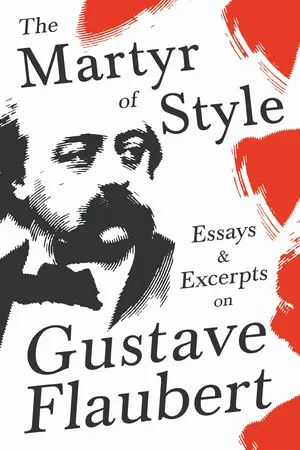
The Martyr of Style - Essays & Excerpts on Gustave Flaubert
About this book
Hailed as one of the greatest western novelists of all time, French author Gustave Flaubert (1821–1880) first became famous for his debut novel "Madame Bovary" (1857), a seminal work of literary realism that resulted in Flaubert being put on trail for obscenity. Mentor of the celebrated writer Guy de Maupassant. Flaubert was highly influential and is generally considered to be leading exponent of literary realism in France. This volume contains a collection of essays and excerpts on the famous French novelist by various writers, including Henry James, Guy De Maupassant, and others. Highly recommended for students of literature and others with an interest in the life and work of this seminal writer. Contents include: "Gustave Flaubert, by Georg Brandes", "Style, an Essay by Walter Horatio Pater", "Flaubert, by Dmitry Sergeyevich Merezhkovsky", "Gustave Flaubert, by Henry James", "Gustave Flaubert, by Arthur Symons", "Of 'The' Novel, by Guy De Maupassant", "The Question of Style, by Frederic Taber Cooper", and "The Public Vs. M. Gustave Flauber". Read & Co. Books is publishing this collection of classic essays and excerpts for the enjoyment of a new generation of students and literature lovers.
Trusted by 375,005 students
Access to over 1.5 million titles for a fair monthly price.
Study more efficiently using our study tools.
Information
EXCERPTS
OF "THE NOVEL"
By Guy De Maupassant
Translated by Clara Bell
I do not intend in these pages to put in a plea for this little novel. On the contrary, the ideas I shall try to set forth will rather involve a criticism of the class of psychological analysis which I have undertaken in Pierre and Jean. I propose to treat of novels in general.
I am not the only writer who finds himself taken to task in the same terms each time he brings out a new book. Among many laudatory phrases, I invariably meet with this observation, penned by the same critics: "The greatest fault of this book is that it is not, strictly speaking, a novel."
The same form might be adopted in reply:
"The greatest fault of the writer who does me the honour to review me is that he is not a critic."
For what are, in fact, the essential characteristics of a critic?
It is necessary that, without preconceived notions, prejudices of "School," or partisanship for any class of artists, he should appreciate, distinguish, and explain the most antagonistic tendencies and the most dissimilar temperaments, recognising and accepting the most varied efforts of art.
Now the Critic who, after reading Manon Lescaut, Paul and Virginia, Don Quixote, Les Liaisons dangereuses, Werther, Elective Affinities (Wahlverwandschaften), Clarissa Harlowe, Émile, Candide, Cinq-Mars, René, Les Trois Mousqetaires, Mauprat, Le Père Goriot, La Cousine Bette, Colomba, Le Rouge et le Noir, Mademoiselle de Maupin, Notre-Dame de Paris, Salammbo, Madame Bovary, Adolphe, M. de Camors, l'Assommoir, Sapho, etc., still can be so bold as to write "This or that is, or is not, a novel," seems to me to be gifted with a perspicacity strangely akin to incompetence. Such a critic commonly understands by a novel a more or less improbable narrative of adventure, elaborated after the fashion of a piece for the stage, in three acts, of which the first contains the exposition, the second the action, and the third the catastrophe or dénouement.
And this method of construction is perfectly admissible, but on condition that all others are accepted on equal terms.
Are there any rules for the making of a novel, which, if we neglect, the tale must be called by another name? If Don Quixote is a novel, then is Le Rouge et le Noir a novel? If Monte Christo is a novel, is l'Assommoir? Can any conclusive comparison be drawn between Goethe's Elective Affinities, The Three Mousqueteers, by Dumas, Flaubert's Madame Bovary, M. de Camors, by Octave Feuillet, and Germinal, by Zola? Which of them all is The Novel? What are these famous rules? Where did they originate? Who laid them down? And in virtue of what principle, of whose authority, and of what reasoning?
And yet, as it would appear, these critics know in some positive and indisputable way what constitutes a novel, and what distinguishes it from other tales which are not novels. What this amounts to is that without being producers themselves they are enrolled under a School, and that, like the writers of novels, they reject all work which is conceived and executed outside the pale of their æsthetics. An intelligent critic ought, on the contrary, to seek out everything which least resembles the novels already written, and urge young authors as much as possible to try fresh paths.
All writers, Victor Hugo as much as M. Zola, have insistently claimed the absolute and incontrovertible right to compose—that is to say, to imagine or observe—in accordance with their individual conception of originality, and that is a special manner of thinking, seeing, understanding, and judging. Now the critic who assumes that "the novel" can be defined in conformity with the ideas he has based on the novels he prefers, and that certain immutable rules of construction can be laid down, will always find himself at war with the artistic temperament of a writer who introduces a new manner of work. A critic really worthy of the name ought to be an analyst, devoid of preferences or passions; like an expert in pictures, he should simply estimate the artistic value of the object of art submitted to him. His intelligence, open to everything, must so far supersede his individuality as to leave him free to discover and praise books which as a man he may not like, but which as a judge he must duly appreciate.
But critics, for the most part, are only readers; whence it comes that they almost always find fault with us on wrong grounds, or compliment us without reserve or measure.
The reader, who looks for no more in a book than that it should satisfy the natural tendencies of his own mind, wants the writer to respond to his predominant taste, and he invariably praises a work or a passage which appeals to his imagination, whether idealistic, gay, licentious, melancholy, dreamy or positive, as "striking" or "well written."
The public as a whole is composed of various groups, whose cry to us writers is:
"Comfort me."
"Amuse me."
"Touch me."
"Make me dream."
"Make me laugh."
"Make me shudder."
"Make me weep."
"Make me think."
And only a few chosen spirits say to the artist:
"Give me something fine in any form which may suit you best, according to your own temperament."
The artist makes the attempt; succeeds or fails.
The critic ought to judge the result only in relation to the nature of the attempt; he has no right to concern himself about tendencies. This has been said a thousand times already; it will always need repeating.
Thus, after a succession of literary schools which have given us deformed, superhuman, poetical, pathetic, charming or magnificent pictures of life, a realistic or naturalistic school has arisen, which asserts that it shows us the truth, the whole truth, and nothing but the truth.
All these theories of art must be recognised as of equal interest, and we must judge the works which are their outcome solely from the point of view of artistic value, with an a priori acceptance of the general notions which gave birth to each. To dispute the author's right to produce a poetical work or a realistic work, is to endeavour to coerce his temperament, to take exception to his originality, to forbid his using the eyes and wits bestowed on him by Nature. To blame him for seeing things as beautiful or ugly, as mean or epic, as gracious or sinister, is to reproach him for not being made on this or that pattern, and for having eyes which do not see exactly as ours see.
Let him be free by all means to conceive of things as he pleases, provided he is an artist.
Let us rise to poetic heights to judge an idealist, and then prove to him that his dream is commonplace, ordinary, not mad or magnificent enough. But if we judge a materialistic writer, let us show him wherein the truth of life differs from the truth in his book.
It is self-evident that schools so widely different different must have adopted diametrically opposite processes in composition.
The novelist who transforms truth—immutable, uncompromising, and displeasing as it is—to extract from it an exceptional and delightful plot, must necessarily manipulate events without an exaggerated respect for probability, moulding them to his will, dressing and arranging them so as to attract, excite, or affect the reader. The scheme of his romance is no more than a series of ingenious combinations, skilfully leading to the issue. The incidents are planned and graduated up to the culminating point and effect of the conclusion, which is the crowning and fatal result, satisfying the curiosity aroused from the first, closing the interest, and ending the story so completely that we have no further wish to know what happened on the morrow to the most engaging actors in it.
The novelist who, on the other hand, proposes to give us an accurate picture of life, must carefully eschew any concatenation of events which might seem exceptional. His aim is not to tell a story to amuse us, or to appeal to our feelings, but to compel us to reflect, and to understand the occult and deeper meaning of events. By dint of seeing and meditating he has come to regard the world, facts, men, and things in a way peculiar to himself, which is the outcome of the sum total of his studious observation. It is this personal view of the world which he strives to communicate to us by reproducing it in a book. To make the spectacle of life as moving to us as it has been to him, he must bring it before our eyes with scrupulous exactitude. Hence he must construct his work with such skill, it must be so artful under so simple a guise, that it is impossible to detect and sketch the plan, or discern the writer's purpose.
Instead of manipulating an adventure and working it out in such a way as to make it interesting to the last, he will take his actor or actors at a certain period of their lives, and lead them by natural stages to the next. In this way he will show either how men's minds are modified by the influence of their environment, or how their passions and sentiments are evolved; how they love or hate, how they struggle in every sphere of society, and how their interests clash—social interests, pecuniary interests, family interests, political interests. The skill of his plan will not consist in emotional power or charm, in an attractive opening or a stirring catastrophe, but in the happy grouping of small but constant facts from which the final purpose of the work may be discerned. If within three hundred pages he depicts ten years of a life so as to show what its individual and characteristic significance may have been in the midst of all the other human beings which surrounded it, he ought to know how to eliminate from among the numberless trivial incidents of daily life all which do not serve his end, and how to set in a...
Table of contents
- Gustave Flaubert
- ESSAYS
- EXCERPTS
Frequently asked questions
Yes, you can cancel anytime from the Subscription tab in your account settings on the Perlego website. Your subscription will stay active until the end of your current billing period. Learn how to cancel your subscription
No, books cannot be downloaded as external files, such as PDFs, for use outside of Perlego. However, you can download books within the Perlego app for offline reading on mobile or tablet. Learn how to download books offline
Perlego offers two plans: Essential and Complete
- Essential is ideal for learners and professionals who enjoy exploring a wide range of subjects. Access the Essential Library with 800,000+ trusted titles and best-sellers across business, personal growth, and the humanities. Includes unlimited reading time and Standard Read Aloud voice.
- Complete: Perfect for advanced learners and researchers needing full, unrestricted access. Unlock 1.5M+ books across hundreds of subjects, including academic and specialized titles. The Complete Plan also includes advanced features like Premium Read Aloud and Research Assistant.
We are an online textbook subscription service, where you can get access to an entire online library for less than the price of a single book per month. With over 1.5 million books across 990+ topics, we’ve got you covered! Learn about our mission
Look out for the read-aloud symbol on your next book to see if you can listen to it. The read-aloud tool reads text aloud for you, highlighting the text as it is being read. You can pause it, speed it up and slow it down. Learn more about Read Aloud
Yes! You can use the Perlego app on both iOS and Android devices to read anytime, anywhere — even offline. Perfect for commutes or when you’re on the go.
Please note we cannot support devices running on iOS 13 and Android 7 or earlier. Learn more about using the app
Please note we cannot support devices running on iOS 13 and Android 7 or earlier. Learn more about using the app
Yes, you can access The Martyr of Style - Essays & Excerpts on Gustave Flaubert by Various in PDF and/or ePUB format, as well as other popular books in Literature & Literary Biographies. We have over 1.5 million books available in our catalogue for you to explore.