This new release of the classic text Pragmatism is absolutely timely. James' seminal statement of pragmatism's underpinnings and its treatment of essential philosophical questions (the nature of truth; the one and the many; free will; etc.) could not come at a more appropriate time. In a "post-truth" era of fake news, alternative facts, and a belief that "truth isn't truth," James' presentation of pragmatism as a method of adjudicating truth-claims is a must-read.
Perfect for courses in: Philosophy of Education (Graduate Level), American Philosophy (Graduate and Upper-Level Undergraduate), American Studies, Special topics class on William James or Pragmatism, Sociology of Education (Graduate Level), Religious Studies.
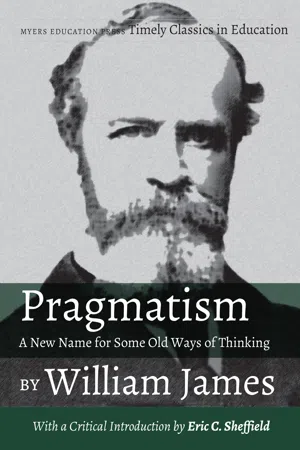
eBook - ePub
Pragmatism - A New Name for Some Old Ways of Thinking by William James
With a Critical Introduction by Eric C. Sheffield
- 200 pages
- English
- ePUB (mobile friendly)
- Available on iOS & Android
eBook - ePub
Pragmatism - A New Name for Some Old Ways of Thinking by William James
With a Critical Introduction by Eric C. Sheffield
About this book
Trusted by 375,005 students
Access to over 1.5 million titles for a fair monthly price.
Study more efficiently using our study tools.
Information
Pragmatism
Preface
The lectures that follow were delivered at the Lowell Institute in Boston in November and December, 1906, and in January, 1907, at Columbia University, in New York. They are printed as delivered, without developments or notes. The pragmatic movement, so-called—I do not like the name, but apparently it is too late to change it—seems to have rather suddenly precipitated itself out of the air. A number of tendencies that have always existed in philosophy have all at once become conscious of themselves collectively, and of their combined mission; and this has occurred in so many countries, and from so many different points of view, that much unconcerted statement has resulted. I have sought to unify the picture as it presents itself to my own eyes, dealing in broad strokes, and avoiding minute controversy. Much futile controversy might have been avoided, I believe, if our critics had been willing to wait until we got our message fairly out.
If my lectures interest any reader in the general subject, he will doubtless wish to read farther. I therefore give him a few references.
In America, John Dewey’s ‘Studies in Logical Theory’ are the foundation. Read also by Dewey the articles in the Philosophical Review, vol. xv, pp. 113 and 465, in Mind, vol. xv, p. 293, and in the Journal of Philosophy, vol. iv, p. 197.
Probably the best statements to begin with however, are F. C. S. Schiller’s in his ‘Studies in Humanism,’ especially the essays numbered i, v, vi, vii, xviii and xix. His previous essays and in general the polemic literature of the subject are fully referred to in his footnotes.
Furthermore, see G. Milhaud: “le Rationnel,” 1898, and the fine articles by Le Roy in the Revue de Metaphysique, vols. 7, 8 and 9. Also articles by Blondel and de Sailly in the Annales de Philosophie Chretienne, 4me Serie, vols. 2 and 3. Papini announces a book on Pragmatism, in the French language, to be published very soon.
To avoid one misunderstanding at least, let me say that there is no logical connexion between pragmatism, as I understand it, and a doctrine which I have recently set forth as ‘radical empiricism.’ The latter stands on its own feet. One may entirely reject it and still be a pragmatist.
—Harvard University, April, 1907.
Expanded Contents
Lecture I: The Present Dilemma in Philosophy
Chesterton quoted. Everyone has a philosophy. Temperament is a factor in all philosophizing. Rationalists and empiricists. The tender-minded and the tough-minded. Most men wish both facts and religion. Empiricism gives facts without religion. Rationalism gives religion without facts. The layman’s dilemma. The unreality in rationalistic systems. Leibnitz on the damned, as an example. M. I. Swift on the optimism of idealists. Pragmatism as a mediating system. An objection. Reply: philosophies have characters like men, and are liable to as summary judgments. Spencer as an example.
Lecture II: What Pragmatism Means
The squirrel. Pragmatism as a method. History of the method. Its character and affinities. How it contrasts with rationalism and intellectualism. A ‘corridor theory.’ Pragmatism as a theory of truth, equivalent to ‘humanism.’ Earlier views of mathematical, logical, and natural truth. More recent views. Schiller’s and Dewey’s ‘instrumental’ view. The formation of new beliefs. Older truth always has to be kept account of. Older truth arose similarly. The ‘humanistic’ doctrine. Rationalistic criticisms of it. Pragmatism as mediator between empiricism and religion. Barrenness of transcendental idealism. How far the concept of the Absolute must be called true. The true is the good in the way of belief. The clash of truths. Pragmatism unstiffens discussion.
Lecture III: Some Metaphysical
Problems Pragmatically Considered
The problem of substance. The Eucharist. Berkeley’s pragmatic treatment of material substance. Locke’s of personal identity. The problem of materialism. Rationalistic treatment of it. Pragmatic treatment. ‘God’ is no better than ‘Matter’ as a principle, unless he promise more. Pragmatic comparison of the two principles. The problem of design. ‘Design’ per se is barren. The question is what design. The problem of ‘free-will.’ Its relations to ‘accountability.’ Free-will a cosmological theory. The pragmatic issue at stake in all these problems is what do the alternatives promise.
Lecture IV: The One and the Many
Total reflection. Philosophy seeks not only unity, but totality. Rationalistic feeling about unity. Pragmatically considered, the world is one in many ways. One time and space. One subject of discourse. Its parts interact. Its oneness and manyness are co-ordinate. Question of one origin. Generic oneness. One purpose. One story. One knower. Value of pragmatic method. Absolute monism. Vivekananda. Various types of union discussed. Conclusion: We must oppose monistic dogmatism and follow empirical findings.
Lecture V: Pragmatism and Common Sense
Noetic pluralism. How our knowledge grows. Earlier ways of thinking remain. Prehistoric ancestors discovered the common sense concepts. List of them. They came gradually into use. Space and time. ‘Things.’ Kinds. ‘Cause’ and ‘law.’ Common sense one stage in mental evolution, due to geniuses. The ‘critical’ stages: 1) scientific and 2) philosophic, compared with common sense. Impossible to say which is the more ‘true.’
Lecture VI: Pragmatism’s Conception of Truth
The polemic situation. What does agreement with reality mean? It means verifiability. Verifiability means ability to guide us prosperously through experience. Completed verifications seldom needful. ‘Eternal’ truths. Consistency, with language, with previous truths. Rationalist objections. Truth is a good, like health, wealth, etc. It is expedient thinking. The past. Truth grows. Rationalist objections. Reply to them.
Lecture VII: Pragmatism and Humanism
The notion of the Truth. Schiller on ‘Humanism.’ Three sorts of reality of which any new truth must take account. To ‘take account’ is ambiguous. Absolutely independent reality is hard to find. The human contribution is ubiquitous and builds out the given. Essence of pragmatism’s contrast with rationalism. Rationalism affirms a transempirical world. Motives for this. Tough-mindedness rejects them. A genuine alternative. Pragmatism mediates.
Lecture VIII: Pragmatism and Religion
Utility of the Absolute. Whitman’s poem ‘To You.’ Two ways of taking it. My friend’s letter. Necessities versus possibilities. ‘Possibility’ defined. Three views of the world’s salvation. Pragmatism is melioristic. We may create reality. Why should anything be? Supposed choice before creation. The healthy and the morbid reply. The ‘tender’ and the ‘tough’ types of religion. Pragmatism mediates.
PRAGMATISM
LECTURE I.
The Present Dilemma in Philosophy
In the preface to that admirable collection of essays of his called ‘Heretics,’ Mr. Chesterton writes these words: “There are some people—and I am one of them—who think that the most practical and important thing about a man is still his view of the universe. We think that for a landlady considering a lodger, it is important to know his income, but still more important to know his philosophy. We think that for a general about to fight an enemy, it is important to know the enemy’s numbers, but still more important to know the enemy’s philosophy. We think the question is not whether the theory of the cosmos affects matters, but whether, in the long run, anything else affects them.”
I think with Mr. Chesterton in this matter. I know that you, ladies and gentlemen, have a philosophy, each and all of you, and that the most interesting and important thing about you is the way in which it determines the perspective in your several worlds. You know the same of me. And yet I confess to a certain tremor at the audacity of the enterprise which I am about to begin. For the philosophy which is so important in each of us is not a technical matter; it is our more or less dumb sense of what life honestly and deeply means. It is only partly got from books; it is our individual way of just seeing and feeling the total push and pressure of the cosmos. I have no right to assume that many of you are students of the cosmos in the class-room sense, yet here I stand desirous of interesting you in a philosophy which to no small extent has to be technically treated. I wish to fill you with sympathy with a contemporaneous tendency in which I profoundly believe, and yet I have to talk like a professor to you who are not students. Whatever universe a professor believes in must at any rate be a universe that lends itself to lengthy discourse. A universe definable in two sentences is something for which the professorial intellect has no use. No faith in anything of that cheap kind! I have heard friends and colleagues try to popularize philosophy in this very hall, but they soon grew dry, and then technical, and the results were only partially encouraging. So my enterprise is a bold one. The founder of pragmatism himself recently gave a course of lectures at the Lowell Institute with that very word in its title-flashes of brilliant light relieved against Cimmerian darkness! None of us, I fancy, understood all that he said—yet here I stand, making a very similar venture.
For the philosophy which is so important in each of us is not a technical matter; it is our more or less dumb sense of what life honestly and deeply means.
I risk it because the very lectures I speak of drew—they brought good audiences. There is, it must be confessed, a curious fascination in hearing deep things talked about, even tho neither we nor the disputants understand them. We get the problematic thrill, we feel the presence of the vastness. Let a controversy begin in a smoking-room anywhere, about free-will or God’s omniscience, or good and evil, and see how everyone in the place pricks up his ears. Philosophy’s results concern us all most vitally, and philosophy’s queerest arguments tickle agreeably our sense of subtlety and ingenuity.
Believing in philosophy myself devoutly, and believing also that a kind of new dawn is breaking upon us philosophers, I feel impelled, per fas aut nefas, to try to impart to you some news of the situation.
Philosophy is at once the most sublime and the most trivial of human pursuits. It works in the minutest crannies and it opens out the widest vistas. It ‘bakes no bread,’ as has been said, but it can inspire our souls with courage; and repugnant as its manners, its doubting and challenging, its quibbling and dialectics, often are to common people, no one of us can get along without the far-flashing beams of light it sends over the world’s perspectives. These illuminations at least, and the contrast-effects of darkness and mystery that accompany them, give to what it says an interest that is much more than professional.
The history of philosophy is to a great extent that of a certain clash of human temperaments. Undignified as such a treatment may seem to some of my colleagues, I shall have to take account of this clash and explain a good many of the divergencies of philosophers by it. Of whatever temperament a professional philosopher is, he tries when philosophizing to sink the fact of his temperament. Temperament is no conventionally recognized reason, so he urges impersonal reasons only for his conclusions. Yet his temperament really gives him a stronger bias than any of his more strictly objective premises. It loads the evidence for him one way or the other, making for a more sentimental or a more hard-hearted view of the universe, just as this fact or that principle would. He trusts his temperament. Wanting a universe that suits it, he believes in any representation of the universe that does suit it. He feels men of opposite temper to be out of key with the world’s character, and in his heart considers them incompetent and ‘not in it,’ in the philosophic business, even tho they may far excel him in dialectical ability.
Yet in the forum he can make no claim, on the bare ground of his temperament, to superior discernment or authority. There arises thus a certain insincerity in our philosophic discussions: the potentest of all our premises is never mentioned. I am sure it would contribute to clearness if in these lectures we should break this rule and mention it, and I accordingly feel free to do so.
Of course I am talking here of very positively marked men, men of radical idiosyncracy, who have set their stamp and likeness on philosophy and figure in its history. Plato, Locke, Hegel, Spencer, are such temperamental thinkers. Most of us have, of course, no very definite intellectual temperament, we are a mixture of opposite ingredients, each one present very moderately. We hardly know our own preferences in abstract matters; some of us are easily talked out of them, and end by following the fashion or taking up with the beliefs of the most impressive philosopher in our neighborhood, whoever he may be. But the one thing that has counted so far in philosophy is that a man should see things, see them straight in his own peculiar way, and be dissatisfied with any opposite way of seeing them. There is no reason to suppose that this strong temperamental vision is from now onward to count no longer in the history of man’s beliefs.
Now the particular difference of temperament that I have in mind in making these remarks is one that has counted in literature, art, government and manners as well as in philosophy. In manners we find formalists and free-and-easy persons. In government, authoritarians and anarchists. In literature, purists or academicals, and realists. In art, classics and romantics. You recognize these contrasts as familiar; well, in philosophy we have a very similar contrast expressed in the pair of terms ‘rationalist’ and ‘empiricist,’ ‘empiricist’ meaning your lover of facts in all their crude variety, ‘rationalist’ meaning your devotee to abstract and eternal principles. No one can live an hour without both facts and principles, so it is a difference rather of emphasis; yet it breeds antipathies of the most pungent character between those who lay the emphasis differently; and we shall find it extraordinarily convenient to express a certain contrast in men’s ways of taking their universe, by talking of the ‘empiricist’ and of the ‘rationalist’ temper. These terms make the contrast simple and massive.
More simple and massive than are usually the men of whom the terms are predicated. For every sort of permutation and combination is possible in human nature; and if I now proceed to define more fully what I have in mind when I speak of rationalists and empiricists, by adding to each of those titles some secondary qualifying characteristics, I beg you to regard my conduct as to a certain extent arbitrary. I select types of combination that nature offers very frequently, but by no means uniformly, and I select them solely for their convenience in helping me to my ulterior purpose of characterizing pragmatism. Historically we find the terms ‘intellectualism’ and ‘sensationalism’ used as synonyms of ‘rationalism’ and ‘empiricism.’ Well, nature seems to combine most frequently with intellectualism an idealistic and optimistic tendency. Empiricists on the other hand are not uncommonly materialistic, and their optimism is apt to be decidedly conditional and tremulous. Rationalism is always monistic. It starts from wholes and universals, and makes much of the unity of things. Empiricism starts from the parts, and makes of the whole a collection is not averse therefore to calling itself pluralistic. Rationalism usually considers itself more religious than empiricism, but there is much to say about this claim, so I merely mention it. It is a true claim when the individual rationalist is what is called a man of feeling, and when the individual empiricist prides himself on being hard-headed. In that case the rationalist will usually also be in favor of what is called free-will, and the empiricist will be a fatalist—I use the terms most popularly current. The rationalist finally will be of dogmatic temper in his affirmations, while the empiricist may be more sceptical and open to discussion.
I will write these traits down in two columns. I think you will practically recognize the two types of mental make-up that I mean if I head the columns by the titles ‘tender-minded’ and ‘tough-minded’ respectively.
| THE TENDER-MINDED | THE TOUGH-MINDED |
|---|---|
| Rationalistic (going by ‘principles’) | Empiricist (going by ‘facts’) |
| Intellectualistic | Sensationalistic |
| Idealistic | Materialistic |
| Optimistic | Pessimistic |
| Religious | Irreligious |
| Free-willist | Fatalistic |
| Monistic | Pluralistic |
| Dogmatical | Sceptical |
Pray postpone for a moment the question whether the two contrasted mixtures which I have written down are each inwardly coherent and self-consistent or not—I shall very soon have a good deal to say on that point. It suffices for our immediate purpose that tender-minded and tough-minded people, characterized as I have written them down, do both exist. Each of you probably knows some well-marked example of each type, and you know what each example thinks of the example on the other side of the line. They have a low opinion of each other. Their antagonism, whenever as individuals their temperaments have been intense, has formed in all ages a part of the philosophic atmosphere of the time. It forms a part of the philosophic atmosphere to-day. The tough think of the tender as sentimentalists and soft-heads. The tender feel the tough to be unrefined, callous, or brutal. Their mutual reaction is very much like that that takes place when Bostonian tourists mingle with a population like that of Cripple Creek. Each type believes the other to be inferior to itself; but disdain in the one case is ...
Table of contents
- Cover
- Title
- Copyright
- Dedication
- Contents
- Introduction
- Pragmatism
Frequently asked questions
Yes, you can cancel anytime from the Subscription tab in your account settings on the Perlego website. Your subscription will stay active until the end of your current billing period. Learn how to cancel your subscription
No, books cannot be downloaded as external files, such as PDFs, for use outside of Perlego. However, you can download books within the Perlego app for offline reading on mobile or tablet. Learn how to download books offline
We are an online textbook subscription service, where you can get access to an entire online library for less than the price of a single book per month. With over 1.5 million books across 990+ topics, we’ve got you covered! Learn about our mission
Look out for the read-aloud symbol on your next book to see if you can listen to it. The read-aloud tool reads text aloud for you, highlighting the text as it is being read. You can pause it, speed it up and slow it down. Learn more about Read Aloud
Yes! You can use the Perlego app on both iOS and Android devices to read anytime, anywhere — even offline. Perfect for commutes or when you’re on the go.
Please note we cannot support devices running on iOS 13 and Android 7 or earlier. Learn more about using the app
Please note we cannot support devices running on iOS 13 and Android 7 or earlier. Learn more about using the app
Yes, you can access Pragmatism - A New Name for Some Old Ways of Thinking by William James by William James, Patricia H. Hinchey in PDF and/or ePUB format, as well as other popular books in Education & Education General. We have over 1.5 million books available in our catalogue for you to explore.