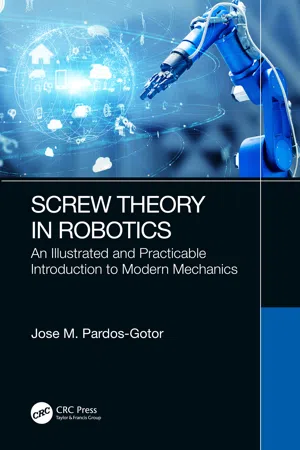
Screw theory is an effective and efficient method used in robotics applications. This book demonstrates how to implement screw theory, explaining the key fundamentals and real-world applications using a practical and visual approach.
An essential tool for those involved in the development of robotics implementations, the book uses case studies to analyze mechatronics. Screw theory offers a significant opportunity to interpret mechanics at a high level, facilitating contemporary geometric techniques in solving common robotics issues. Using these solutions results in an optimized performance in comparison to algebraic and numerical options. Demonstrating techniques such as six-dimensional (6D) vector notation and the Product of Exponentials (POE), the use of screw theory notation reduces the need for complex algebra, which results in simpler code, which is easier to write, comprehend, and debug. The book provides exercises and simulations to demonstrate this with new formulas and algorithms presented to aid the reader in accelerating their learning. By walking the user through the fundamentals of screw theory, and by providing a complete set of examples for the most common robot manipulator architecture, the book delivers an excellent foundation through which to comprehend screw theory developments.
The visual approach of the book means it can be used as a self-learning tool for professionals alongside students. It will be of interest to those studying robotics, mechanics, mechanical engineering, and electrical engineering.
Trusted by 375,005 students
Access to over 1.5 million titles for a fair monthly price.
For millennia, the study of mechanical systems that interact with each other has aroused interest in the scientific world. The history of robotics began in the ancient world. Greek mythology already presents metallic humanoids that do the work of servants of the Gods. When the Greeks controlled Egypt, several generations of engineers in Alexandria built viable automata powered by hydraulic or steam systems. In Byzantium, this knowledge continued, and then the ability passed to the Arabs, who made automatic clocks and even humanoids. Through medieval Spain, Europeans acquired this knowledge. They devised the famous brazen talking heads like Roger Bacon’s, and tradition keeps that Albertus Magnus constructed a complete android that could perform domestic tasks and speak with people.
As a great inspiration, we want to mention the works of Leonardo da Vinci during the 15th and 16th centuries. In several of Leonardo’s codices, we can find studies of human anatomy, which are undoubtedly works of great interest for those interested in bioengineering. Also, we find animal anatomy studies, among which we can see some bird studies (see Figure 1.1) in which there was the mechanical analysis of a wing. We can appreciate the draw is a chain of rigid bodies with three joints. It is an image that directly evokes the constitution of an industrial robotic manipulator. Additionally, Leonardo made extensive and remarkable studies on the structure of mechanisms which are an inspirational reference for robotics research.
Figure 1.1 A bird’s wing study from a codex on the flight of birds by Leonardo da Vinci. (Photograph by the author.)
In the 17th and 18th centuries, the interest in automation continued, especially in France. There were several mechanical animals and androids with truly complex mechanisms.
Nikola Tesla demonstrated a prototype of a remote-controlled boat by the end of the 19th century. This automaton had a shocking and sophisticated level of self-control to maneuver without human intervention.
1.1.2 A Hundred Years of Menacing Robots!
At the beginning of the 20th century, we mark the contemporary inception of the “Robot” idea within the Karel Capek play “R.U.R. - Rossum’s Universal Robots.” The concept stems from the verb “robota,” which means “to work” in Slavic language. Moreover, the oeuvre title could mean “universal reasoning robots” and is the name of a company that manufactures robots.
Curiously, the first use of the word robot in the 20th century was to define a machine designed as an artificial human that helps people perform heavy work. Again, the first modern robot concept has the shape of an android. There is a warning message about this technology since the robots opposed society, starting a revolution to destroy humanity.
In 1926, Fritz Lang’s classic film “Metropolis” showed a super industrialized society controlled by an android. Once again, a robot becomes a humanoid enemy of people. Furthermore, this foundational concept continues to be maintained throughout the 20th century, as we saw in the series of “Terminator” movies. Even today, we are bombarded with much fake news, insisting on the idea that humanoid robots are dangerous because they are already going to steal our jobs.
1.1.3 A Century of Helping Robots!
From a different perspective, some people saw robotics as a technology with a great potential to help humankind. The collective imaginary also nourished positive stories, such as those of Isaac Asimov. He defined the famous “Three Laws of Robotics.” A robot does not harm a human being; a robot obeys a human being except where such orders would conflict with the first law; a robot protects its existence as long as it does not conflict with the first or second laws. This robotics philosophy is still present in many works of literature and film.
As excellent examples, there is also a suitable positive image for some robots fixed in the collective imagination of society worldwide, such as the robots in the movie “Wall-e” or the saga “Star Wars.” Additionally, some real robots in medical technology create a world where robotics plays a fantastic service to society.
1.1.4 And Only 50 Years of Commercial Robots!
Let us do a historical review of what were commercial robotics applications. It is a journey of approximately half a century, in which robots with practical application have been developed especially for the industrial world. Furthermore, this is where there are the most critical advances in engineering, science, and technology.
We can recall some milestones of contemporary robotics, such as the first mechanical telemanipulation at the Argonne National Lab (1948), the first robot used in the automotive industry, Unimation (1960), the original programming language for robots developed at Stanford, called Wave (1973) or the first of a kind all-electric robotics manipulator from ASEA (1973).
These first industrial manipulators were machines not flexible enough and dangerous for human work environments. Thus, in recent years, the trend continues to develop collaborative robots (cobots), whose design paradigm is inherently safe and allows interaction with humans. UNIVERSAL UR series and KUKA IIWA are good examples of the current cobots.
Depending on the applications, robots today have a great variety of morphologies (e.g., stationary, wheeled, legged, flying, swimming, modular, hybrid, soft). In any case, we must take advantage of everything learned from industrial manipulators, especially in terms of mechanics, to extend this knowledge to other models and robotic structures. We must work so that when the future arrives, people perceive robots as a beneficial system. They must be excellent products and versatile machines that serve competently and with productivity to complement humans’ capabilities.
1.1.5 The Mathematical Complexity of Robotics
Anyone who has experience working with the robot’s motion equations has realized the enormous complexity involved in solving them. Apparently, according to classical mechanics, getting the motion equations of a chain of coupled rigid bodies may seem relatively straightforward. The only need is to have a reference coordinate system and apply the equations Newton–Euler’s or Lagrange’s to obtain the corresponding differential equations. The Lagrange approach provides an exciting high-level formulation to represent important parameters and give closed-form implementations, while the Newton–Euler formulation is used more for recursive algorithms.
When the system is humanoid, the mechanical analysis’s complexity grows even more. The first reason is the enormous number of Degrees of Freedom (DoF). The second cause is because stable biped locomotion problems appear. Besides, we need to solve complex collision-free trajectory planning problems.
It is crucial to have simpler motion equations formulations when the robots are increasingly complex. It is desirable to have an explicit representation of these equations, which we can manipulate at a high level. The parameters of the mechanical system’s kinematics and dynamics must be capable of being represented transparently. Furthermore, the algorithms used must be independent of the chosen coordinate systems (i.e., algorithms not linked to any local reference system) to be flexible in analyzing kinematics and dynamics.
1.1.6 Here Comes Screw Theory in Robotics
Many researchers use differential geometry, Lie algebras, and screw theory mathematical tools to study sets of linked rigid bodies.
The very cornerstone of the modern revival of these theories came with connecting the Lie groups theory to robot kinematics by introducing the Product of Exponentials (POE) (Brockett, 1983). There were excellent introductions to Lie groups theory and the special Euclidean group SE(3) and its algebra se(3) (Murray et al., 2017). They showed the geometric meaning of these theories related to the Theory of Screws (Ball, 1900). The new developments introduced in this book follow that way to a great extent. Therefore, we use the same terminology for the formulations of this text.
Some researchers studied the Lie theory applied to the properties of manipulators (Paden & Sastry, 1988). Many used the mathematics of Lie to formulate robot dynamics (Park et al., 1995). Some derived the motion equations for open chains of rigid bodies, using screw theory and the Lagrange equations (Brockett et al., 1993). Some presented iterative versions of the Newton–Euler and Lagrange formulations to solve robot dynamics with Lie theory (Selig, 2005). There was a valuable functional space formulation for applications on force/position control of the robot tool (Khatib, 1987). There were simulations of robotic mechanisms with dynamics algorithms (Lilly & Orin, 1994). Some researchers develop iterative versions for the motion equations of linked rigid bodies, resulting in algorithms independent of the coordinate system (Ploen, 1997). There were also geometric versions for the solution of those equations (Featherstone, 2016). Moreover, we must highlight the pioneering developments of Featherstone on robot dynamics by the introduction of the Spatial Vector.
For formulations of the dynamics of a chain of rigid bodies, we have several alternatives. On the one hand, there are geometric formulations based on the Lagrange equations, and on the other, the recursive developments of the Newton–Euler equations. The two are equivalent in terms of effectiveness, but the second is more efficient in computational cost. All avant-garde techniques employ the representation of the screw theory with six-dimensional vectors or some extension of this concept.
Robots need a system that allows solving the problem of Inverse Dynamics (ID) and control of this chain of rigid bodies, even in the presence of disturbances and errors. We use two control paradigms for robotics, control in the workspace and control in the joint space. They benefit from Lie groups theory to develop control algorithms (Murray et al., 2017). We will see examples of ID robust control for some industrial robots with these methodologies. Of course, there are many more developments, but control is a subject that is mostly beyond the scope of this text, and we hope to address it thoroughly in a possible future edition of this text.
We also have to highlight the works in the “RoboticsLab” at the University Carlos III of Madrid (UC3M). The whole team has carried out exciting works for robots’ mechanical analysis. The new screw theory methods and algorithms presented in this book have got tests with several industrial manipulators.
1.1.7 The Future of Robotics
Automation improves the quality of production by offering precise repeatability. These tasks would be impossible to achieve by only using humans. However, today’s robots do not look or act like the beings portrayed in science fiction movies. Instead, these machines are carrying out basic tasks inside factories to boost productivity. At a minimum, we are still far away from some foreseeable future with robots carrying out more significant tasks.
Engineering and computer scientists are devising ways to make robots wiser, dexterous, and more human-like in cognitive abilities. In warehouses and factories, they are already working alongside humans. They are even starting to perform functions that have typically been the domain of humans. However, no matter which sector they serve, robots are far less advanced than many thought they would be nowadays.
Some say it is advantageous for robots outside of a factory to look more like humans, and the humanoids come in. However, their utility in real life is still to prove. Even it is the case for some awe-inspiring models that can run, jump and flip (e.g., several from Boston Dynamics). Recently, the robot dog “Spot,” also from this company, was made available in the real world. The jury regarding the commercial success of these robots is still out, even though it is a promising start like the invention “Digit” from Agility Robotics, designed for the delivery of packages vehicle-to-door. We must wait and see for the possibility of armies of these machines in the years to come.
Ultimately, we wish to have humanoid robots working in commercial activities. Anyhow, we do not have to worry about all the hype of artificial intelligence (AI). No machine is going to chase us up the stairs anytime soon. We do not come anywhere near to what a human can do. Perhaps it will take one or several centuries to see such a level of cleverness in robotics.
One of the problems we have is the inexistence of something as good as human muscle. Besides, developing robots with high-performing intellectual capacity is a challenging dare. If we want to make robots react as people do physically, the challenge is even more formidable. Of course, the human body has soft materials such as muscle and skin. There is a new research area of “soft robotics” for robot bodies inspired by the efficiency of the soft materials found in nature.
Right now, the trend is to work on what some robotics specialists describe as “multiplicity.” It is related to the already operational idea that humans and machines work in collaboration. We must ensure that society sees robots as systems that can cooperate with people and not perceive as threats. The world of cobots has already reached the industry, but we must take it even furthe...
Table of contents
Cover
Half Title Page
Title Page
Copyright Page
Dedication
Contents
Preface
Acknowledgments
List of Abbreviations
Author
Introduction
1 Introduction
2 Mathematical Tools
3 Forward Kinematics
4 Inverse Kinematics
5 Differential Kinematics
6 Inverse Dynamics
7 Trajectory Generation
8 Robotics Simulation
9 Conclusions
Epigram
References
Index
Frequently asked questions
Yes, you can cancel anytime from the Subscription tab in your account settings on the Perlego website. Your subscription will stay active until the end of your current billing period. Learn how to cancel your subscription
No, books cannot be downloaded as external files, such as PDFs, for use outside of Perlego. However, you can download books within the Perlego app for offline reading on mobile or tablet. Learn how to download books offline
Perlego offers two plans: Essential and Complete
Essential is ideal for learners and professionals who enjoy exploring a wide range of subjects. Access the Essential Library with 800,000+ trusted titles and best-sellers across business, personal growth, and the humanities. Includes unlimited reading time and Standard Read Aloud voice.
Complete: Perfect for advanced learners and researchers needing full, unrestricted access. Unlock 1.5M+ books across hundreds of subjects, including academic and specialized titles. The Complete Plan also includes advanced features like Premium Read Aloud and Research Assistant.
Both plans are available with monthly, semester, or annual billing cycles.
We are an online textbook subscription service, where you can get access to an entire online library for less than the price of a single book per month. With over 1.5 million books across 990+ topics, we’ve got you covered! Learn about our mission
Look out for the read-aloud symbol on your next book to see if you can listen to it. The read-aloud tool reads text aloud for you, highlighting the text as it is being read. You can pause it, speed it up and slow it down. Learn more about Read Aloud
Yes! You can use the Perlego app on both iOS and Android devices to read anytime, anywhere — even offline. Perfect for commutes or when you’re on the go. Please note we cannot support devices running on iOS 13 and Android 7 or earlier. Learn more about using the app
Yes, you can access Screw Theory in Robotics by Jose M. Pardos-Gotor,Jose Pardos-Gotor in PDF and/or ePUB format, as well as other popular books in Technology & Engineering & Mechanical Engineering. We have over 1.5 million books available in our catalogue for you to explore.