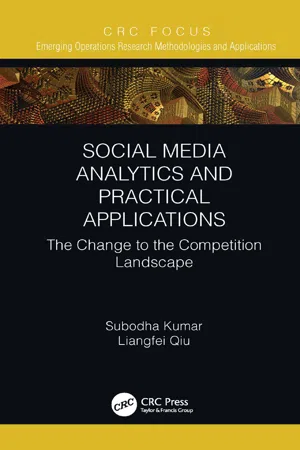
Social Media Analytics and Practical Applications: The Change to the Competition Landscape provides a framework that allows you to understand and analyze the impact of social media in various industries. It illustrates how social media analytics can help firms build transformational strategies and cope with the challenges of social media technology.
By focusing on the relationship between social media and other technology models, such as wisdom of crowds, healthcare, fintech and blockchain, machine learning methods, and 5G, this book is able to provide applications used to understand and analyze the impact of social media. Various industries are called out and illustrate how social media analytics can help firms build transformational strategies and at the same time cope with the challenges that are part of the landscape. The book discusses how social media is a driving force in shaping consumer behavior and spurring innovations by embracing and directly engaging with consumers on social media platforms. By closely reflecting on emerging practices, the book shows how to take advantage of recent advancements and how business operations are being revolutionized.
Social Media Analytics and Practical Applicationsis written for academicians and professionals involved in social media and social media analytics.
Trusted by 375,005 students
Access to over 1 million titles for a fair monthly price.
In Connie Willis’s famous science-fiction novel, “Bellwether,” the main character, Dr. Sandra Foster, studies how to predict fads by experimenting with a flock of sheep. In the novel, the secret to all fads is: “The herd instinct. People wanted to look like everybody else. That was why they bought white bucks and pedal pushers and bikinis” (Willis, 1996, p. 33). Before the age of social media, things did not catch on easily because people interacted at a low level. Even if there was a “bellwether” who could lead the flocks, the size of the flocks that this “bellwether” could reach was rather limited. Social media not only amplifies the herd instinct through intense interactions, but also increases the number of “bellwethers” or social media celebrities.
This book looks at how social media affects the way we think and provides a framework to understand and analyze the impact of social media in various industries using analytics. Recent years have witnessed an unprecedented explosion in social media (e.g., Facebook, Twitter, Instagram, and Pinterest). Social media is not about changing a specific industry, but rather revolutionizing the nature of how businesses operate and changing the landscape of industry competition in online retailing, healthcare, telecommunications, etc.
When one of the authors was writing this book, his cellphone beeped, and the Facebook app reminded him that he checked in at a fancy restaurant in Austin, Texas, eight years ago. It was a valuable memory, especially when restaurant dining became impossible during the COVID-19 pandemic. It also illustrates how social media affects the way we think. Let our social media journey begin!
1.2 How Social Media Shapes the Way Companies and Consumers Think
It is well known that aggregating dispersed information from crowds in the right way may produce accurate predictions. The reason is that when we aggregate diverse individuals’ estimates, those errors can be canceled out. Surowiecki (2004) called it the wisdom of crowds. However, as people are increasingly influenced by social media, a slight error of an individual tends to be amplified. Therefore, we may observe the madness of crowds instead of the wisdom of crowds. In Chapter 2, we dig deeper into how social media and online social networks affect the operation of the wisdom of crowds.
Since social media affects the way consumers think, it naturally affects how companies think. Social media–based strategies are fundamentally different from traditional firm strategies without considering the impact of social media content. Negative word of mouth on social media stemming from a poor customer engagement or a brand response can disseminate rapidly and reach a large audience. In Chapter 3, we examine the role of social media in firms’ strategies.
Social media platforms are prone to abuse and manipulations, manifested in the form of fake news and fake reviews. Even if a statement is known to be false, it becomes less wild if people hear it again and again. Social media platforms spread and repeat fake news faster and farther than ever before. In Chapter 4, we look at social media misinformation and identify who spreads misinformation.
The COVID-19 pandemic caused a significant disruption in the offline healthcare channel, and online health communities illustrate the digital resilience in recovering from and adjusting to this massive exogenous disruption. In recent years, with the rapid development of information technologies, online health communities with social media features are increasingly important in supporting access to the mass of information and resources and promoting barrier-free communication and information exchanges between physicians and patients. Chapter 5 investigates the design of online healthcare communities.
With the upcoming 5G Internet, the Internet of Things (IoT) connects billions of physical devices worldwide, collecting and sharing data for smart cars, smart homes, and smart cities. This fast-growing market provides a huge opportunity, and the telecommunications industry has been exploring new business models. In Chapter 6, we introduce some new business models inspired by social media and telecommunications technology. The last chapter, Chapter 7, discusses some of the key future trends in social media and associated challenges.
References
Surowiecki, J. (2004). The wisdom of crowds: Why the many are smarter than the few and how collective wisdom shapes business, economies, societies, and nations. New York: Doubleday.
Willis, C. (1996). Bellwether. New York: Bantam Books.
2Wisdom of Crowds Meets Social Media
DOI: 10.1201/9781003196198-2
2.1 Introduction: Guessing Weight Competition in the Age of Social Media
The year 2021 is the year of the ox in the Chinese zodiac. Interestingly, one of the first stories about the wisdom of crowds is a competition to guess the weight of an ox at a country fair in 1906 (Surowiecki, 2004): Eight hundred people participated in the competition, and no one got a close guess. However, the median (1,197 lb.) of all guesses was extremely close to the actual weight (1,198 lb.) of the ox. The main insight of this story is that some people tend to make positive errors while others tend to make negative errors. When we aggregate diverse individuals’ estimates, those errors can be canceled out. In other words, aggregating dispersed information from crowds in the right way may produce accurate predictions.
A critical condition to ensure the wisdom of crowds is that individuals’ estimates are independent, which means an individual’s guess does not affect others’ guesses (Lorenz et al., 2011). However, this condition is rarely satisfied in many real-world scenarios. If individuals’ estimates are affected by each other, the herd instinct of human beings may lead to the madness of crowds rather than the wisdom of crowds (Qiu & Whinston, 2017). In the old times, people used to choose restaurants by looking at how many customers were already there. In a study, the ranking information of the five most popular dishes was shown to some customers and the demand for those dishes increased significantly (Cai et al., 2009). The herd instinct of following others also played a great role in the tulip mania, the first recorded speculative bubble: In February 1637, the prices of some single tulip bulbs were more than ten times the annual income of a skilled artisan (MacKay, 1980). Therefore, if individuals receive more information from others, it may not benefit the crowds’ wisdom. Instead, information sharing among individuals tends to corrupt the wisdom of crowds. The reason is that when an individual’s guess does affect others’ guesses, a small error of this individual will be amplified. The key “error canceling” mechanism mentioned earlier will no longer work (see Figure 2.1).
Figure2.1 Wisdom of Crowds.
In fact, individuals’ estimates are becoming more and more correlated due to the intense interactions in today’s social networking world. Before the age of social media, social interactions were rather limited and were built primarily on face-to-face interactions, emails, and phone calls. Social media and online social networks, such as Facebook, Twitter, Instagram, Reddit, and Clubhouse, have revolutionized how we interact with others. It is widely believed that social media has played an important role in political elections (Aral, 2020; Mallipeddi et al., 2021). Instead of focusing on a small number of friends who are physically close to us, social networking apps allow us to communicate with tenuous ties in this global village.
People are increasingly influenced by social media, and customers turn to social media for product discovery. For example, social commerce has become one of the mainstream retail channels and makes consumers see others’ purchase decisions and influence each other more easily. Many social networks have introduced pro-selling features, such as shoppable posts (e.g., Instagram Storefronts), and 72% of Instagram users make purchase decisions after seeing something on others’ Instagram pages (Influencer MarketingHub, 2021, Qiu et al., 2021). In the social gallery of Kohl’s (a department store), consumers can see posts on Kohl’s products from both Twitter and Instagram and purchase them via direct links to the product home page.
Furthermore, location-based social networking applications (e.g., Facebook Places and Yelp) allow consumers to seek their social network friends’ recommendations and share their location information (i.e., mobile check-ins) with friends through GPS-equipped mobile devices (Qiu et al., 2018). It is time for us to revisit our earlier example: In the old times, people used to choose restaurants by looking at how many customers were already there. In the age of social media, the influence from others is stronger: People can observe their friends’ mobile check-ins and know the dining choices made by their Facebook friends without having to visit restaurants to observe their friends’ behaviors physically. Researchers show that a consumer’s dining decision is significantly affected by the observation of friends’ choices in location-based social networks (Qiu et al., 2018).
In many other scenarios, a number of studies present similar findings on peer influence in the age of social media. When readers rate books, their online ratings are significantly affected by the ratings of their friends in online social networks (Wang et al., 2018). A similar phenomenon of peer influence has also been found in online digital music consumption (Hendricks et al., 2012). In these cases, the aggregated opinions, which are represented by the mean ratings, do not necessarily reflect the wisdom of the crowds because any small initial errors can be amplified by peer influence in social media.
Due to the explosive growth of social media, the wisdom of crowds may not always work in the age of social media. An interesting question naturally arises: How do social media and online social networks affect the operation of the wisdom of crowds? In this chapter, we will dig deeper into this issue from several aspects. One challenge in implementing the wisdom of crowds is how to aggregate diverse estimates into a good prediction. A prediction market is one of the most popular information aggregation mechanisms to tap into the wisdom of crowds (Qiu & Kumar, 2017). In prediction markets, the individual participants place bets on events that they think are most likely to happen, thus revealing their private information. Essentially, it is a betting market, which incorporates real-time information and provides a method of “putting your money where your mouth is” (Qiu et al., 2013). Prediction market prices, which are similar to stock prices in financial markets, have informational value because they aggregate the diverse information of market participants and represent overall market forecasts. For example, in the Iowa Electronic Markets, one of the most famous prediction markets, traders can bet whether the next U.S. president is a Democrat or a Republican by buying and selling contracts that pay $1 if a given candidate wins the election (Berg et al., 2008).
There are two types of prediction markets: public prediction markets and corporate prediction markets. A public pr...
Table of contents
Cover
Half Title
Series Page
Title Page
Copyright Page
Dedication
Contents
Preface
Authors
1 How Social Media Shapes the Way We Think
2 Wisdom of Crowds Meets Social Media
3 Social Media and Firm Strategies
4 Social Media, Fake Reviews, and Machine Learning Method
5 Social Media and Healthcare
6 Social Media and Telecommunications
7 Future Trends and Challenges in Social Media
Frequently asked questions
Yes, you can cancel anytime from the Subscription tab in your account settings on the Perlego website. Your subscription will stay active until the end of your current billing period. Learn how to cancel your subscription
No, books cannot be downloaded as external files, such as PDFs, for use outside of Perlego. However, you can download books within the Perlego app for offline reading on mobile or tablet. Learn how to download books offline
Perlego offers two plans: Essential and Complete
Essential is ideal for learners and professionals who enjoy exploring a wide range of subjects. Access the Essential Library with 800,000+ trusted titles and best-sellers across business, personal growth, and the humanities. Includes unlimited reading time and Standard Read Aloud voice.
Complete: Perfect for advanced learners and researchers needing full, unrestricted access. Unlock 1.4M+ books across hundreds of subjects, including academic and specialized titles. The Complete Plan also includes advanced features like Premium Read Aloud and Research Assistant.
Both plans are available with monthly, semester, or annual billing cycles.
We are an online textbook subscription service, where you can get access to an entire online library for less than the price of a single book per month. With over 1 million books across 990+ topics, we’ve got you covered! Learn about our mission
Look out for the read-aloud symbol on your next book to see if you can listen to it. The read-aloud tool reads text aloud for you, highlighting the text as it is being read. You can pause it, speed it up and slow it down. Learn more about Read Aloud
Yes! You can use the Perlego app on both iOS and Android devices to read anytime, anywhere — even offline. Perfect for commutes or when you’re on the go. Please note we cannot support devices running on iOS 13 and Android 7 or earlier. Learn more about using the app
Yes, you can access Social Media Analytics and Practical Applications by Subodha Kumar,Liangfei Qiu in PDF and/or ePUB format, as well as other popular books in Business & Computer Science General. We have over one million books available in our catalogue for you to explore.