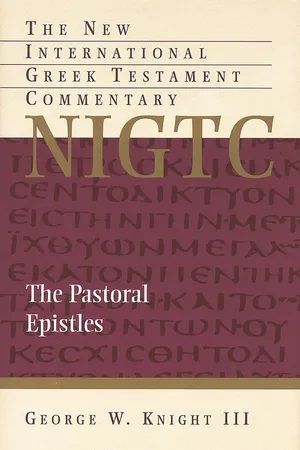
This is a thorough, full- scale English commentary on the Greek text of 1 and 2 Timothy and Titus. While author George W. Knight gives careful attention to the comments of previous interpreters of the text, both ancient and modern, his emphasis is on exegesis of the Greek text itself and on the flow of the argument in each of these three epistles.
Besides providing a detailed look at the meanings and interrelationships of the Greek words as they appear in each context, Knight's commentary includes an introduction that treats at length the question of authorship (he argues for Pauline authorship and proposes, on the basis of stylistic features, that Luke might have been the amanuensis for the Pastoral Epistles), the historical background of these letters, and the personalities and circumstances of the recipients.
Knight also provides two special excursuses: the first gathers together the information in the Pastorals and elsewhere in the New Testament on early church offices and leaders; the other excursus examines the motivations for conduct in Titus 2:1-10 with a view to their applicability to present-day situations.
- 548 pages
- English
- ePUB (mobile friendly)
- Available on iOS & Android
eBook - ePub
The Pastoral Epistles
About this book
Information
SALUTATION: 1:1-2
The letter begins like other NT letters bearing Paul’s name by indicating the author and the recipient and giving a greeting. This form, similar to Greek letters of the time, has been expanded in a noteworthy way by the apostle to express his Christian perspective, as is the case in all thirteen Pauline letters.
Except in 1 and 2 Thessalonians, Philippians, and Philemon, Paul refers to himself as an “ἀπόστολος of Jesus Christ,” either in this brief form or in a more expanded form. In the PE the expanded form is used. In the letters to churches, except Galatians, the reference to the addressees refers to their relationship to Jesus Christ. The PE and Philemon, letters to “individuals,” expand the reference to the addressees to indicate their relationship to Paul. In all thirteen Pauline letters, the greetings speak of “grace” (1 and 2 Timothy add “mercy”) and “peace” “from God the Father and Christ Jesus our Lord” and are thus virtually identical.
This form of salutation reflects three factors: First, the teachings of the Christian faith have molded Paul’s adaptation of the standard form. Second, there is a great uniformity in this molding, especially in the greeting section, which reflects a certain crystallization of his manner of expression of the essential Christian truths in these salutations. Third, there are certain variations that either reflect the recipients’ situation and need or anticipate and emphasize that which will be presented in the letter proper.
On the salutations see Roller, Formular, 55ff., 147ff., 213ff., and the tables at the book’s end comparing the PE and the other Paulines; Wendlund, Die urchristlichen Literaturformen, 342-58; Funk, Language, 250-74; Lohmeyer, “Probleme I”; Friedrich, “Lohmeyers These”; Cranfield, Romans, 45-48.
1:1 Paul begins with his name (Παῦλος; see the Introduction for responses to the challenges that have been made to Pauline authorship) and continues by indicating his office and authority (ἀπόστολος), the one whose apostle he is (Χϱιστοῦ Ἰησοῦ), and the basis of his apostleship (ϰατ’ ἐπιταγὴν θεοῦ ϰτλ.). Παῦλος is the only name Paul uses to designate himself and is the only name used for Paul/Saul in other NT letters. In Acts Σαῦλος is used exclusively up to the statement in 13:9, Σαῦλος δέ, ὁ ϰαὶ Παῦλος, after which the name Paul is used exclusively. On the relationship of these two names, what other names Paul might have had, and why only one name is used see Cranfield, Romans, 48-50 and the literature cited there.
Paul refers to himself as ἀπόστολος Χϱιστοῦ Ἰησοῦ in all his letters except 1 and 2 Thessalonians, Philippians, and Philemon. ἀπόστολος (NT 79x, Pl. 34x, PE 5x) designates one who is sent with the authority of and on behalf of the one sending (cf. Jn. 13:16; cf. further Hebrew šālîaḥ and and Aramaic šelîḥā’, which denote an authorized agent or representative). With only a few exceptions (e.g., 2 Cor. 8:23; Phil. 2:25, for messengers or delegates of the churches), the NT uses ἀπόστολος to refer to the inner circle of leaders appointed by Christ and usually referred to as “apostles of Jesus Christ” or known to be such, even without the addition of “of Jesus Christ.” Paul uses the term in this sense, as is evidenced by his statement about his apostleship in Gal. 1:1 (cf. 1:11-17) and by the fact that in his use of ἀπόστολος in the salutations he always adds “of Jesus Christ.”
For the discussion of ἀπόστολος see the articles in BAGD, TDNT, NIDNTT, and Cranfield, Romans, 51-52 and the literature mentioned there; for the basic discussion in regard to šālîaḥ and šelîḥā’ see Str-B III, 2-4.
For Paul that he was ἀπόστολος Χϱιστοῦ Ἰησοῦ meant that he was: (a) directly appointed by Jesus Christ and empowered and authorized by him (Gal. 1:1, 11-17; 2 Cor. 12:12; 1 Thes. 2:6), (b) an eyewitness of the resurrected Christ (1 Cor. 15:3-9; cf. Acts 1:22; 1 Cor. 9:1), (c) a foundation stone of the church along with the prophets as a bearer of the gospel and of God’s revelation (Rom. 1:1; Eph. 2:20 and 3:4, 5; 1 Tim. 2:7; 2 Tim. 1:11), and thus (d) first in leadership and authority in the church along with the other apostles (1 Cor. 12:28; 2 Cor. 11:5; 12:11; Eph. 4:11; 1 Thes. 2:6; cf. Acts 15, especially vv. 23-29 and 16:4). Along with all this, in Paul’s case an aspect of apostleship was to be especially responsible, under God, for the Gentiles (Rom. 1:5; 11:13; 1 Cor. 9:2; Gal. 2:7-9; 1 Tim. 2:7).
The addition of Χϱιστοῦ Ἰησοῦ is best explained in Paul’s carefully chosen words in Gal. 1:1, where he makes it plain, on the background of his Damascus road experience (Acts 9:1-22; 22:3-21; 26:9-23), that both the origin (ἀπ’) and mediation (δι’) of his apostleship is solely διὰ Ἰησοῦ ϰαὶ θεοῦ πατϱός, and neither from nor through any human agency. The genitive here with no preposition has the same double sense of origin and mediation. It is with this awareness of authority as Christ Jesus’ spokesman that Paul writes. Therefore he places this designation of himself at the beginning of the letter to express the authority by which he writes.
It has been objected that such an official title in a letter to a friend and colleague is surely out of place and is a sign of inauthenticity. But this is not just a friendly letter between colleagues, but a letter of instruction from an apostle to his assistant, even, perhaps, an official mandate (cf. 1:3, “I urged you … remain … in order that you may instruct”; 1:18, “this command I entrust to you”; 4:11-16, “prescribe and teach these things”; 6:13, “I charge you in the presence of God”; 6:20, “guard what has been entrusted to you”). This relationship is no different than that between the apostle and Timothy demonstrated elsewhere in the Pauline letters (cf., e.g., 1 Cor. 4:17; Phil. 2:19-23; and the remarks about Timothy here at v. 2).
Furthermore, this letter is also written so that Timothy can have apostolic authorization in the church and instruction for the church over against the false teachers. In effect the church is written to through Timothy. Thus the concluding benediction, “grace be with you” (6:21), is addressed to a plural “you,” which fits with the fact that the church in its corporate capacity is instructed about prayer and worship (2:1-8), about the role of women (vv. 9-15), and about the qualifications for officers (3:1-13), and in general with the specific raison d’être of the letter (3:14, 15).
Therefore, Paul’s use of his official title is no more strange here than in his other letters. The other letters were also written to friends and acquaintances but were also nonetheless written with apostolic authority.
The double designation, either Ἰησοῦ Χϱιστοῦ or Χϱιστοῦ Ἰησοῦ, is normal in Paul’s writings (MGM, s.v.; for lists see Burton, Galatians, 393). The question arises as to the significance of such a double reference particularly on the background of the use of a single name for individuals in general in the NT and the fact that on some occasions Paul uses only one or the other by itself or with ϰύϱιος. The answer seems to be Paul’s desire to identify Jesus as the Christ, i.e., as the Messiah promised in the OT, the anointed one of God. This identification is so important to him that the double designation predominates over all other designations except perhaps ϰύϱιος (which is, however, often used with the double designation).
That this identification of Jesus as the Messiah was significant for Paul is seen in his preaching in Acts. Luke indicates that Paul preached τὸν Ἰησοῦν ὅτι οὗτός ἐστιν ὁ υἱὸς τοῦ θεοῦ (9:20) and ὅτι οὗτος ἐστιν ὁ Χϱιστός (v. 22). Another summary giving the essence of Paul’s preaching (17:2, 3) ends with the words ὅτι οὗτός ἐστιν ὁ Χϱιστός [ὁ] Ἰησοῦς, ὃν ἐγὼ ϰαταγγέλλω ὑμῖν (cf. 18:5).
Thus for Paul Ἰησοῦς (NT 905x; Pl. 203x) is the personal name and Χϱιστός is the title (NT 529x; Pl. 374x, just under 72% of the total NT occurrences, the next highest being Acts with only 25x; PE 32x; cf. Morris, NT Theology, 39). Hence the double designation Ἰησοῦ Χϱιστοῦ or Χϱιστοῦ Ἰησοῦ is to be understood as “Jesus the Christ” or “the Christ, Jesus.”
All this assumes that Paul’s use of Χϱιστός in Acts refers to the promised one of the OT, anointed by God (Hebrew māšîaḥ, transliterated as Μεσσίας ** and translated as Χϱιστός). That this was the general understanding of the NT community is evidenced most directly by Jn. 1:41 and 4:25 and also in the Synoptics and in Acts where Paul is not in view (cf. Mt. 16:16 par. Mk. 8:29 par. Lk. 9:20; Acts 2:36; 3:18, 20; 18:28, etc.).
Within the Pauline corpus one finds a chronological transition from Ἰησοῦς Χϱιστός to Χϱιστὸς Ἰησοῦς, which is the rule in the PE and is, in fact, except in a few passages in Acts (3:20; 5:42; 24:24), found only in the Pauline corpus. Why did Paul reverse the order of the designation? Some, e.g., Hendriksen, have speculated that in a transition from a more Hebraic setting to a more Hellenic language setting Paul gradually changed from the translation form, “Jesus the Christ” (Ἰησοῦς Χϱιστός) to the form that better expressed the title and the name in Greek, “the Christ, Jesus” (Χϱιστὸς Ἰησοῦς). McCasland argues that this change would only come about if Χϱιστός remained an appellative or title (in his article “Christ Jesus”).
I would suggest as another influence the significance and usage of the phrase ἐν Χϱιστῷ for Paul when used to express communion with Christ. Whenever this sense is found in Paul it is always with ἐν Χϱιστῷ or ἐν Χϱιστῷ Ἰησοῦ. It would appear that where communion or union is in view Χϱιστός is used, and where more than one name is used Χϱιστός occurs first. Is this so because Paul thinks of believers’ union with their Lord more in terms of the representative work and status of Christ as the Messiah than in terms of identification of him as Jesus the man? If this is true, then this perspective would also have influenced Paul to write Χϱιστός before Ἰησοῦς more often because this union and communion became a more dominant thought for him.
Paul’s growing preference for the order Χ. Ἰ. is already reflected in the salutations of his earlier letters, where this is almost the exclusive form. His prevailing practice would seem to indicate a preference for the order X. Ἰ. when referring to his own relationship to and servanthood of the Lord. The usage in the PE would seem to have brought to a culmination a usage that more and more appealed to Paul over the other order.
For the discussion and literature relating to the names Χϱιστός and Ἰησοῦς see the articles in BAGD, TDNT, and NIDNTT (K. H. Rengstorf, II, 330-48); McCasland, “Christ Jesus”; Burton, Galatians, 392-99; Knight, Faithful Sayings, 32-36; C. F. D. Moule, Origin, 1-10, 31-35, 54-69, 136.
ϰατ’ ἐπιταγήν ϰτλ. indicates the ultimate basis of Paul’s apostleship. As in Galatians, he is concerned not only to indicate that he is an apostle of Jesus Christ but that this apostleship has its origin in the will or command of both God the Father and Christ Jesus. The phrase contains four elements: (a) the idea of command or will; (b) the reference to God; (c) the joining of the name of Christ Jesus with that of God in a genitive construction linking them both to the one word ἐπιταγήν; and (d) a further qualification of both names, i.e., “our Savior” and “our hope.”
Parts (a) and (b) of this pattern are similar to that found in the other Pauline salutations. In the other salutations, when Paul uses “apostle” he refers to God’s decision, either with θέλημα (1 and 2 Corinthians, Colossians, Ephesians, and 2 Timothy) or ἑπιταγή (1 Timothy and also Titus in a much longer qualification), or to God’s “will” without (Romans) or with (Titus again) a key term, or in Galatians no key word is used in the salutation but the idea is presented later in the letter in the defense of Paul’s apostleship (cf. Gal. 1:15ff.; 2:7-9). The use in the PE of ἐπιταγή ** (only in Paul, usually with ϰατά: Rom. 16:26; 1 Cor. 7:6; 2 Cor. 8:8; here; Tit. 1:3; twice without ϰατά: 1 Cor. 7:25; Tit. 2:15), which means “command,” “order,” or “injunction” (cf. MM and Spicq), rather than the more usual θέλημα, should probably be explained by Paul’s desire to relate his being under orders to the need for Timothy and Titus to be under orders in carrying out the mandate from Christ’s apostle. 2 Timothy, however, being a more personal letter, returns to θέλημα. Lock’s summary is helpful: “Here it refers primarily to the choice of Paul as an Apostle (27, Acts 2214)…. It gives the commission in virtue of which he acts, and the rule and standard of his work.”
Paul used θεός with astonishing frequency because God “was central in his thinking” (Pl. 548x, more than 40% of the NT’s 1,314x, although Paul’s writings make up only about a quarter of the NT; “far more often than does anyone else in the New Testament,” Morris, NT Theology, 25; here the first of 21x in 1 Tim. and of 47x in the PE).
God the Father is referred to here as σωτήϱ (NT 24x, Pl. 12x, PE 10x). For Paul the background is the OT concept of God as Savior, which he and other NT writers utilize in terms of God acting to save people through Jesus (cf. Thayer, Lexicon, s.v.). “Yahweh is presented as saviour in Deut. 32:15; 1 Chr. 16:35; Pss. 24(23):5; 25(24):5; 27(26):1, 9; 62(61):2, 6; 65(64):5; 79(78):9; 95(94):1; Prov. 29:25 v.l.; Mic. 7:7; Hab. 3:18; Is. 12:2; 17:10; 25:9; 62:11. Often the LXX speaks concretely of (e.g.) ‘God my saviour [ho theos ho soter mou],’ whereas the MT speaks of ‘the God of my salvation’” (J. Schneider and C. Brown, NIDNTT III, 218; cf. G. Fohrer, TDNT VII, 1012f.; the plural “our” is used in 1 Ch. 16:35; Pss. 65[64]:5; 79[78]:9; 95[94]:1; and “your” in Is. 17:10; 62:11). The term was also applied to Hellenistic rulers and the Roman emperor and used by the mystery religions (cf. G. Fohrer and W. Foerster, TDNT VII, 1003-21). Although the OT background adequately explains Paul’s usage (cf. TDNT VII, 1015), the term may also be used over against rival statements of the day, especially those with religious denotation.
God is referred to as “Savior” in the PE (6 of 10x) and Christ less frequently (the remaining 4). But in the other Paulines God is not referred to as Savior while Christ is. This has been highlighted as a noteworthy difference between the PE and the other Pauline letters. But the usage of the other Paulines amounts to only two instances (Eph. 5:23; Phil. 3:20), which is an inadequate basis for comparison. Furthermore, it should not be thought strange for Paul to refer to God in reference to salvation here, for, as Lock indicates, 1 Cor. 1:21 has already done so. Also, Paul is not the only one in the NT to refer to the Father as Savior; scant though the evidence may be, both Luke (1:47) and Jude (25) do as well. Finally, the PE do also, as we have seen, use the title for Christ (2 Tim. 1:10; Tit. 1:4; 2:13; 3:6), as do the earlier two Pauline occurrences.
The use of σωτήϱ here with reference to God the Father reflects Paul’s concern to communicate this reality of God as Savior as a corrective to the false teachers’ perspective on God as less than the Savior of “all people.” This emphasis on “all” will be highlighted in connection with prayers and evangelism (2:3ff., especially v. 4; cf. 4:10). This emphasis is present also in Titus, where God is again referred to as Savior (Tit. 1:3; and then especially 2:10, 11 and 3:1ff., especially vv. 2 and 4). Six of the eight NT references to Go...
Table of contents
- Cover
- Title Page
- Copyright
- Dedication
- Contents
- Foreword
- Preface
- Abbreviations
- Bibliography
- Introduction
- Commentary on 1 Timothy
- Commentary on Titus
- Commentary on 2 Timothy
Trusted by 375,005 students
Access to over 1.5 million titles for a fair monthly price.
Study more efficiently using our study tools.
Frequently asked questions
Yes, you can cancel anytime from the Subscription tab in your account settings on the Perlego website. Your subscription will stay active until the end of your current billing period. Learn how to cancel your subscription
No, books cannot be downloaded as external files, such as PDFs, for use outside of Perlego. However, you can download books within the Perlego app for offline reading on mobile or tablet. Learn how to download books offline
Perlego offers two plans: Essential and Complete
- Essential is ideal for learners and professionals who enjoy exploring a wide range of subjects. Access the Essential Library with 800,000+ trusted titles and best-sellers across business, personal growth, and the humanities. Includes unlimited reading time and Standard Read Aloud voice.
- Complete: Perfect for advanced learners and researchers needing full, unrestricted access. Unlock 1.5M+ books across hundreds of subjects, including academic and specialized titles. The Complete Plan also includes advanced features like Premium Read Aloud and Research Assistant.
We are an online textbook subscription service, where you can get access to an entire online library for less than the price of a single book per month. With over 1.5 million books across 990+ topics, we’ve got you covered! Learn about our mission
Look out for the read-aloud symbol on your next book to see if you can listen to it. The read-aloud tool reads text aloud for you, highlighting the text as it is being read. You can pause it, speed it up and slow it down. Learn more about Read Aloud
Yes! You can use the Perlego app on both iOS and Android devices to read anytime, anywhere — even offline. Perfect for commutes or when you’re on the go.
Please note we cannot support devices running on iOS 13 and Android 7 or earlier. Learn more about using the app
Please note we cannot support devices running on iOS 13 and Android 7 or earlier. Learn more about using the app
Yes, you can access The Pastoral Epistles by George W. Knight in PDF and/or ePUB format. We have over 1.5 million books available in our catalogue for you to explore.