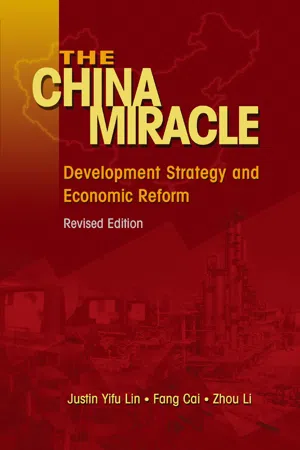
The tremendous success of China's economic reform, in contrast with the vast difficulties encountered by the former Soviet Union and Eastern European countries in their transition, has attracted worldwide attention. Using a historical, comparative and analytic approach grounded in mainstream economics, the authors develop a consistent and rational framework of state-owned enterprises and individual agents to analyze the internal logic of the traditional planning system. They also explain why the Chinese economy grew slowly before the market-oriented reform in 1979 but became one of the fastest growing economies afterwards, and why the vigour/chaos cycle became part of China's reform process. The book also addresses to the questions that whether China can continue its trend of reform and development and become the largest economy in the world in the early 21st century, and what the general implications of China's experience of development and reform are for other developing and transition economies. The first edition has been well-received and is the standard textbook or reference for students and researchers of China studies. In this thoroughly revised edition, the authors have updated the data and information in the book and include a new chapter on the impact of China's WTO accession on its economic reforms and causes of the current deflation.
eBook - PDF
The China Miracle
Development Strategy and Economic Reform (Revised Edition)
- 431 pages
- English
- PDF
- Available on iOS & Android
eBook - PDF
The China Miracle
Development Strategy and Economic Reform (Revised Edition)
About this book
Information
Publisher
The Chinese University of Hong KongeBook ISBN
9789622019850
Year
2003Table of contents
- Contents
- Title Page
- Copyright
- CHAPTER 1. Introduction
- CHAPTER 2. The Leap-forward Strategy and the Formationof the Traditional Economic System
- CHAPTER 3. Economic Performance and China’sDevelopment Strategy
- CHAPTER 4. The Comparative-advantage-followingStrategy
- CHAPTER 5. Economic Reform in China
- CHAPTER 6. Success of the Economic Reform
- CHAPTER 7. Problems with China’s Reform
- CHAPTER 8. The Internal and External Environmentfor Economic Reform and SustainableDevelopment
- CHAPTER 9. Deflation in China since 1998
- CHAPTER 10, WTO Accession and China’s Reform
- CHAPTER 11. The Characteristics and General Implicationsof China’s Reform
- CHAPTER 12. Concluding Remarks
- Bibliography
- Index
Trusted by 375,005 students
Access to over 1.5 million titles for a fair monthly price.
Study more efficiently using our study tools.