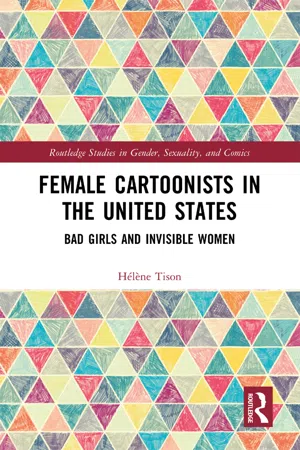
This book provides an introduction to women cartoonists in the US, reading their work from a feminist, literary and stylistic perspective, which shines a light on their innovative and unique narratives and graphic languages.
From rabid feminists to blundering teenagers to dyke avengers and pregnant butches, from political satire to memoirs to troubling sexual tales, from caricature to the clear line, from realism to minimalism and abstraction – they have done it all. This book looks at the work of over thirty authors who have challenged the boys' club of comics in the US and whose stories shed a revealing light on contemporary society, through countercultural ripostes to the patriarchy, raw or humorous confessions, deconstruction of femininity, stories of vulnerability that offer powerful counterpoints to the "super bodies" of mainstream comics, non-white and queer cartoonists "drawing back" and more.
This is a key title for students and scholars in the fields of Comics Studies, Literature and Women and Gender Studies.
Trusted by 375,005 students
Access to over 1.5 million titles for a fair monthly price.
As discussed in the introduction, women and non-binary cartoonists have long found themselves in a doubly minor position, and to this day, with a few notable exceptions, their work remains fairly confidential even in the US, although the tradition does exist as Trina Robbins and others have shown. But independent women cartoonists only really became active in the late 1960s and mid-1970s: with the advances of the counterculture and feminist ideas and the development of alternative papers, magazines and fanzines, etc., the time was right – if not for a huge popular success, at least for their creative emancipation.
The rise of underground comix in the 1960s1 provided women cartoonists with a few new outlets, and many of the names that are still remembered today began in alternative and underground publications. But, as any publication on the topic will show2, the field remained overwhelmingly male-dominated. The rebellious youth movements of the 1960s, which integrated women but tended to confine them to subordinate positions, contributed in complex ways to the rise of feminism3. The spirit of freedom, the rejection of the old rules, truths and limitations that characterized the underground movement, combined with a sense of frustration caused by the imposition of a not dissimilar set of limitations based on gender within the movement, gave women cartoonists an incentive to create their own work and, in the early 1970s, to launch their own magazines. The idea was to be in complete control of content as well as production and, as trailblazer Lyn Chevli (co-creator, with Joyce Farmer, of Tits & Clits, 1972) said in a 1979 interview,
[At] the time we started I owned a bookstore, sold [underground comix], and was impressed by their honesty but loathed their macho depictions of sex. Our work, originally, was a reaction to the glut of testosterone in comics (Chevli, 13)
1.1 Oh pioneers! Wimmen's Comix and counterculture
Probably the most famous pioneer in the field is Trina Robbins, who, in July 1970, put together with Barbara Willy Mendes what is generally considered as the first comics magazine by women in the US: It Aint Me Babe: Womens Liberation4 (Figure 1.1); inside the cover is a disclaimer: “Any resemblance to chauvenist [sic] comic characters living or dead is strictly admitted.” They and others then started a collective that launched the groundbreaking Wimmen’s Comix in 1972. Wimmen’s Comix is a major landmark, the longest-running, all-women’s comix magazine, though its publication was irregular: issues 1–7 appeared between 1972 and 1976, when publication stopped for seven years, before resuming in 1983, with issues 8–17 published almost every year until 1992. This irregularity testifies to the fringe position of female cartoonists and the precariousness of their publication. Granted, the quality of the work published in Wimmen’s Comix was varied, but the same is true of most underground publications; more importantly, the collective was instrumental in supporting beginners, in encouraging them to pursue their interest in the medium5 – in short, in the very existence of such a tradition.
Figure1.1 Trina Robbins, cover of It Aint Me Babe: Womens Liberation.
feminism within comics has always been out of sync with mainstream feminism. Female underground comics creators of the 1970s were consistently denied space in feminist bookstores and magazines6 (Oksman and O’Malley, 6)
And indeed, Wimmen’s Comix seems to have had a fraught relationship with feminism: Trina Robbins has complained of (or presented as a badge of honor) the fact that the publication was derided and excluded by “mainstream” feminists, while such contributors as Aline Kominsky-Crumb and Diane Noomin, though aware of the importance of the magazine7, explained that they left the collective out of exasperation at its self-righteous feminist politics, and after being attacked as misogynistic collaborators8.
Nonetheless, feminism was a central concern of the women who created and contributed to Wimmen’s Comix, so much so that it is possible to fit most of the stories and strips published in the 1970s into a small range of thematic categories, which were dealt with both seriously and humorously: the fight for social justice and emancipation from patriarchy and misogyny; forgotten historical female figures, or characters from myth and folklore (there is a didactic, “herstory” dimension here: re-creating a female tradition, countering the marginalization of women9); sex, abortion and sexual emancipation (including same sex relations, years before Gay Comix was launched, in 1980); and autobiography and the everyday lives of women (as a reminder of the actual lives many women led, as opposed to their depiction in comics made by men)10. Another characteristic of the magazine is the frequent choice of popular cultural genres such as fantasy and science fiction, enabling the authors to set their stories in worlds where gender roles are radically different, a simple and effective way to make a political point: stepping to the side, taking some distance to look at the “norm” and expose it as an imposed, arbitrary order, not the natural state of things that patriarchy would have us think it is.
An interesting illustration of the complexities that early women cartoonists found themselves in is Margery Peters’s “Reactionary Comics” (Figure 1.2) in issue #2 (1973, 106), about the conundrums of women’s lib; it mocks both the movement, which the characters are kvetching about, and their own “reactionary” outbursts; it imitates (and satirizes) earlier cartooning styles associated with misogynistic content11 and adds underground twists: the penis drawn in the first panel of the last tier; the silhouettes of the characters, who might as well be naked; the anachronistic combinations of drawing style, type of characters and theme (two young women complaining about their boyfriends/husbands) as well as current hip and crude slang; and the temptation, and rejection, of lesbianism. The page is both humorous and slightly embarrassing, epitomizing the types of intricacies and ambiguities inherent in 1970s “women’s lib” that the cartoonists, and many women along with them, found themselves navigating.
It may be hard for today’s youth to understand how vastly different the world that these women grew up in was, especially in terms of gender representations and (in)equality; it is crucial to keep these huge differences in mind – without contextualization, much of the work of these pioneers is difficult to understand fifty, forty, even thirty years on. To young readers today, some of these early feminists can seem confused at best, at worst, alienated, if not enslaved by the very patriarchy that they set out to overthrow. The cover of issue #1 (Figure 1.3) by Patricia Moodian, which not only parodies sexist romance comix but also caricatures and ridicules non-conformity, with the figure of the woman in the background, is revealing in this respect.
Figure1.3 Patricia Moodian, cover of Wimmen's Comix issue #1, 1972.
Although the work of the Wimmen’s Comix collective was spurred by a desire to respond to the misogyny that characterized the majority of comics at the time, it is laced with tensions between adherence to and rejection of stereotypes, which are particularly obvious in the physical representation of cartoon heroines. Their work was inevitably influenced by the misogynistic representations of women in mainstream and (male) underground media – which, opposed though they were in many respects, diverged little in this one. Despite an awareness that is made regularly apparent (as on the cover of issue #2, showing a sexy naked woman – with a duck face; cartoonist Edna Jundis offers a feminist slant, pointing to the objectification and sexualization of women in comics, even in “animal funnies”), overall the female characters are drawn in a style and with standards of beauty that do not differ greatly from those found elsewhere, and there is little evidence that this is done ironically or with much distance – the same norms regularly find their way into the pages of Wimmen’s Comix12; many authors seem to have internalized misogynistic standards of female beauty and character, even authors who can at times be fiercely critical of these norms13. But stereotypical beauty can also be used in more complex ways, and in particular, it can be not merely a mask but a disguise and (paradoxically) a “secret weapon”: being the norm in comics (and other visual media), female beauty is largely invisible; being associated with limited intelligence, it is a camouflage; and because it (hyper)sexualizes the characters, it can also be used as an instrument of empowerment, enabling them to control others (mainly, namely, men)14.
The physical and moral de-idealization of female figures was obviously a more difficult step to take, but it often yielded much more interesting results, as we will see with Lee Marrs, Diane Noomin and Aline Kominsky-Crumb. For all their flaws and tentativeness, and despite the difficulties they faced15, the women cartoonists of the 1970s played a very important role, both creatively and politically; the freedom that they won for themselves enabled them to explore new ground, to reach new audiences and to open the field and industry to their “sisters” and “daughters” – if not so much to other minorities, far from it. Many important creators contributed to, or even made their debut in, Wimmen’s Comix, and many others were inspired by this pioneering publication – albeit sometimes adversely inspired, as in the case of Mary Wings.
1.2 Coming out as inward journey: Mary Wings
Mary Wings (b. 1949) has explained that the impulse to create Come Out Comix (1973), which Justin Hall describes as “the world’s first lesbian comic book”16, came from being incensed by Trina Robbins’s “Sandy Comes Out” (1972). The comic, then, is the product both of one woman’s frustrations and desires and of the sexual politics of the times: Robbins thought her lesbian-themed story, published in the very first issue of Wimmen’s Comix, was politically important, and she thought she was doing it correctly as it was inspired by a true story and created with the help of the woman it was based on (who happened to be Robert Crumb’s sister). But the result, in the eyes of Wings, Gregory and probably many others, was unsatisfactory:
When Wings saw the comic, she (…) was floored by how cut and dry Robbins—who was straight—rendered Sandy’s coming-out process. Her decision to love women, it seemed to Wings, was depicted as a choice as capricious as ‘deciding to go brunette this week’ (Frank, 2018a, n.p.)
And for all Trina’s good intentions, it is true that Sandy’s experience, told in a three-page, twelve-panel story, feels like a wholly intellectualized process: in the first panel, standing in front of the mirror, she tells herself
Sandy, you must find a positive alternative to the dehumanizing nuclear family … some way to smash phallic imperialism … could it be that the only release from the yoke of macho oppression can be found in lesbianism?
She immediately proceeds to explore this hypothesis in a dyke bar where she blunders when she takes a woman for a man; on the very next and last panel (which takes up the entire last page), “months later”, she is living in a “San Francisco gay/hippie commune” and pictured in bed with a woman (Robbins, 2016, 54–56).
If Trina Robbins’s story did not reveal very much about the experience of lesbians, it did highlight the lack of lesbian voices in the medium of comics; even before her better-known counterpart Roberta Gregory17 sent a story to Wimmen’s Comix (published in its fourth issue ...
Table of contents
Cover
Half Title
Series Page
Title Page
Contents
List of figures
Acknowledgments
Introduction
1 Down with the patriarchy!
2 Not entertainment: ageing, illness and abuse
3 Memoirs and dysfunctional diaries
4 Full color
5 Queer power!
6 Mirror of the world
Conclusion
Bibliography
Index
Frequently asked questions
Yes, you can cancel anytime from the Subscription tab in your account settings on the Perlego website. Your subscription will stay active until the end of your current billing period. Learn how to cancel your subscription
No, books cannot be downloaded as external files, such as PDFs, for use outside of Perlego. However, you can download books within the Perlego app for offline reading on mobile or tablet. Learn how to download books offline
Perlego offers two plans: Essential and Complete
Essential is ideal for learners and professionals who enjoy exploring a wide range of subjects. Access the Essential Library with 800,000+ trusted titles and best-sellers across business, personal growth, and the humanities. Includes unlimited reading time and Standard Read Aloud voice.
Complete: Perfect for advanced learners and researchers needing full, unrestricted access. Unlock 1.5M+ books across hundreds of subjects, including academic and specialized titles. The Complete Plan also includes advanced features like Premium Read Aloud and Research Assistant.
Both plans are available with monthly, semester, or annual billing cycles.
We are an online textbook subscription service, where you can get access to an entire online library for less than the price of a single book per month. With over 1.5 million books across 990+ topics, we’ve got you covered! Learn about our mission
Look out for the read-aloud symbol on your next book to see if you can listen to it. The read-aloud tool reads text aloud for you, highlighting the text as it is being read. You can pause it, speed it up and slow it down. Learn more about Read Aloud
Yes! You can use the Perlego app on both iOS and Android devices to read anytime, anywhere — even offline. Perfect for commutes or when you’re on the go. Please note we cannot support devices running on iOS 13 and Android 7 or earlier. Learn more about using the app
Yes, you can access Female Cartoonists in the United States by Hélène Tison in PDF and/or ePUB format, as well as other popular books in Social Sciences & Gender Studies. We have over 1.5 million books available in our catalogue for you to explore.