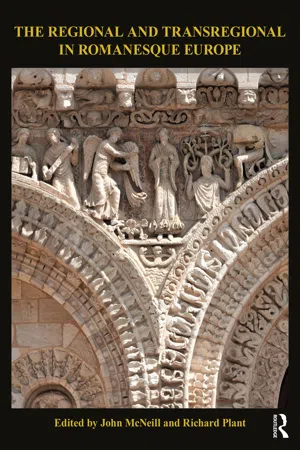
The Regional and Transregional in Romanesque Europe
eBook - ePub

The Regional and Transregional in Romanesque Europe

  1. 304 pages
  2. English
  3. ePUB (mobile friendly)
  4. Available on iOS & Android
eBook - ePub

The Regional and Transregional in Romanesque Europe

About this book

The Regional and Transregional in Romanesque Europe considers the historiography and usefulness of regional categories and in so doing explores the strength, durability, mutability, and geographical scope of regional and transregional phenomena in the Romanesque period.

This book addresses the complex question of the significance of regions in the creation of Romanesque, particularly in relation to transregional and pan-European artistic styles and approaches. The categorization of Romanesque by region was a cornerstone of 19th- and 20th-century scholarship, albeit one vulnerable to the application of anachronistic concepts of regional identity. Individual chapters explore the generation and reception of forms, the conditions that give rise to the development of transregional styles and the agencies that cut across territorial boundaries. There are studies of regional styles in Aquitaine, Castile, Sicily, Hungary, and Scandinavia; workshops in Worms and the Welsh Marches; the transregional nature of liturgical furnishings; the cultural geography of the new monastic orders; metalworking in Hildesheim and the valley of the Meuse; and the links which connect Piemonte with Conques.

The Regional and Transregional in Romanesque Europe offers a new vision of regions in the creation of Romanesque relevant to archaeologists, art historians, and historians alike.

Trusted by 375,005 students

Access to over 1.5 million titles for a fair monthly price.

Study more efficiently using our study tools.

Information

Publisher
Routledge
Year
2021
Print ISBN
9780367755270
eBook ISBN
9781000476118

INDEX

(Page references in bold refer to illustrations)
Acy-en-Multien (Oise), 133
Adela, countess of Blois-Chartres, 127, 128, 135
Adelard II, abbot of Saint-Trond, 174
Adrian IV, pope, 195
Agata, saint, 163, 165, 166
Agrigento (Sicily), cathedral, 160
Aiguilhe (Haute-Loire), Saint-Michel, 237
Ákos (Hungary), 262, 268
Ål (Norway), 282
Alet (Ille-et-Vilaine), 16, 17
Alfonso I, king of Aragon, 222, 228
Alfonso VI, king of Castile, 293,
Alfonso VIII, king of Castile, 287, 294
AlmĂĄd (Hungary), abbey, 262
Alveley (Shropshire), 195, 211
Amalarius of Metz, 41
Andorra, Santa Coloma, 243, 244
Andrea Buvina, painter, 255
Angers (Maine-et-Loire), Saint-Aubin, 37
Angilbertus II, bishop of Milan, 51
Angoulȇme (Charente), cathedral, 6, 7, 37, 38, 42, 43, 44
Angsar, 274, 276
Ansger (Angerio), 160
Aosta, Sant’Orso cloister, 115
Aracs (Serbia), 263
Århus (Denmark), cathedral, 276, 281
Asser Rig, 281
Aston (Herefordshire), 191, 197, 198, 208, 209, 210, 211
Augsburg (Bavaria), cathedral, 255
Aulnay (Charente-Maritime), 36, 37, 39, 40, 41, 43, 212
Ávila (León and Castile), San Vicente, 232
Bagerque (Aran), 238
Baldaqui de Ribes (Vic Episcopal Museum MEV 3884), 53, 55
Baldaqui de Tost, 54, 55
Balfour ciborium, 85, 86, plate VII bottom
BaltruĆĄaitis, Jurgis, 19
Bamberg (Bavaria), cathedral, 71, 177, 180, 182, 184
Barcelona cathedral, 235
Bari (Puglia), San Nicola, 57, 58, 60, 61, plate III bottom
Barnsley (Glouces...

Table of contents

  1. Cover
  2. Half Title Page
  3. Title Page
  4. Copyright Page
  5. Contents
  6. Notes on contributors
  7. Preface
  8. Colour plates
  9. The epistemological, political, and practical issues affecting regional categories in French Romanesque architecture
  10. Hans Kubach’s treatment of regions in the study of Romanesque architecture
  11. Did Zodiaque’s regional portrayal create a false impression as to the nature of Romanesque?
  12. Romanesque sculpture in Aquitaine: a history of the marginalisation of a widely imitated regional sculptural style
  13. The baldachin-ciborium: the shifting meanings of a restricted liturgical furnishing in Romanesque art
  14. Hildesheim as a nexus of metalwork production, c. 1130–1250
  15. ‘Mosan’ metalwork and its diffusion in the Rhineland, France, and England
  16. Winchester’s Holy Sepulchre Chapel and Byzantium: iconographic transregionalism?
  17. Transregional dynamics, monastic networks: Santa Fede in Cavagnolo, Conques, and the geography of Romanesque art
  18. Tiron on the edge: cultural geography, regionalism and liminality
  19. Four Romanesque Cistercian abbeys in Lesser Poland: the context of their foundation
  20. The Cathedral of Catania and the creation of the Norman County of Sicily: transregional and transalpine models in the architecture of the late 11th century
  21. ʻSchool’ or ʻmasons’ workshop’?: reflections on the so-called Wormser Bauschule and on the definition of regional style
  22. Towards an anatomy of a regional workshop: the Herefordshire School revisited
  23. Crossing the Pyrenees: migration, urbanization, and transregional collaboration in Romanesque Aragon
  24. Transregionalism and particularity in Romanesque woodcarving in 12th-century Catalonia
  25. Romanesque woodcarvers and plasterers in the Abruzzi: the Mediterranean connection
  26. A country without regions?: the case of Hungary
  27. Reassessing the problem of Scandinavian Romanesque
  28. The creation of Castilian identity under Alfonso VIII and Leonor Plantagenet
  29. Index

Frequently asked questions

Yes, you can cancel anytime from the Subscription tab in your account settings on the Perlego website. Your subscription will stay active until the end of your current billing period. Learn how to cancel your subscription
No, books cannot be downloaded as external files, such as PDFs, for use outside of Perlego. However, you can download books within the Perlego app for offline reading on mobile or tablet. Learn how to download books offline
Perlego offers two plans: Essential and Complete
  • Essential is ideal for learners and professionals who enjoy exploring a wide range of subjects. Access the Essential Library with 800,000+ trusted titles and best-sellers across business, personal growth, and the humanities. Includes unlimited reading time and Standard Read Aloud voice.
  • Complete: Perfect for advanced learners and researchers needing full, unrestricted access. Unlock 1.5M+ books across hundreds of subjects, including academic and specialized titles. The Complete Plan also includes advanced features like Premium Read Aloud and Research Assistant.
Both plans are available with monthly, semester, or annual billing cycles.
We are an online textbook subscription service, where you can get access to an entire online library for less than the price of a single book per month. With over 1.5 million books across 990+ topics, we’ve got you covered! Learn about our mission
Look out for the read-aloud symbol on your next book to see if you can listen to it. The read-aloud tool reads text aloud for you, highlighting the text as it is being read. You can pause it, speed it up and slow it down. Learn more about Read Aloud
Yes! You can use the Perlego app on both iOS and Android devices to read anytime, anywhere — even offline. Perfect for commutes or when you’re on the go.
Please note we cannot support devices running on iOS 13 and Android 7 or earlier. Learn more about using the app
Yes, you can access The Regional and Transregional in Romanesque Europe by John McNeill, Richard Plant, John McNeill,Richard Plant in PDF and/or ePUB format, as well as other popular books in Art & History of Architecture. We have over 1.5 million books available in our catalogue for you to explore.